Krishna Medical and Technical Research Centre is a privately owned health education institute established in 2012 AD in Janakpur, Dhanusa district, Nepal. It is affiliated with Purbanchal University (PU) and offers bachelor-level programs in nursing, pharmacy, and public health.
The centre offers Bachelor of Public Health (BPH), Bachelor of Pharmacy (B.Pharm), Bachelor of Science in Nursing (BSN), and Post-Basic Bachelor of Nursing Science (PBNS). Its nursing education is accredited by the Nepal Nursing Council.
The institution combines classroom study with laboratory, field, clinical, and hospital-based practical learning according to the requirements of each academic program. Practicum is available through its own 100-bed hospital.
Established: 2012 AD as a privately owned health education institute in Janakpur, Dhanusa.
Affiliation: Purbanchal University (PU).
Programs: BPH, B.Pharm, BSN, and PBNS.
Nursing Accreditation: Nepal Nursing Council.
Clinical Learning: Practicum is available through the centre’s own 100-bed hospital.
Class Schedule: Morning classes for PBNS and evening classes for BPH and B.Pharmacy.
Facilities: Hostel, library, laboratories, counselling, placement service, conference facility, multimedia facilities, scholarship support, and hospital-based practicum.
Admission: Applicable health and nursing program admissions follow MECEE-BL and the prevailing Medical Education Commission framework.
Seats and Fees: MEC determines applicable seats, fees, scholarship provisions, and related admission arrangements for each admission cycle.
Professional Entry: Graduates must meet the licensing requirements of the respective professional council before entering regulated professional practice.
The centre runs four health-science programs under Purbanchal University. The programs differ in academic structure and professional focus, with practical, laboratory, clinical, field, research, or internship components included where required.
| Program | Duration and structure | Main study areas |
|---|---|---|
| Bachelor of Public Health (BPH) | 4 years, 8 semesters | Public health, epidemiology, nutrition, family health, environmental health, statistics, health education, and health service management |
| Bachelor of Pharmacy (B.Pharm) | 4 years, 8 semesters | Pharmaceutical sciences, pharmacology, pharmaceutical chemistry, pharmaceutics, hospital and community pharmacy |
| Bachelor of Science in Nursing (BSN) | 4 years | Nursing sciences, medical-surgical nursing, community health, pediatric nursing, midwifery, research, and management |
| Post-Basic Bachelor of Nursing Science (PBNS) | 3 years | Nursing sciences, medical-surgical nursing, pediatric nursing, midwifery, community health, research, and leadership |
The BPH program follows an eight-semester structure. It covers subjects related to public health practice, human health sciences, epidemiology, nutrition, family health, environmental and occupational health, demography, health education, statistics, and health service management.
The curriculum also includes laboratory and field-based learning in different stages of the program. Students study areas such as public health microbiology, public health pharmacy and pharmacology, epidemiology of communicable and non-communicable diseases, reproductive health, community organization, disaster management, and public health service management.
B.Pharm is a four-year program divided into eight semesters. Its curriculum combines basic sciences, basic medical sciences, and pharmaceutical sciences.
Study areas include pharmaceutical chemistry, pharmacognosy, pharmacology, pharmacotherapeutics, hospital and clinical pharmacy, community pharmacy, physical pharmacy, pharmaceutics, and dosage-form design.
The Purbanchal University B.Pharm program carries 168 credits covering theory, practical work, seminars, project work, and professional internship.
BSN is a four-year nursing program combining theory and practical education.
The program begins with subjects such as anatomy and physiology, biochemistry, microbiology and parasitology, pathophysiology, pharmacology, nutrition and dietetics, foundation of nursing, and community health nursing.
Later study includes medical-surgical nursing, psychiatric nursing, geriatric nursing, pediatric nursing, midwifery, gynaecology nursing, epidemiology, research and biostatistics, educational science, and leadership and management.
PBNS is a three-year nursing program.
The first year includes anatomy and physiology, pharmacology, pathophysiology, microbiology and parasitology, biochemistry, nutrition and dietetics, medical-surgical nursing, nursing concepts and theories, pediatric nursing, medical sociology and anthropology, and professional English.
The second and third years cover midwifery, community health nursing, psychiatric nursing, educational science, epidemiology, geriatric nursing, applied computer technology, leadership and management, research and biostatistics, oncology nursing, and elective nursing study.
Admission to the applicable medical and nursing education programs follows MECEE-BL and the prevailing rules of the Medical Education Commission (MEC), Nepal.
The admission framework may include entrance requirements, matching procedures, scholarship provisions, seat allocation, fee structures, codes of conduct, and other procedures determined for the relevant admission cycle.
Applicants participating in the MEC matching process may select Krishna Medical and Technical Research Centre Pvt. Ltd. for an eligible program according to the applicable matching arrangements.
Seat numbers are determined by MEC and may change from one academic year to another. A 20-seat annual intake is stated for B.Sc. Nursing, but the approved MEC seat allocation for the relevant admission cycle governs the actual intake.
Fees, scholarships, seat distribution, admission procedures, and examination-related provisions may also change under MEC decisions and the applicable MEC calendar.
Graduation from a health-science program does not by itself complete the professional entry process where council licensing applies. Students must pass the licensing examination of the respective professional council before entering regulated professional practice.
For nursing, pharmacy, and public health regulation, the relevant professional bodies include the Nepal Nursing Council, Nepal Pharmacy Council, and Nepal Health Professional Council (NHPC).
Students should therefore consider both university graduation requirements and the applicable professional licensing process when planning professional practice.
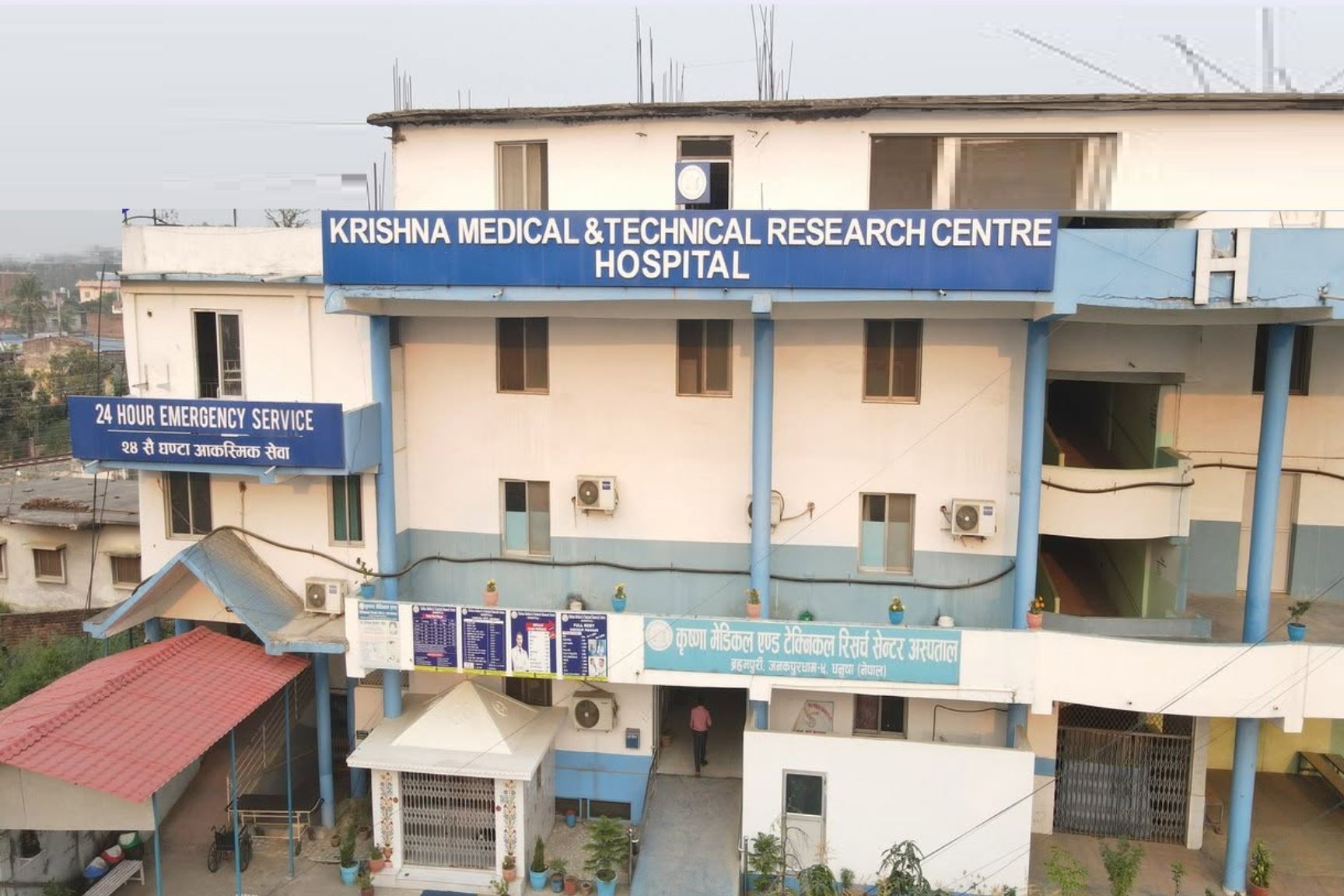
Krishna Medical & Technical Research Center Hospital operates alongside the institution's health education activities. The centre provides practicum opportunities through its own 100-bed hospital.
Hospital services include 24-hour emergency care, neurosurgery, cardiology, orthopedics, obstetrics, diagnostic imaging, surgical services, and maternity care. Diagnostic services include X-ray and CT scan facilities.
The hospital setting supports practical exposure for programs that include clinical or hospital-based learning, subject to the curriculum and practical requirements of each course.
The centre provides facilities and student services that support academic and practical study, including:
Hostel
Library
Laboratories
Counselling
Placement service
Conference facility
Multimedia facilities
Scholarship support
Hospital-based practicum
Availability of a placement service does not imply a guaranteed job or employment outcome.
PBNS is offered with morning classes, while BPH and B.Pharmacy are offered with evening classes.
Students considering these schedules can contact the administrative office for current class timing and course-related information.
Scholarship support is available among the institution's student services. For programs governed through the MEC admission system, applicable scholarship provisions follow the prevailing MEC framework.
Seats and fees may also change between admission cycles. Current figures depend on the applicable MEC determination and admission arrangements for the relevant academic year.
Students seeking details about admission, eligibility, fees, scholarships, counselling, facilities, or course arrangements can contact the administrative office directly.
Institution: Krishna Medical and Technical Research Centre
Address: Brahampuri-9, Janakpur, Madhesh Province, Nepal
Phone: 041-591092
Additional Contact: +9779814029769
Enquiry: 9801666518
Email: kmtrcjnk@gmail.com
Website: https://kmtrch.org.np/