Rammani Multiple Campus is a community-based public campus in Manigram, Tilottama Municipality, Rupandehi, Lumbini Province. Established in 1988 AD (2045 B.S.), the campus grew from a single management faculty into a multi-level institution offering programs under the National Examinations Board (NEB) and Tribhuvan University.
It serves students at the +2, bachelor’s, and master’s levels and has expanded its academic and physical base through community support, institutional planning, and coordinated development work. The campus also received Quality Assurance Accreditation in 2019, marking an important stage in its institutional development.
Established: 1988 AD (2045 B.S.)
Institution Type: Community-based public campus
Location: Anandaban, Manigram, Rupandehi, Lumbini Province, Nepal
Local Setting: About 600 metres west of Siddhartha Highway in Tilottama Municipality
Affiliation: NEB and Tribhuvan University
Academic Levels: Ten Plus Two (+2), bachelor’s, and master’s
NEB Streams: Humanities, Education, Science, and Management
TU Bachelor’s Programs: BA, BBS, B.Ed.
TU Master’s Programs: MBS and MA in Sociology
Academic System: Annual system at +2 and most bachelor’s programs; semester system in master’s programs
Governance: Campus Management Committee as the governing body; Campus Chief as the main administrator
Major Institutional Milestone: Quality Assurance Accreditation in 2019
Core Facilities: Library, e-library zone, seminar hall, computer lab, multimedia-supported classrooms, health desk, canteen, sports space, and administrative units
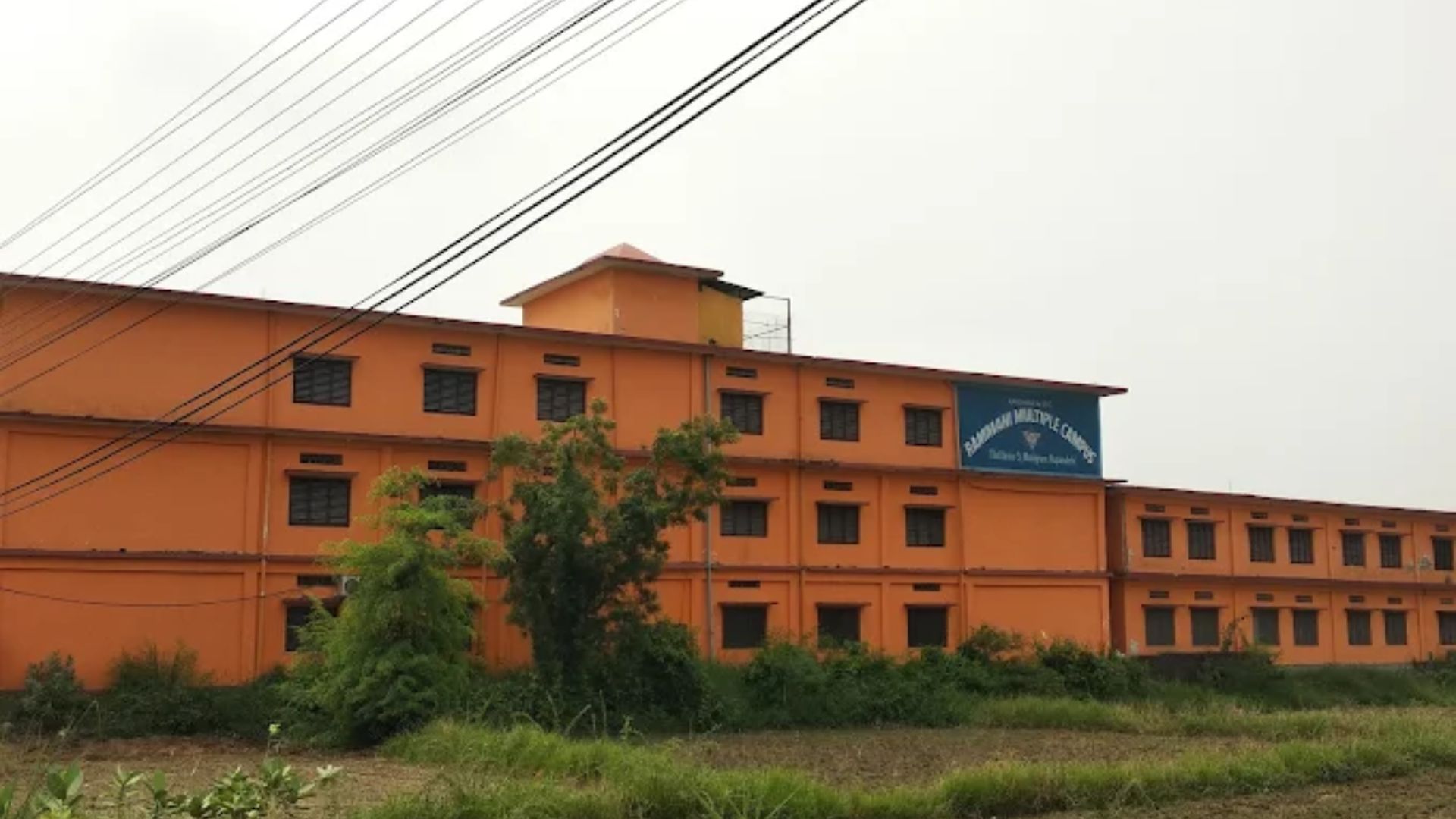
Rammani Multiple Campus (राममणि बहुमुखी क्याम्पस) was founded through local initiative led by educationists, social workers, guardians, teachers, farmers, merchants, and other community members. The institution was named after the national educationist and linguist Rammani Adi. Its early years were modest. Classes were first conducted in another school’s building before the campus developed its own physical infrastructure.
The campus began with management education under Tribhuvan University. Over time, it expanded into a multiple campus model and added humanities and education at the bachelor’s level, followed by master’s-level study in management and sociology. This shift changed the institution from a single-faculty setup into a broader academic center serving different academic interests and levels.
Its location has shaped its role. Situated between Butwal and Siddharthanagar in Rupandehi, the campus serves students from Tilottama Municipality and neighboring areas. Enrollment has also drawn students from surrounding districts, including Palpa, Gulmi, Nawalparasi, Kapilvastu, Arghakhanchi, Syangja, Parbat, and Baglung. The catchment area reflects the campus’s regional role in widening access to higher education.
Rammani Multiple Campus operates under updated bylaws and statutes endorsed by the Campus Management Committee. The Campus Chief functions as the main academic and administrative head. This governance structure is supported by a range of academic, student-support, and administrative units, including academic departments, exam and library sections, research and quality bodies, and student service committees.
The institution’s development also reflects external academic support. Since 2011, the campus has coordinated with University Grants Commission (UGC) projects, including SHEP Scheme D and HERP. That development path contributed to the campus receiving Quality Assurance Accreditation in 2019.
Rammani Multiple Campus runs programs under both NEB and TU. The academic structure covers general school education at the +2 level, undergraduate study in arts, education, and management, and postgraduate study in management and sociology.
Ten Plus Two (+2) Humanities
A two-year NEB program designed for students interested in humanities and social sciences.
Ten Plus Two (+2) Education
A two-year NEB program that introduces students to education, curriculum, guidance, and related educational foundations.
Ten Plus Two (+2) Science
A two-year NEB science program for students preparing for further study in science, health, engineering, computing, and related fields.
Ten Plus Two (+2) Management
A two-year NEB management program focused on the basic areas of management, accountancy, finance, office practices, and marketing.
Bachelor of Arts (BA)
A four-year annual program under TU. The BA structure is interdisciplinary and includes compulsory subjects along with major and elective options from the humanities and social sciences.
Bachelor of Business Studies (BBS)
A four-year annual program under TU. The BBS curriculum combines foundation courses, core business study, concentration areas, and final project work in the fourth year.
Bachelor of Education (B.Ed.)
The campus runs the four-year annual B.Ed. program under TU. The program includes communication skills, professional core areas, specialization major and minor subjects, and teaching practicum. Campus material also notes the operation of a one-year B.Ed. program.
Master of Business Studies (MBS)
A two-year, four-semester TU master’s program in management.
MA in Sociology
A two-year, four-semester TU master’s program. The structure includes required and optional papers across four semesters, with a compulsory thesis in the final semester.
The academic profile of the campus shows a clear progression path. Students can begin at the +2 level and continue into bachelor’s and master’s study within the same institution, especially in management, education, and humanities-linked fields.
Admission for NEB Class 11 programs generally begins after the publication of SEE results.
Applicants for +2 programs submit the prescribed form, academic records, photographs, and related documents required by the campus and the NEB framework.
Depending on the stream and campus decision, admission at the +2 level may also involve an entrance test, interview, or merit-based selection.
Subject registration for Class 11 is completed through the campus under the NEB system.
For TU bachelor’s programs, admission follows the rules of the concerned faculty, Dean’s Office, and campus.
Bachelor’s applicants submit the prescribed application form and required academic documents after the admission notice is published.
Depending on the program or campus policy, TU bachelor’s admission may include an entrance examination, merit-based selection, or both.
Selected bachelor’s applicants complete admission by submitting final documents and paying the prescribed fees.
For TU master’s programs, admission notices are published by the concerned campus, department, institute, or Dean’s Office.
Master’s admission may include an entrance examination depending on the program.
MA in Sociology applicants are required to sit for a one-hour entrance examination conducted by the Office of the Dean, Faculty of Humanities and Social Sciences, TU.
Final enrollment in TU programs is completed according to university rules and the campus schedule.
Annual examinations for annual-system TU programs are conducted through TU’s Office of the Controller of Examinations.
Semester-end examinations for semester-system master’s programs are conducted by the respective Dean’s Office.
NEB Class 12 final examination processes, centers, schedules, and result publication follow the NEB framework.
SEE marksheet or grade sheet
SEE character certificate or school leaving certificate
Transfer Certificate (TC) from the previous school
Migration certificate, if applicable
Citizenship certificate or birth certificate copy
Passport-size photographs
NEB Class 11 registration or subject registration form
Class 12 / +2 transcript or grade sheet
Character certificate from the previous institution
Migration certificate, if the previous board or university is different
Transfer Certificate (TC)
Citizenship certificate or birth certificate copy
Passport-size photographs
Entrance examination scorecard, if required
Completed campus application form
Admission fee payment receipt
Equivalence certificate, if the qualification is from a foreign board or university
Bachelor’s degree transcript or marksheet
Bachelor’s degree certificate or provisional certificate
Character certificate from the bachelor’s institution
Migration certificate, if the bachelor’s degree is from another university
Transfer Certificate (TC)
Citizenship certificate or birth certificate copy
Passport-size photographs
Entrance examination scorecard, if required
Completed admission or application form
Admission fee payment receipt
Equivalence certificate, if the bachelor’s degree is from a foreign university
The campus follows a mixed teaching approach that combines conventional classroom methods with updated classroom and IT-supported practices. It places emphasis on student-centered teaching and encourages presentation, demonstration, and classroom interaction as regular parts of the teaching-learning process.
The academic approach also connects teaching with co-curricular planning. The campus has worked on integrating co-curricular session planning with the existing TU curriculum and has aimed to strengthen problem-based learning, teacher development, and the broader use of academic and technical support in classrooms.
Campus material also points to orientation and training activities for students as part of its academic environment. These are intended to support capacity building, academic adjustment, and longer-term career development.
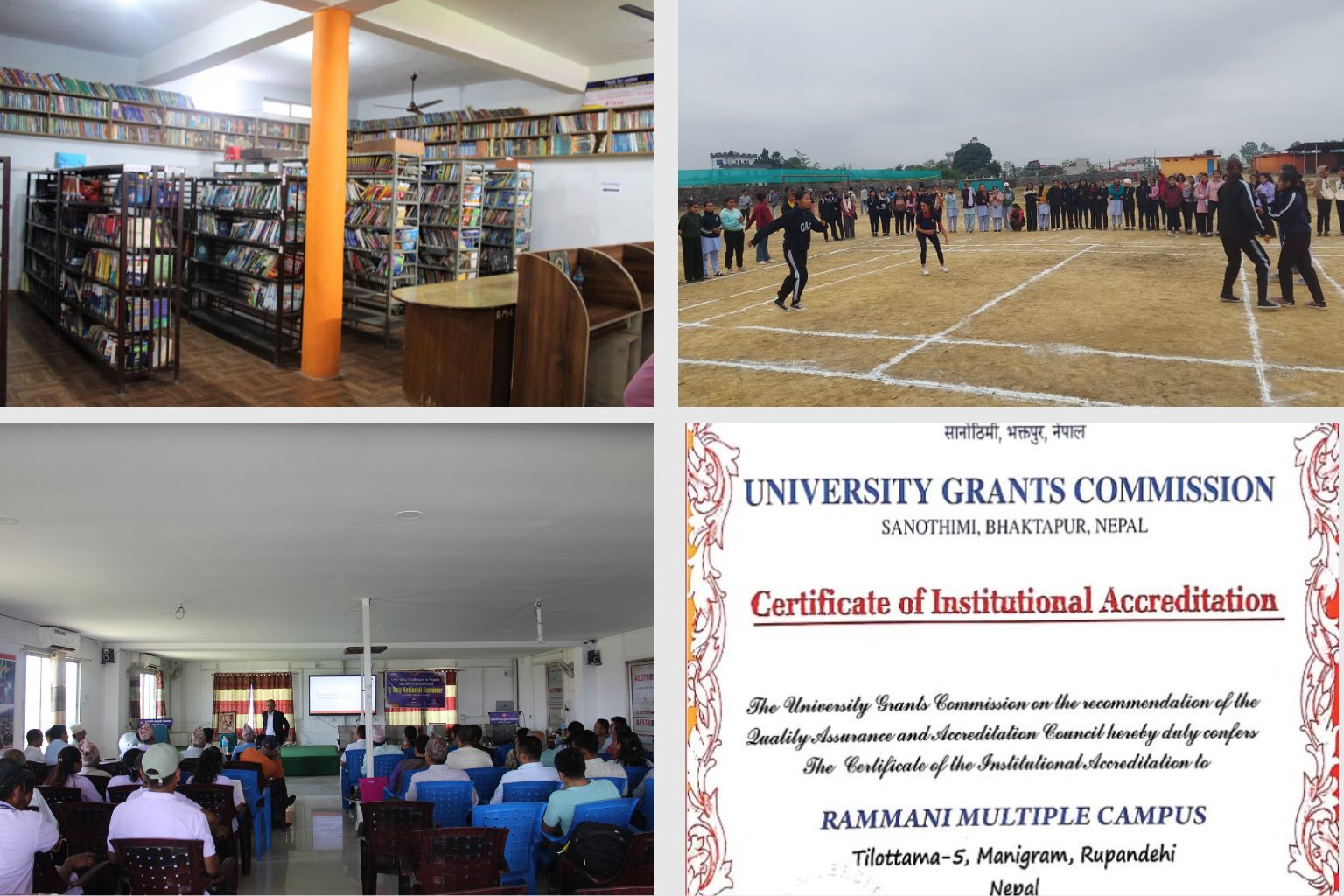
Five campus blocks with 33 rooms used for teaching and learning
Separate office rooms for campus leadership, administration, accounts, and examinations
Faculty and department cabins
Library hall with counter section
Reading zone, reference zone, and e-library zone
Main server room
Seminar hall with capacity for around 200 participants
Computer room and computer lab facilities
Health desk
Canteen hall
Sports space for football, table tennis, volleyball, and related activities
Own building and playground
Sixty-six computers for library access, lab use, and office work
Eleven laptops with high-speed internet
Eleven multimedia projectors
Printers and photocopy machines
Generator backup
CCTV system
Attendance machine
Student life at Rammani Multiple Campus is closely tied to its community setting. The campus draws students from local municipalities and nearby districts, which gives it a mixed student base across academic levels. Its role is less that of a closed campus and more that of a regional academic center connected to the social and educational needs of surrounding communities.
The student experience is shaped by support structures inside the institution. Orientation programs and training sessions are conducted to help students build academic and practical capacity. The institution also runs a Student Guidance Committee, Employment Cell, Research Management Cell, Public Information Cell, and a First Aid Unit under the Health and Sanitation Department. These units indicate that student life is supported through both academic and welfare-oriented services.
The organizational structure also includes student-related and academic service units such as the library section, lab section, exam section, quality support units, and student counseling functions. This creates a campus environment where academic processes and support services work side by side.
Extra Curricular Activities Committee for physical and mental development
Sports space for football, volleyball, table tennis, and related campus activities
Orientation programs and trainings for students
Research and academic support activities through the Research Management Cell
Student guidance and counseling support mechanisms
The campus runs scholarship and freeship programs
Support is noted especially for students from poor and marginalized groups
Some scholarship support has been established in the names of contributors associated with the campus
Institutional development has also been supported through UGC-linked projects
Established in 1988 AD (2045 B.S.) as a community campus
Began as a management faculty and later expanded into a multiple campus
Extended academic offerings to humanities, education, management, and sociology
Coordinated with UGC-supported projects from 2011 onward, including SHEP Scheme D and HERP
Received Quality Assurance Accreditation in 2019
Built a multi-block campus with library, seminar, laboratory, administrative, and student-service infrastructure
Campus Chief Tara Prasad Parajuli presents the institution as a community effort created to expand access to higher education in the region. His message places emphasis on the campus’s long institutional journey, its student base drawn from local and neighboring areas, and its academic expansion across TU and NEB programs. The message also highlights scholarship and freeship support for poor and marginalized students and links the campus mission to educational access, regional development, and responsible academic growth.
Rammani Multiple Campus has developed through local initiative, gradual academic expansion, and institutional strengthening. Its profile combines community roots with a broad academic range under NEB and TU, extending from +2 study to postgraduate education. The campus’s QAA milestone, library and lab facilities, student-support units, and mixed teaching approach reflect an institution that has moved well beyond its early single-faculty stage. For students in Rupandehi and nearby districts, it serves as an established option for continuing study in management, education, humanities, science, and sociology-related fields.
College Name: Rammani Multiple Campus (राममणी बहुमुखी क्याम्पस)
Location: Anandaban, Manigram, Rupandehi, Lumbini Province, Nepal
Phone: +977-71-560226
Email: rmcrupandehi@gmail.com
Website: rammani.edu.np
Contact Rammani Multiple Campus's administrative office for detailed information on the course, admissions, location, fees, scholarships, facilities, counseling, or eligibility.
Rammani Multiple Campus is a community-based public campus established in 1988 AD (2045 B.S.) in Manigram, Rupandehi.
The campus is affiliated with the National Examinations Board for +2 programs and Tribhuvan University for university-level programs.
The campus offers +2 programs in Humanities, Education, Science, and Management. At the university level, it runs BA, BBS, B.Ed., MBS, and MA in Sociology. Campus material also notes a one-year B.Ed. program.
The master’s programs run under the semester system. The campus specifically operates MBS and MA in Sociology as four-semester programs.
The campus has classrooms, offices, faculty cabins, a library with reading, reference, and e-library zones, a seminar hall, computer facilities, multimedia equipment, a health desk, canteen, sports areas, and administrative support units.
Yes. The campus runs scholarship and freeship programs, including support intended for poor and marginalized students.
Admission follows the framework of the concerned body and academic level. +2 admission is processed under NEB after SEE results, while TU bachelor’s and master’s admissions follow campus and university procedures, which may include application review, merit, and entrance examination depending on the program.