Rupandehi Campus is a public campus in Siddharthanagar-9, Bhairahawa, Rupandehi, Nepal. Established in 2048 BS (1991 AD), it was formed through local initiative to expand access to higher education in the area. The campus now runs bachelor-level programs in Education and Management under the affiliation of Tribhuvan University. It is QAA-accredited by UGC Nepal.
Its present academic profile is centered on the four-year annual-system Bachelor of Education (B.Ed.) and Bachelor of Business Studies (BBS), supported by community-based governance, academic departments, research activity, library and ICT facilities, and donor-supported scholarship funds.
Established in 2048 BS (1991 AD)
Located in Siddharthanagar-9, Bhairahawa, Rupandehi, Nepal
Situated within Siddharthanagar Municipality
Public campus with community participation in governance
Affiliated with Tribhuvan University
Current bachelor-level streams: Education and Management
Programs in operation: Bachelor of Education (B.Ed.) and Bachelor of Business Studies (BBS)
Four-year annual-system programs
Morning shift operation
English and Nepali medium
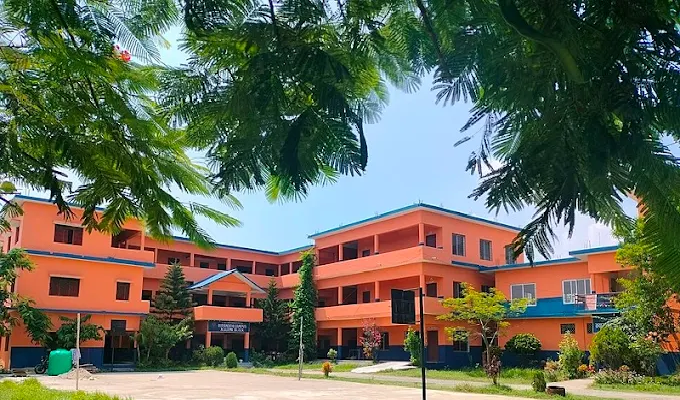
Two academic blocks, one library block, and one administrative block
31 rooms used for classes, library, canteen, and ICT lab
658 bachelor-level students reported
Faculty distribution: 15 in Education and 11 in Management
ICT lab with 20 computers
Library holdings include 7,682 books, 1,725 reference books, and 16 research journals
Educational resources include 5 ICT projectors and 45 computers/laptops
Research unit with campus-funded research activity
Three research journals published
QAA Certified Institution, accredited by the University Grants Commission (UGC) Nepal
Health desk in operation since 2078 BS
Multiple donor-supported renewable scholarship funds
Rupandehi Campus grew out of a local effort to build a higher education institution after the political changes of 2046/2047 BS. The campus was established in 2048 BS and initially received affiliation for the Proficiency Certificate Level Law program from Tribhuvan University. After the PCL Law program was phased out, the campus shifted its academic focus to the four-year B.Ed. and BBS programs.
The campus follows a public governance model. Its legislative body is the campus assembly, which includes academicians, social workers, administrators, businesspeople, representatives of community groups, and other local stakeholders. The executive body is the management committee formed by the campus assembly. This committee is responsible for implementing campus policies and programs. The institution also operates under its own constitution and related bylaws, which define the duties, responsibilities, and rights of internal bodies, subject committees, and working units.
This governance structure is closely tied to the campus’s community base. Local society has contributed through land donation, building support, and scholarship funds. The management committee includes representatives from the Siddharthanagar Chamber of Commerce and Industry, educationists, social and business leaders, teacher representatives, the Campus Chief, and the Assistant Campus Chief. The Campus Chief serves as the member secretary and reports campus developments and challenges in monthly board meetings.
Institutionally, the campus combines academic delivery with local participation, student support, and community engagement. In addition to formal academic programs, it has developed research, social outreach, and scholarship mechanisms that connect it to the wider public sphere of Rupandehi.
Rupandehi Campus currently operates two bachelor-level academic streams:
Education
Management
These streams are delivered through two faculties:
Faculty of Education
Faculty of Management
The Faculty of Education started in 2061 BS. It reports 15 faculty members and 280 students. The faculty structure includes:
Department of Language
Department of Education (Health and Mathematics)
Department of Teaching Practice
The teaching areas highlighted in the campus material include:
English
Nepali
Mathematics
Health and Physical Education
The main education program in operation is the four-year annual-system Bachelor of Education (B.Ed.).
The TU four-year B.Ed. is a professional and academic program designed to prepare teachers who can teach two subjects at the secondary level. The course requires students to complete 22 courses grouped into communication skills, professional core areas, specialization major courses, specialization minor courses, and teaching internship/practicum. TU allows specialization pathways such as Nepali, English, Mathematics, Science, Health and Physical Education, Population, Geography, Economics, History, and Political Science, with additional minor options in areas such as Biology, Health Education, Physical Education, Primary Education, Early Childhood Development Education, Non-Formal Education, and Education Management.
The Faculty of Management reports 11 faculty members and 378 students. It is intended for academic and professional study related to business, industry, and government.
The main management program in operation is the four-year annual-system Bachelor of Business Studies (BBS).
The TU BBS structure combines foundation, core, concentration, research, and project components across four academic years. The first year includes courses such as Business English, Business Statistics, Microeconomics for Business, Financial Accounting and Analysis, and Principles of Management. The second and third years continue with Business Communication, Macroeconomics for Business, Cost and Management Accounting, Organizational Behavior and Human Resource Management, Fundamentals of Financial Management, Business Law, Foundation of Financial Systems, Business Environment and Strategy, Taxation in Nepal, and Fundamentals of Marketing. The fourth year includes Entrepreneurship, concentration courses, Business Research Methods, and a final project.
Admission to bachelor-level programs follows the rules of the concerned faculty, Dean’s Office, and campus under Tribhuvan University.
The campus publishes an admission notice for eligible applicants.
Applicants submit the prescribed admission or application form along with the required academic documents.
Admission may include an entrance examination, merit-based selection, or both, depending on program requirements and campus procedure.
Selected students complete admission by submitting documents and paying the prescribed fees.
Academic registration, examinations, and results follow TU rules, guidelines, and the applicable academic calendar.
As B.Ed. and BBS are annual-system bachelor programs, final examinations are conducted by TU through the Office of the Controller of Examinations.
Academic Transcript (Grade Sheet) of Class 12 / +2 or equivalent
Character Certificate from the previous institution
Migration Certificate, if the previous board or university is different
Transfer Certificate (TC) from the previous school or college
Citizenship Certificate or Birth Certificate copy
Passport-size photographs
Entrance Examination Scorecard, if required
Completed campus admission or application form
Admission fee payment receipt
Equivalence Certificate, if the qualification is from a foreign board or university
The academic environment at Rupandehi Campus is organized through faculties, departments, and program units. The campus material emphasizes student participation in teaching and learning rather than a purely one-way classroom model. It also notes early and continued interaction between students and faculty, along with structured access to research and professional development opportunities.
Teaching methods mentioned in the campus material include lectures, discussions, demonstrations, surveys, project work, and PowerPoint presentations. This approach is supported by departmental research activity and classroom-based academic engagement. The campus also reports a research unit that involves both students and teachers. Research activities are funded by the campus, and departments are encouraged to publish journals. Three research journals have already been published, alongside magazines and news bulletins.
Faculty development also appears in the institutional profile. Among the reported faculty members, one is pursuing a PhD, two hold MPhil degrees, and two are pursuing MPhil study. This adds a research-oriented layer to the academic profile of the campus.
Two academic blocks
One library block
One administrative block
Total of 31 rooms used for classes, library, canteen, and ICT lab
Separate academic block for regular classes
Separate administrative building for campus offices
Library modernized with library management software
Library with 7,682 books
1,725 reference books
16 research journals
ICT lab with 20 computers
Educational resources including 5 ICT projectors
45 computers/laptops
Sufficient classroom furniture
Staff room
Vehicle parking area
Common room for students
Student union office
Indoor and outdoor sports facilities
Reading room
Communication center planned for study aids and soft-skill development
Canteen provision within campus infrastructure
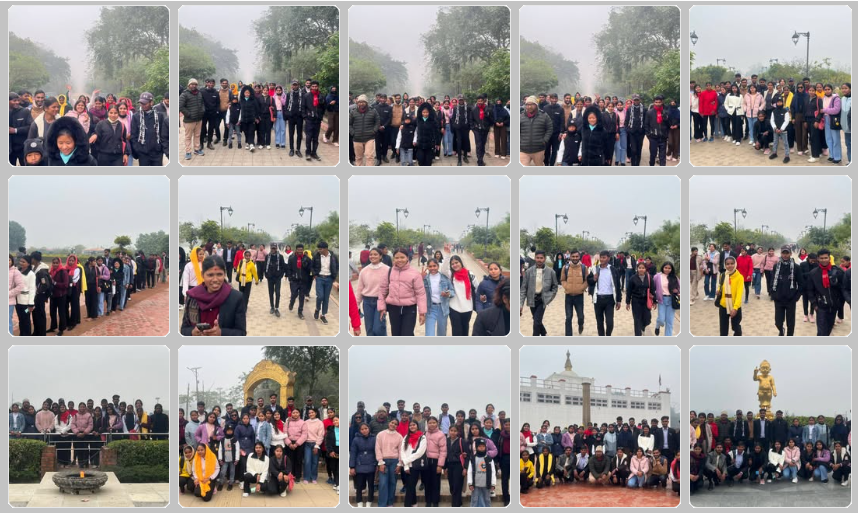
Rupandehi Campus brings together students from different cultural and social backgrounds from across the western region. Its campus experience is shaped not only by classroom teaching but also by community links, student support services, and participation in campus bodies.
The institution reports a health desk in operation since 2078 BS with permanent service from a doctor. It also notes the involvement of students in research activities and the existence of a college-industry-neighborhood network connected to course work. The campus regularly consults stakeholders in possible fields of employment and uses those interactions to shape program relevance.
Student participation is linked to several institutional and community bodies. Alumni and parent associations are involved in different campus activities, and donors are recognized during annual programs. In the Management stream, female students accounted for about 51 percent of total enrollment in 2078/79. Graduate data also shows continuing participation of female and educationally disadvantaged groups across the two bachelor programs.
In 2079 BS, the campus recorded 29 bachelor graduates in total: 14 from B.Ed. and 15 from BBS. Of these, 17 were female graduates and 18 were from educationally disadvantaged groups. These figures indicate that the campus serves a varied student population within its current academic scope.
Games and sports
Blood donation programs
Health camps
Eye camps
Sanitation programs
Plantation programs
Student Quality Circle Cell
Alumni Association activities
Parent Teacher Association involvement
CSR-related community engagement
The campus has a renewable scholarship fund structure supported by donors and memorial funds.
Community contribution to the campus includes the establishment of scholarship funds.
Named scholarship funds include Buddha Vijayalakshmi Scholarship, Late Dhanapati Upadhyay Jehender Scholarship, Janakinarayan Kharel Scholarship, Late Vidyadevi Pradhan Memorial Scholarship, and several other donor-supported scholarship funds.
The campus receives regular grants from the University Grants Commission (UGC) and support from other government bodies.
Research activity and journal publication are funded by the campus.
Established in 2048 BS (1991 AD)
Transitioned from the earlier PCL Law affiliation to four-year bachelor-level B.Ed. and BBS programs
Faculty of Education started in 2061 BS
QAA Certified Institution
Accredited by UGC Nepal
Three research journals published
Health desk operating since 2078 BS
Research works completed in collaboration with the provincial government in the last two years
Library modernization through library management software
Community-supported scholarship network in place
The President’s message connects the establishment and growth of the campus with the broader educational changes that followed the political transformation of 2046/2047 BS. It presents Rupandehi Campus as an institution built through local initiative and sustained by a commitment to continuing TU academic programs with modern facilities and institutional continuity.
The Campus Chief’s message focuses on student-centered academic development. It emphasizes careful academic planning, staff selection, family-campus communication, and a learning experience that extends beyond the classroom to include cultural, athletic, and performance-related opportunities. It also presents education as a collaborative process involving students, families, and the campus.
Rupandehi Campus is a community-governed public campus with a clear bachelor-level academic focus. Its present institutional identity rests on two TU-affiliated programs, B.Ed. and BBS, supported by faculty structures in Education and Management, research activity, library and ICT resources, and community participation in governance.
The campus profile is also shaped by its scholarship funds, health desk, social outreach programs, and local institutional relationships. For students seeking a public campus in Rupandehi with four-year TU annual-system study in education or management, Rupandehi Campus presents a defined and locally rooted academic option.
College Name: Rupandehi Campus
Location: Siddharthanagar-9, Bhairahawa, Rupandehi, Nepal
Phone No.: +977-71-521572, +977-9857023125, +977-9802717265, +977-9867292404
Email: rupandehicampus@gmail.com
Website: https://rupandehicampus.edu.np
Affiliation: Tribhuvan University
Contact Rupandehi Campus's administrative office for detailed information on the course, admissions, location, fees, scholarships, facilities, counseling or eligibility.
Rupandehi Campus is located at Siddharthanagar-9, Bhairahawa, Rupandehi, Nepal.
The campus is affiliated with Tribhuvan University.
The campus currently runs the Bachelor of Education (B.Ed.) and Bachelor of Business Studies (BBS) at the bachelor level.
Both programs are four-year bachelor programs under the annual system.
Admission begins with a campus notice. Eligible applicants submit the required form and documents, and the process may include an entrance examination, merit-based selection, or both, depending on the program and campus procedure.
Commonly required documents include the Class 12 or equivalent transcript, character certificate, migration certificate if applicable, transfer certificate, citizenship or birth certificate copy, photographs, completed application form, fee receipt, and equivalence certificate if required.
The campus has academic, library, and administrative blocks; an ICT lab; library resources; projectors; computers/laptops; sports facilities; a common room; staff room; parking area; and a student union office.
Yes. The campus has multiple donor-supported renewable scholarship funds and also receives institutional grant support from UGC and other government bodies.