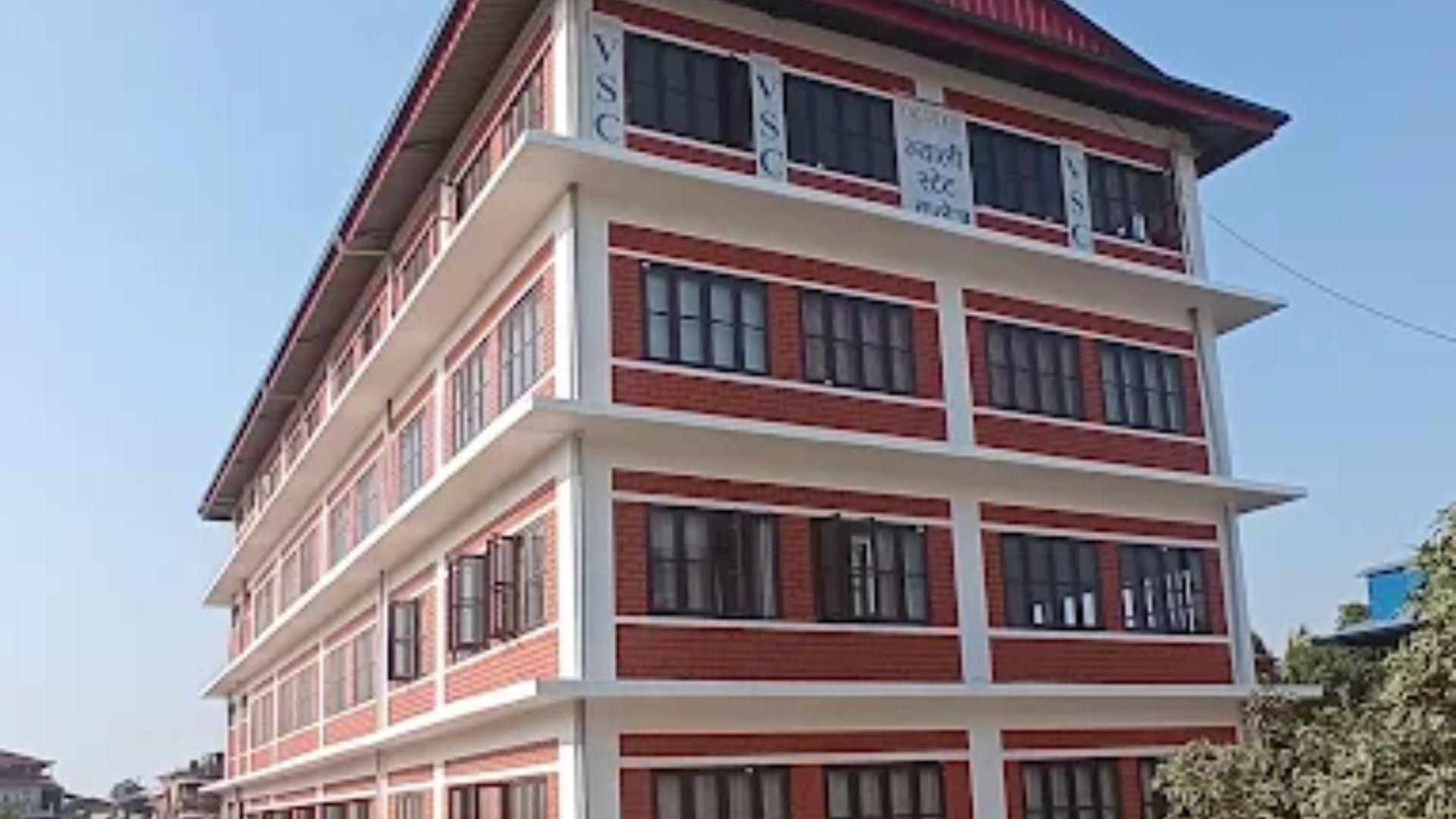
Valley State College is a higher education institution located at Bharatpur-10, Hakimchowk, Bidhyut Pradhikaran Road, Chitwan, Bagmati Province, Nepal. Established in 2012 AD, the college is affiliated with Pokhara University and offers Bachelor of Business Administration (BBA), Bachelor of Health Care Management (BHCM), and Master of Business Administration (MBA) programs.
BBA has been offered since the college's establishment, while BHCM and MBA were introduced in 2024. The academic setting combines classroom instruction with practical work, corporate and industrial visits, workshops, guest sessions, student-led projects, research activities, clubs, and corporate apprenticeship. Ethics, communication, business knowledge, entrepreneurship, and professional exposure form recurring parts of the college's academic and extracurricular activities.
| Particular | Details |
|---|---|
| Established | 2012 AD |
| Location | Bharatpur-10, Hakimchowk, Bidhyut Pradhikaran Road, Chitwan |
| Province | Bagmati Province, Nepal |
| Affiliation | Pokhara University |
| Academic Levels | Bachelor's and Master's |
| Programs | BBA, BHCM, MBA |
| BBA Started | 2012 |
| BHCM and MBA Started | 2024 |
| Undergraduate Eligibility | 10+2, PCL, or equivalent |
| MBA Eligibility | Minimum 10+5 years of formal education and minimum CGPA 2.0 / 45% at bachelor's level |
| Scholarships | PU Entrance Merit and VSC Special Scholarship provisions |
| valleystatecollege@gmail.com | |
| Website | https://valleystatecollege.edu.np |
Valley State College began in 2012 with the Bachelor of Business Administration program. Its academic scope later expanded to include health care management and postgraduate business education, with BHCM and MBA added in 2024.
The college's educational approach places classroom knowledge alongside practical exposure. Management education is supported through seminars, workshops, corporate visits, industry interaction, student-managed activities, research-oriented work, and opportunities to communicate with professionals from academic and business settings.
Ethics and socio-human responsibility also appear within the college's stated academic direction. The institution connects these themes with management competence, communication, entrepreneurship, and the practical application of knowledge.
Valley State College is affiliated with Pokhara University. Its BBA, BHCM, and MBA programs operate under this university affiliation.
The undergraduate programs follow semester-based academic structures, while the MBA follows a trimester arrangement. Academic content across the programs covers business, management, communication, quantitative study, technology, research, practical assignments, and program-specific subject areas.
| Program | Level | Structure |
|---|---|---|
| Bachelor of Business Administration (BBA) | Bachelor's | 4 years, 8 semesters |
| Bachelor of Health Care Management (BHCM) | Bachelor's | 8 semesters |
| Master of Business Administration (MBA) | Master's | Trimester-based, six academic terms shown in the curriculum |
The Bachelor of Business Administration is the college's longest-running program, offered since 2012. It follows a four-year, semester-based structure and includes subjects from management, economics, accounting, finance, marketing, information technology, communication, research, entrepreneurship, business law, and strategy.
The curriculum moves from foundation subjects into applied business study. Early semesters include English, basic and business mathematics, IT for Business, Behavioral Science, Principles of Management, Business Communication, Microeconomics, Organizational Behavior, and Financial Accounting.
Later semesters cover Business Statistics, Macroeconomics, Cost and Management Accounting, Finance, Marketing, Data Analysis and Modeling, Business and Society, Business Research Methods, Human Resource Management, Financial Management, Entrepreneurship, Operations Management, Management Information System, Project Management, e-Business, International Business, Strategic Management, Business Law, and Business Environment.
Practical components are spread across the program rather than being confined to the final semester. They include:
Software Skills Practicum
Soft Skills Practicum
Digital Marketing Practicum
Fintech Practicum
Academic Writing
Project Work
Business Development Project
Community Engagement Project
Internship
The eighth semester includes a six-credit internship. Concentration areas identified within the curriculum include Accounting, Marketing, Finance, Human Resource Management, Entrepreneurship, and IT & Management Science. Elective areas include subjects such as Media & Public Relations, Society & Politics, environmental studies, sustainable development, and family business management.
BHCM was introduced at Valley State College in 2024. The program combines management study with subjects related to hospitals, health services, administration, health policy, epidemiology, health information, quality management, law, and health care operations.
The first semesters establish foundations through English, management, IT, psychology, economics, sociology, mathematics, anatomy and physiology, hospital management, hospital administration, and hospital planning.
As the program progresses, students study areas such as:
Organizational Behavior
Accounting and Finance
Health Policy and Program Management
Basic Epidemiology
Human Resource Management
Health Information System
Business Research Method
Biostatistics and Computer Application
Health Care Inventory and Biomedical Equipment Management
Hospital Support Services Management
Health Care Law
Hospital Quality Management
Introductory Diseases Management
Strategic Management
Practical work is integrated into the academic sequence. Internship I appears in the third semester, Internship II in the fifth semester, and Internship III in the eighth semester. The sixth semester also includes a Health Care Project.
The later semesters include concentration study in Hospital Management and Health Management, along with related electives. This arrangement gives the program a clear connection between general management study and the administration of health care organizations.
The MBA was introduced in 2024. Its academic calendar is organized around Fall, Winter, and Spring trimesters. Fall runs from September to December, Winter from January to April, and Spring from May to August. New student intake is identified for Fall and Spring.
The curriculum is organized across six terms. Initial terms cover Accounting for Managerial Decisions, Statistics for Managers, Managerial Economics, Organizational Behavior and Human Resource Management, Financial Management, Quantitative Methods for Decision Making, Macroeconomics and Global Economy, Operations and Supply Chain Management, and Marketing Management.
Later terms add Business Research and Consultancy, Entrepreneurship, Management Information System, Managerial Communication, Leadership, Governance and Ethics, Business Environment and Strategy, concentration subjects, electives, experiential learning, and internship.
Practicum components include Human Resource Management, Digital Marketing, Management Information Systems, and Entrepreneurship. The program also includes industry and research pathways. Academic options identified within these pathways include consulting work, new venture creation, Doing Business in Nepal, and a graduate thesis.
Concentration areas include:
Finance
Marketing
Human Resource Management
IT & Business Analytics
Entrepreneurship & Innovation
The curriculum also identifies project and elective topics such as Digital Economy, Bank Operations and Management, Project Management, Behavioral Economics, Monetary Economics, Tourism and Hospitality Management, Real Estate Management, Technology Management, and Tax Planning. The sixth term includes a six-credit internship.
Admission eligibility differs between the undergraduate and postgraduate programs.
| Program Level | Eligibility |
|---|---|
| BBA / BHCM | 10+2, PCL, or equivalent |
| MBA | Minimum 10+5 years of formal education and minimum CGPA 2.0 / 45% at bachelor's level |
Students should contact the administrative office for the current admission process, entrance requirements, application schedule, required documents, available seats, and fee structure.
Valley State College identifies two scholarship arrangements for students:
100% scholarship for 18 students based on Pokhara University Entrance Merit
VSC Special Scholarship of up to 100% based on VSC Entrance and semester performance
Because scholarship selection is tied to entrance merit or academic performance, students should obtain the applicable conditions for their admission cycle before applying.
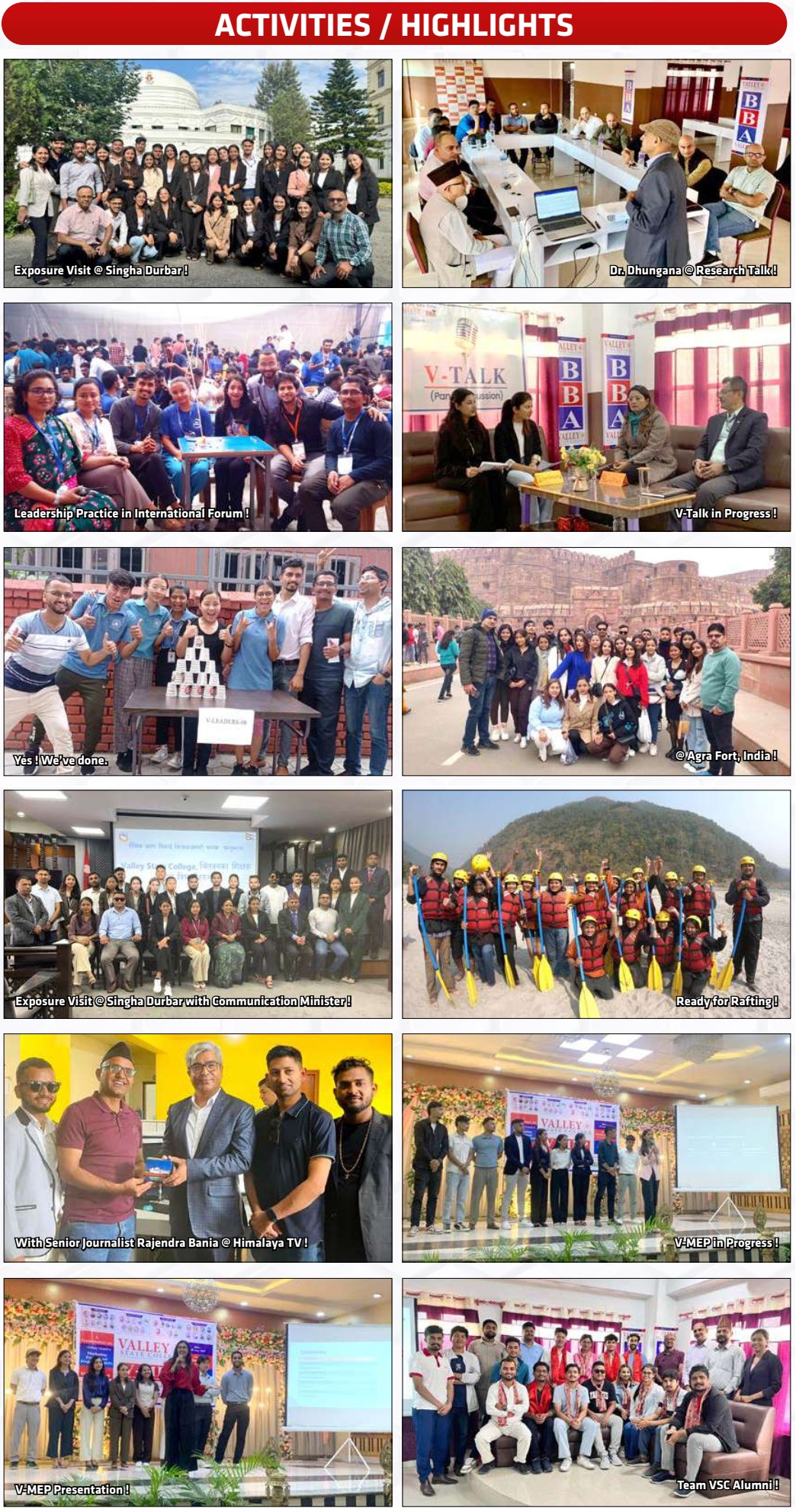
The college combines formal coursework with activities that place students in different learning settings. These include corporate interaction, workshops, seminars, market exposure, guest sessions, presentations, research talks, and student-led projects.
Academic activities highlighted by the college include:
Practice-oriented teaching and learning
Industry and market exposure
Guest lectures and professional sessions
Workshops and seminars
Digital and multimedia presentations
Corporate and industrial visits
Academic-industry interaction
Research-oriented activities
Corporate apprenticeship
Student-managed projects and events
Faculty members cover areas including finance and accountancy, general management, English and managerial communication, IT and MIS, economics, mathematics, statistics, research, business law, psychology, sociology, and health science.
Practical learning at Valley State College includes several named student projects.
Corporate apprenticeship is mandatory for undergraduate and graduate students. It is intended to give students experience in corporate settings, with students in their final semester or trimester taking a leading role in the project.
V-TALK began as an interactive knowledge-sharing initiative involving BBA students and is also intended for the MBA level. Sessions follow a seminar format in which invited speakers discuss practical, theoretical, and context-relevant topics.
V-MEP is organized by BBA students around market-oriented activities. It brings together communication, marketing, human resource management, accounting, financial planning, presentation, and sales-related work.
V-EP developed from an earlier project known as Packet of Celebration. It is associated with the Valley State Business Aspirants' Group and gives students a setting for working around entrepreneurship and business ideas.
V-Smile Feast is an annual management event centered on networking, presentation, talent showcase, and interaction among participants from different areas.
Undergraduate students in BBA and BHCM have an exposure schedule extending across their semesters.
| Semester | Activity |
|---|---|
| 1st and 2nd | Day outing for corporate visit |
| 3rd | 1-night/2-day exposure visit |
| 4th | Day outing for industrial visit |
| 5th | 2-night/3-day exposure visit |
| 6th | Day outings for corporate visit |
| 7th | 5-night/6-day exposure visit |
| 8th | 1-night/2-day capital visit |
For MBA students, exposure activities, training, and visits are organized trimester-wise. The college also includes conferences, seminars, workshops, excursions, and other exposure activities within its broader student learning program.
Student clubs cover communication, social work, reading, culture, business, technology, research, events, and sports.
V-Smile works in media, communication, and outreach and is responsible for the college newsletter carrying the same name.
V-Events functions as the event management group and coordinates activities involving different student clubs.
V-SS focuses on social-support and philanthropic activities. Its work is linked with individual and corporate social responsibility.
The readers' club promotes reading and post-reading discussion, giving students a space for academic and general reading beyond the classroom.
The cultural club organizes activities such as singing and dancing competitions, welcome and farewell programs, role play, fashion programs, Rangoli, Holi activities, Saraswati Puja, and collage arts.
V-BAG supports entrepreneurship talks, workshops, business idea competitions, and visits to business organizations.
V-IT organizes computing and technology-related activities with attention to basic software and hardware skills.
V-RMC supports research-related activities, publication work, seminars, conferences, and research discussion.
The college also identifies a sports club within its student activity structure.
Valley State College provides facilities for academic work and day-to-day student use.
Library with reference books, journals, magazines, and newspapers
Computer lab with computers, multimedia resources, OHP, and internet access
Cafeteria
Safe drinking water
Playground for extracurricular activities
College premises used for academic and student activities
Presentation and multimedia facilities
These facilities support reading, computing, presentations, group activities, extracurricular participation, and routine campus needs.
The faculty structure covers the principal subject areas required across BBA, BHCM, and MBA. Academic groups include finance and accountancy, general management, managerial communication, IT/MIS, economics, mathematics and statistics, research, law and social sciences, and health science.
The college also hosts guest presenters from universities, academic institutions, corporate organizations, banking, media, research, and other professional settings. The listed guest contributors include academics and professionals from Pokhara University, Tribhuvan University, Kathmandu University, XLRI, BIMTECH, and other institutions and organizations.
Dr. Krishna Sharma is identified as Research Committee Chairperson, while Dr. Sunil Pokharel is identified as Head of the Research Management Cell.
Er. Hari Bhandari serves as Chairman of Valley State College. The Board of Directors includes Dr. Keshav Raj Bhurtel, Mr. Gopal Parajuli, and Mr. Netra Bhusal.
Mr. Baburam Khanal serves as Principal. The institutional leadership places emphasis on business education, practical exposure, ethics, and socio-human responsibilities within the college's academic direction.
Valley State College is located in Bharatpur Metropolitan City at Bharatpur-10, Hakimchowk, Bidhyut Pradhikaran Road, Chitwan, Bagmati Province, Nepal.
Students can contact the administrative office for information concerning admission, courses, eligibility, fees, scholarships, counseling, facilities, and other academic or administrative matters.
| Contact Field | Details |
|---|---|
| College: | Valley State College |
| Location: | Bharatpur-10, Hakimchowk, Bidhyut Pradhikaran Road, Chitwan, Bagmati Province, Nepal |
| Phone: | +977-56-590861, +977-56-590507, +977-9855013054, +977-9865038315, +977-9855086861 |
| Email: | valleystatecollege@gmail.com |
| Website: | https://valleystatecollege.edu.np |
Valley State College was established in 2012 AD in Bharatpur, Chitwan.
The college is affiliated with Pokhara University.
It offers Bachelor of Business Administration (BBA), Bachelor of Health Care Management (BHCM), and Master of Business Administration (MBA).
Both BHCM and MBA were introduced in 2024. BBA has been offered since 2012.
Applicants need 10+2, PCL, or an equivalent qualification.
The listed requirement is a minimum of 10+5 years of formal education and at least CGPA 2.0 or 45% at bachelor's level.
Yes. Scholarship provisions include a 100% scholarship for 18 students based on Pokhara University Entrance Merit and a VSC Special Scholarship of up to 100% based on VSC Entrance and semester performance.
Yes. The programs include internships, corporate apprenticeship, corporate and industrial visits, exposure visits, workshops, seminars, and student-led practical projects.
Student groups include V-Smile, V-Events, V-SS, V-RC, V-CC, V-BAG, V-IT, V-RMC, and a sports club.
It is located at Bharatpur-10, Hakimchowk, Bidhyut Pradhikaran Road, Chitwan, Bagmati Province, Nepal.