Bharatpur Metropolitan City is a local government in Chitwan District, Bagmati Province, Nepal. It includes the commercial area of Narayangarh, the administrative and residential areas of Bharatpur, agricultural settlements in western Chitwan, and hilly areas in the north.
According to the decision of the Council of Ministers of the Government of Nepal dated 27 Falgun 2073 BS, the former Bharatpur Sub-Metropolitan City was upgraded to Bharatpur Metropolitan City by incorporating Narayani Municipality, Chitrawan Municipality, and Kabilas Village Development Committee (VDC).
The metropolitan city covers an area of 432.95 square kilometres and consists of 29 wards. According to the National Population and Housing Census 2078 BS (2021 AD), it had a total population of 369,268 and 96,591 households.
Bharatpur Metropolitan City is responsible for local administration, infrastructure development, basic and secondary education, basic healthcare, local revenue, vital event registration, social security, environmental management, and other local public services.
Official Name: Bharatpur Metropolitan City (भरतपुर महानगरपालिका)
English Name: Bharatpur Metropolitan City
Type of Local Government: Metropolitan City (Mahanagarpalika)
Province: Bagmati Province
District: Chitwan
Upgraded to Metropolitan City: 27 Falgun 2073 BS
Total Area: 432.95 square kilometres
Number of Wards: 29
Total Population (2078 BS): 369,268
Male Population: 178,897
Female Population: 190,371
Number of Households: 96,591
Population Density: 853 persons per square kilometre
Literacy Rate: 87.20%
Office of the Municipal Executive: Bharatpur–10, Chitwan
Official Website: https://bharatpurmun.gov.np/
The population, household, population density, and literacy figures are based on the National Population and Housing Census 2078 BS (2021 AD). These figures should not be interpreted as estimates of the city's population in 2026.
The present administrative structure of Bharatpur Metropolitan City is the result of several stages of local government restructuring. Its administrative status and geographical boundaries have changed over time, from a former Town Panchayat to the present metropolitan city.
According to the official institutional profile of Bharatpur Metropolitan City, Bharatpur Town Panchayat was established in 2035 BS by merging the former Bharatpur Village Panchayat and Narayangarh Village Panchayat.
Urban development in the Bharatpur and Narayangarh areas progressed alongside settlement expansion, road transportation, agriculture, and commercial activities in the Chitwan Valley.
The metropolitan city's official profile states that Bharatpur began operating as Bharatpur Municipality in 2048 BS.
During this period, Bharatpur functioned as a local municipal administration.
In 2071 BS, the Government of Nepal decided to establish Bharatpur Sub-Metropolitan City by incorporating five surrounding Village Development Committees into the former Bharatpur Municipality.
The incorporated Village Development Committees were:
Mangalpur
Phulbari
Gitanagar
Shivanagar
Patihani
This restructuring expanded Bharatpur's administrative territory beyond the boundaries of the former municipality.
According to the decision of the Council of Ministers of the Government of Nepal dated 27 Falgun 2073 BS, the former Bharatpur Sub-Metropolitan City was upgraded to a metropolitan city by incorporating three additional administrative units.
The administrative units merged to form the present metropolitan city were:
Bharatpur Sub-Metropolitan City
Narayani Municipality
Chitrawan Municipality
Kabilas Village Development Committee
Following this restructuring, Bharatpur Metropolitan City began operating as a local government comprising 29 wards.
The establishment of Bharatpur Town Panchayat in 2035 BS and its upgrading to a metropolitan city in 2073 BS represent two separate stages in its administrative history.
Bharatpur Metropolitan City extends across the central and western parts of Chitwan District. Its geographical features include flat valley areas, urban settlements, agricultural land, riverbanks, and hilly terrain.
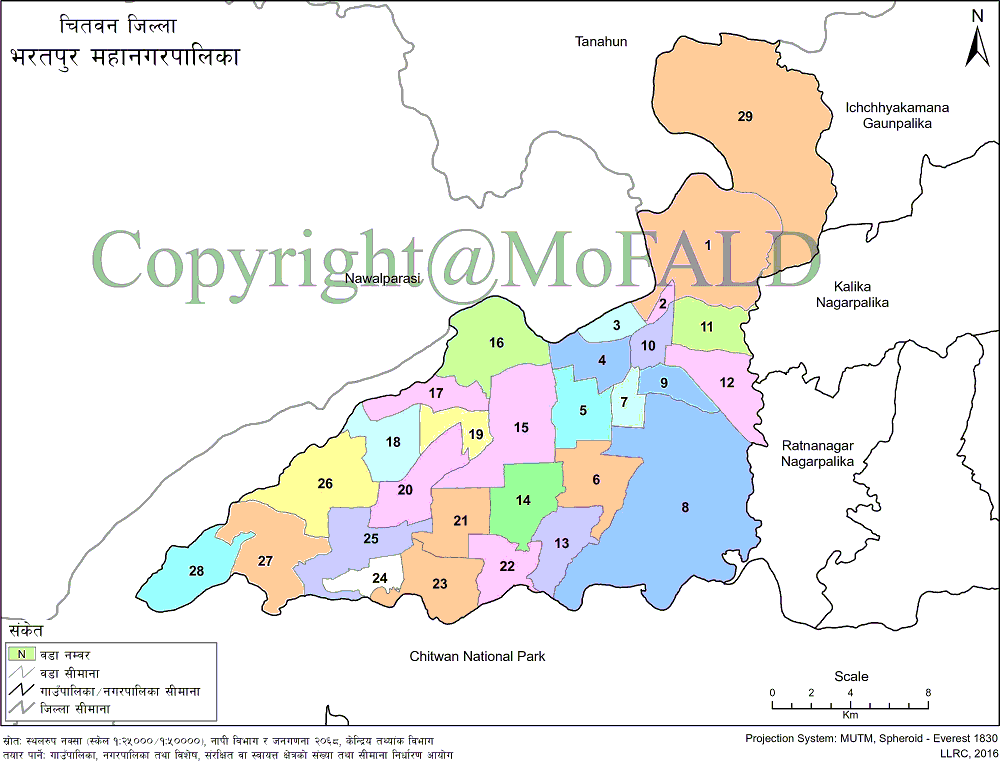
Most of the metropolitan city's territory lies in the flat Chitwan Valley within Nepal's Inner Terai region. Ward No. 29, however, includes hilly terrain and rural settlements.
The Narayani River is one of Bharatpur's major geographical features. The Narayangarh market area is connected to the riverbank, while the area surrounding Devghat is also associated with the Narayani River system.
The river is important to the local geography, settlements, commercial activities, riverbank land use, and disaster management.
The Rapti River is another major river associated with the southern part of the Chitwan Valley.
Areas surrounding Meghauli and Golaghat in western Chitwan are connected to the Narayani and Rapti river systems.
Flooding, riverbank erosion, water resource use, and environmental conservation are important local concerns in riverside areas.
Settlement patterns are not uniform across all wards of Bharatpur Metropolitan City.
Areas surrounding Narayangarh and Bharatpur markets contain commercial establishments, transportation facilities, government offices, hospitals, educational institutions, and residential settlements.
Various wards in the western region include agricultural activities, livestock farming, local markets, and rural settlements.
Ward No. 29 covers the northern hilly terrain of the metropolitan city.
Because of this geographical diversity, requirements for road access, public service delivery, infrastructure, and disaster management may vary between areas.
According to the National Population and Housing Census 2078 BS, conducted by the National Statistics Office, Bharatpur Metropolitan City had a population of 369,268.
The demographic information published by the metropolitan city records 178,897 males and 190,371 females.
Total Population: 369,268
Male Population: 178,897
Female Population: 190,371
Number of Households: 96,591
Average Household Size: 3.82 persons
Sex Ratio: 93.97
Annual Population Growth Rate: 2.64%
Population Density: 853 persons per square kilometre
Overall Literacy Rate: 87.20%
Male Literacy Rate: 92.12%
Female Literacy Rate: 82.64%
The sex ratio represents the number of males per 100 females.
The literacy figures relate to the population aged five years and above. Literacy rates should not be treated as equivalent to school enrolment rates or indicators of students' academic achievement.
The official demographic profile of Bharatpur Metropolitan City records a population of 280,502 in the National Census 2068 BS.
The population increased to 369,268 in the National Census 2078 BS.
|
Indicator |
Census 2068 BS |
Census 2078 BS |
|---|---|---|
|
Total Population |
280,502 |
369,268 |
|
Number of Households |
69,035 |
96,591 |
The difference between the population figures recorded in the two censuses was 88,766 people.
Natural population growth and migration may have contributed to this change. However, comparing the total population figures alone does not establish the contribution of each factor.
Bharatpur Metropolitan City has published population and household figures for all 29 wards based on the National Census 2078 BS.
|
Ward No. |
Households |
Population |
|---|---|---|
|
1 |
2,252 |
9,109 |
|
2 |
5,252 |
19,564 |
|
3 |
4,447 |
17,222 |
|
4 |
5,678 |
20,871 |
|
5 |
3,435 |
13,710 |
|
6 |
3,464 |
13,349 |
|
7 |
4,620 |
17,211 |
|
8 |
2,854 |
11,438 |
|
9 |
4,148 |
15,183 |
|
10 |
6,397 |
20,633 |
|
11 |
9,651 |
35,692 |
|
12 |
4,318 |
15,826 |
|
13 |
1,767 |
6,892 |
|
14 |
2,819 |
11,134 |
|
15 |
3,929 |
15,833 |
|
16 |
4,470 |
17,818 |
|
17 |
2,168 |
8,608 |
|
18 |
2,688 |
10,577 |
|
19 |
2,170 |
8,454 |
|
20 |
2,173 |
8,470 |
|
21 |
2,451 |
9,385 |
|
22 |
1,695 |
6,652 |
|
23 |
2,010 |
8,039 |
|
24 |
1,371 |
5,459 |
|
25 |
2,348 |
9,517 |
|
26 |
2,704 |
10,736 |
|
27 |
2,231 |
9,058 |
|
28 |
1,659 |
6,907 |
|
29 |
1,422 |
5,921 |
|
Total |
96,591 |
369,268 |
Source: Demographic Profile of Bharatpur Metropolitan City, National Census 2078 BS.
In the 2078 BS census, Ward No. 11 had a population of 35,692, the highest among the metropolitan city's wards. Ward No. 24 had a population of 5,459, the lowest.
Differences in ward populations indicate variations in settlement distribution. However, population size alone is not the only factor determining public service requirements or infrastructure conditions.
Bharatpur Metropolitan City is a local government operating under the Constitution of Nepal and the Local Government Operation Act, 2074 BS.
Its local governance structure includes the Municipal Assembly, Municipal Executive, Ward Committees, Judicial Committee, and administrative divisions and sections.
The Municipal Assembly is the local legislative body of the metropolitan city.
Under Article 223 of the Constitution of Nepal, the Municipal Assembly consists of the Mayor, Deputy Mayor, Ward Chairpersons, four elected members from each ward, and members elected to the Municipal Executive from Dalit or minority communities.
For Bharatpur Metropolitan City, which has 29 wards, the constitutional composition is as follows:
Mayor: 1
Deputy Mayor: 1
Ward Chairpersons: 29
Four Members from Each Ward: 116
Executive Members Elected from Dalit or Minority Communities: 3
Total Membership at Full Strength: 150
This represents the full membership structure provided for under the Constitution. The actual number of serving members may differ if positions are vacant.
Within its legal jurisdiction, the Municipal Assembly makes decisions on local laws, policies and programmes, budgets, and other matters.
The Municipal Executive is the local executive body of the metropolitan city.
Under Article 216 of the Constitution of Nepal, the Municipal Executive consists of the Mayor, Deputy Mayor, all Ward Chairpersons, five female members elected by the Municipal Assembly, and three members elected from Dalit or minority communities.
Under this structure, the Bharatpur Municipal Executive has 39 members at full strength.
The Municipal Executive is responsible for implementing Municipal Assembly decisions, managing local administration, delivering public services, carrying out development plans, and implementing various sectoral programmes.
Under Article 223 of the Constitution of Nepal, each ward has a Ward Chairperson and four elected members.
Ward Offices are important institutions through which residents interact directly with their local government.
Services such as vital event registration, various recommendations, local record management, and social security administration are provided at the ward level according to applicable laws and assigned responsibilities.
Under Article 217 of the Constitution of Nepal, municipalities have a three-member Judicial Committee coordinated by the Deputy Mayor.
The jurisdiction of the Judicial Committee is determined by the Local Government Operation Act and other applicable laws.
The committee may resolve disputes or facilitate mediation in matters specified by law. Not all types of disputes fall within its jurisdiction.
The administrative operations of the metropolitan city are led by the Chief Administrative Officer.
Under applicable laws, the Chief Administrative Officer performs responsibilities related to office administration, implementation of approved programmes, financial administration, and personnel management.
As listed on the metropolitan city's official website checked on 1 November 2026, the following officials were identified:
Acting Mayor: Chitrasen Adhikari
Chief Administrative Officer: Birendra Dev Bharti
Information Officer: Menaka Pandit
Following the 2079 BS local elections, Renu Dahal assumed office as Mayor, while Chitrasen Adhikari assumed office as Deputy Mayor.
The information available on the metropolitan city's official website identifies Chitrasen Adhikari as the Acting Mayor.
As official positions and responsibilities may change, the metropolitan city's official records should be consulted for updated appointments and changes in responsibilities.
The education sector of Bharatpur Metropolitan City can be understood through two separate aspects: the local government's responsibilities for school education and the higher education institutions located within its geographical boundaries.
The Constitution of Nepal and the Local Government Operation Act include basic and secondary education among the subjects associated with local government authority.
Under applicable legal provisions, the metropolitan city's educational administration responsibilities include local education planning, school administration, monitoring, educational data management, and implementation of related programmes.
Bharatpur Metropolitan City has published a citizen charter for its Educational Administration Division on its official website.
For procedures concerning school approval, operation of classes, educational records, scholarships, and other educational services, the relevant official notices should be consulted.
The central office of Agriculture and Forestry University (AFU) is located in Rampur, Chitwan.
The university's academic and research areas include agriculture, animal science, veterinary science, fisheries, forestry, and related disciplines.
The university's academic administration operates under its own legal and institutional arrangements.
Further details: Agriculture and Forestry University (AFU)
Birendra Multiple Campus is a public campus affiliated with Tribhuvan University, located in Bharatpur.
The campus offers academic programmes under the relevant academic structure of the university.
Further details: Birendra Multiple Campus, Chitwan
Saptagandaki Multiple Campus is a community campus located in Bharatpur–10, Chitwan.
The campus offers university-affiliated higher education programmes.
Further details: Saptagandaki Multiple Campus, Chitwan
The presence of higher education institutions within the metropolitan city's geographical boundaries does not necessarily mean that those institutions are directly operated by the metropolitan government.
University and campus affiliations, curricula, admission procedures, and examinations are administered according to the regulations of the respective universities and responsible authorities.
Bharatpur has government hospitals, specialised hospitals, teaching hospitals, and other healthcare institutions alongside basic healthcare services.
These institutions do not all operate under the same ownership, service jurisdiction, or administrative authority.
Under Schedule 8 of the Constitution of Nepal and the Local Government Operation Act, basic healthcare and sanitation are matters associated with local government authority.
In accordance with applicable laws, the metropolitan city plays a role in local health planning, basic healthcare services, public health programmes, and related management activities.
The official metropolitan city website provides a citizen charter for its Health and Social Development Division.
Bharatpur Hospital is a government hospital located in Bharatpur, Chitwan.
Under its institutional arrangements, the hospital provides outpatient, emergency, laboratory, and other healthcare services.
Its official notices can be consulted for information about service availability, charges, and other details.
Official Website: https://www.bharatpurhospital.gov.np/
B.P. Koirala Memorial Cancer Hospital is a specialised cancer hospital located in Bharatpur–7, Chitwan.
The institution provides services related to cancer screening, diagnosis, and treatment.
Official Website: https://bpkmch.gov.np/
Bharatpur also has other teaching and private hospitals. The location of a hospital within the metropolitan city's boundaries does not mean that the metropolitan government is responsible for all its administrative and financial operations.
Updated information regarding treatment, service charges, health insurance, specialist services, and operating hours should be obtained from the respective healthcare institutions.
Bharatpur has economic activities related to trade, services, agriculture, livestock farming, education, healthcare, and transportation.
Narayangarh is an established commercial market area connected to Bharatpur.
Retail and wholesale trade, financial services, transportation-related businesses, and other commercial activities operate in the area.
Other urban areas of Bharatpur contain government offices, educational institutions, hospitals, residential settlements, and commercial establishments.
Agricultural and livestock farming activities are carried out in various rural and western areas of the metropolitan city.
Cultivation of rice, maize, wheat, vegetables, and other crops forms part of the agricultural system of the Chitwan Valley.
Farmers, cooperatives, private businesses, and various government agencies may participate in activities related to livestock farming and agricultural production.
Official agricultural statistics for the relevant year are necessary to make specific claims about annual production volumes, cultivated areas, or economic contributions.
Bharatpur is connected to the East–West Highway and the Narayangarh–Muglin road.
These roads play a role in the transportation network connecting Chitwan with different parts of Nepal.
The metropolitan city also has infrastructure related to local roads and internal transportation.
Road conditions and public transportation services may change over time.
Bharatpur Airport is located in Bharatpur.
Flight operations, destinations, and schedules are determined according to updated information from the relevant airlines and civil aviation authorities.
Bharatpur's environmental features include river systems, agricultural land, urban settlements, forests, and wetland areas.
Beeshazar and Associated Lakes, located in the Barandabhar forest area of Chitwan District, is a wetland system of international importance.
The site was included in the Ramsar List on 13 August 2003.
According to Ramsar records, the wetland system covers 3,200 hectares and is associated with the buffer zone of Chitwan National Park.
The park administration, relevant conservation authorities, local communities, and other stakeholders have roles in conserving the wetland system.
Its conservation and management should not be presented as the sole responsibility of the metropolitan city.
Environmental matters within the metropolitan city's responsibilities include waste management, sanitation, local drainage, environmental conservation, and public health.
Flooding and riverbank erosion in riverside areas, as well as soil erosion and landslides in hilly areas, may be relevant to local disaster management.
Official reports and records are necessary to confirm specific risk areas, project status, or achievements of conservation programmes.
Financial management in Bharatpur Metropolitan City is governed by the Local Government Operation Act, laws relating to intergovernmental fiscal management, and local financial legislation.
Under Section 71 of the Local Government Operation Act, 2074 BS, estimates of income and expenditure for the upcoming fiscal year must be presented to the Municipal Assembly by Asar 10.
The law also provides that the Assembly must discuss and approve the budget by the end of Asar.
Local budgets may include internal municipal revenue, fiscal transfers, revenue sharing, and funds received from other legally permitted sources.
Bharatpur Metropolitan City has published the following documents relating to fiscal year 2083/84 BS in the Budget and Programme section of its official website:
Policies and Programmes for Fiscal Year 2083/84
Budget Statement for Fiscal Year 2083/84
Planning Book for Fiscal Year 2083/84
These documents contain policies, budget information, and plans for the respective fiscal year.
An approved budget, allocated funds, actual expenditure, and completed projects should not be treated as the same financial achievement.
Official Budget and Programme Section: https://bharatpurmun.gov.np/ne/budget-program
The metropolitan city may establish provisions for various local taxes, service charges, and fees within the authority granted by law.
Tax categories, rates, exemptions, and payment procedures are governed by the Economic Act and official decisions applicable to the respective fiscal year.
The approved legal provisions for the relevant year should be consulted to determine current tax rates and service charges.
Financial and administrative accountability in the metropolitan city is associated with public budgets, financial statements, audits, public hearings, and right-to-information provisions.
Reports of the Office of the Auditor General and approved financial records of the metropolitan city are sources of information on public expenditure and financial management.
Any figures concerning audit irregularities, budget implementation rates, or expenditure progress for a particular fiscal year should be based on official reports covering that period.
Bharatpur Metropolitan City and its Ward Offices provide various citizen services within their respective legal jurisdictions.
The responsible office, required documents, fees, and procedures may differ depending on the type of service.
Vital event registration includes the following events:
Birth
Death
Marriage
Divorce
Migration
According to official information from the Department of National ID and Civil Registration, vital events can be registered free of charge within 35 days at the Ward Office of the concerned person's permanent address or the office of the Local Registrar where the event occurred.
A late registration fee may apply after 35 days, subject to applicable provisions.
The person responsible for reporting an event and the required documents may differ depending on the type of event. The relevant Ward Office or departmental guidelines should be consulted.
Local governments have responsibilities related to beneficiary registration, record management, renewal, and service coordination under social security programmes.
Beneficiary eligibility, allowance amounts, required evidence, and procedures are determined by applicable laws and official notices.
For information on social security, residents may contact their respective Ward Office or the metropolitan city's Civil Registration and Social Security Section.
Ward Offices provide various recommendations and certification services according to applicable laws and approved citizen charters.
Depending on the service, Ward Offices may issue recommendations concerning residence, citizenship applications, family details, land and property, and other matters.
Issuing a citizenship certificate and providing a local recommendation for citizenship are separate administrative procedures.
Building construction permits and map approvals within the metropolitan city's jurisdiction are administered according to applicable building standards and local laws.
Access to an electronic building plan approval system is available through the metropolitan city's website.
Required documents and approval procedures may differ depending on the type of building, proposed construction, and condition of the land.
The metropolitan city's responsible administrative sections carry out tasks relating to local business administration, revenue collection, and record management.
Some businesses may also require registration, permits, or approval from regulatory authorities other than the local government.
Before beginning a business-related procedure, applicants should review the responsible office's citizen charter and applicable legal provisions.
The official website of Bharatpur Metropolitan City lists access to the following electronic services:
Online Revenue Payment System
Judicial Proceedings Management System
Electronic Building Plan Approval System
Online Vital Event Registration System
The availability and procedures of these systems depend on the current arrangements of the respective portals and the nature of the services.
The listing of an online portal does not necessarily mean that every procedure can be completed entirely online.
Bharatpur Metropolitan City has published citizen charters on its website for revenue management, educational administration, health and social development, general administration, and other relevant sections.
Residents can consult the official information on required documents, responsible administrative sections, and applicable service charges before applying for services.
Citizen Charter: https://bharatpurmun.gov.np/ne/citizen-charter
The Office of the Municipal Executive of Bharatpur Metropolitan City is located in Bharatpur–10, Chitwan.
Office: Bharatpur Metropolitan City, Office of the Municipal Executive
Address: Bharatpur–10, Chitwan
Province: Bagmati Province
Phone: 056-511467
Additional Office Phone: 056-597004
Email: info@bharatpurmun.gov.np
Official Website: https://bharatpurmun.gov.np/
The metropolitan city's website provides sections for ward profiles, elected officials, employees, administrative divisions, citizen charters, budgets, plans, and public notices.
Information about specific services can be obtained from the relevant Ward Office or administrative division.
Bharatpur Metropolitan City is a local government comprising 29 wards in Chitwan District, Bagmati Province. Its current administrative structure was established following local government restructuring in 2073 BS.
According to the National Census 2078 BS, the metropolitan city had a population of 369,268 and 96,591 households. Its geographical diversity, including urban markets, agricultural areas, riverside settlements, and hilly terrain, creates different requirements for infrastructure and public service management.
The metropolitan city carries out responsibilities related to local administration, education, basic healthcare, revenue, planning, and citizen services according to the Constitution of Nepal, the Local Government Operation Act, and other applicable legal provisions.
Historical information and census statistics should be understood in relation to their respective reference periods. For current officials, budgets, taxes, service procedures, and other changing information, the metropolitan city's official records should be consulted.
Statistical Reference Period: National Census 2078 BS (2021 AD). Information about administrative officials and public services that may change over time is presented according to details available on the official website.
Bharatpur Metropolitan City is located in Chitwan District, Bagmati Province, Nepal.
According to the decision of the Council of Ministers of the Government of Nepal dated 27 Falgun 2073 BS, the former Bharatpur Sub-Metropolitan City was upgraded to a metropolitan city by incorporating Narayani Municipality, Chitrawan Municipality, and Kabilas Village Development Committee.
Bharatpur Metropolitan City has 29 wards and covers a total area of 432.95 square kilometres.
According to the National Census 2078 BS, Bharatpur Metropolitan City had a total population of 369,268. This figure is from the 2021 census.
According to the National Census 2078 BS, Bharatpur Metropolitan City had 96,591 households.
According to the 2078 BS census, Ward No. 11 had a population of 35,692. It was the most populous ward in Bharatpur Metropolitan City in that census.
According to the National Census 2078 BS, Bharatpur Metropolitan City had an overall literacy rate of 87.20%. The male literacy rate was 92.12%, while the female literacy rate was 82.64%.
The Office of the Municipal Executive of Bharatpur Metropolitan City is located in Bharatpur–10, Chitwan.
According to the Department of National ID and Civil Registration, vital events, including births, can be registered free of charge within 35 days. The relevant Ward Office should be consulted for information about required documents and procedures.
The official website of Bharatpur Metropolitan City is https://bharatpurmun.gov.np/. The website provides official notices, citizen charters, budget information, and other public records.