The Master of Business Administration (MBA) at Valley State College is a postgraduate management program affiliated with Pokhara University. The college introduced the MBA in 2024 at Bharatpur-10, Hakimchowk, Chitwan. The program follows a trimester system and is organized across six academic terms carrying 60 credits.
The curriculum moves from accounting, economics, statistics, finance, marketing, operations, human resource management, and communication into strategy, concentration courses, electives, capstone work, research or industry-oriented study, and internship. MBA students also take part in practicums, corporate apprenticeship, training, visits, and other trimester-wise exposure activities arranged by the college.
| Particular | Details |
|---|---|
| Course | Master of Business Administration (MBA) |
| College | Valley State College |
| Location | Bharatpur-10, Hakimchowk, Chitwan |
| Affiliation | Pokhara University |
| Level | Master's |
| Academic Structure | 6 terms under a trimester system |
| Total Credits | 60 credits |
| Introduced at VSC | 2024 |
| Academic Cycle | Fall, Winter, Spring |
| Intake | Fall and Spring |
| Eligibility | Minimum 10+5 years of formal education and CGPA 2.0 / 45% at bachelor's level |
| Concentrations | Finance, Marketing, HRM, IT & Business Analytics, Entrepreneurship & Innovation |
| Final Term | 6-credit internship |
MBA is the postgraduate management program offered by Valley State College under its Pokhara University affiliation. It was added to the college's academic portfolio in 2024.
The program covers managerial decision-making from several angles rather than concentrating on a single business function. Accounting, statistics, managerial economics, financial management, quantitative methods, operations, supply chain management, marketing, research, management information systems, communication, leadership, governance, strategy, and entrepreneurship all appear within the core academic sequence.
Students then move into concentration and elective study before completing capstone and experiential work and a final internship. The curriculum also provides Industry and Research pathway components, allowing later-stage academic work to include consulting, venture development, Nepal-focused business study, or graduate research.
Pokhara University's MBA academic calendar is divided into three trimesters:
Fall: September to December
Winter: January to April
Spring: May to August
New student intake takes place twice a year, in Fall and Spring.
The curriculum itself is arranged across six terms. Each term has a defined credit load, with the first three terms focused mainly on core management study, Terms IV and V moving into specialization and capstone work, and Term VI assigned to internship.
Valley State College specifies the following academic requirement for MBA applicants:
Minimum 10+5 years of formal education
Minimum CGPA of 2.0 or 45% at bachelor's level
Pokhara University's Faculty of Management Studies also sets a bachelor's-level academic standard for MBA admission. Its management-program criteria identify a bachelor's degree with at least 15 years of formal education and a minimum CGPA of 2.0 on a 4.0 scale, second division, or 45% at undergraduate level.
Admission to Pokhara University master's-level programs includes fulfillment of the applicable academic criteria and a written entrance examination.
The application process includes:
Submission through the applicable college-specific admission process
Academic transcripts
Proof of the required application payment
A recent passport-sized photograph
Other documents required for the applicable admission cycle
A written entrance examination covering the relevant field of study
Entrance examination dates, locations, and syllabus details are communicated through the applicable admission process.
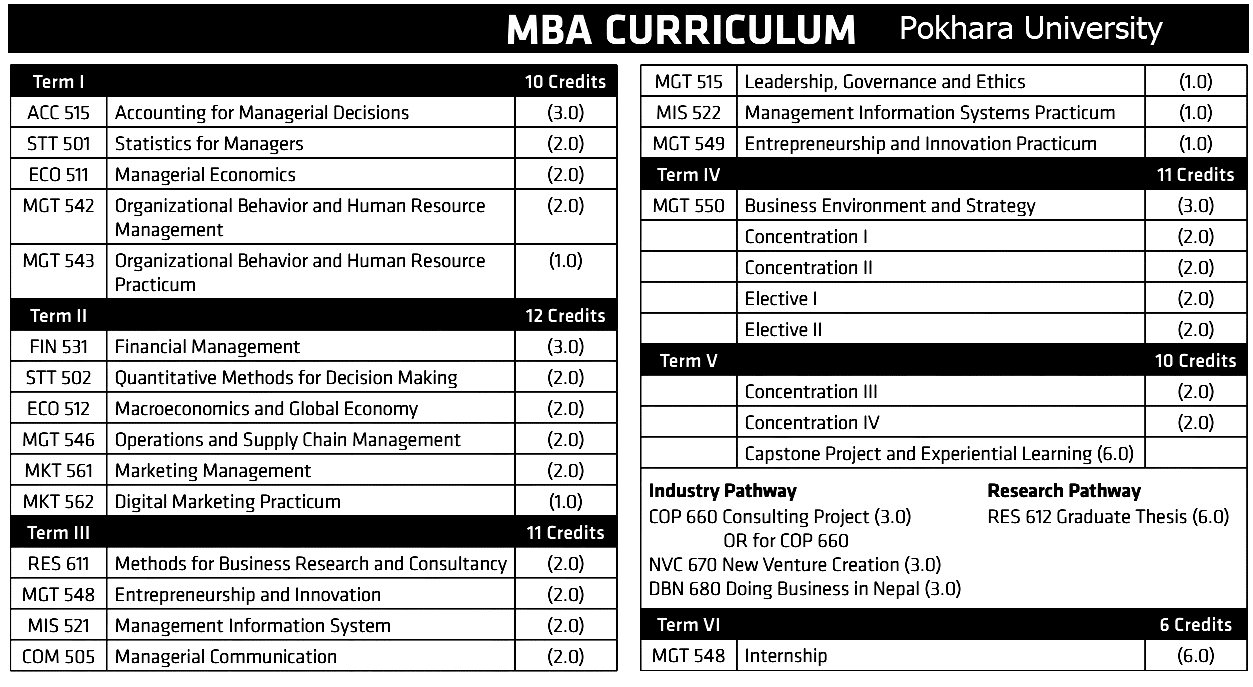
The MBA curriculum contains six terms with a combined 60-credit academic load. Core courses dominate the first three terms, while the later sequence introduces concentration subjects, electives, capstone work, experiential learning, pathway options, and internship.
| Term | Courses and Academic Components | Credits |
|---|---|---|
| Term I | Accounting for Managerial Decisions; Statistics for Managers; Managerial Economics; Organizational Behavior and Human Resource Management; Organizational Behavior and Human Resource Practicum | 10 |
| Term II | Financial Management; Quantitative Methods for Decision Making; Macroeconomics and Global Economy; Operations and Supply Chain Management; Marketing Management; Digital Marketing Practicum | 12 |
| Term III | Methods for Business Research and Consultancy; Entrepreneurship and Innovation; Management Information System; Managerial Communication; Leadership, Governance and Ethics; Management Information Systems Practicum; Entrepreneurship and Innovation Practicum | 11 |
| Term IV | Business Environment and Strategy; Concentration I; Concentration II; Elective I; Elective II | 11 |
| Term V | Concentration III; Concentration IV; Capstone Project and Experiential Learning | 10 |
| Term VI | Internship | 6 |
The first term carries 10 credits and begins with subjects used in managerial analysis and organizational work.
Students study:
Accounting for Managerial Decisions
Statistics for Managers
Managerial Economics
Organizational Behavior and Human Resource Management
Organizational Behavior and Human Resource Practicum
The practicum gives Term I an applied component alongside the academic study of organizational behavior and human resources.
Term II carries 12 credits and moves further into decision-making, finance, markets, and organizational operations.
The courses are:
Financial Management
Quantitative Methods for Decision Making
Macroeconomics and Global Economy
Operations and Supply Chain Management
Marketing Management
Digital Marketing Practicum
The Digital Marketing Practicum accompanies the marketing course, while quantitative methods and financial management extend the analytical side of the program.
Term III carries 11 credits. Research and consultancy methods are introduced alongside entrepreneurship, information systems, communication, leadership, governance, and ethics.
The term includes:
Methods for Business Research and Consultancy
Entrepreneurship and Innovation
Management Information System
Managerial Communication
Leadership, Governance and Ethics
Management Information Systems Practicum
Entrepreneurship and Innovation Practicum
Two separate practicums appear in this term, one linked with management information systems and another with entrepreneurship.
Term IV carries 11 credits and marks the shift from the common core toward specialized study.
It includes:
Business Environment and Strategy
Concentration I
Concentration II
Elective I
Elective II
Four of the term's courses allow students to work within concentration and elective areas while continuing common study through Business Environment and Strategy.
Term V carries 10 credits and includes:
Concentration III
Concentration IV
Capstone Project and Experiential Learning
The capstone and experiential component is presented through Industry and Research pathways. Named components associated with these pathways include Consulting Project, New Venture Creation, Doing Business in Nepal, and Graduate Thesis.
This term gives students space to bring together material from earlier courses through project, venture, consultancy, Nepal-focused business, or research work within the applicable pathway.
The sixth term consists of a six-credit internship.
Placed after core study, concentrations, electives, and capstone work, the internship serves as the final practical component within the six-term curriculum.
The curriculum identifies five concentration areas:
Finance
Marketing
Human Resource Management
IT & Business Analytics
Entrepreneurship & Innovation
Students take four concentration courses across Terms IV and V. This creates a specialized component within the broader MBA curriculum.
The MBA structure also identifies bouquet courses or elective areas. Named topics include:
Digital Economy
Bank Operations & Management
Project Management
Behavioral Economics
Monetary Economics
Tourism & Hospitality Management
Real Estate Management
Technology Management
Tax Planning
These electives sit alongside the common MBA subjects and concentration courses.
Practical work appears at several points in the program rather than being limited to the final internship.
The curriculum includes:
Organizational Behavior and Human Resource Practicum
Digital Marketing Practicum
Management Information Systems Practicum
Entrepreneurship and Innovation Practicum
Capstone Project and Experiential Learning
Industry or Research pathway work
Six-credit internship
This sequence connects classroom subjects with applied assignments in human resource management, marketing, information systems, entrepreneurship, consultancy, research, and workplace study.
Valley State Corporate Apprenticeship, or V-CAPS, is part of the college's practical activity structure for both undergraduate and graduate students. Students in the final semester or trimester take a leading role in the apprenticeship project.
For MBA students, V-CAPS operates alongside the formal internship and other exposure activities associated with the program.
Graduate-level MBA students take part in several exposure, training, and visit activities organized trimester-wise.
The college's wider academic activity format also includes corporate visits, excursions, exposure meetings, conferences, seminars, workshops, and training sessions.
V-TALK, an interactive seminar-based knowledge-sharing program that began with BBA students, is also intended to continue at MBA level. Sessions involve invited speakers discussing practical, theoretical, and context-related subjects.
The curriculum gives students postgraduate-level study across several parts of business and management:
Managerial accounting
Statistics and quantitative decision-making
Economics
Finance
Human resource management
Organizational behavior
Operations and supply chain management
Marketing and digital marketing
Business research and consultancy
Entrepreneurship
Management information systems
Managerial communication
Leadership, governance, and ethics
Business environment and strategy
Concentration-based study
Project, research, or industry-oriented work
Internship
These areas are reinforced through practicums and later concentration study rather than being treated only as stand-alone theory courses.
The academic and practical structure can support development in areas such as:
Managerial analysis and decision-making
Financial and quantitative interpretation
Business research
Professional communication
Marketing analysis
Human resource and organizational understanding
Operations and supply chain decision-making
Information-system use in management
Entrepreneurship and project work
Business strategy
Consulting or research-oriented project work
The level of ability developed in each area depends on a student's academic performance, participation, practical work, and experience.
Valley State College combines its MBA curriculum with guest sessions, practical exposure, research activity, training, and corporate interaction.
The college has faculty coverage in finance and accountancy, general management, English and managerial communication, IT and MIS, economics, mathematics, statistics, research, business law, psychology, and sociology. Guest presenters also come from academic and professional backgrounds.
Academic facilities include a library, computer lab, internet access, and multimedia resources. These facilities are relevant to MBA work involving research, information systems, presentations, quantitative analysis, projects, and academic assignments.
Valley State College is located in Bharatpur Metropolitan City at Bharatpur-10, Hakimchowk, Bidhyut Pradhikaran Road, Chitwan, Bagmati Province, Nepal.
Students considering the MBA can compare its six-term structure, concentrations, elective subjects, practicum courses, capstone work, pathway options, internship, and trimester-wise exposure activities with their academic background and management-study goals.
Valley State College also offers:
BBA has been offered since 2012, while MBA and BHCM were introduced in 2024.
Students can contact the administrative office regarding current MBA admission schedules, fees, required documents, scholarship applicability, counseling, and other course-related matters.
| Contact | Details |
|---|---|
| Location | Bharatpur-10, Hakimchowk, Bidhyut Pradhikaran Road, Chitwan, Bagmati Province, Nepal |
| Phone | +977-56-590861, +977-56-590507, +977-9855013054, +977-9865038315, +977-9855086861 |
| valleystatecollege@gmail.com | |
| Website | https://valleystatecollege.edu.np |
It is a postgraduate Master of Business Administration program affiliated with Pokhara University. Valley State College introduced the MBA in 2024.
The curriculum contains six academic terms and 60 credits. The program follows Pokhara University's trimester system.
The academic cycle consists of Fall from September to December, Winter from January to April, and Spring from May to August.
New MBA intake is identified for Fall and Spring.
Valley State College specifies a minimum of 10+5 years of formal education and at least CGPA 2.0 or 45% at bachelor's level.
The concentration areas are Finance, Marketing, Human Resource Management, IT & Business Analytics, and Entrepreneurship & Innovation.
Yes. The curriculum contains HR-related, digital marketing, MIS, and entrepreneurship practicums, along with capstone and experiential learning.
Yes. Term VI consists of a six-credit internship.
Yes. The capstone component identifies Industry and Research pathways, with named work including Consulting Project, New Venture Creation, Doing Business in Nepal, and Graduate Thesis.
Yes. Exposure activities, training, and visits are organized trimester-wise for MBA students. Graduate students also take part in the college's corporate apprenticeship activity.