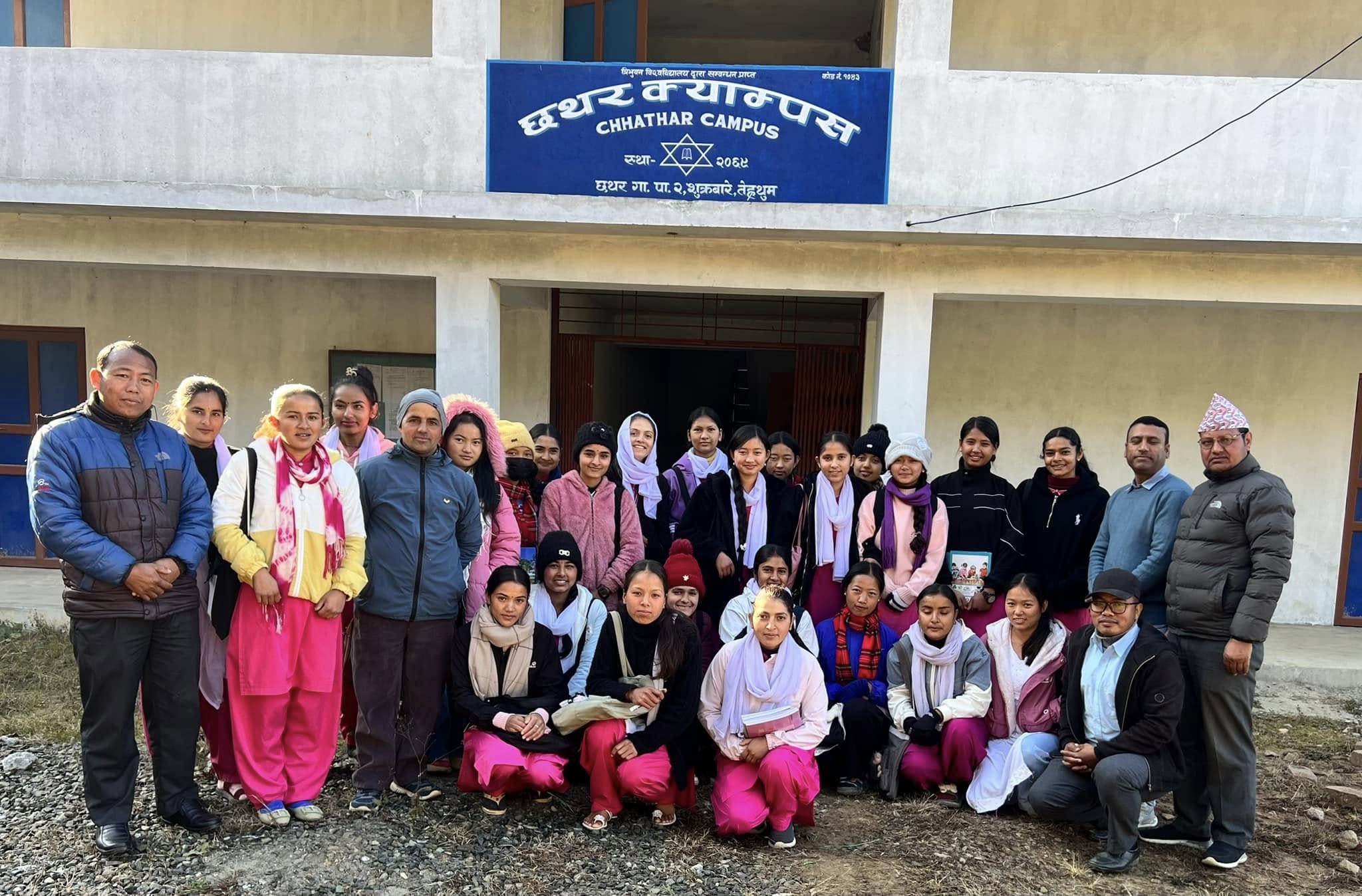
Bachelor of Education (B.Ed.) at Chhathar Campus, Panchakanya Pokhari Municipality, Terhathum, runs under Tribhuvan University (TU) and holds recognition from the University Grants Commission (UGC) of Nepal.
The program serves students preparing for school teaching and community learning roles. Specializations include Economics, English, and Nepali, offered within the same B.Ed. framework.
TU affiliation and UGC recognition
Community-campus fee policy and transparent processes
Experienced teachers and regular internal evaluation with feedback
Library access, basic sports, study tours, and observation programs
Morning classes available for employed learners
Teaching conducted in the campus’s own building and infrastructure
The B.Ed. follows TU Faculty of Education structure. Students study education foundations, curriculum studies, assessment, classroom management, ICT-in-education, and subject pedagogy. Subject content deepens through specialization streams:
Economics: micro/macro fundamentals, Nepal’s economy, statistics for education, public finance basics
English: language systems, literature studies, ELT methods, classroom language, materials development
Nepali: grammar and usage, literature genres, language teaching methods, classroom resources
School observation, micro-teaching, and a teaching practicum occur as guided by TU regulations. Continuous assessment supports TU final examinations.
Build subject depth and classroom pedagogy for secondary-level teaching.
Prepare lesson planning, assessment, and reflective practice skills.
Support inclusive, ethical teaching suited to local school contexts.
Encourage community engagement through educational outreach.
Graduates remain eligible for teaching roles in schools that offer the chosen subject. Community learning centres, bridge programs, and municipality-led education projects often seek facilitators. Further study in M.Ed. or relevant MA programs stays open under university rules.
Plan and deliver subject lessons that match national curricula.
Apply appropriate assessment tools and provide timely feedback.
Use classroom interaction strategies for mixed-ability groups.
Reflect on teaching and adjust methods for learner progress.
Lesson and unit planning, questioning techniques
Low-cost teaching aids and worksheet creation
Classroom assessment: written tests, projects, oral tasks
Data use for progress tracking at school level
Communication skills for learners and guardians
Faculty combine interactive lectures, guided discussion, problem sets, and model lessons. Students practise micro-teaching before practicum. Library tasks, presentations, and field exposure provide applied learning. Internal evaluation remains periodic and systematic.
10+2 or equivalent from NEB or a recognized board, as per TU Faculty of Education eligibility.
Selection and deadlines follow campus admission notices.
Interest in Economics, English, or Nepali helps in choosing the major stream.
Secondary-level teacher in the chosen subject (as per national rules)
Instructor in bridge or remedial language programs
Community education facilitator and resource developer
Entry roles in education projects and school improvement initiatives
Chhathar Campus operates as a community institution. Limited scholarships or fee concessions may be available under campus rules and relevant national provisions. Notices at the campus office provide current criteria and dates.
Students seeking a TU-recognized teacher education route find a clear pathway here. The campus offers steady feedback, supportive class timings for working learners, and field-based practice that links coursework to real classrooms.
B.Ed. at Chhathar Campus integrates specialization in Economics, English, or Nepali within a single program. TU standards, UGC recognition, and a community setting create a practical route to school teaching and local education service.