MBBS at Nepalese Army Institute of Health Sciences – College of Medicine (NAIHS-COM), Sanobharyang, Bhandarkhal, Kathmandu, is a five-and-a-half-year undergraduate medical program affiliated with the Institute of Medicine, Tribhuvan University. The course includes four and a half years of academic study followed by a one-year compulsory rotating internship.
The college gained approval from the Ministry of Defence on Bhadra 30, 2067 B.S. and started the MBBS program on 29 Mangsir 2068 B.S. with an annual intake of 100 students. Over fourteen batches have been admitted, and hundreds of graduates have already entered service in hospitals, community health programs, and the Nepal Army health services.
For you as a prospective student or parent, this means the MBBS program runs within an established academic and clinical environment under clear national regulations and professional recognition.
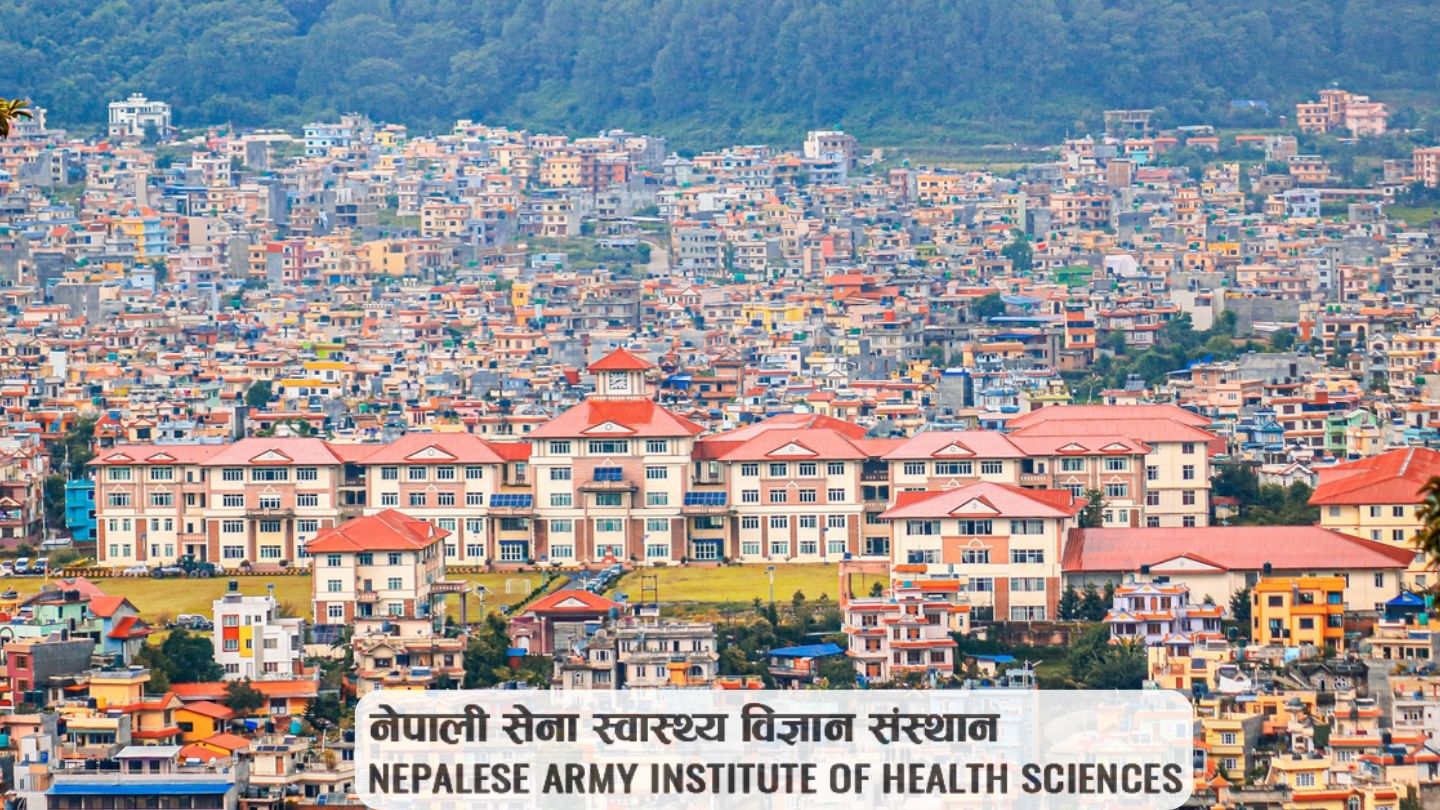
MBBS in Nepal under Tribhuvan University, Institute of Medicine affiliation
Duration: 5.5 years, including a one-year compulsory rotational internship
Annual intake: 100 MBBS seats (as per current allocation)
Teaching hospital: Shree Birendra Hospital, a 635-bed tertiary referral hospital of the Nepal Army in Chauni, Kathmandu
Not-for-profit institutional model with fixed quota system for different categories of students
Recognition: Medical Education Commission (MEC), Nepal Medical Council (NMC), and Nepal Health Professional Council (NHPC)
The MBBS curriculum at NAIHS-COM follows the structure of Tribhuvan University, Institute of Medicine. It gradually moves you from basic medical sciences to clinical practice and community-based learning over 5.5 years.
Students focus on understanding normal structure and function of the human body and basic disease mechanisms. Subjects usually include:
Anatomy
Physiology
Biochemistry
Introduction to Community Medicine and Public Health
Early clinical orientation through problem-based discussions and hospital visits
Laboratory sessions, museum-based learning, dissection hall practice, and small group tutorials help you link theory to observation and early clinical skills.
The middle phase introduces disease processes and early clinical reasoning. Key subjects include:
Pathology
Microbiology
Pharmacology
Forensic Medicine and Forensic practical sessions
Community Medicine with field-based family health exercises and applied epidemiology
Fourth year focuses on:
Ophthalmology (eye diseases) and practical sessions
Otorhinolaryngology (ENT) and practicals
Orthopaedics and related clinical postings
Additional community medicine fieldwork
These years help you connect pathology, microbiology and pharmacology to the way patients present in clinics and hospitals.
Fifth year is largely clinical and focuses on major disciplines:
Internal Medicine
General Surgery
Paediatrics
Obstetrics and Gynaecology, including related practical postings
After passing final examinations, students complete a one-year compulsory rotating internship in different departments of Shree Birendra Hospital and associated centers.
The internship year allows you to assume supervised responsibility in patient care, emergency management, ward work, operation theatres, and community outreach clinics.
The MBBS course at NAIHS-COM seeks to prepare graduates who can:
Understand common health problems in Nepal and manage them safely at primary and secondary care levels.
Apply scientific knowledge of basic, para-clinical, and clinical sciences to patient care.
Provide preventive, promotive, curative, and rehabilitative health services, including in rural and resource-limited settings.
Communicate clearly with patients, families, health teams, and the wider community.
Follow professional ethics, respect patient rights, and maintain confidentiality and accountability.
Engage in continuous learning, audit, and research to improve practice.
These objectives match the expectations of the Medical Education Commission and Nepal Medical Council for MBBS graduates.
An MBBS degree from NAIHS-COM, once registered with Nepal Medical Council, allows graduates to:
Work as medical officers in government hospitals, Nepal Army health services, local level health institutions, and private hospitals.
Serve in primary health care centers, district hospitals, emergency units, and community health projects.
Participate in public health programs, including immunization, maternal and child health, epidemiological surveillance, and disaster response.
Pursue MD/MS and other postgraduate training in Nepal or abroad, subject to regulations of respective councils and universities.
For many students from Nepal and abroad, this course offers a clear pathway from undergraduate medical education to specialist training and long-term clinical practice.
By the end of the MBBS program, students are expected to:
Take a systematic history, perform complete physical examinations, and make initial clinical judgments.
Formulate differential diagnoses and plan appropriate investigations, using evidence and national guidelines where available.
Manage common medical, surgical, paediatric, obstetric, psychiatric, and emergency conditions within the limits of a new medical graduate.
Recognize conditions that require referral and communicate this effectively to patients and senior staff.
Apply basic principles of community medicine, epidemiology, and biostatistics when assessing health problems in populations.
Demonstrate professionalism, respect for diversity, and responsible behavior in clinical and community settings.
These outcomes reflect typical expectations for MBBS graduates under Tribhuvan University and MEC frameworks.
NAIHS-COM places strong focus on practical skills and early exposure to real clinical environments:
Skills laboratories for basic procedures such as injections, IV line insertion, catheterization, suturing, and resuscitation.
Dissection hall, histology labs, and museum rooms to support anatomy and pathology learning.
Community field exercises in family health, applied epidemiology, and primary care clinics.
Clinical postings in medicine, surgery, orthopaedics, ENT, ophthalmology, paediatrics, obstetrics and gynaecology, psychiatry, and other specialties at Shree Birendra Hospital.
Exposure to laboratory medicine and diagnostics, including handling of specimens in appropriate biosafety conditions.
For you as a learner, these structured activities reduce the gap between classroom theory and bedside practice.
Teaching and learning in MBBS at NAIHS-COM usually combines:
Classroom lectures for core concepts.
Small group tutorials and case-based discussions encouraging active participation.
Practical classes and demonstrations in laboratories and museums.
Bedside teaching in wards and outpatient departments at Shree Birendra Hospital.
Seminars, journal clubs, and clinical presentations led by faculty and senior residents.
Community postings and field visits that help students understand health problems outside hospital walls.
Continuous internal assessments, periodic tests, and university examinations monitor progress through each phase of the course.
Admission to MBBS at NAIHS-COM follows the national framework set by the Medical Education Commission (MEC):
Completion of 10+2 Science or equivalent (Physics, Chemistry, Biology, and English) from a recognized board.
Minimum 50% aggregate marks or CGPA 2.4 or above in the relevant subjects as per MEC undergraduate examination guidelines.
Appearance and qualifying score in the MEC MBBS entrance examination (MECEE-BL).
Participation in MEC counseling and seat allocation, including quotas applicable for NAIHS (such as Nepali Army category and open/general categories), as per current MEC notices.
Candidates should check the latest MEC and NAIHS admission notices for detailed seat categories, documentation requirements, deadlines, and any changes in regulations.
Graduates of MBBS at NAIHS-COM may:
Work as medical officers in Nepal Army health units, military hospitals, and peacekeeping missions (subject to recruitment rules).
Serve in government hospitals, primary health care centers, and local level health institutions.
Join private hospitals, clinics, and NGOs involved in health service delivery.
Enter postgraduate training (MD/MS and other programs) in Nepal or abroad, based on entrance examinations and eligibility rules.
Students interested in academic medicine and research can later move into teaching positions in medical colleges or research institutions after appropriate postgraduate training.
NAIHS functions as a not-for-profit institution under the welfare structure of the Nepali Army. The college follows a fixed quota system that distributes MBBS seats across categories such as Nepali Army personnel and dependents and the general public under MEC rules.
Key points for you to keep in mind:
Total MBBS seats: 100 per academic year at NAIHS-COM.
Current total fee reported for MBBS: around NPR 4,168,090 for the full course (subject to revision by the Medical Education Commission).
Needs-based or merit-based concessions may apply within specific quotas, according to welfare and government policies.
For exact fee structure, installment plans, and scholarship rules for a given year, students should refer to the latest notices from MEC and the NAIHS administration office.
Students and parents often consider NAIHS-COM for MBBS because:
The program runs under Tribhuvan University, Institute of Medicine, with recognition from MEC, NMC, and NHPC.
The college has a steady track record, with fourteen MBBS batches admitted and seven batches already graduated.
Shree Birendra Hospital, a large tertiary teaching hospital with 635 beds, offers broad clinical exposure across disciplines and patient groups.
The not-for-profit model and quota system aim to keep medical education accessible to different categories of students.
The institute invests in research, community service, and collaborations with national and international organizations, which adds academic depth and wider perspectives.
For a student who wants structured MBBS training in Nepal under a disciplined environment linked to the Nepali Army health system, NAIHS-COM offers a clear and regulated pathway.
MBBS at Nepalese Army Institute of Health Sciences – College of Medicine is a structured undergraduate medical course that combines classroom learning, laboratory work, community exposure, and hospital-based training over 5.5 years. The program operates under recognized national authorities and uses a large army teaching hospital as its main clinical platform.
The MBBS program runs for 5.5 years, including four and a half years of academic study and a one-year compulsory rotating internship.
NAIHS-COM has 100 MBBS seats per academic year as per the current allocation.
The total fee reported for the MBBS program is around NPR 4,168,090 for the full course, but students should verify the latest figure from MEC and NAIHS notices, as national regulations may change.
The MBBS program is affiliated with Tribhuvan University, Institute of Medicine, and recognized by the Medical Education Commission, Nepal Medical Council, and Nepal Health Professional Council.
Clinical training mainly takes place at Shree Birendra Hospital, a 635-bed tertiary hospital of the Nepal Army located in Chauni, Kathmandu. Students also participate in community field postings and outreach activities.
Students must meet MEC academic eligibility criteria, pass the national MBBS entrance examination (MECEE-BL), and then obtain a seat through MEC counseling and allocation, including the relevant NAIHS quotas.
Graduates can work as medical officers in government hospitals, Nepal Army medical services, private hospitals, and public health projects. They may also pursue MD/MS or other postgraduate training in Nepal or abroad, depending on entrance examinations and regulatory requirements.