



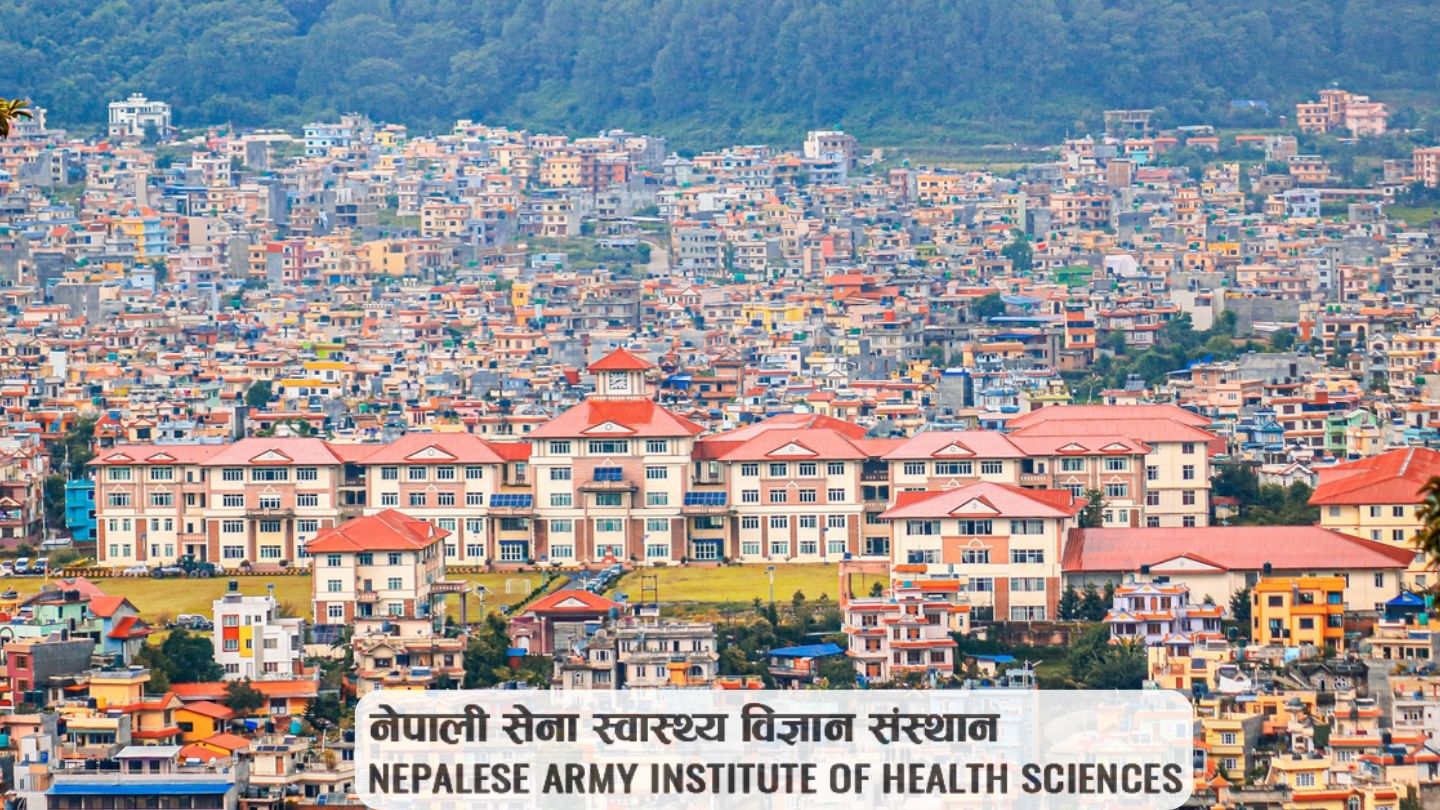
Bachelor of Public Health (BPH) at Nepalese Army Institute of Health Sciences – College of Medicine (NAIHS-COM), Sanobharyang, Bhandarkhal, Kathmandu, is a four-year undergraduate programme under the Institute of Medicine, Tribhuvan University.
The college started BPH on 20th Mangsir 2078 B.S. and admits 20 students in each academic year. So far, four batches have been admitted, with 92 students enrolled in total. The programme runs within the not-for-profit framework of NAIHS and uses Shree Birendra Hospital and community field sites as major learning platforms.
If you are interested in health systems, communities, and prevention rather than individual clinical practice alone, this course gives a structured path into public health work in Nepal and beyond.
Four-year Bachelor of Public Health under Tribhuvan University, Institute of Medicine
Start date at NAIHS-COM: 20th Mangsir 2078 B.S.
Intake: 20 seats per year; four batches and 92 students admitted so far
Recognized within national frameworks that list public health at bachelor level under Nepal Health Professional Council and regulated through the Medical Education Commission (MEC) entrance system
Department of Public Health located inside NAIHS premises, with dedicated classrooms, public health laboratory, faculty room, and access to journals and online databases
Regular field visits, community diagnosis camps, municipal health system practicums, and health awareness events conducted by BPH students
The BPH curriculum follows the framework of the Institute of Medicine and national public health standards. Four academic years cover basic health sciences, core public health disciplines, management, and practicum.
In the first year, students study basic health sciences in relation to public health, including anatomy, physiology, pathology, biochemistry, pharmacology, and toxicology. This foundation helps you understand how diseases develop and how drugs, vaccines, and other interventions work at population level.
Second year usually moves deeper into epidemiology, biostatistics, environmental health, and family health. Courses link data analysis, water and sanitation, nutrition, and maternal and child health. Practical exercises help you apply concepts to real public health problems.
Third year often focuses on health education, behavioural sciences, reproductive health, communicable and non-communicable diseases, and health program planning. Students start to take more responsibility for small projects and group assignments.
Fourth year includes health management, health economics, international health, and a large public health practicum. The practicum usually involves several months of field posting, where you and your classmates work with municipalities, health offices, or NGOs to assess local health issues and prepare practical recommendations.
The BPH programme at NAIHS-COM and IOM aims to:
Prepare competent public health graduates who can respond to priority health needs of Nepal.
Build understanding of behavioural, socio-cultural, economic, and environmental factors that shape health.
Develop skills to plan, manage, monitor, and evaluate health programmes at community and municipal level.
Strengthen ability to work in multidisciplinary teams across government, NGOs, and international agencies.
For you as a learner, these objectives mean constant balance between theory, field exposure, and management practice.
BPH graduates from NAIHS-COM enter a wide range of roles in Nepal’s health system and development sector. Bachelor-level public health is formally recognized by NHPC as one of the professional programmes in its list of health education pathways.
You may work in:
Municipal health sections and local health offices
Provincial health directorates and federal health programmes
Government hospitals and primary health care centres in health promotion and management roles
National and international NGOs working in nutrition, WASH, maternal and child health, HIV, NCDs, or emergencies
Research institutions and survey projects focusing on population health
Further study at master’s level (MPH or related degrees) opens routes into policy, advanced research, and senior management positions.
By the end of the BPH programme, students are expected to:
Explain links between basic health sciences and public health practice.
Analyse health problems using epidemiology and biostatistics.
Plan, implement, and review community-based health interventions.
Conduct community diagnosis and prepare concise reports for decision-makers.
Communicate clearly with communities, health workers, and managers.
Apply ethics, equity, and human rights perspectives in public health work.
These outcomes help you move confidently into field postings, entry-level jobs, or postgraduate study.
The Department of Public Health at NAIHS describes a strong focus on technical and managerial competencies through “dynamic” teaching approaches.
Key skill areas include:
Public health assessment: community diagnosis, household surveys, focus group discussions
Data skills: epidemiological methods, basic statistical software, report preparation
Environmental and occupational health skills: visits to water treatment plants, waste management sites, and environmental monitoring units
Programme skills: planning, budgeting basics, supervision, and monitoring tools
Advocacy and communication: school health programmes, mental health awareness events, breastfeeding week activities, and environment day campaigns
These activities aim to connect your classroom learning with real communities and institutions.
Teaching in BPH at NAIHS-COM combines lectures, practical sessions, and intensive fieldwork. The department notes that faculty members and administrative staff actively support teaching and learning across different public health subjects and contribute to interdepartmental teaching for research and methods.
You can expect:
Interactive lectures with case examples
Group work and presentations
Field visits to health facilities, water treatment plants, waste management sites, and municipalities
Regular assignments, quizzes, and presentations
Supervised community diagnosis and practicum projects
Continuous internal assessment and university examinations under Tribhuvan University maintain academic standards.
Admission follows the national rules set by the Medical Education Commission for bachelor-level public health programmes.
Typical eligibility includes:
Completion of 10+2 Science (Biology group) or equivalent, with Physics, Chemistry, and Biology, securing at least 50% aggregate or CGPA 2.4.
Alternatively, completion of a Proficiency Certificate or Diploma in a health science discipline (such as General Medicine, Nursing, Medical Lab Technology, Pharmacy, Radiography, etc.) with required marks and registration in the concerned council, as per NHPC minimum requirement for BPH.
Passing the Bachelor Level Common Entrance Examination (MECEE-BL) for BPH or related cluster and obtaining a place in the merit list.
NAIHS-COM then admits students against the 20 BPH seats allocated for the academic year, following MEC seat allocation and institutional quotas.
After graduation, BPH students from NAIHS-COM can work as:
Public health officers or coordinators in municipal or district health offices
Programme staff in government or NGO projects on immunization, nutrition, NCD control, TB, HIV, or reproductive health
Monitoring and evaluation officers for health and development programmes
Health educators, trainers, or school health coordinators
Research assistants in surveys, operational research, and implementation research
Many graduates later join MPH or specialized master’s degrees in areas such as epidemiology, health promotion, health economics, or global health, based on their interests and opportunities.
For the academic year 2082/83, NAIHS received 20 BPH seats as part of its bachelor-level allocation. The institutional fee shared for BPH at NAIHS-COM is around NPR 777,000 for the full course, subject to revision by national regulators.
Students may access:
National scholarships and reserved seats under the Medical Education Commission framework
Support mechanisms linked to the welfare structure of the Nepalese Army and NAIHS’s not-for-profit policy
Anyone planning to apply should check the latest MEC and NAIHS notices for updated fee details, scholarship quotas, and documentation requirements.
Several features make this course attractive for students who want to work in public health:
Affiliation with Tribhuvan University, Institute of Medicine, and recognition under national councils and MEC frameworks.
A dedicated Department of Public Health with its own classrooms, public health lab, and access to online databases and journals.
Strong field-learning tradition, including community diagnosis, municipal health system practicums, and visits to water, waste, and health facilities.
Campus setting that brings you into contact with MBBS, nursing, and other health science students, helping you understand teamwork in real health systems.
If your goal is to work on health problems at community and system level, BPH at NAIHS-COM offers a structured and practice-oriented route.
Bachelor of Public Health at Nepalese Army Institute of Health Sciences – College of Medicine is a four-year programme that links public health theory, basic science, management, and hands-on fieldwork. The course runs within a disciplined academic environment, under national regulatory bodies, and prepares graduates for roles in government, NGOs, and research.
This text serves only as informational content for students, parents, educators, and planners. It does not replace professional medical, legal, or financial advice. You should always consult official NAIHS and MEC notices before taking admission decisions.
The BPH programme runs for four academic years under the Institute of Medicine, Tribhuvan University, following the national BPH curriculum.
NAIHS-COM has 20 BPH seats per academic year. Four batches have been admitted so far, with 92 students in total.
The programme runs under Tribhuvan University, Institute of Medicine, and falls within the recognition list of bachelor-level public health programmes under Nepal Health Professional Council, along with oversight from the Medical Education Commission.
You need to pass the Bachelor Level Common Entrance Examination (MECEE-BL) managed by the Medical Education Commission for BPH and other health science programmes, and then gain a seat through the official merit list and counseling.
Applicants generally need 10+2 Science (Biology group) or equivalent with at least 50% aggregate or CGPA 2.4 in Physics, Chemistry, and Biology, or a relevant health science certificate or diploma with required marks and council registration, as outlined in NHPC and MEC guidelines.
Graduates can join municipal health offices, government programmes, NGOs, hospitals, and research projects in roles such as public health officer, programme coordinator, health educator, or monitoring and evaluation staff, and can later continue to MPH or related master’s degrees.



.png)





