



The Immortal Stars of Nepal’s History and Martyrs’ (Sahid Diwas) Day
In Nepal’s historical memory, Magh 16 is presented as more than a calendar date. It is described as a day marked by bloodshed in the struggle for freedom in modern Nepal.
A “martyr” is described as a person who sacrifices their life to protect their country, culture, and existence. In Nepal’s context, martyrs are presented as those who gave their lives to keep the idea of freedom alive during the era of Rana rule described as lasting 104 years.
The article argues that words like freedom and democracy feel easy to say today, but around B.S. 1997, speaking them could lead to severe punishment.
It states that under Rana rule, people had no rights to speak, write, or organize, and that education was limited to a small elite group.
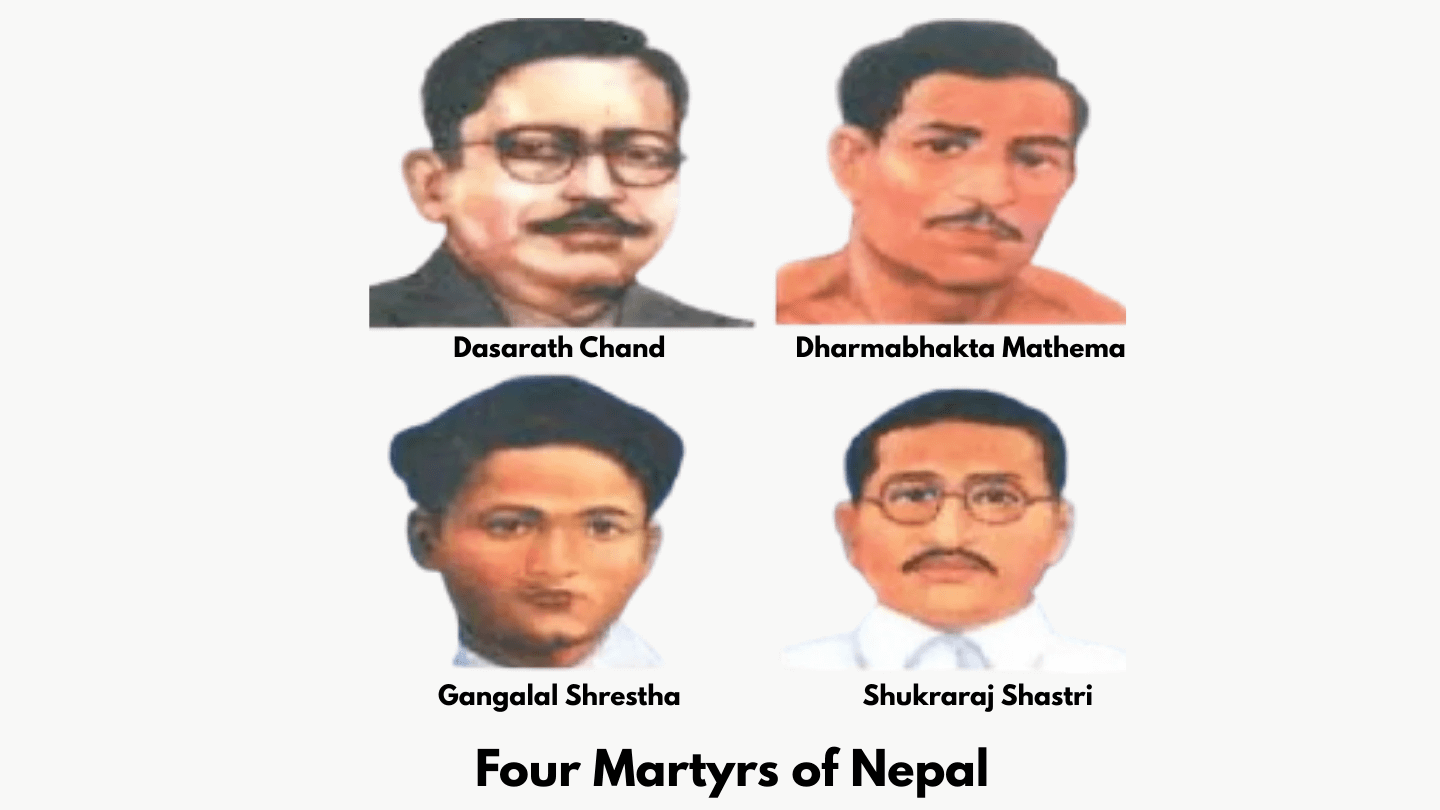
In that context, the article highlights four figures—Shukraraj Shastri, Dharmabhakta Mathema, Gangalal Shrestha, and Dasharath Chand—whose deaths are presented as part of the broader push to end Rana rule and establish civic supremacy.
It also states that the purpose of this article is to help younger readers understand the history behind Martyrs’ Day rather than viewing it only as a public holiday. The article presents itself as based on facts, dates, and historical documents.
The origin of Martyrs’ Day (Sahid Diwas) and the role of Nepal Praja Parishad
When discussing Martyrs’ Day (Sahid Diwas), the article emphasizes Nepal Praja Parishad, described as Nepal’s first political party, established on B.S. 1993 Jestha 20.
It states that the organization was formed as an underground group at Dharmabhakta Mathema’s house in Ombahal, Kathmandu, by the following individuals:
-
Tankaprasad Acharya
-
Dasharath Chand
-
Ramhari Sharma
-
Jeevaraj Sharma
-
Dharmabhakta Mathema
The historical problem and the attempted response
The article identifies the core problem as the absolutism of Rana rule and argues that open movements were not possible.
It describes a strategy of distributing pamphlets and secretly circulating anti-Rana writing. It states that anti-Rana articles were printed in a publication named Janata in Patna, India, brought to Kathmandu, and distributed covertly.
Betrayal and arrests
The article states that in Kartik, B.S. 1997, members of the organization scattered pamphlets widely across locations in the Kathmandu Valley.
It further states that after Ramji Joshi (and other informants) revealed information from within the organization, the then Rana Prime Minister Juddha Shumsher ordered a broad crackdown. The article presents this as the point from which the four martyrs’ final journey began.
Four martyrs: biographies and final moments
The article presents the following biographies and events.
1. Shukraraj Shastri (Lifespan: B.S. 1950 to 1997 Magh 10)
Personality: He is described as a distinguished scholar, educationist, and reformer. The article states that his association with leaders of the Arya Samaj in Dehradun influenced his revolutionary outlook.
Key contribution: The article states that in B.S. 1994, at Indrachowk in Kathmandu, he gave a public speech against Rana rule while explaining the essence of the Gita and speaking about civic rights. It presents his argument as: government exists to serve the people, not to be their master.
Martyrdom: The article states that on the night of B.S. 1997 Magh 10, he was executed by hanging at Kharibot in Teku Pachali, Kathmandu. It states he was told to ask for forgiveness, but refused and accepted death while affirming that he would not abandon democracy and dharma. It also states that a pamphlet was attached to his body claiming that this was the punishment given to a traitor.
2. Dharmabhakta Mathema (Lifespan: B.S. 1966 to 1997 Magh 13)
Personality: He is described as King Tribhuvan’s gym instructor. The article presents him as a bridge between the palace and Nepal Praja Parishad and describes his resolve as strong.
Relationship with the King: The article states that Dharmabhakta informed King Tribhuvan about the organization’s activities and helped convey the King’s secret support to the revolutionaries, and that this became a major concern for the Rana authorities.
Martyrdom: The article states that on B.S. 1997 Magh 13, he was executed by hanging on a bakaino tree on the uphill path at Sifal. It also states that the execution took place in front of his father.
3. Gangalal Shrestha (Lifespan: B.S. 1975 to 1997 Magh 15)
Personality: He is described as the youngest among the four martyrs, an energetic speaker, and a student of Tri-Chandra College.
Key contribution: The article states that his speech at Indrachowk inspired youth. It states he was initially arrested and released, then arrested again after being identified as an active member of the organization.
Martyrdom: The article states that on B.S. 1997 Magh 15, he was executed by being shot at Shobha Bhagwati on the bank of the Bishnumati River, along with Dasharath Chand. It also states that he sent a message to his wife before the execution asking her not to cry because he was dying for the country.
4. Dasharath Chand (Lifespan: B.S. 1960 to 1997 Magh 15)
Personality: He is described as born in Baitadi and, despite belonging to a Thakuri lineage, rebelling against Rana luxury and injustice. The article states he was influenced by Mahatma Gandhi’s method of nonviolent resistance, while also believing that an armed revolution was necessary in Nepal.
Revolutionary role: The article presents him as one of the key planners and among those involved in naming Nepal Praja Parishad. It also states he was known as Maila Ba.
Martyrdom: The article states that on the night of Magh 15, he and Gangalal were shot together at Shobha Bhagwati. It also records a legend that he continued chanting opposition slogans against Rana rule until he was hit by bullets.
The “first martyr”: Lakhan Thapa Magar
The article argues that discussing the four martyrs of B.S. 1997 without mentioning Lakhan Thapa Magar would be unfair to history.
It states that Lakhan Thapa Magar attained martyrdom long before the B.S. 1997 events.
Revolt
The article states that after Jung Bahadur Rana took power through the Kot Massacre in B.S. 1903, Lakhan Thapa Magar of Gorkha led a people’s revolt against Jung Bahadur around B.S. 1933.
It states that he organized people by arguing that Jung Bahadur had sold Nepal to the British, described using the term mlechchha.
Martyrdom
The article states that in B.S. 1933 (A.D. 1877), he was executed by hanging on a khirra tree near the Manakamana Temple in Gorkha.
Fact check
It further states that on B.S. 2072 Asoj 3, through a Cabinet decision after the Constitution was issued, the Government of Nepal formally granted him the status of Nepal’s first martyr.
Martyrs’ Week and the present context
The article states that Nepal observes Martyrs’ Week each year from Magh 10 to Magh 16.
-
Magh 10: Shukraraj Shastri remembrance programs at Teku Pachali
-
Magh 13: Dharmabhakta Mathema remembrance programs at Sifal
-
Magh 15: Gangalal Shrestha and Dasharath Chand remembrance programs at Shobha Bhagwati
-
Magh 16: Main Martyrs’ Day ceremony at Martyrs’ Gate in Kathmandu and the Martyrs’ Memorial at Lainchaur
It states that the Prime Minister, ministers, and senior officials traditionally offer garlands at the Martyrs’ Memorial. It then raises the question of whether garlanding alone is sufficient.
Problem and proposed approach
The article describes a growing disconnect among youth and argues that Martyrs’ Day is increasingly treated only as a holiday.
Problem: The article argues that martyrs’ contributions are often limited to curriculum content and ritual speeches.
Proposed approach: The article argues that martyrs should be presented as real people rather than supernatural figures. It suggests that Dharmabhakta Mathema’s identity as a body builder could connect with sports-oriented youth, and that Gangalal Shrestha’s young age could connect with college students.
It also argues that sacrifice should be linked to civic duty, and that the martyrs’ dream was a civilized and egalitarian society, with responsibility now placed on the current generation.
Literary and cultural influence
The article states that martyrs have had a deep influence on Nepal’s literature and art.
It highlights senior poet Bhupi Sherchan’s poem In Memory of the Martyrs as a strong expression of the meaning of Martyrs’ Day, presenting the central idea that national building requires sacrifice.
It also cites another satirical line attributed to Bhupi Sherchan that contrasts the difficulty of living with the ease of becoming a martyr, framing it as a tension between honor after death and the struggles of those who remain alive.
The article argues that such works have helped keep the memory of martyrs present in public life.
Conclusion
The article concludes that the meaning of Martyrs’ Day is fulfilled only when people attempt to follow the path the martyrs showed.
It states that Rana rule ended, the Panchayat system ended, and the monarchy ended, and that Nepal is now a federal democratic republic. It then asks whether the country matches the Nepal the martyrs envisioned.
It presents corruption, misgovernance, and political instability as concerns and frames them as potential disrespect toward the martyrs’ sacrifice.
Finally, the article argues that a true Martyrs’ Day is when citizens set aside narrow self-interest and think in the national interest. It further argues that instead of leaving the country through migration, youth should confront internal problems and bring change within Nepal, presenting this as a true tribute to Shukraraj Shastri, Dharmabhakta Mathema, Gangalal Shrestha, and Dasharath Chand.
It ends with salutation to Nepal’s immortal sons and a closing expression of national respect.

.png)

Comments 0
No comments yet. Be the first to start the conversation.