The Civil Service Hospital, also known as Nijamati Karmachari Hospital in Nepali (निजामति कर्मचारी अस्पताल), stands as a significant healthcare institution in Kathmandu, Nepal. Established with the support of the People's Republic of China, this hospital began its journey towards providing top-notch medical care on November 14, 2008. A landmark in the healthcare sector of Nepal, the hospital is dedicated primarily to serving the employees of the Nepal Government, filling a crucial gap in the healthcare system.
Efficient and Transparent Administration: Establishing a self-sustainable and innovative hospital administration system.
Specialized Medical Staff: Recruiting, training, and retaining a team of dedicated, knowledgeable, and highly skilled specialist doctors in all medical and surgical specialties.
Supportive Staff Excellence: Ensuring the recruitment and retention of competent nursing, paramedical, and other supportive staff, mirroring the expectations set for specialist doctors.
Patient Turnover and Community Service: Opening CSH to the general public increases patient turnover, which in turn enhances the experience and skills of medical staff, boosts hospital income, and solidifies CSH's image as a socially responsible institution.
Academic and Professional Development: Providing regular opportunities for research, continuous medical education, and training. Establishing partnerships with leading national and international healthcare institutions to exchange clinical and other experts. Aiming to develop CSH into a post-graduate training institution.
Staff Personal Development: Engaging hospital staff in programs and activities for personal development, ensuring they are healthy, happy, and responsible in their duties.
Incentives for Staff: Offering sufficient financial, job-related, and personal incentives, especially to specialist doctors.
Not-for-Profit Status: Maintaining the hospital as a not-for-profit institution.
Subsidy Campaign for Civil Service Employees: Advocating for the continuation of maximum possible subsidies for hospital services utilized by civil service employees.
Utilization of Extra Income: Using income generated from services to the general public to subsidize healthcare service charges, increase staff incentives, and establish a social welfare fund for financially needy patients.
Advanced Medical Equipment: Installing the best and most advanced medical equipment available.
Comprehensive Medical Services: Making all existing medical and surgical services available promptly to prevent and discourage patients from seeking such services abroad.
Discount Facility for Civil Servants: Offering a discount on healthcare services for civil servants and their families (up to six members, including parents, spouses, and two children under 21 years). Gazetted officers receive a 40% discount, while non-gazetted and retired personnel receive a 50% discount. The discount card, available for Rs 10/card, requires an attested photo and the personnel code (Shanket) number recorded in Nijamati Kitabkhana.
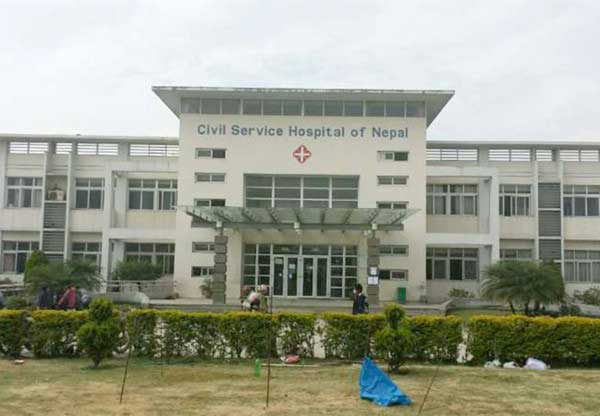
Start Date and Official Inauguration: The hospital's outpatient services commenced on March 29, 2009, marking the beginning of its commitment to accessible healthcare. Prime Minister Madhav Kumar Nepal officially inaugurated the facility on May 30, 2009, further solidifying its role in the public health domain.
Facility and Capacity: With 132 beds, the Civil Service Hospital is designed to accommodate many patients and ensure adequate care and attention.
Advanced Medical Equipment: The hospital boasts advanced medical equipment and offers comprehensive surgical services, ensuring patients can access modern healthcare solutions.
Not-for-Profit Orientation: Maintaining its status as a service-oriented institution, it operates on a not-for-profit basis, prioritizing patient care over profit.
Background and Strategic Development
Rationale for Establishment: The Civil Service Hospital was established because, unlike the facilities available for Nepal Army and Police personnel, a dedicated healthcare facility for civil service employees is lacking in Nepal.
Collaboration with PRC: The Government of Nepal approached the People's Republic of China for assistance in establishing this hospital, and an agreement was reached that laid the foundation for the Civil Service Hospital.
Location and Administration: The hospital, located in Minbhawan, Kathmandu, operates autonomously under the Ministry of General Administration. A seven-member hospital board governs and is responsible for setting policies and programs.
Leadership and Management: The Executive Director, who is also a member of the Hospital Board, manages the day-to-day operations and ensures efficient and responsive administration.
Hospital for Nepal Government Employees: Primarily serving the Nepal Government's employees, the hospital symbolizes the state's commitment to its workforce.
Range of Services: Since its inception, the hospital has expanded its services to include outpatient services, emergency care, inpatient facilities, and surgical operations. It provides comprehensive medical care.
Sustainable Operations: The hospital's self-sustained and creative system ensures long-term viability and continuous improvement in service delivery.
The Civil Service Hospital (SCH) is embarking on an ambitious master plan to expand its facilities and services. The plan includes the development of a multi-story super-specialty building, a Radiotherapy and nuclear Medicine block, a separate building for Emergency and faculty rooms, a Library, Telemedicine, Teaching and Research Rooms, and a Conference Hall. This initiative reflects SCH's commitment to providing state-of-the-art healthcare services and facilities.
1st Floor: Intensive Care Unit (ICU)
2nd Floor: Surgical Gastrointestinal (GI)
3rd Floor: Gastroenterology
4th Floor: Urology and Kidney Transplant
5th Floor: Nephrology and Dialysis
6th Floor: Cardiovascular Surgery and Heart Transplant
7th Floor: Cardiology
8th Floor: Neurosurgery
9th Floor: Neurology and Plastic/Reconstructive Surgery
10th Floor: Dermatology
11th Floor: Orthopedics
12th Floor: Ear, Nose, and Throat (ENT)
13th Floor: Ophthalmology
14th Floor: Thoracic/Respiratory Medicine
15th Floor: Oncosurgery, Medical Hematology & Oncology, Transplants
16th Floor: Rheumatology and Endocrinology
17th Floor: Fertility Surgery and Medicine
Radiotherapy & Nuclear Medicine Block: Dedicated block for specialized treatments.
Multistorey Building for Emergency & Faculty Rooms: This building includes facilities for emergency services, faculty accommodations, a comprehensive library, telemedicine services, teaching and research rooms, and a conference hall.
Registration Process: Utilizes an e-number system with time allocation, screening, and registration using stickers only.
Flow of OPD: From vitals room to respective department rooms with double carbon-included sheets for record-keeping.
Investigation Process: Two types of investigation forms – one for body fluids and another for other investigations.
Reporting System: All reports must be computer-printed, ensuring accuracy and clarity.
Prescription and Referral Process: Computer-generated prescriptions and referral colored stickers indicating the date and referring doctor’s signature.
Admission and Discharge Procedures: Admission re-registration is marked with an “A” added to the OPD registration number, followed by a printed admission form and notes sheet. Discharge procedures include a computer-printed copy for record and billing purposes.
Follow-up Scheduling: Organized OPD schedule for follow-ups.
Regular Hours (9 AM to 4 PM): Screening and doctor consultations by rotation.
Off-Hours Operations: Each doctor's room operates with a ceiling amount. The minimum duty is 3 hours (4 PM to 7 PM), and the maximum is 9 hours (4 PM to 10 PM and 6 AM to 9 AM). The registration system remains similar to regular hours, with differences in pricing and doctor choices.
Department of Medicine
Internal Medicine Unit
Cardiology Unit
Gastroenterology Unit
Neurology Unit
Clinical Hematology Unit
Radiation Oncology Unit
Dermatology Unit
Psychiatry Unit
Medical Oncology Unit
Department of Anesthesiology
Department of Family Medicine and Emergency
Department of Surgery
Department of Obs/Gynecology
Department of Orthopedics
Department of Radiology Diagnosis & Imaging
Department of Pathology
Department of Dentistry
Department of Pediatrics
Department of Nursing
Pharmacy Unit
Physiotherapy Unit
Department of Administration & Finance
The Civil Service Hospital in Nepal is not just a medical facility; it represents a significant stride in the healthcare landscape of Nepal. With its patient-centric approach, state-of-the-art facilities, and commitment to non-profit operations, the hospital sets a benchmark for regional healthcare institutions. Its ongoing collaboration with the People's Republic of China and the Nepal Government's support highlights the importance of international cooperation in advancing public health services. The future of the Civil Service Hospital looks promising as it continues to evolve and adapt to the changing healthcare needs of its community.


.jpg)