Dhangadhi Sub-Metropolitan City (Upa Mahanagarpalika) is a local government in Kailali District of Sudurpashchim Province, Nepal. Dhangadhi, which also serves as the administrative headquarters of Kailali District, is a major urban center for government administration, commerce, education, and healthcare in Sudurpashchim Province.
Dhangadhi hosts several offices of the Sudurpashchim Provincial Government, including provincial ministries and the Provincial Assembly. However, the Provincial Assembly has designated the Godawari area of Kailali District as the permanent provincial capital. As the necessary infrastructure has not yet become operational at the designated location, the provincial government continues to conduct its administrative activities from Dhangadhi.
Dhangadhi's history of local administration dates back to 2033 BS, when it was established as a municipality. The Government of Nepal upgraded it to a sub-metropolitan city on Ashoj 1, 2072 BS. The local government currently comprises 19 wards and covers an area of 261.75 square kilometers.
According to the National Population and Housing Census 2021 (2078 BS), Dhangadhi Sub-Metropolitan City has a total population of 198,792, comprising 98,184 males and 100,608 females. The census recorded 44,779 households.
Official Nepali Name: धनगढी उपमहानगरपालिका
English Name: Dhangadhi Sub-Metropolitan City
Office: Office of the Municipal Executive
Local Government Type: Sub-Metropolitan City
Province: Sudurpashchim Province
District: Kailali
Administrative Headquarters: Dhangadhi, Kailali
Established as a Municipality: 2033 BS
Upgraded to Sub-Metropolitan City: Ashoj 1, 2072 BS
Total Wards: 19
Total Area: 261.75 square kilometers
Population (2021 Census): 198,792
Male Population: 98,184
Female Population: 100,608
Total Households: 44,779
Population Density: 759 persons per square kilometer
Literacy Rate: 83.28%
Official Website: https://www.dhangadhimun.gov.np/
Source: Official Local-Level Profile of Dhangadhi Sub-Metropolitan City and the National Statistics Office's Nepal Statistical Year Book 2023, Table 1.7.
Dhangadhi's administrative development can be understood through three main stages: its establishment as a municipality, its subsequent upgrade to a sub-metropolitan city, and its operation as a local government under Nepal's federal system.
According to the official institutional profile of Dhangadhi Sub-Metropolitan City, Dhangadhi Municipality was established in 2033 BS.
Following its establishment, Dhangadhi began performing administrative functions as a local body under the governance system existing at that time.
The Government of Nepal upgraded Dhangadhi Municipality to a sub-metropolitan city on Ashoj 1, 2072 BS.
Since then, Dhangadhi has operated its local administration and public services with the status of a sub-metropolitan city.
Following the promulgation of the Constitution of Nepal in 2072 BS, local levels were granted constitutional status and authority as governments.
Under the federal structure, Dhangadhi Sub-Metropolitan City operates through its Municipal Assembly, Municipal Executive, Judicial Committee, and Ward Committees.
The Local Government Operation Act, 2074 BS (2017), provides the legal basis for municipal powers, functions, duties, administrative arrangements, and public service delivery.
Dhangadhi Sub-Metropolitan City is located in the southern Terai region of Kailali District. Its geographical landscape consists mainly of flat terrain.
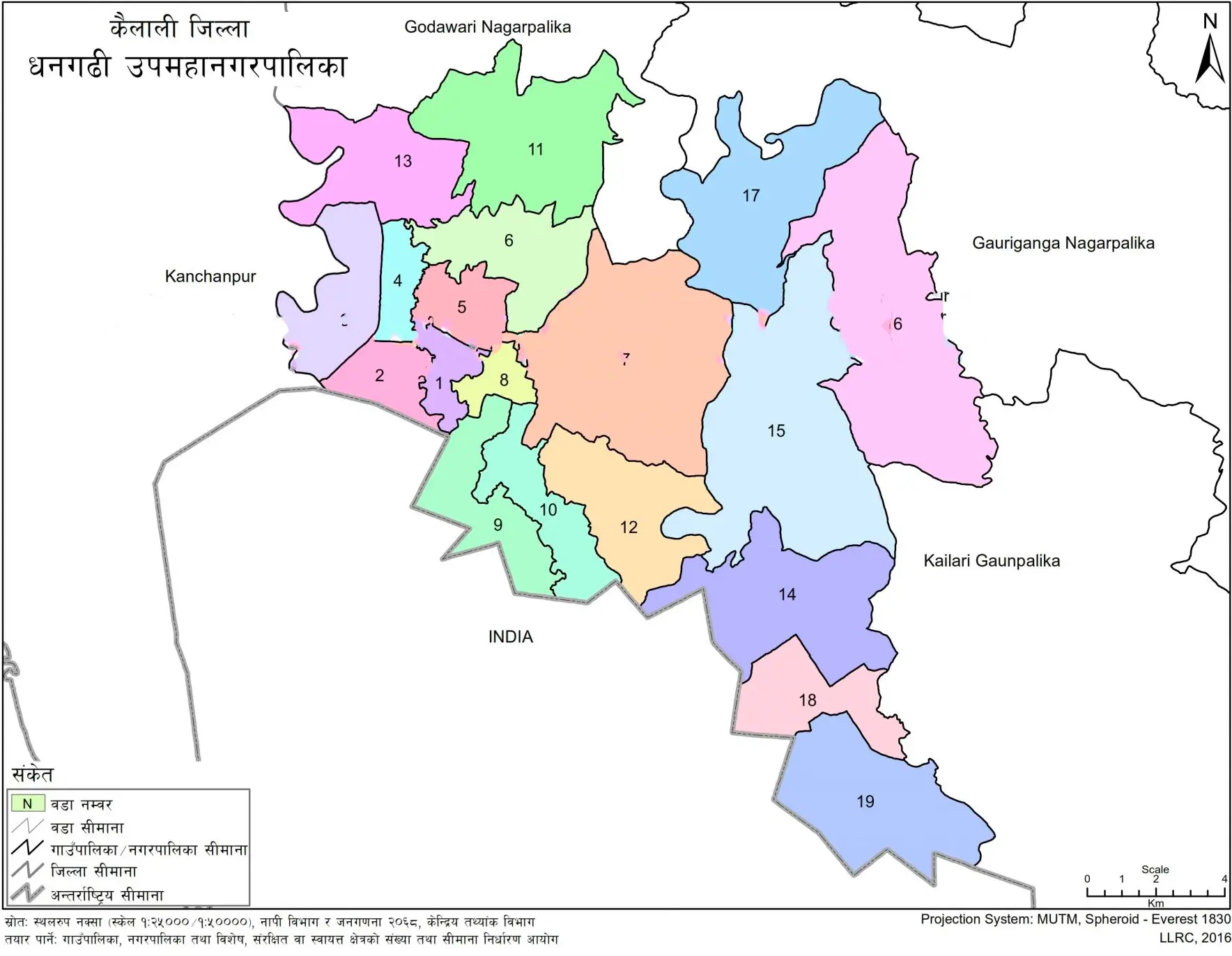
The sub-metropolitan city covers an area of 261.75 square kilometers. Its southern territory includes areas adjoining the Indian state of Uttar Pradesh.
The Nepal–India border, agricultural land, urban settlements, and road transportation play important roles in Dhangadhi's geographical and economic activities.
Different parts of the sub-metropolitan city contain residential settlements, government offices, commercial establishments, educational institutions, healthcare facilities, and agricultural areas.
Dhangadhi Sub-Metropolitan City is divided into 19 wards, numbered from Ward No. 1 to Ward No. 19.
Each ward has an elected Ward Committee and a Ward Office. These offices perform functions related to local public services, recommendations, vital event registration, and ward-level development activities.
Details of the Ward Offices and updated contact information are available on the sub-metropolitan city's official website.
According to the National Population and Housing Census 2021 (2078 BS), published by the National Statistics Office, Dhangadhi Sub-Metropolitan City has a population of 198,792.
The 2011 Census (2068 BS) recorded a population of 147,741 for the area. Between the 2011 and 2021 censuses, the population increased by 51,051 people.
According to the National Statistics Office, the average annual population growth rate during this period was 2.85%.
Total Population: 198,792
Male Population: 98,184
Female Population: 100,608
Total Households: 44,779
Average Household Size: 4.44 persons
Sex Ratio: 97.59 males per 100 females
Population Density: 759 persons per square kilometer
Overall Literacy Rate: 83.28%
Male Literacy Rate: 89.91%
Female Literacy Rate: 76.91%
Annual Population Growth Rate (2011–2021): 2.85%
Source: National Statistics Office, Nepal Statistical Year Book 2023, Table 1.7, page 65.
These figures refer to the 2021 national census reference period. They should not be interpreted as estimates of the population for the current year.
Dhangadhi is home to communities representing different ethnic, linguistic, and cultural backgrounds.
The Rana Tharu and Dangaura Tharu communities have a historical presence in the area. Various communities that migrated from the hill districts of Sudurpashchim Province also reside in the city.
This social composition contributes to the use of Nepali, Tharu, and other local languages and linguistic traditions of Sudurpashchim Province.
Festivals, religious traditions, cultural practices, and lifestyles vary among the communities living in Dhangadhi.
Dhangadhi Sub-Metropolitan City is a local government exercising powers granted under the Constitution of Nepal and applicable laws.
Part 17 of the Constitution contains provisions concerning the Local Executive, Part 18 addresses the Local Legislature, and Part 19 covers Local Financial Procedures.
Schedule 8 of the Constitution specifies the exclusive powers of local governments, while Schedule 9 identifies powers shared among the federal, provincial, and local governments.
The Local Government Operation Act, 2074 BS (2017), further regulates local government operations and public service delivery.
Under Articles 221 and 223 of the Constitution of Nepal, the Municipal Assembly serves as the legislative body of the local government.
Dhangadhi's Municipal Assembly comprises the Mayor, Deputy Mayor, Ward Chairpersons, four elected members from each ward, and Municipal Executive members elected from Dalit or minority communities in accordance with the Constitution.
Its principal responsibilities include enacting local laws, approving annual policies and programs, passing the municipal budget, and making decisions concerning local governance.
Under Articles 214 and 216 of the Constitution, executive authority at the municipal level is vested in the Municipal Executive.
The constitutional composition of the Municipal Executive of Dhangadhi Sub-Metropolitan City includes:
The Mayor and Deputy Mayor
Ward Chairpersons from all 19 wards
Five female members elected from among the Municipal Assembly members
Three members elected from Dalit or minority communities
Under this structure, the Municipal Executive consists of 29 members.
The Municipal Executive is responsible for implementing the policies, programs, plans, and budgets approved by the Municipal Assembly and making decisions related to daily executive administration.
Article 217 of the Constitution of Nepal provides for a three-member Judicial Committee in municipalities, coordinated by the Deputy Mayor.
Sections 46 and 47 of the Local Government Operation Act, 2074 BS (2017), establish provisions concerning the committee's formation and jurisdiction.
The Judicial Committee handles disputes falling within its legally defined jurisdiction. Depending on the nature of a dispute, it may issue decisions or facilitate resolution through mediation.
Not all disputes fall under the jurisdiction of the Judicial Committee. Its authority depends on the subject matter, legal nature, and applicable procedures of each case.
Each ward has a five-member Ward Committee, including the Ward Chairperson.
Ward Committees perform functions related to basic administrative services, local development planning, citizen recommendations, and community coordination within their respective areas.
The administration of Dhangadhi Sub-Metropolitan City operates through a division of responsibilities between elected representatives and administrative personnel.
According to the official elected representatives' records published by Dhangadhi Sub-Metropolitan City:
Mayor: Gopal Hamal
Deputy Mayor: Kandakala Kumari Rana
The official municipal website identifies both representatives as having assumed office on Jestha 9, 2079 BS, and lists their status as active.
Updated information concerning elected officeholders can be obtained from the local government's official records.
Section 84 of the Local Government Operation Act, 2074 BS (2017), provides for a Chief Administrative Officer at the municipal office.
The Chief Administrative Officer is responsible for implementing decisions of the Municipal Assembly and Municipal Executive, coordinating administrative operations, and performing other duties prescribed by law.
As the individual serving as Chief Administrative Officer may change over time, the current officeholder's details should be checked against the municipality's official employee records.
The responsibilities of local government cover areas such as general administration, financial administration, education, healthcare, infrastructure development, revenue, agriculture, social development, and vital event registration.
To carry out these functions, the sub-metropolitan city operates through divisions, sections, and service units established under its approved organizational structure.
The names of these divisions, their organizational arrangements, and staff responsibilities may change according to the approved administrative structure.
Dhangadhi has community and institutional schools, along with campuses providing higher education.
The responsibilities of local government, federal and provincial authorities, and universities differ in the administration and regulation of education.
Under Schedule 8 of the Constitution of Nepal and the Local Government Operation Act, 2074 BS (2017), basic and secondary education fall within the jurisdiction of local governments.
Subject to applicable education laws and standards, the sub-metropolitan city performs functions related to the management, regulation, and monitoring of school education.
These responsibilities include local aspects of school operations and management, educational planning, basic-level examination management, and programs related to school education.
Community schools in Dhangadhi include Panchodaya Secondary School and Trinagar Secondary School.
For updated information concerning the number of schools, grades offered, academic programs, and facilities, readers should consult information published by the respective schools and the Education Section of Dhangadhi Sub-Metropolitan City.
Kailali Multiple Campus, located in Dhangadhi, is a constituent campus of Far Western University.
According to the campus's official institutional history, it was established in 2037 BS. Initially affiliated with Tribhuvan University, the campus became a constituent campus of Far Western University in 2021 AD.
The campus offers various undergraduate and postgraduate academic programs.
Curricula, examinations, academic programs, and university-related regulations in higher education fall under the jurisdiction of the respective universities and regulatory authorities.
The location of a campus within the geographical boundaries of Dhangadhi Sub-Metropolitan City does not, by itself, mean that the campus is directly administered by the sub-metropolitan government.
Dhangadhi's healthcare system includes basic health services associated with the local government and hospitals administered by the provincial government. Their administrative responsibilities are distinct.
Under the Constitution of Nepal and the Local Government Operation Act, 2074 BS (2017), basic healthcare and sanitation fall within the jurisdiction of local governments.
These responsibilities include health promotion, basic healthcare management, local implementation of vaccination programs, sanitation, and public health activities.
Information concerning available healthcare services, types of health facilities, treatment facilities, and service hours in a particular ward should be obtained from the relevant healthcare institution or the Health Section of the sub-metropolitan city.
Seti Provincial Hospital is a government healthcare institution located in Ward No. 1 of Dhangadhi Sub-Metropolitan City.
According to its official website, the hospital operates under the Ministry of Social Development of the Sudurpashchim Provincial Government.
The administrative responsibilities of Seti Provincial Hospital differ from those of basic healthcare services operated under the sub-metropolitan city.
For updated information about available medical treatments, specialist doctors, health insurance, and hospital services, readers can visit the official website of Seti Provincial Hospital.
Trade, transportation, agriculture, and the service sector contribute to economic activities in Dhangadhi.
Its geographical location near the Nepal–India border and its status as the administrative headquarters of Kailali District support local and regional commercial activities.
Dhangadhi has commercial establishments dealing in daily consumer goods, construction materials, agricultural products, and various services.
Education, healthcare, transportation, hotels, financial services, and retail trade also form part of the local economy.
The Gauriphanta border area adjoining India plays a role in cross-border trade and movement of people associated with Dhangadhi.
In addition to urban settlements, Dhangadhi Sub-Metropolitan City includes agricultural areas.
The municipality's official institutional profile identifies crops such as paddy, wheat, and mustard as agricultural products grown in the area.
Within its responsibilities for agriculture and livestock development, the local government performs functions related to agricultural extension, farmer-support programs, and livestock services.
However, the availability of agricultural subsidies, seed distribution, animal healthcare programs, and other facilities depends on approved programs and official notices for the relevant fiscal year.
Dhangadhi is connected by both road and air transportation networks.
The road network connecting Dhangadhi with Attariya provides access to the East–West Highway.
The Dhangadhi–Attariya road is an important route for local and interdistrict transportation.
Additional roads connect Dhangadhi with other areas of Kailali District and locations near the Nepal–India border.
Dhangadhi Airport is located in Ward No. 13 of Dhangadhi Sub-Metropolitan City, Kailali District.
The Civil Aviation Authority of Nepal's airport records identify its location within Dhangadhi Sub-Metropolitan City. The airport's official contact information also lists Dhangadhi-13, Kailali, as its address.
The airport operates within the regulatory and management framework of the Civil Aviation Authority of Nepal.
Flight destinations, schedules, fares, and availability may change over time. Travelers should obtain updated information from the relevant airlines or civil aviation authorities.
Dhangadhi's cultural identity reflects the religious and social traditions of the Tharu communities and various other communities of Sudurpashchim Province.
Festivals such as Maghi, Gaura Parva, Holi, Dashain, and Tihar are celebrated according to different community traditions.
Religious sites, lakes, ponds, and cultural practices are also connected to local life.
Behada Baba Temple is a religious site located in Ward No. 16 of Dhangadhi Sub-Metropolitan City.
The official municipal website also identifies the Behada Baba Temple area as being within Ward No. 16.
The site is associated with local religious traditions and cultural activities.
Jokhar Lake is a natural lake located in Ward No. 7 of Dhangadhi Sub-Metropolitan City.
It is one of Dhangadhi's local lakes. The conservation of such water bodies is associated with natural resource management and local environmental planning.
Shivpuri Dham is located in Ward No. 4 of Dhangadhi Sub-Metropolitan City.
It is one of the religious and cultural sites in Dhangadhi.
Environmental protection, waste management, and disaster risk reduction are among the public responsibilities associated with Dhangadhi Sub-Metropolitan City.
Because Dhangadhi is located in the Terai region, monsoon drainage, urban sanitation, and natural resource conservation are important municipal management concerns.
Under the Local Government Operation Act and applicable disaster risk reduction and management laws, local governments perform responsibilities related to disaster preparedness, coordination, and local risk management.
The sub-metropolitan city's environmental responsibilities include local sanitation, waste management, protection of public spaces, and other environmental activities in accordance with applicable laws and plans.
However, identifying specific disaster-prone areas, predicting floods, or determining the risk level of a particular ward requires official hazard maps, technical studies, or information issued by the relevant authorities.
The budget and financial administration of Dhangadhi Sub-Metropolitan City operate under the Constitution of Nepal, the Local Government Operation Act, and applicable financial laws.
Local government financial resources include internal revenue, revenue-sharing arrangements, and different types of grants received from the federal and provincial governments.
Section 71 of the Local Government Operation Act, 2074 BS (2017), requires the estimates of revenue and expenditure for the upcoming fiscal year to be approved by the Municipal Executive and submitted to the Municipal Assembly by Ashadh 10.
The Municipal Assembly discusses the proposed budget and approves it in accordance with the law.
The municipality's actual annual budget, expenditure, income, and financial performance should be examined through approved budget statements and financial reports for the relevant fiscal year.
Local governments may collect various local taxes, fees, and charges in accordance with the law.
The financial administration of the sub-metropolitan city includes revenue collection, budget implementation, accounting, internal control, and auditing procedures.
The Constitution provides for the final audit of local government accounts by the Auditor General.
When examining financial information, it is necessary to distinguish between the approved budget, actual expenditure, revised estimates, and audit findings.
The Office of the Municipal Executive and the Ward Offices of Dhangadhi Sub-Metropolitan City provide various public services within their respective legal jurisdictions.
Depending on the nature of the service, citizens may need to contact the relevant Ward Office, a thematic section of the sub-metropolitan city, or another authorized government agency.
Ward Offices may perform functions related to the following services:
Registration of vital events, including births, deaths, marriages, divorces, and migration
Citizenship-related recommendations
Relationship certification and other legally authorized certification services
Recommendations related to houses, land, and local records
Local administrative functions associated with social security programs
Coordination of ward-level development activities and public services
Whether a particular service can be completed directly at the Ward Office or requires referral to another government agency depends on the applicable legal procedures.
Services within the jurisdiction of the sub-metropolitan city include business registration and renewal, local revenue administration, building construction permits, local administration of education and healthcare, and other thematic public services.
The availability and procedures of these services are determined by the relevant municipal sections, legal standards, and approved service arrangements.
Before requesting a public service, citizens should verify the required documents, applicable fees, procedures, and expected service completion time through the updated Citizen Charter or official notices issued by the relevant office.
Tax and fee rates may vary by fiscal year. Even where online applications are available, some services may require additional verification or a physical visit to the office.
Outdated notices or procedures obtained through informal sources should not be treated as substitutes for current official requirements.
Office Name: Dhangadhi Sub-Metropolitan City, Office of the Municipal Executive
Address: Dhangadhi, Kailali, Sudurpashchim Province, Nepal
Telephone: 091-590690, 091-521429
Official Email: info@dhangadhimun.gov.np
Official Website: https://www.dhangadhimun.gov.np/
The institutional contact information above is based on details published on the official website of Dhangadhi Sub-Metropolitan City.
As office hours, service sections, and contact information may change, visitors and individuals seeking correspondence are advised to check the official website for updated information before contacting or visiting the office.
Dhangadhi Sub-Metropolitan City is located in Kailali District of Sudurpashchim Province, Nepal. Dhangadhi also serves as the administrative headquarters of Kailali District.
Dhangadhi Sub-Metropolitan City has 19 wards, numbered from Ward No. 1 to Ward No. 19.
Dhangadhi Sub-Metropolitan City covers a total area of 261.75 square kilometers.
According to the National Population and Housing Census 2021, Dhangadhi Sub-Metropolitan City has a total population of 198,792, comprising 98,184 males and 100,608 females.
According to the 2021 National Census, Dhangadhi Sub-Metropolitan City has 44,779 households.
The Government of Nepal upgraded Dhangadhi Municipality to a sub-metropolitan city on Ashoj 1, 2072 BS.
Following the 2079 BS local elections, Gopal Hamal assumed office as Mayor, while Kandakala Kumari Rana assumed office as Deputy Mayor.
The municipality's official elected representatives' records list both officeholders as active.
Dhangadhi continues to serve as the location from which the Sudurpashchim Provincial Government conducts its administrative operations.
However, the Provincial Assembly has designated the Godawari area of Kailali District as the permanent provincial capital.
As the physical implementation of that decision has not been completed, provincial government offices continue to operate from Dhangadhi.
Kailali Multiple Campus, located in Dhangadhi, is a constituent campus of Far Western University.
Seti Provincial Hospital, located in Ward No. 1 of Dhangadhi, operates under the Ministry of Social Development of the Sudurpashchim Provincial Government.