When looking for practical answers such as “Which statistics are official in Nepal?”, “Why do different numbers appear for the same topic?”, “Where can I find reliable data for research or a thesis?”, or “Which source should a local level use for planning?”, the central institution you ultimately reach is the National Statistics Office (National Statistics Office, NSO - Rastriya Tathyanka Karyalaya).
The socio-economic statistics produced by the NSO through censuses, surveys, and other scientific methods have become a foundation for national planning, policy formulation, service delivery, budget prioritization, research, journalism, and public debate.
Understanding the NSO only as an “office that produces data” is incomplete. It also leads on coordination of the national statistical system, standardization, quality assurance, data access, publication of metadata (definitions/methods/classifications), and protection of respondent confidentiality.
Another major public importance of this institution is “credibility.” If statistics are misunderstood or used incorrectly, policies can move in the wrong direction, duplication of sources can increase, and public spending can become ineffective. Therefore, the NSO’s work is not only to publish numbers, but also to maintain definitions, methods, and quality so that all agencies can use them with the same meaning. Its long-term vision is the “establishment of a coordinated, active, and capable national statistical system.”
This profile focuses on how students/youth, public bodies, policymakers, local levels, academic institutions, and researchers can use the NSO in a service-oriented way, and presents the legal basis, service processes, fees/time, rules for data use, and solutions to common problems.

In Nepal, the central body for producing statistics began as the “Central Bureau of Statistics (CBS).” Under the Statistics Act, 2015, it is stated that the CBS was established on BS 2015 Poush 17 as the central agency for statistics collection, compilation, processing, analysis, publication, and dissemination.
Over time, its institutional placement changed. The NSO’s official “Introduction” section itself states that it initially operated under the Ministry of Finance, then under a finance-related ministry, and in recent times functioned under the National Planning Commission. The main objective was to provide state agencies with the statistics required in time for periodic development plans, policy formulation, and decision-making, with censuses and surveys as the primary production route.
After the new Statistics Act, 2079 was issued on BS 2079 Bhadra 28, provisions were made to upgrade the former CBS to the National Statistics Office, and it is stated that the National Statistics Office was established on BS 2079 Ashwin 27. At present, this office is under the Office of the Prime Minister and Council of Ministers.
This “upgrade” also brought changes in the leadership structure. Previously, the CBS was led by a Director General, whereas the NSO is led by the Chief Statistician. This is not only about a job title; it is linked to responsibilities such as coordinating the national statistical system in line with the federal governance structure, applying standards across multi-agency statistical production, and increasing public trust in official statistics.
The NSO has set its long-term vision as follows:
Coordinated, active and capable national statistical system establishment.
The goal to move this vision toward implementation is:
Develop a federal governance system–appropriate system for producing, managing, and supplying quality statistics for policies related to equitable development and prosperity.
The three main directions of the Strategic Objectives are:
Establish coordination among federal, provincial, and local levels to develop a statistical system in line with the federal structure.
Produce reliable and quality statistics and ensure regular supply to support evidence-based policy making/development management and to address user demand.
Strengthen institutions by improving legal and procedural aspects for statistical work management.
These objectives convey a practical message: the NSO’s job is not only “producing statistics from Kathmandu,” but also ensuring statistical coordination, quality, and access across national, provincial, and local levels required in a federal system.
The NSO links its objectives to policy/plan utility, the data lifecycle (processing–analysis–dissemination), coordination, and human resource development. The official list is as follows:
Provide the government with timely, quality statistics for planning and policy formulation, and understand the country’s socio-economic condition.
Process, analyze, publish, disseminate, and preserve collected data.
Avoid statistical inconsistencies and coordinate with various agencies involved in data collection/processing/analysis.
Play a leading role in developing a standard statistical system.
Develop statistical human resources.
In reader-centered terms, this translates into problem-solving such as:
Students/researchers: access reliable data and its methodological explanation (metadata).
Local levels/policymakers: use indicators and definitions that carry “the same meaning” in planning.
Media/public debate: present statistics with correct context without misinterpretation or incorrect comparisons.
Under the heading “Key Functions,” the NSO clarifies its scope of work. In brief, its work appears at three levels: (a) production, (b) standardization/coordination, and (c) access/capacity development.
The official list of key functions (central-level functions) includes:
Provide statistics needed by the government for plan and policy formulation.
Collect, process, and analyze data related to socio-economic sectors.
Develop definitions and scientific methods for reliable data collection.
Coordinate various statistical collection agencies, develop an integrated statistical system, and reduce duplication.
Preserve statistical records.
Improve data collection–processing–analysis by exploring new technologies/methods.
Coordinate to maintain continuity and uniformity in national-level statistical quality.
Organize training, seminars, and workshops at national and international levels.
Develop basic statistical human resources.
A practical signal for readers follows from this: if you are planning nationally representative surveys/data collection, the NSO is not only “a place to get data,” but also holds a regulatory role in coordinating methods, definitions, samples, and standards. (This is further strengthened by legal provisions—see below.)
The credibility of official statistics is not only technical; it is also protected through legal and institutional structures. In Nepal, the new “Statistics Act, 2079” and, for its implementation, the “Statistics Regulation, 2080” clarify major processes and responsibilities related to statistical production, access, confidentiality, and coordination.
A frequently requested resource for students/researchers and institutions is “microdata,” which enables independent analysis, modeling, and thesis/research work. However, because microdata can contain sensitive personal/household-level details, the regulation sets strict boundaries. When using microdata, the regulation mentions conditions such as:
It must not be shared with other institutions/persons.
Attempts must not be made to identify respondents (and if identified, it must not be disclosed/made public).
Sources must be cited in prepared articles/reports according to the dataset.
Completed publications/outputs must be provided to the relevant data producer.
Responsibility for analysis/interpretation lies with the user (the producer does not take responsibility).
Analysis must not be conducted in a way that the sample size does not represent.
The same indicators already published by the producer must not be re-published differently as “the same indicator.”
The practical meaning is that access to data is an “entitlement” as well as a “responsibility.” This is why, when writing a thesis, policy note, or report, metadata such as “whose data, which year, which sample, which definition” must not be omitted.
The regulation includes an important condition: microdata may be made available as per rules only after the final results of a census/survey have been made public.
This manages expectations: requesting “raw microdata” before the final results may not lead to availability.
If a government body or institution wants to collect statistics in a way that is nationally representative, the regulation provides a permission process. Examples of required documents include:
Copy of the decision of the concerned body/institution.
Concept note including purpose/scope/method/estimated cost.
Permission form (as per schedule), etc.
It also mentions that the decision to grant or deny such permission must be made within 30 days from the date the application is submitted.
Practical suggestion for readers: if an institution/project claims to be conducting a “nationally representative” survey, verify permission, sample design, metadata, and documentary evidence of quality. This is where public trust is built.
The NSO’s portal/information structure clearly shows major statistical areas such as population, poverty/living standards/labour force, social statistics, environment, national accounts, prices, economic/agricultural/industrial censuses, trade, provincial/district statistics, and others.
Reader-centered use can be approached as follows:
Students/researchers: identify relevant publications, metadata, and datasets by topic (e.g., labour force, trade, price indices) through the concerned division/section.
Local levels: assess sectoral data availability through district/provincial statistics or coordination offices.
Media: when multiple versions of the same indicator exist (e.g., updated/revised), look for a “revision note” and ensure source citation.
The NSO appears to provide links such as “Data NSO Nepal Portal,” “Microdata Catalogue,” “National Data Profile,” and census/agricultural census portals.
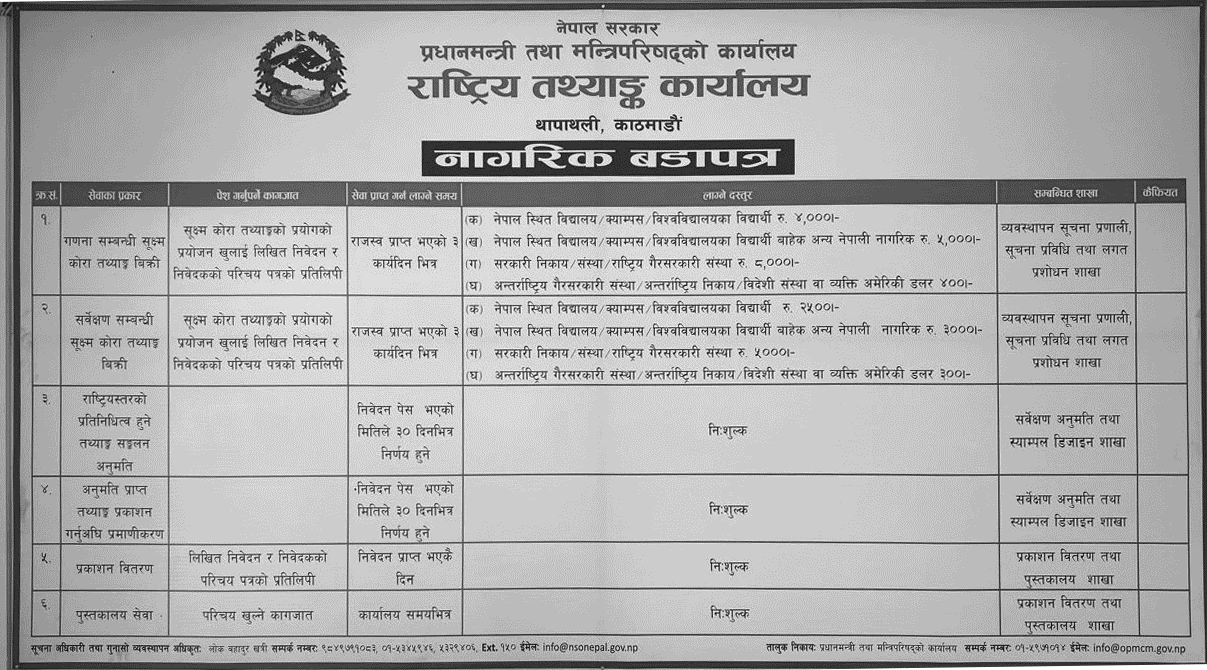
Among the most searched practical topics about the NSO are service procedures, especially microdata, permissions, publications, and library services.
The Statistics Regulation, 2080 (Schedule–2) clearly sets the fees for providing microdata:
Microdata for Census:
Nepal-based school/college/university students: NPR 4,000
Nepali citizens other than students: NPR 5,000
Government bodies/institutions/national non-government organizations: NPR 8,000
International non-government organizations/international bodies/foreign institution or individual: USD 400
Microdata for Survey:
Nepal-based school/college/university students: NPR 2,500
Nepali citizens other than students: NPR 3,000
Government bodies/institutions/national non-government organizations: NPR 5,000
International non-government organizations/international bodies/foreign institution or individual: USD 300
In the field-office citizen charter (Rupandehi Statistics Coordination Office), for microdata sales:
Required documents: written application stating the purpose of use + copy of the applicant’s identification document
Time: within 3 working days after revenue is received
Practical tip:
Writing clearly in the application—research topic, dataset name/year, type of variables needed, and commitment to confidentiality—helps ease the process. Because the rules prohibit sharing microdata and attempting identification, preparing an institutional ethics/data-protection plan is also appropriate.
As per the regulation, an application with required documents must be submitted, and a decision must be made within 30 days from the submission date. The citizen charter also shows that this service fee is free of charge.
What does this process ensure?
It reduces the risk that multiple agencies use different samples/definitions and publish results as “national statistics.”
It applies minimum standards to sample design, questionnaire, concept, cost, and timeline.
If you have collected data after obtaining permission, the citizen charter mentions that verification may be required when publishing publicly (decision within 30 days). This strengthens quality and coordination of public statistics.
In the field-office citizen charter:
Publication distribution: written application + identification document; same day as application receipt; free of charge
Library service: document that identifies the person; during office hours; free of charge
Identify the dataset/publication that matches the topic (year, area, sample).
Review metadata (definitions, classifications, methods)—the regulation provides for making metadata public.
Check whether the sample size “represents” the analysis you need (the regulation mentions that analysis should not be done in a non-representative way).
While using microdata, avoid risks of respondent identification (small cell, rare category).
When publishing results, cite the source and dataset (the rules provide for source citation and providing outputs to the producer).
When writing conclusions, keep responsibility clear that “this analysis is the user’s interpretation” (in line with the spirit of the rules).
Mistake: applying the “national average” directly to district/local levels
Solution: infer only after reading the representation level (national/province/district) and sample design.
Mistake: comparing indicators from different years without checking base-year/revision changes in price/population bases
Solution: review the publication’s revision note/metadata and use a series with the same definition/method.
Mistake: publicly disclosing details from microdata that can lead to identification
Solution: do not attempt/disclose identification as prohibited by the rules; use aggregation, anonymization, and disclosure control.
The NSO’s goal is to develop a federal governance–appropriate system for producing, managing, and supplying quality statistics. This means:
Helping local levels use uniform definitions/classifications in planning
Coordination to reduce duplication of sources
Developing a system for timely availability of statistics
Practically, local levels/institutions can work effectively across three levels:
Data inventory: a list of required indicators (population, labour, education, agriculture, trade, prices, etc.)
Source standardization: distinguish official/unofficial sources; if different versions of the same indicator exist, decide which to use
Update cycle: understand different frequencies (annual/quarterly/census-based) and create a planning review schedule accordingly
Internationally, trust in official statistics is guided by the “Fundamental Principles of Official Statistics,” which the United Nations General Assembly endorsed in 2014.
In summary, these principles emphasize scientific methods, impartiality, equal access, confidentiality, transparency, and coordination.
The IMF’s Data Quality Assessment Framework (DQAF) is also a widely referenced framework for quality management; the IMF states that it is based on the UN principles.
NSO legal/procedural provisions (permission, metadata, microdata boundaries, fees/schedules) can be understood as tools for “building trust,” because trust is not created only through publication, but through methods, confidentiality, and coordination.
Problem 1: Why do different numbers appear for the same topic?
Main reasons:
Differences in definitions/classifications (e.g., definitions of employment, poverty, industry)
Differences in year/frequency
Differences in sample design (national vs subnational)
Whether revision/update has been made
Solution:
Review metadata (the regulation provides for making metadata public).
Use an official publication in the same series; when comparing, align the same base year/definition.
Problem 2: How credible is a survey publicly presented as “nationally representative”?
Solution:
Check whether permission was obtained; the regulation provides a permission process for nationally representative data collection and mentions a decision within 30 days.
Check whether questionnaire/sample/method are public.
Problem 3: Confusion about what is allowed after obtaining microdata
Solution:
Turn the regulation’s “what not to do/what must be done” list into a personal data-ethics checklist.
Cite source and dataset in publication and avoid identification risks.
Address: Thapathali, Kathmandu, Nepal
Contact Number: 977-1-5345947, 5329406
Email: info@nsonepal.gov.np
Office Hours (published on the website):
Winter: Sunday–Thursday 10:00–4:00; Friday 10:00–3:00
Summer: Sunday–Thursday 10:00–5:00; Friday 10:00–3:00
The role of the National Statistics Office in Nepal is not limited to producing statistics. Its long-term vision, goal, and strategic objectives show that the NSO works to coordinate, standardize, and make accessible a national statistical system aligned with federal governance.
For students, researchers, academic institutions, local levels, and policymakers, the essentials to maximize benefit from the NSO are straightforward: choose the right dataset, read the metadata, comply with legal boundaries, and make context/method clear when writing conclusions. Only with such use do statistics improve decisions, reduce confusion, and increase the usefulness of public resources.
This material is general information based on public information and legal/official sources. Service fees, processes, timelines, or internal directives may be updated over time. For final/official decisions, rely on the NSO’s updated notices, relevant regulations/acts, and written information obtained from the office.
Here is the National Statistics Office Nepal's Citizen Charter (Nagarik Badapatra):








.jpg)