Worst
Nepal worst service




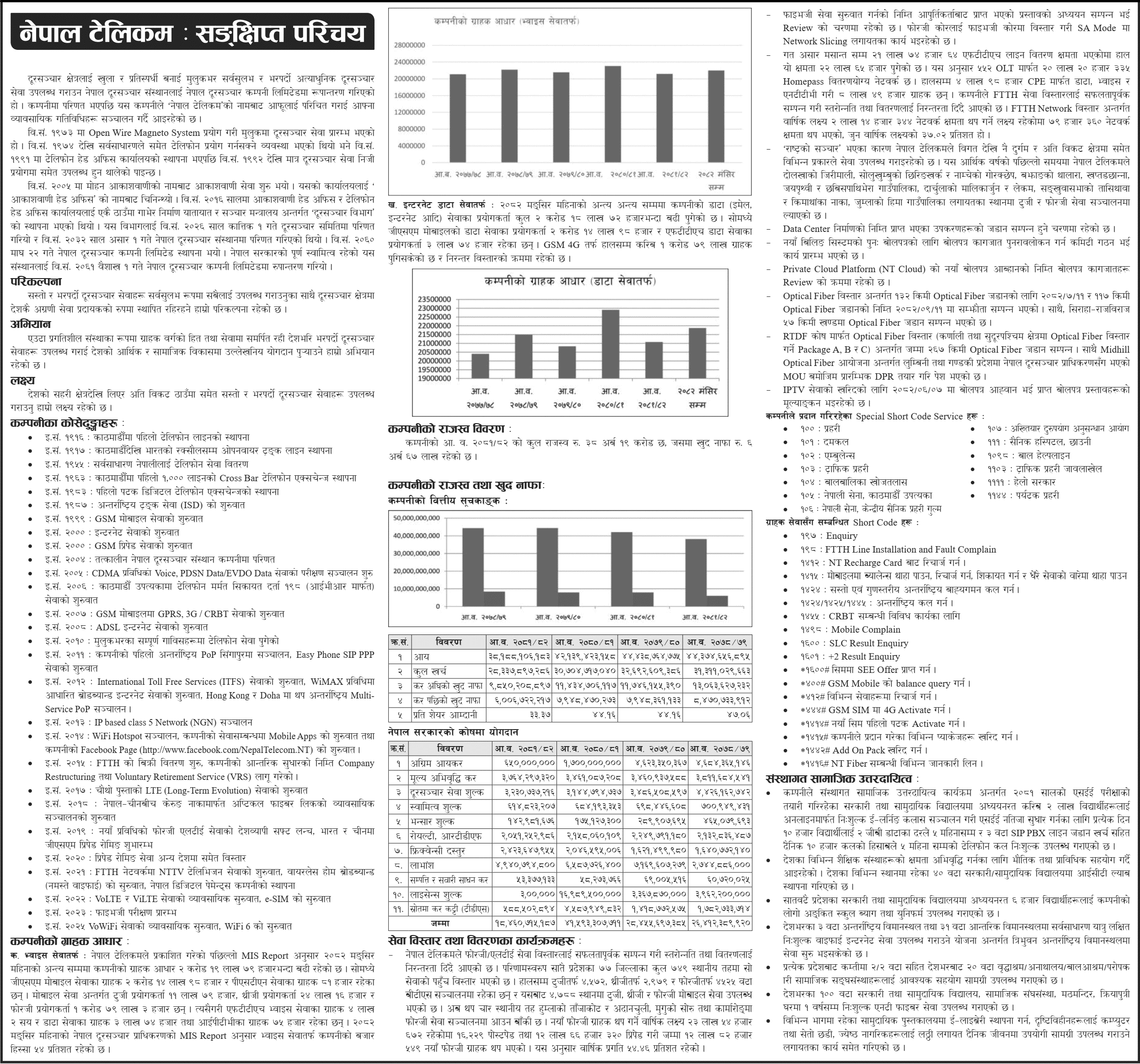
To make the telecommunications sector open and competitive and to provide accessible and reliable modern telecommunications services throughout the country, Nepal Telecommunications Corporation was transformed into Nepal Telecom Company Limited (NTC - Nepal Doorsanchar Company Limited). After becoming a company, it has introduced itself under the name “Nepal Telecom” and has been carrying out its business activities.
In B.S. 1973, telecommunications services began in the country using the Open Wire Magneto System. From B.S. 1974, arrangements were made so that the general public could also use telephones. After the establishment of the Telephone Head Office in B.S. 1991, telecommunications services began to be available for private use only from B.S. 1992.
In B.S. 2005, Akashwani service began under the name “Mohan Akashwani.” Its office was known as the “Akashwani Head Office.” In B.S. 2016, the Akashwani Head Office and the Telephone Head Office were merged at one place, and under the Ministry of Construction, Transport and Communications, the “Telecommunications Department” was established.
This department was converted into the Telecommunications Committee on Kartik 1, B.S. 2026, and converted into Nepal Telecommunications Corporation on Ashar 5, B.S. 2032. On Magh 22, B.S. 2060, Nepal Telecom Company Limited was established. This institution, fully owned by the Government of Nepal, was transformed into Nepal Telecom Company Limited on Baisakh 1, B.S. 2061.
.jpg)
NTC (नेपाल टेलिकम) transformed into Nepal Telecom Company Limited to expand modern, reliable services nationwide.
Telecom service began in Nepal in B.S. 1973; public access expanded from B.S. 1974.
Multiple institutional restructurings; company established Magh 22, B.S. 2060; transformed Baisakh 1, B.S. 2061.
Vision: affordable, reliable telecom for all; remain a leading national provider.
Major milestones: GSM, internet, ADSL, FTTH, LTE, e-SIM, VoLTE/VoWiFi, 5G testing.
Digital role: reducing the Digital Divide, supporting digital literacy and e-government.
4G/LTE reached 749 local levels in 77 districts across all seven provinces.
Remote connectivity supported via fiber, microwave, and satellite transmission.
Our vision is to make affordable and reliable telecommunications services accessible to everyone and to remain established as the country’s leading service provider in the telecommunications sector.
Our mission is to remain dedicated to customer interests and service as a progressive institution, provide reliable telecommunications services nationwide, and make a notable contribution to the country’s economic and social development.
Our goal is to provide affordable and reliable telecommunications services from the country’s urban areas to even very remote places.
A.D. 1916: Establishment of the first telephone line in Kathmandu
A.D. 1917: Establishment of an open-wire trunk line from Kathmandu to Raxaul, India
A.D. 1955: Distribution of telephone service to the general Nepali public
A.D. 1963: Establishment of the first 1,000-line Cross Bar telephone exchange in Kathmandu
A.D. 1983: Establishment of the first digital telephone exchange
A.D. 1987: Start of International Trunk Service (ISD)
A.D. 1999: Start of GSM mobile service
A.D. 2000: Start of internet service
A.D. 2000: Start of GSM prepaid service
A.D. 2004: The then Nepal Telecommunications Corporation converted into a company
A.D. 2005: Start of trial operation of CDMA technology Voice, PDSN Data/EVDO Data services
A.D. 2006: Start of telephone repair complaint registration service 198 (via IVR) in Kathmandu Valley
A.D. 2007: Start of GPRS, 3G / CRBT services on GSM mobile
A.D. 2008: Start of ADSL internet service
A.D. 2010: Telephone service reached all VDCs across the country
A.D. 2011: Operation of the company’s first international PoP in Singapore; start of Easy Phone SIP PPP service
A.D. 2012: Start of International Toll Free Services (ITFS); start of WiMAX-based broadband internet; operation of additional international Multi-Service PoPs in Hong Kong and Doha
A.D. 2013: Operation of IP based class 5 Network (NGN)
A.D. 2014: Operation of WiFi Hotspot; start of Mobile Apps related to company services; start of the company’s Facebook Page (http://www.facebook.com/NepalTelecom.NT)
A.D. 2015: Start of FTTH sales and distribution; implementation of Company Restructuring and Voluntary Retirement Service (VRS) for internal improvement
A.D. 2017: Start of fourth-generation LTE (Long-Term Evolution) service
A.D. 2018: Start of commercial operation of the optical fiber link between Nepal and China via the Kerung border point
A.D. 2019: Nationwide soft launch of new 4G LTE service; start of GSM prepaid roaming in India and China
A.D. 2020: Expansion of prepaid roaming service to other countries as well
A.D. 2021: Start of NTTV television service on the FTTH network; start of wireless home broadband (Namaste WiFi); establishment of Nepal Digital Payments Company
A.D. 2022: Commercial start of VoLTE and ViLTE services; start of e-SIM
A.D. 2023: Start of 5G testing
A.D. 2025: Commercial start of VoWiFi service; start of WiFi 6
Communication services are not limited only to exchanging information; their impact is multi-dimensional. The expansion of communication contributes significantly to a country’s education, health, and economy. Nepal Telecom has been playing a leading role in reducing the Digital Divide, enhancing digital literacy, and implementing the concept of e-government. The company’s contribution to nation-building through the creation of a knowledge-based society is commendable.
In addition, by depositing revenue into the state treasury under various headings and strengthening the national economy, the role played by the company has further elevated its closeness to the Nepali people and a sense of national pride.
As “the nation’s communication,” Nepal Telecom has achieved significant progress in nationwide service expansion this year. The coverage of 4G/LTE service has already been expanded to a total of 749 local levels in 77 districts across all seven provinces. Efforts are underway to extend services to the remaining four local levels at the earliest and to strengthen service quality.
From cities to rural areas, high-speed broadband access has been provided through the expansion of Fiber to the Home (FTTH) services.
Even in geographically remote and very difficult areas, the company has been ensuring continuous service delivery by using fiber, microwave, and satellite transmission technologies. These achievements are the result of the shared efforts of the company’s dedicated employees, management, and stakeholders.
Through the mobilization of the Rural Telecommunications Development Fund and other budgetary programs, the government has been promoting and facilitating such development-oriented work, and this will continue in the coming days.
To respond to rapid global technological changes and growing customer demand, the company has adopted the latest technologies. At present, the company is working in modern areas such as 5G, cloud platforms, a new billing system, and ERP.
In particular, the company is active in preparing the necessary infrastructure for the development of services such as those for the business sector, telehealth, telemedicine, and tele-education.
While facing challenges seen in a competitive market, there is a need for the company to place special focus on youth-friendly facilities and affordable, quality service delivery. For customer convenience, complaint handling and information delivery have been made more effective through call centers such as 198, 1498, and 197, along with online and offline channels.
Nepal Telecom has set the goal of making its future plans technology-friendly and customer-centric. Under this, priority areas include expanding 5G services, internal software development, establishing a 400G IP Network, and expanding optical fiber networks in all provinces.
In addition, plans are being advanced to operate 7 customer service centers, manage a 24/7 Network Operations Center, and expand services on taking routes.
To ensure service quality, the use of “Predictability Based Preventive Maintenance” and automated systems in daily operations will be accelerated. Nepal Telecom is committed to supporting the country’s economic and social development by ensuring access to both wireless and wireline technologies at every Nepali household.
According to the latest MIS Report published by Nepal Telecom, by the end of Mangsir, B.S. 2082, the company’s customer base has exceeded 21,372,000. Among them, GSM mobile service customers are 21,498,000 and PSTN service customers are 81,000.
Under mobile service, there are 1,176,000 2G users, 2,416,000 3G users, and 17,103,000 4G users. Similarly, FTTH voice service customers are 400,200 and data service customers are 374,000, and IPTV customers are 74,000.
According to the MIS Report of Nepal Telecommunications Authority for Mangsir, B.S. 2082, the company’s market share in voice services is 54 percent.
FY 2077/78: 22,655,964
FY 2078/79: 23,480,325
FY 2079/80: 23,773,642
FY 2080/81: 21,614,140
FY 2081/82: 21,313,615
Up to Mangsir 2082: 21,372,663
By the end of Mangsir, B.S. 2082, the total number of users of the company’s data (email, internet, etc.) services has exceeded 21,872,000. Among them, GSM mobile data service users are 21,418,000 and FTTH data service users are 374,000.
In GSM 4G, so far, approximately 17.1 million customers have been reached, and it is in continuous expansion.
FY 2077/78: 20,174,463
FY 2078/79: 20,980,836
FY 2079/80: 21,330,838
FY 2080/81: 21,886,935
FY 2081/82: 21,825,727
Up to Mangsir 2082: 21,872,663
The company’s total revenue for FY 2081/82 is NPR 38.19 billion, in which net profit is NPR 6 billion 67 lakh.
FY 2078/79: Revenue more than 50,000,000,000; Profit more than 10,000,000,000
FY 2079/80: Revenue more than 40,000,000,000; Profit more than 10,000,000,000
FY 2080/81: Revenue more than 40,000,000,000; Profit more than 8,000,000,000
FY 2081/82: Revenue more than 30,000,000,000; Profit more than 6,000,000,000
Income
FY 2081/82: 38,188,106,186
FY 2080/81: 42,939,423,124
FY 2079/80: 44,434,764,775
FY 2078/79: 44,374,656,896
Total Expenditure
FY 2081/82: 28,337,984,296
FY 2080/81: 30,404,717,040
FY 2079/80: 32,692,609,386
FY 2078/79: 31,311,099,663
Net Profit Before Tax
FY 2081/82: 9,850,201,897
FY 2080/81: 12,534,706,114
FY 2079/80: 11,742,155,390
FY 2078/79: 13,063,657,232
Net Profit After Tax
FY 2081/82: 6,606,722,217
FY 2080/81: 7,924,470,243
FY 2079/80: 7,945,341,733
FY 2078/79: 8,470,733,912
Earnings Per Share
FY 2081/82: 33.37
FY 2080/81: 44.18
FY 2079/80: 44.16
FY 2078/79: 47.06
Advance Income Tax
FY 2081/82: 650,000,000
FY 2080/81: 1,700,000,000
FY 2079/80: 4,623,350,367
FY 2078/79: 4,484,365,146
Value Added Tax
FY 2081/82: 3,764,297,320
FY 2080/81: 3,461,087,208
FY 2079/80: 3,460,937,588
FY 2078/79: 3,911,684,431
Telecommunications Service Fee
FY 2081/82: 3,230,737,216
FY 2080/81: 3,144,714,737
FY 2079/80: 3,486,508,597
FY 2078/79: 4,426,162,742
Ownership Fee
FY 2081/82: 614,823,207
FY 2080/81: 684,193,353
FY 2079/80: 699,446,606
FY 2078/79: 700,199,431
Customs Duty
FY 2081/82: 142,981,676
FY 2080/81: 135,127,300
FY 2079/80: 289,907,915
FY 2078/79: 465,079,693
Royalty, RTDF
FY 2081/82: 2,051,982,986
FY 2080/81: 2,158,060,109
FY 2079/80: 2,241,711,180
FY 2078/79: 2,132,836,483
Frequency Fee
FY 2081/82: 2,433,847,155
FY 2080/81: 2,046,595,006
FY 2079/80: 1,821,499,980
FY 2078/79: 1,840,772,940
Dividend
FY 2081/82: 4,940,794,800
FY 2080/81: 6,587,726,400
FY 2079/80: 7,966,507,249
FY 2078/79: 2,744,886,000
Property and Vehicle Tax
FY 2081/82: 53,307,133
FY 2080/81: 58,273,766
FY 2079/80: 69,075,516
FY 2078/79: 60,740,025
License Fee
FY 2081/82: 3,000,000
FY 2080/81: 19,989,500,000
FY 2079/80: 3,367,870,000
FY 2078/79: 3,669,200,000
Tax Deducted at Source (TDS)
FY 2081/82: 588,502,894
FY 2080/81: 4,857,941,832
FY 2079/80: 1,418,772,575
FY 2078/79: 1,782,733,714
Total
FY 2081/82: 18,470,714,387
FY 2080/81: 41,593,303,711
FY 2079/80: 28,455,617,385
FY 2078/79: 26,412,389,920
Nepal Telecom has successfully completed the expansion of 4G/LTE service and has been continuing upgrades and distribution. As a result, access to this service has been expanded to a total of 749 local levels in 77 districts of all seven provinces.
So far, 8,477 BTS are in operation for 2G, 2,999 for 3G, and 5,424 for 4G. Through this, 2G, 3G, and 4G mobile services are available in more than 9,408 locations. Now, service operation is still pending in four additional local levels: Tajakot and Adanchuli of Humla, Soru of Mugu, and Chauri Deurali of Kavre.
The annual target for adding new 4G customers was 2,354,672. A total of 1,282,549 new 4G customers were added, including 16,229 postpaid and 1,266,320 prepaid. Accordingly, annual progress is 54.48 percent.
For starting 5G service, the study of proposals received from the supplier has been completed and it is at the radio stage. Work is in progress to extend the 4G core to a 5G core and, in SA Mode, to carry out activities such as Network Slicing.
Up to the end of the last Ashar month, FTTH line distribution capacity was 2,143,064, and now this capacity has reached 2,265,000. Accordingly, there is a distributable network of 2,020,335 Homepass through 552 OLT.
So far, through 418,000 CPE, there are 814,000 customers including data, voice, and NTTV. The company has successfully completed the expansion of FTTH service and has been continuing upgrades and distribution.
Under FTTH Network expansion, the annual target was to add 214,345 network capacity, and 79,360 network capacity has been added, which is 37.02 percent of the annual target.
Because it is “the nation’s communication,” Nepal Telecom has been providing services in various ways even in remote, difficult, and very remote areas. In the later period of this fiscal year, Nepal Telecom has brought 2G and 4G services into operation in places including Jarimali of Dolpa, Chirdingkhark of Solukhumbu and Gorukhark of Nachpeko, Thalara, Khaptadchhanna, Jayaprithvi and Chhabispathibhera rural municipalities of Bajhang, Malikarjun and Lekam of Darchula, Tashishowa and Kimathangka border point of Sankhuwasabha, and Hima rural municipality of Jumla.
For Data Center construction, installation of the received equipment is in the stage of completion.
For re-tendering a new billing system, a committee has been formed to review the tender documents and work has begun.
For calling a new tender for the Private Cloud Platform (NT Cloud), tender documents are under review.
Under Optical Fiber expansion, the contract for installing 132 km Optical Fiber was completed on 2082/07/11, and the contract for installing 117 km Optical Fiber was completed on 2082/09/11. Also, installation of Optical Fiber has been completed in the Siraha–Rajbiraj 57 km section.
Under Optical Fiber expansion through the RTDF fund (Package A, B, and C for expanding Optical Fiber in Karnali and Sudurpaschim regions), installation of a total of 267 km Optical Fiber has been completed. Also, under the Midhill Optical Fiber project, as per the MOU with Nepal Telecommunications Authority in Lumbini and Gandaki provinces, a preliminary DPR has been prepared and submitted.
For the purchase of IPTV service, a tender was called on 2082/06/07, and evaluation of the received tender proposals is ongoing.
100: Police
101: Fire Brigade
102: Ambulance
103: Traffic Police
104: Child Search
105: Nepali Army, Kathmandu Valley
106: Nepali Army, Central Military Police Battalion
107: Commission for the Investigation of Abuse of Authority
111: Military Hospital, Chhauni
1098: Child Helpline
103: Traffic Police Accountability
1111: Hello Government
1144: Tourist Police
197: Enquiry
198: FTTH Line Installation and Fault Complain
1415: To recharge from NT Recharge Card
1415: To know mobile balance, recharge, lodge complaints, and learn about many services
1425: To make cheap and quality international outgoing calls
1427/1525/1444: To make international calls
1555: For various tasks related to CRBT
1415: Mobile Complain
1600: SLC Result Enquiry
1601: +2 Result Enquiry
*1400#: To get See Offer on the SIM
*400#: To query GSM Mobile balance
*412#: To recharge for various services
*444#: To activate 4G on GSM SIM
*1415#: To activate a new SIM for the first time
*1415#: To purchase various packages provided by the company
*1444#: To purchase Add on Pack
14151#: To obtain various information related to NT Fiber
Under the corporate social responsibility program, the company conducted free online e-learning classes for approximately 200,000 students studying in government and community schools who were preparing for the SEE examination of 2081, and for improving SEE results, it provided 2 GB data per day to 10,000 students for 5 months, and also provided telephone calls free of charge for 5 months at the rate of 10,000 calls per day, including the installation cost of 3 SIP PBX lines.
It has been providing physical and technical support to enhance the capacity of various educational institutions across the country. ICT labs have been established in 40 government/community schools in various locations across the country.
It provided school bags and uniforms bearing the company logo to 6,000 students studying in government and community schools in all seven provinces.
Under the plan to provide free WiFi internet service targeted at general passengers at 3 international airports and 31 domestic airports across the country, service has already started at Tribhuvan International Airport.
It provided necessary support materials to 20 old age homes/orphanages/children’s homes/charitable social organizations across the country, including at least 2 in each province.
It provided free internet service of 60/60 hours annually to 100 government and community schools, social organizations, monasteries, temples, churches, and mosques across the country.
Work has also been carried out to establish e-libraries in community libraries, provide computers and white canes to visually impaired people, provide walking sticks to senior citizens, and provide other daily-life useful materials.
You can view the official details below.
Disclaimer: This NTC profile is provided for general informational purposes only. Figures, service coverage, and program details may change over time. For the most current and official information, refer to Nepal Telecom’s publications and the relevant government or regulatory sources.
Nepal worst service




.jpg)