



Education Budget for FY 2083/84
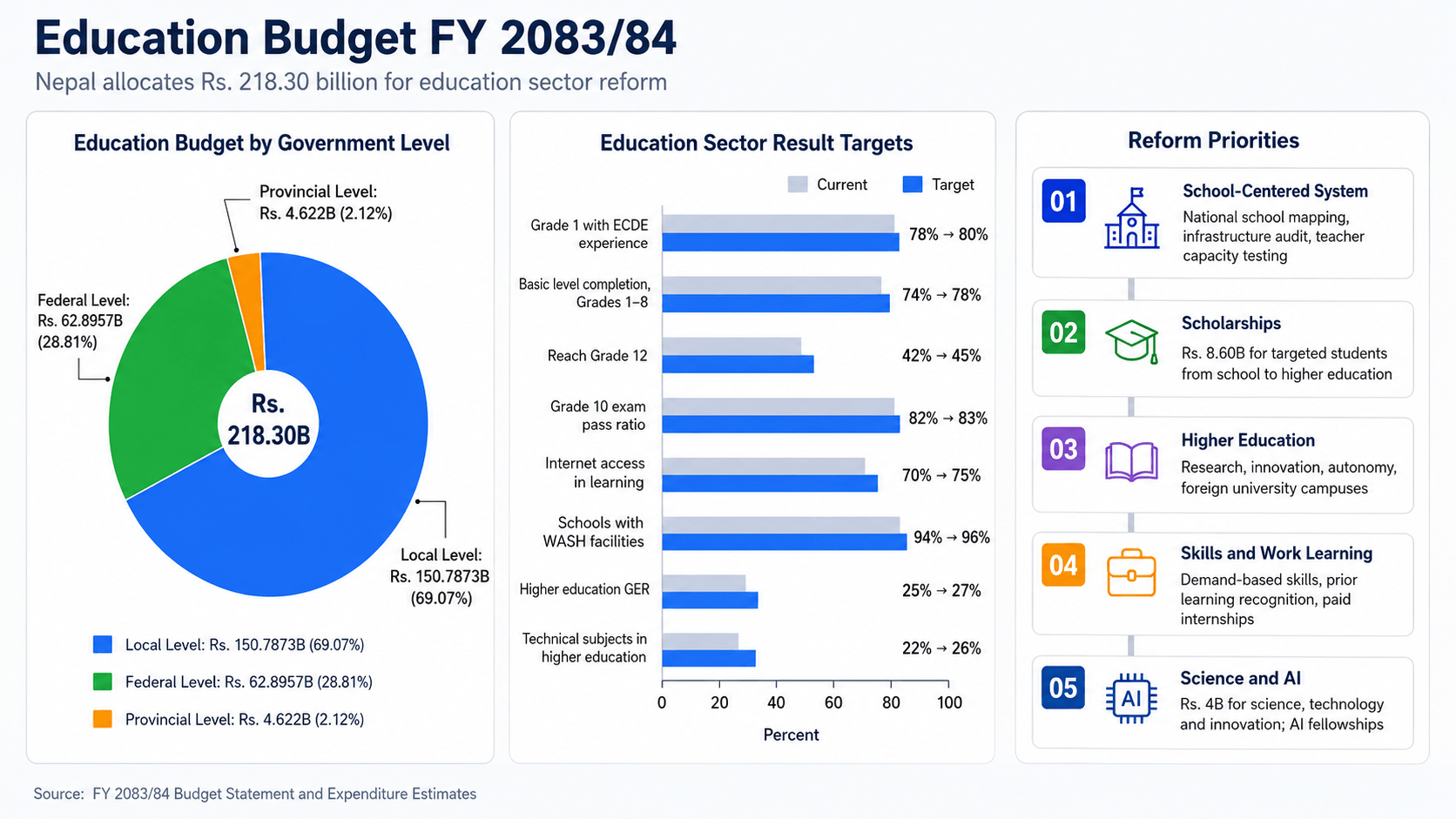
In the budget for Fiscal Year 2083/84, Rs. 218.30 billion has been allocated for the education sector. The budget has introduced programs to transform school education into a “school-centered system,” conduct national school mapping, school infrastructure audits, teacher capacity testing, and AI and ed-tech readiness assessments. Rs. 1 billion has been set aside to identify infrastructure needs in community schools.
Rs. 8.60 billion has been allocated for targeted student scholarships from the school level to higher education. The budget states that a “Clean Toilet Campaign” will be conducted in all educational institutions, residential schools will be operated for communities lagging behind in the Human Development Index, and residential model schools with infrastructure will be operated for children with autism.
In higher education, a policy has been adopted to restructure universities as centers of research, innovation, knowledge production, and national capacity building. The budget announces policy arrangements for foreign universities to operate campuses in Nepal, academic, administrative, and financial autonomy for universities, and study opportunities under the Open University for youths working in foreign employment.
Quotas in medical, nursing, information technology, and other higher education fields will be reviewed and increased within the current fiscal year. Programs in four disciplines of medical education, including MBBS, will be conducted from the academic session 2083/84 at Shahid Dashrath Chand University of Health Sciences in Geta.
In technical education, provisions have been made to expand a demand-based skills system, institutionalize the National Qualifications Framework, recognition of prior learning, and a paid internship system. Rs. 4 billion has been allocated for science, technology, and innovation. The budget also includes a program to provide fellowships to at least 15 Nepali researchers with international recognition in the AI field and invite them to return to Nepal and contribute.
1. Total Allocation for the Education Sector
The budget statement mentions that Rs. 218.30 billion has been allocated for the education sector.
In the schedule of ministry-wise expenditure estimates, a total of Rs. 218.305 billion is shown under the heading “Ministry of Education and Sports.”
Under this ministry-wise allocation:
-
Federal Level: Rs. 62.8957 billion
-
Provincial Level: Rs. 4.622 billion
-
Local Level: Rs. 150.7873 billion
-
Share of Total Budget Estimate: 10.28 percent
2. Education Heading in Functional Expenditure Estimates
In the schedule of functional expenditure estimates, Rs. 59.2387 billion is mentioned under the heading “Education.” The subheading-wise details are as follows:
-
Pre-primary and Primary Education: Rs. 424.9 million
-
Education Not Classified by Level, i.e., Non-formal Education: Rs. 2.0254 billion
-
Support Services for Education: Rs. 56.1076 billion
-
Education Research and Development: Rs. 680.7 million
-
Education Not Elsewhere Classified: Rs. 100,000
-
Share of Education Heading in Functional Expenditure Estimates: 2.79 percent
3. School Education and System Reform
-
Systemic restructuring has been announced for the overall educational ecosystem.
-
National school mapping will be carried out.
-
School infrastructure audits will be conducted.
-
Teacher capacity testing will be conducted.
-
AI and ed-tech readiness assessments will be carried out.
-
Investment in school education will be increased to expand innovation- and skills-centered education.
-
The education system will be transformed into a “school-centered system.”
-
A policy has been adopted to accept parental support for improving educational quality and building infrastructure.
-
School Management Committees have been described as a means of ensuring education.
-
A “Clean Toilet Campaign” will be conducted in all educational institutions.
-
Rs. 1 billion has been allocated to map the infrastructure needs of community schools across the country.
-
Student and teacher exchange programs will be conducted for students studying in Grades 5 to 8 and teachers of community schools in different provinces.
-
Residential schools will be operated to ensure access to basic education for communities lagging behind in the Human Development Index.
-
The residential school program will begin with the Chepang community of Chitwan district.
-
Residential model schools with infrastructure will be operated for children with autism.
4. Scholarships
Rs. 8.60 billion has been allocated for targeted student scholarships from the school level to higher education.
5. Higher Education
-
Higher education will be restructured as a center of research, innovation, knowledge production, and national capacity building.
-
Policy arrangements and incentives will be provided for top-ranked universities of international standard to operate campuses in Nepal.
-
An academic exchange program will be started between Nepali and foreign professors.
-
Universities will be provided academic, administrative, and financial autonomy.
-
Legal arrangements will be made to operate universities under a cost-sharing model.
-
Youths in foreign employment will be provided study opportunities under the Open University.
-
Quotas currently imposed in various fields of higher education, including medicine, nursing, and information technology, will be reviewed and increased within the current fiscal year.
6. Medical Education and Health Science-Related Education Programs
-
At Shahid Dashrath Chand University of Health Sciences in Geta, Sudurpaschim Province, programs in four disciplines of medical education, including MBBS, will be conducted from the academic session 2083/84.
-
Tribhuvan University Teaching Hospital, the National Academy of Medical Sciences, and Patan Academy of Health Sciences will be developed as international-standard universities.
-
These institutions will be made capable of providing education to foreign students as well.
-
Under the public-public partnership model, major government hospitals in all seven provinces will be gradually transformed into teaching hospitals and specialized health service centers.
-
Investable resources available in the Employees Provident Fund, Citizen Investment Trust, and Social Security Fund will be mobilized for health infrastructure, medical education, and expansion of specialized services.
7. Skills, Technical Education, and Work-Linked Learning
-
A demand-based skills system directly linked with industry and the labor market will be expanded.
-
The National Qualifications Framework will be implemented.
-
Recognition of prior learning will be implemented to give formal recognition to the skills of migrant, informal, and experienced workers.
-
The paid internship system will be institutionalized.
-
Youths will be made skilled by conducting short-term thematic and workplace-based training programs.
-
Arrangements will be made so that workers go for foreign employment only after learning skills.
-
A returnee migrant program will be implemented to make use of the knowledge, skills, and competence of those returning from foreign employment.
-
The number of local levels where the Safe Migration Program has been expanded is targeted to increase from 557 to 626.
-
The number of people receiving vocational and skills development training is targeted to increase from 5,000 to 5,500 per year.
-
The share of skilled workers going for foreign employment is targeted to increase from 76.2 percent to 77 percent.
-
The number of people benefiting annually from the reintegration program is targeted to increase from 5,000 to 5,200.
-
The number of people receiving entrepreneurship, employment-oriented, and skills development training is targeted to increase from 0 to 3,000.
-
The number of prisoners receiving skills-based training is targeted to increase from 1,000 to 4,000.
8. Science, Technology, Research, and Innovation
-
At least 1 percent of capital expenditure has been allocated for science, technology, research, and innovation.
-
Rs. 4 billion has been allocated for science, technology, and innovation.
-
Funds have been allocated to conduct research, innovation, and entrepreneurship enhancement programs to provide young scientists with research opportunities within the country.
-
Funds have been allocated to establish an observatory center at Everest Base Camp to promote astronomical tourism.
-
Rs. 500 million has been allocated for the Nepal Enterprise Facility. It is stated that this facility will move forward in an integrated manner with policy arrangements related to enterprises, identification of and access to innovative financial instruments, a support network with incubation, and a domestic enterprise campaign.
9. AI and Education/Research
-
The country’s first “Sovereign AI Compute Center” will be established in Syuchatar, Kathmandu.
-
Thousands of AI processing units will be purchased to provide subsidized computing capacity to AI entrepreneurs and startups.
-
In the coming fiscal year, prestigious fellowships will be provided to at least 15 Nepali researchers who have earned international recognition in the field of AI.
-
Such researchers will be invited to return to Nepal and contribute.
-
Educational disciplines, including mathematics, which will play an important role in the AI era, will be given high priority.
10. Art, Literature, Music, and Study
-
Studies related to music, art, and literature will be promoted across the country.
-
Support will be provided to establish a Guthi Research Institute and Ethnomusicology Center on the premises of Tripureshwar Mahadev Temple, which is registered in the Rajguthi records.
11. Student Development Linked with Sports
-
Students with special interest and ability in sports will be selected from the basic level of school.
-
Arrangements will be made to provide such students with training along with residential facilities.
12. Equity Fee in Education and Health Services
A provision has been made to impose an equity fee at a minimum rate on education and health services provided by the private sector to support the construction of education and health infrastructure and the expansion of services in remote areas.
13. Skills Promotion Fee in Revenue Estimates
In the schedule of revenue estimates, under taxes based on goods and services, an estimated revenue of Rs. 20,186 lakh has been mentioned for Fiscal Year 2083/84 under the heading “Skills Promotion Fee.”
14. Result Targets for the Education Sector
The budget schedule sets the following education- and skills-related targets:
-
Children Enrolling in Grade 1 with Early Childhood Development and Education Experience: From 78 percent to 80 percent
-
Completion Rate of Basic Level Grades 1–8 Compared to the Appropriate Age Group: From 74 percent to 78 percent
-
Rate of Reaching Secondary Level up to Grade 12 Compared to the Appropriate Age Group: From 42 percent to 45 percent
-
Student Pass Ratio in the Grade 10 Public Examination, Including Regular and Supplementary: From 82 percent to 83 percent
-
Educational Institutions with Internet Access in Teaching and Learning: From 70 percent to 75 percent
-
Proportion of Schools with WASH Facilities: From 94 percent to 96 percent
-
Gross Enrollment Rate in Higher Education: From 25 percent to 27 percent
-
Share of Students Studying Technical Subjects in Higher Education: From 22 percent to 26 percent
-
Annual Skills Testing and Certification: From 700,000 to 735,000
-
Number Receiving Workplace-Based Training, Apprenticeship: From 3,423 to 3,983
.jpg)


Comments 0
No comments yet. Be the first to start the conversation.