



Budget 2083/84: Sector-Wise Summary
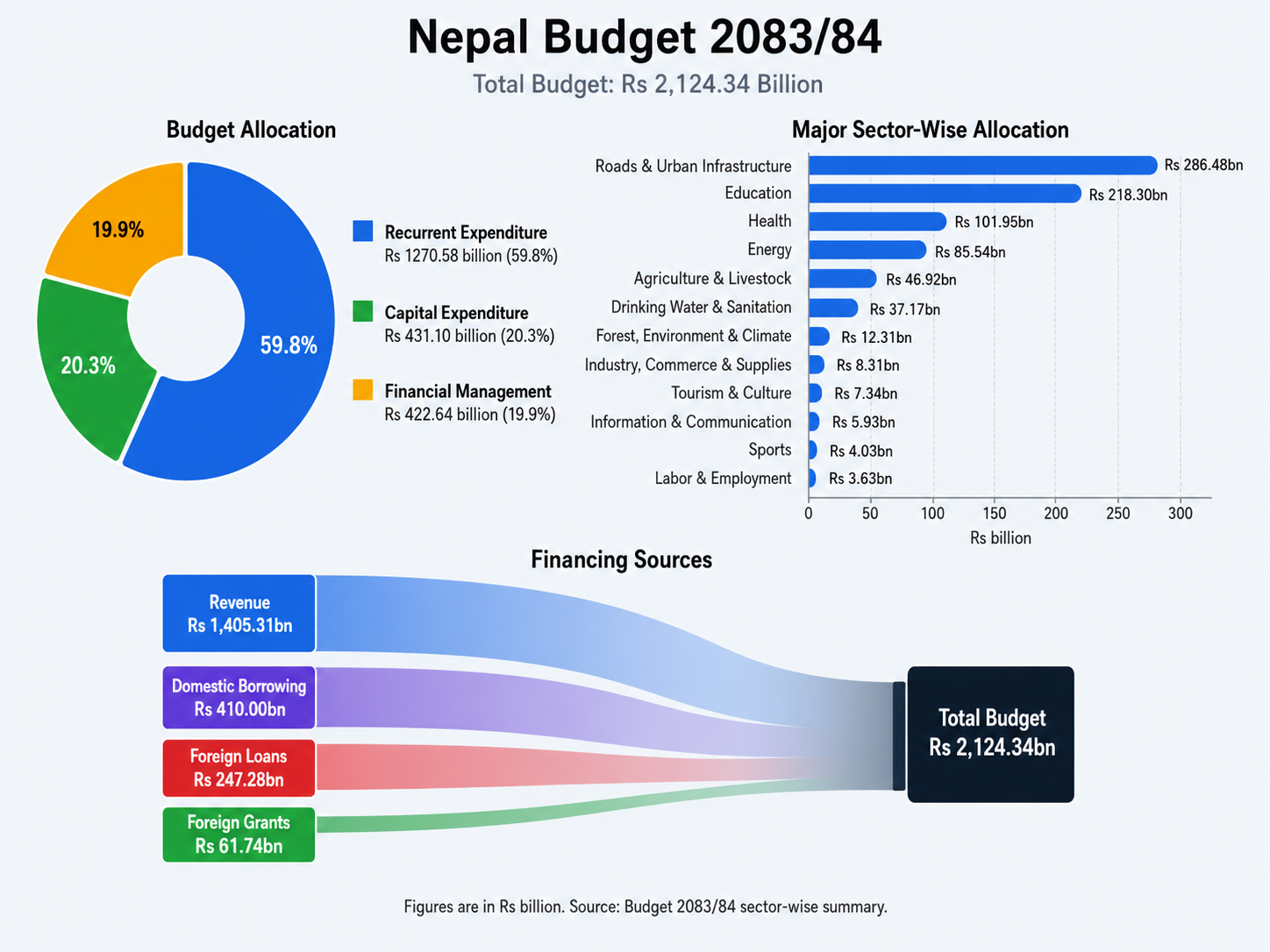
For fiscal year 2083/84, the government has introduced a total budget of Rs 2,124.34 billion. Rs 1,270.58 billion has been allocated for recurrent expenditure, Rs 431.10 billion for capital expenditure, and Rs 422.64 billion for financial management.
Main Sources and Expenditure
-
Total Budget: Rs 2,124.34 billion
-
Recurrent Expenditure: Rs 1,270.58 billion
-
Capital Expenditure: Rs 431.10 billion
-
Financial Management: Rs 422.64 billion
-
To Be Covered from Revenue: Rs 1,405.31 billion
-
Foreign Grants: Rs 61.74 billion
-
Foreign Loans: Rs 247.28 billion
-
Domestic Borrowing: Rs 410 billion
Tax and Revenue
-
The personal income tax exemption threshold has been doubled to Rs 1 million for individuals.
-
The maximum personal income tax rate has been reduced by 10 percentage points.
-
Customs duty has been reduced on 273 types of industrial raw materials.
-
The customs duty structure has been limited from 11 tiers to seven tiers.
-
Excise duty imposed on 360 goods has been abolished.
-
Taxes including the infrastructure development tax and road maintenance and improvement fee have been merged into the green tax.
-
A provision will be implemented to provide a 10 percent rebate on value-added tax for purchases made through digital payments.
-
For pending tax disputes, if the determined tax amount is paid with an additional 1 percent, fees, fines, additional charges, late fees, or interest will be waived.
Government Structure and Expenditure Cuts
-
The number of federal ministries has been fixed at 18, down from 22.
-
A total of 31 agencies will be dissolved, six agencies will be merged, six agencies will be transferred, and 18 agencies will be restructured.
-
Office operating expenses have been reduced.
-
Budget allocations for training expenses outside training centers and for equipment such as cameras and televisions have been removed.
-
It is initially estimated that around Rs 20 billion will be saved through expenditure cuts.
-
The starting salary scale of civil servants has been increased by 10 percent.
-
A monthly incentive allowance of 10 percent of the new salary scale will be provided.
Investment and Legal Reforms
-
Company law will be amended to make the company liquidation process easier.
-
The provision allowing Nepali citizens to invest abroad will be made easier.
-
Prior approval from Nepal Rastra Bank will not be required for repatriating foreign investment; providing information will be sufficient.
-
Under the “Investment Express” concept, an automatic route system will be implemented within three months.
-
A policy has been adopted to issue offshore bonds, clean energy bonds, and diaspora bonds.
-
A “Motherland Fund” will be established to invest in strategic projects.
Public Enterprises
-
The federal government will retain 66 percent shares in Nepal Telecom, while the remaining shares will be sold to the public.
-
The proceeds will be used to develop Nepal as a “tech hub.”
-
There is a plan to convert Nepal Airlines Corporation into a company.
-
Shares of Rastriya Jeevan Beema Company and Bishal Bazar Company will be issued to the general public.
-
Assets and liabilities of seven public enterprises, including Gorakhkali Rubber Industry, will be evaluated.
Information Technology and AI
-
A “Sovereign AI Compute Center” will be established at Syuchatar in Kathmandu.
-
Thousands of AI processing units will be purchased to provide concessional computing capacity to AI entrepreneurs and startups.
-
A fintech marketplace will be established under the supervision of Nepal Rastra Bank.
-
Dozens of government services will be linked to the Nagarik App.
-
Rs 5.93 billion has been allocated for the information and communication sector.
Energy
-
The target is to add 1,040 megawatts of electricity to the national transmission system, including 670 megawatts from hydropower and 370 megawatts from solar power.
-
The target is to raise total installed capacity to 5,535 megawatts.
-
The 40-megawatt Rahughat Hydropower Project will be completed.
-
The 1,061-megawatt Upper Arun, 828-megawatt Uttarganga, 210-megawatt Chainpur Seti, 99-megawatt Tamakoshi-5, and 77-megawatt Ghunsakhola projects will be advanced.
-
Rs 70 billion has been allocated for transmission lines and substations.
-
Rs 85.54 billion has been allocated for energy generation, transmission, and distribution line construction.
-
Nepal Electricity Authority will be divided into three separate companies for generation, transmission, and distribution/trade.
Roads, Bridges, and Urban Infrastructure
-
Around 1,000 kilometers of roads will be blacktopped.
-
The target is to construct 275 road bridges.
-
The East-West Highway will be upgraded to four lanes within five years.
-
Rs 37.46 billion has been allocated for the East-West Highway.
-
Rs 17.64 billion has been allocated for the Kathmandu-Tarai/Madhesh Fast Track.
-
Rs 4.65 billion has been set aside to complete the Postal Highway within three years.
-
A total of Rs 286.48 billion has been allocated for roads and urban infrastructure development.
Drinking Water and Sanitation
-
The target is to provide safe and clean drinking water services to 65 percent of citizens within three years and to all citizens within five years.
-
Rs 2.50 billion has been allocated to complete 280 incomplete drinking water projects in Tarai-Madhesh.
-
A study will be conducted to transfer water from the Yangri and Larke rivers to Melamchi.
-
Rs 7.26 billion has been allocated for expanding pipe networks in various places of Kathmandu Valley.
-
Rs 37.17 billion has been allocated for drinking water and sanitation.
Irrigation
-
The target is to provide irrigation facilities to an additional 15,800 hectares of cultivable land.
-
The share of irrigated cultivable land will be raised to 64 percent.
-
Rs 5.63 billion has been allocated for the Babai Irrigation and Bheri-Babai Diversion projects.
-
Rs 2.55 billion has been allocated for the Sikta Irrigation Project.
-
Rs 2.98 billion has been set aside for the Sunkoshi-Marin Diversion Project.
Agriculture and Livestock
-
Rs 46.92 billion has been allocated for agriculture and livestock development.
-
Rs 32.46 billion has been set aside for the purchase of chemical fertilizers.
-
A pilot program will be introduced to provide up to 40 percent incentive grants to farmers who invest at least Rs 20 million as initial capital.
-
Up to 80 percent premium subsidy will be provided for agriculture and livestock insurance.
-
Rs 2.19 billion has been allocated for agricultural insurance premium subsidies.
-
Rs 2.07 billion has been set aside for the National Agricultural Modernization Program.
Forest, Environment, and Climate
-
Rs 12.31 billion has been allocated for the forest, environment, and climate sector.
-
Around Rs 1 billion has been set aside to make the water cycle sustainable in the Chure and Tarai-Madhesh areas.
-
Procurement will begin after fixing support prices for medicinal herbs and non-timber forest products.
-
A medicinal herb processing center will be established in Karnali.
-
Drones and satellites will be used for wildfire control.
Industry, Commerce, and Supplies
-
Rs 8.31 billion has been allocated for the industry, commerce, and supplies sector.
-
Rs 220 million has been set aside to convert 100 industries to electric or bio-briquette-based boilers.
-
Rs 650 million has been allocated for industrial infrastructure development.
-
Rs 500 million has been allocated for industrial and mining access roads.
-
Rs 1.18 billion has been allocated for production-based incentive programs.
Startup and Innovation
-
Nepal Enterprise Facility will be established.
-
Rs 500 million has been allocated for this facility.
-
Startup facilities will be provided to 1,000 young entrepreneurs who want to engage in agricultural and livestock enterprises.
-
Rs 4 billion has been allocated for science, technology, and innovation.
-
At least 1 percent of capital expenditure has been allocated for science, technology research, and innovation.
Tourism, Culture, and Civil Aviation
-
Preparations will be made for Visit Nepal Year 2085 and Nepal Arogya Year 2027.
-
Rs 830 million has been allocated for the Greater Lumbini Development Program.
-
Janakpur will be developed as a wedding destination.
-
Rs 1.53 billion has been allocated for upgrading Tribhuvan International Airport.
-
The construction modality of Nijgadh International Airport will be finalized within six months.
-
Rs 7.34 billion has been allocated for culture and tourism, and Rs 2.93 billion for civil aviation.
Education
-
Rs 218.30 billion has been allocated for the education sector.
-
Rs 1 billion has been set aside for mapping the infrastructure needs of community schools.
-
Rs 8.60 billion has been allocated for student scholarships.
-
Medical education programs, including MBBS, will be conducted from academic session 2083/84 at Shahid Dasharath Chand University of Health Sciences in Geta.
-
Quotas for higher education in medicine, nursing, information technology, and other fields will be reviewed and increased.
Health
-
Rs 101.95 billion has been allocated for the health sector.
-
Rs 15 billion has been set aside for the health insurance program.
-
Rs 13.15 billion has been allocated for programs including treatment for poor citizens, safe motherhood, and free medicines.
-
The target is to complete 336 basic hospitals within the next three years.
-
Rs 5.90 billion has been set aside for the operation of basic hospitals and infrastructure construction.
-
The target is to bring 90 percent of Nepalis under health insurance coverage within the next three years.
-
Cancer treatment for children will be provided free of cost in government hospitals.
Social Security, Women, and Children
-
Rs 120 billion has been allocated for social security.
-
The child nutrition allowance for Dalit children has been doubled to Rs 1,000 per month.
-
Rs 3 billion has been set aside for nutrition support for Dalit children under five years of age.
-
Rs 2.27 billion has been allocated for women, children, gender, and sexual minorities.
-
Disability rehabilitation centers will be expanded to all provinces.
-
Residential model schools will be operated for children with autism.
Labor, Employment, and Foreign Employment
-
Rs 3.63 billion has been allocated for the labor and employment sector.
-
Workers and employers will be mandatorily linked to the labor registry.
-
Written agreements, minimum wages, insurance, workplace safety, and payment of remuneration through banks will be made mandatory.
-
A Returnee Migrant Program will be introduced for those who have returned from foreign employment.
-
A system will be introduced under which workers go for foreign employment only after acquiring skills.
-
A lottery program based on remittance receipts will be operated to encourage formal remittances.
Sports
-
Rs 4.03 billion has been allocated for the sports sector.
-
Ten football stadiums will be upgraded with floodlights within three years.
-
Modern cricket stadiums will be built in eight major cities within five years.
-
Indoor multipurpose stadiums will be constructed in Biratnagar, Lahan, Kathmandu, Pokhara, Butwal, Surkhet, and Fapla in Dhangadhi.
Banking, Insurance, and Cooperatives
-
A personal credit scoring system will be implemented.
-
Peer-to-peer transactions will be operated under regulation.
-
A policy has been adopted to provide loans at long-term fixed interest rates in the agriculture, industry, tourism, and hydropower sectors.
-
A National Asset Management Company will be established by the end of Poush to manage non-performing loans and non-banking assets.
-
Third-party insurance coverage will be raised to Rs 1 million.
-
The process of returning deposits to depositors of troubled cooperatives will be continued.
Provinces and Local Levels
-
Fiscal Equalization Grant for Provinces: Rs 61.50 billion
-
Fiscal Equalization Grant for Local Levels: Rs 90.20 billion
-
Complementary Grant for Provinces: Rs 4.60 billion
-
Complementary Grant for Local Levels: Rs 8.93 billion
-
Special Grant for Provinces: Rs 3.82 billion
-
Special Grant for Local Levels: Rs 9.40 billion
-
Conditional Grant for Provinces: Rs 39.72 billion
-
Conditional Grant for Local Levels: Rs 206.08 billion
-
Estimated Transfer Through Revenue Sharing: Rs 175 billion to provinces and local levels
-
Estimated Mobilization Through Revenue Sharing and Fiscal Transfers: More than Rs 600 billion at provincial and local levels
.jpg)



Comments 0
No comments yet. Be the first to start the conversation.