



Budget 2083/84: Rs 2,124.34 Billion Allocated; What Has Been Included Sector-Wise?
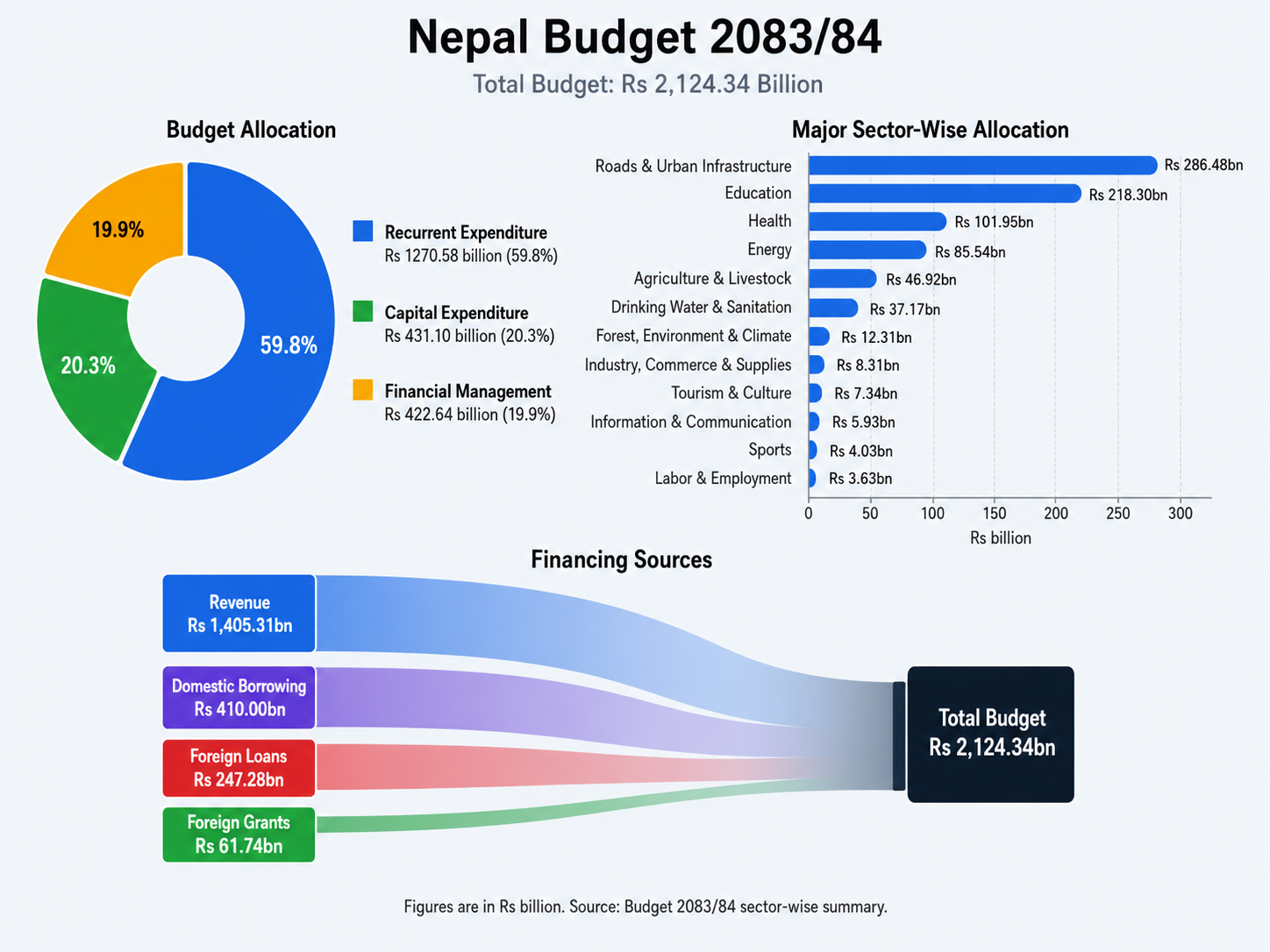
Finance Minister Dr. Swarnim Wagle has presented a total budget of Rs 2,124.34 billion for fiscal year 2083/84. Of the total allocation, Rs 1,270.58 billion has been set aside for recurrent expenditure, Rs 431.10 billion for capital expenditure, and Rs 422.64 billion for financial management.
According to the budget, the sources of expenditure will include Rs 1,405.31 billion from revenue, Rs 61.74 billion from foreign grants, Rs 247.28 billion from foreign loans, and Rs 410 billion from domestic borrowing. Here is the sector-wise budget 2083/84 summary.
Tax and Revenue
The budget has doubled the personal income tax exemption threshold to Rs 1 million for individuals. The maximum personal income tax rate has been reduced by 10 percentage points.
Customs duty on industrial raw materials has been reduced for 273 types of raw materials so that it remains at least one level lower than that imposed on finished goods. The budget has announced that the existing 11-tier customs duty structure will be limited to seven tiers.
Excise duty currently imposed on 360 goods has been abolished. Scattered taxes collected at customs points, such as the infrastructure development tax and road maintenance and improvement fee, have been incorporated into the green tax.
The budget states that a provision will be implemented to provide a 10 percent rebate on value-added tax at the time of invoice issuance for purchases made through digital payments. It has also announced that the VAT refund system will be automated and lottery-like programs will be introduced to encourage an invoice culture.
For tax disputes under consideration in courts or judicial bodies, if taxpayers pay the determined tax amount with an additional 1 percent within the prescribed deadline, the case will be withdrawn, and fees, fines, additional charges, late fees, or interest will be waived.
A 50 percent tax exemption has been provided on income earned from the export of information technology services. The budget has also arranged a 100 percent exemption in taxable income calculation for sweat equity received by human resources working in the information technology sector.
Excise duty has been increased by up to around 10 percent on cigarettes and on liquor and beer. The budget states that the Department of Revenue Investigation will be dissolved and its functions will be carried out through sectoral agencies.
Government Structure, Expenditure Cuts, and Employee Benefits
In the context of reducing the number of federal ministries from 22 to 18, the budget has announced the dissolution of 31 agencies, merger of six agencies, transfer of six agencies, and restructuring of 18 agencies. It states that office operating expenses will be reduced, budget allocations for training expenses outside training centers and for equipment such as cameras and televisions will be removed, and the practice of establishing various funds to provide facilities will be ended. These measures are initially estimated to save around Rs 20 billion.
The starting salary scale of civil servants has been increased by 10 percent. The budget states that a monthly incentive allowance equal to 10 percent of the new salary scale has also been arranged, resulting in a net increase of around 21 percent in the remuneration currently being received. The new salary scale will come into effect from Shrawan 1, 2083. Related details on the Nepal government salary scale are expected to receive attention following the announcement.
Investment, Law, and Financial Instruments
The budget states that company laws will be amended to bring clarity on conflict of interest, disclosure of details, and company liquidation procedures. It has announced that arrangements allowing Nepali citizens to invest abroad will be made easier, and that prior approval from Nepal Rastra Bank will no longer be required for the repatriation of foreign investment; notification will be sufficient.
Under the “Investment Express” concept, an automatic route system will be implemented within three months. The budget states that services ranging from company and industry registration, financial services, participation in the tax system, and visa applications will be connected to this system.
The budget has arranged for the issuance of offshore bonds, clean energy bonds, and diaspora bonds in Nepali currency in the international market; the establishment of a “Motherland Fund”; and hedging services to reduce exchange risk in projects funded through foreign loans or investment.
Public Enterprises and Capital Market
The budget has announced that the federal government will retain 66 percent shares in Nepal Telecom, while the remaining shares will be sold to the public by the end of Poush. The proceeds will be used to develop Nepal as a “tech hub.”
Nepal Airlines Corporation will be converted into a company to improve management and identify a method for strategic partnership. There is also a plan to issue shares of Rastriya Jeevan Beema Company and Bishal Bazar Company to the general public.
In the capital market, the restructuring of Nepal Stock Exchange will be advanced, and intraday trading, short selling, and derivative instruments will be introduced in phases. The budget states that a zero-tolerance policy will be adopted against share cornering and insider trading.
Information Technology and AI
The budget has announced the establishment of the country’s first “Sovereign AI Compute Center” at Syuchatar in Kathmandu. Thousands of AI processing units will be purchased to provide concessional computing capacity to AI entrepreneurs and startups.
A fintech marketplace will be established under the supervision of Nepal Rastra Bank. Dozens of government services will be linked to the Nagarik App, and arrangements will be made for information technology software used in government agencies to be procured through a single agency.
Rs 5.93 billion has been allocated for the information and communication sector. Related discussions on artificial intelligence are expected to become more relevant with the budget’s AI-focused initiatives.
Roads, Bridges, Railways, and Urban Infrastructure
The target for the upcoming fiscal year is to blacktop around 1,000 kilometers of roads and construct 275 road bridges. The budget states that the East-West Highway will be upgraded to four lanes within five years, the upgrading of the Kamala-Kanchanpur and Narayangadh-Butwal road sections will be completed, and 80 kilometers of roads will be upgraded in the Kakarbhitta-Laukahi, Kamala-Bagmati, Butwal-Gorusinge, and Dhankhola-Lamahi sections. Rs 37.46 billion has been allocated for the East-West Highway.
Rs 17.64 billion has been allocated to complete the construction of 40 bridges and 5.4 kilometers of tunnels on the Kathmandu-Tarai/Madhesh Fast Track. Rs 4.65 billion has been set aside to complete the Postal Highway within three years.
Rs 28.52 billion has been allocated for the road maintenance campaign, Rs 2.46 billion for road safety, and Rs 3.17 billion to remove obstructions on highways caused by landslides.
Rs 1.83 billion has been allocated to build identity-based cities in 12 locations around the Mid-Hill Highway. Rs 4.19 billion has been allocated for waste management in major cities, the sewage-free river campaign, and promotion of greenery.
A total of Rs 286.48 billion has been allocated for roads and urban infrastructure development.
Drinking Water and Sanitation
To address drinking water shortages during the dry season in the Tarai-Madhesh region, the budget states that community-level systems with deep boring will be developed and an arsenic-free Tarai campaign will be launched. Rs 2.50 billion has been allocated to complete 280 incomplete drinking water projects in Tarai-Madhesh.
Rs 7.26 billion has been allocated for programs to complete studies on transferring water from the Yangri and Larke rivers to Melamchi, and to expand pipe networks in places including Kirtipur, Madhyapur Thimi, Jorpati, Pepsicola, Nagarjun, and Mahalaxmi.
Rs 3.46 billion has been allocated to complete wastewater treatment plants with a daily capacity of 72.7 million liters at Sallaghari, Kodku, Dhobighat, Gokarna, and Hanumanghat in Kathmandu Valley.
Rs 37.17 billion has been allocated for drinking water and sanitation.
Energy and Electricity
The budget has set a target of adding 1,040 megawatts to the national transmission system in the upcoming fiscal year, including 670 megawatts from hydropower projects and 370 megawatts from solar projects. The total installed capacity is targeted to reach 5,535 megawatts.
The 40-megawatt Rahughat Hydropower Project will be completed. The Tanahu Storage Project, Upper Modi A, Upper Modi, Upper Trishuli-3B, and Budhiganga projects will be expedited.
Financial arrangements will be made and the contract process will begin for the 1,061-megawatt Upper Arun, 828-megawatt Uttarganga, 210-megawatt Chainpur Seti, 99-megawatt Tamakoshi-5, and 77-megawatt Ghunsakhola projects.
Rs 70 billion has been allocated for transmission lines and substations under construction. Rs 85.54 billion has been allocated for energy generation, transmission, and distribution line construction.
The budget has announced that Nepal Electricity Authority will be divided into three separate companies for electricity generation, transmission, and distribution/trade. The private sector will be allowed to trade electricity in the international market.
Irrigation
The target for the upcoming fiscal year is to provide irrigation facilities to an additional 15,800 hectares of cultivable land. The budget states that this will raise the share of irrigated cultivable land to 64 percent.
Rs 5.63 billion has been allocated to provide irrigation to 1,066 hectares of land through the Babai Irrigation Project and to construct headworks for the Bheri-Babai Diversion Project.
Rs 2.55 billion has been allocated to provide additional irrigation to 5,000 hectares of land in the eastern and western areas of Banke through the Sikta Irrigation Project. Rs 2.98 billion has been set aside for the Sunkoshi-Marin Diversion Project.
Rs 1.83 billion has been allocated to provide underground irrigation facilities to an additional 3,980 hectares of land in Tarai-Madhesh. Rs 800 million has been set aside for lift irrigation in agricultural terraces in hill and mountain regions.
Agriculture, Livestock, and Land Management
Rs 46.92 billion has been allocated for agriculture and livestock development. The allocation for purchasing chemical fertilizers has been increased to Rs 32.46 billion.
The budget has announced a pilot program under which the government will provide up to 40 percent incentive grants to farmers who invest at least Rs 20 million as initial capital for agricultural and livestock production. The grant will be reimbursed at the rate of 10 percent annually for four consecutive years from the date production begins.
The budget has set a direction to provide up to 80 percent premium subsidy on agriculture and livestock insurance while gradually removing other subsidies. Rs 2.19 billion has been set aside for premium subsidies for agricultural insurance.
Rs 2.07 billion has been allocated for the National Agricultural Modernization Program, while Rs 360 million has been allocated for transferring conditional grants to local levels to promote organic fertilizer and green manure.
The budget states that mango processing centers in Siraha and Saptari, a tomato processing center in Sarlahi, and fruit zones and cold storage facilities for apples, walnuts, and other fruits in Karnali will be advanced. These programs are linked to broader issues of agriculture in Nepal.
Forest, Environment, and Climate
Rs 12.31 billion has been allocated for the forest, environment, and climate sector. Around Rs 1 billion has been set aside for protecting water sources, constructing ponds, controlling landslides, and building embankments to make the water cycle sustainable in the Chure and Tarai-Madhesh areas.
The budget has announced that support prices will be determined and procurement will begin for medicinal herbs and non-timber forest products. It also includes establishing a herb processing center in Karnali, using drones and satellites for wildfire control, and upgrading air pollution measurement centers in major cities and the central environmental laboratory.
Industry, Commerce, and Supplies
Rs 8.31 billion has been allocated for the industry, commerce, and supplies sector. Emphasis has been placed on operating employment-linked production sectors, clean energy-based technologies in industrial areas and industrial corridors, replacing traditional boilers with electric boilers, and access infrastructure in mining areas.
Rs 220 million has been allocated to convert 100 industries to electric or bio-briquette-based boilers, Rs 650 million for industrial infrastructure development, and Rs 500 million for industrial and mining access roads.
Rs 1.18 billion has been allocated for production-based incentive programs. The budget states that the Integrated Check Post in Bhairahawa will be brought into operation and the Integrated Check Post under construction in Chandani-Dodhara will be completed within two years.
Startup, Science, and Innovation
The budget has announced the establishment of the Nepal Enterprise Facility as a platform to connect startups and small and medium enterprises with the national enterprise ecosystem. Rs 500 million has been set aside for the Nepal Enterprise Facility.
Startup facilities will be provided to 1,000 young entrepreneurs who want to engage in agricultural and livestock enterprises. Rs 4 billion has been allocated for science, technology, and innovation. Related guidance on startup business may be useful for readers following these programs.
Tourism, Culture, and Civil Aviation
The budget states that preparations will be made to successfully conduct Visit Nepal Year 2085 and Nepal Arogya Year 2027. Physical and financial incentives will be provided for the construction and operation of resorts and hotels targeting high-value tourists.
Rs 830 million has been allocated for the Greater Lumbini Development Program. Programs include developing Janakpur as a wedding destination, upgrading the Ram-Janaki Path and Ram-Janaki Parikrama Road, and developing the Great Himalayan Trail and Danphe Route.
Rs 1.53 billion has been allocated for upgrading Tribhuvan International Airport. The construction modality for Nijgadh International Airport will be finalized within six months. The budget has also announced cooperation with the private sector in the operation and management of Gautam Buddha and Pokhara Regional International Airports, and night flights at Bharatpur Airport.
Rs 7.34 billion has been allocated for culture and tourism, and Rs 2.93 billion for civil aviation.
Education
Rs 218.30 billion has been allocated for the education sector. Rs 1 billion has been set aside for mapping the infrastructure needs of community schools across the country.
The budget has announced that programs in four disciplines of medical education, including MBBS, will be conducted from the academic session 2083/84 at Shahid Dasharath Chand University of Health Sciences in Geta, Sudurpaschim Province.
Rs 8.60 billion has been allocated for targeted student scholarships from school level to higher education. The budget states that youths in foreign employment will be given study opportunities under the Open University, policy arrangements will be made for foreign universities to operate campuses in Nepal, and residential schools will be operated for communities lagging behind in the Human Development Index.
Health
Rs 101.95 billion has been allocated for the health sector. Of this, Rs 15 billion has been set aside for the health insurance program. Rs 13.15 billion has been allocated for health social security programs, including treatment for poor citizens, the Safe Motherhood Program, and free medicines.
The target is to complete 336 basic hospitals whose construction has started within the next three years. Rs 5.90 billion has been allocated for the operation of basic hospitals and infrastructure construction.
The budget states that cancer treatment for children will be provided free of cost in government hospitals, construction of a kidney disease treatment center and trauma center will begin in Madhesh Province, air ambulance service will start in remote areas of Karnali, and night duty allowance for nursing staff will be doubled.
The health insurance program will be restructured, with a target of bringing 90 percent of Nepalis under the health insurance coverage within the next three years.
Women, Children, Social Security, and Inclusion
Rs 120 billion has been allocated for social security. The child nutrition allowance provided to Dalit children across the country has been doubled to Rs 1,000 per month. The nutrition allowance received by children in 25 districts of Madhesh, Karnali, and Sudurpaschim provinces with high poverty and low Human Development Index has been continued.
Rs 3 billion has been allocated for nutrition support for children under five years of age from the Dalit community. Rs 2.27 billion has been allocated for women, children, gender, and sexual minorities.
The budget includes programs to gradually establish disability rehabilitation centers in all provinces, operate residential model schools for children with autism, and support family reunification and social rehabilitation of street children and senior citizens.
Labor, Employment, and Foreign Employment
Rs 3.63 billion has been allocated for the labor and employment sector. Workers and employers will be mandatorily linked to the labor registry. The budget states that written agreements, minimum wages, insurance, workplace safety standards, and payment of remuneration through banks will be made mandatory in the labor sector.
A Returnee Migrant Program will be introduced to utilize the knowledge, skills, and competencies of those who have returned from foreign employment. The budget also states that arrangements will be made for workers to go for foreign employment only after acquiring skills, and a lottery program based on each remittance receipt will be operated to encourage remittances entering through formal channels.
Sports
Rs 4.03 billion has been allocated for the sports sector. The budget has announced that 10 football stadiums with a capacity of at least 8,000 spectators will be upgraded with floodlights within the next three years, and modern cricket stadiums will be built in eight major cities within five years.
Indoor multipurpose stadiums with a capacity of at least 2,000 will be constructed within the next three years in Biratnagar, Lahan, Kathmandu, Pokhara, Butwal, Surkhet, and Fapla of Dhangadhi.
Banking, Insurance, and Cooperatives
The budget has announced that the Banks and Financial Institutions Act and the Banking Offence and Punishment Act will be amended in line with the changing context. A personal credit scoring system will be implemented, and peer-to-peer transactions will be operated under regulation.
The budget mentions a policy of providing loans at long-term fixed interest rates to the agriculture, industry, tourism, and hydropower sectors. It has announced that a National Asset Management Company will be established by the end of Poush to manage rising non-performing loans and non-banking assets.
At least 20 percent of the sum insured issued by Nepali insurance companies will be reinsured through Nepal Reinsurance Company. The budget states that third-party insurance coverage will be raised to Rs 1 million, insurance for accidents, critical illness, and transport will be made mandatory, and insurance will be compulsory while approving building maps in urban areas.
The process of returning deposits to depositors of troubled cooperatives through the Integrated Depositor Protection Fund will be continued.
Governance, Security, and Federalism
The budget states that a law on conflict of interest will be formulated to end policy-level corruption. Hello Sarkar will be developed as a government-citizen dialogue platform, digital time cards will be implemented in government offices, and the national identity card will be made the basic identity document for public service delivery.
An electronic court management system will be expanded in the justice system, and free legal aid programs will be operated for poor citizens and those living in remote areas.
Rs 2 billion has been allocated to upgrade housing for Nepal Army personnel. The Armed Police Force, Nepal, will be developed as a dedicated force for international border security, and prisons will gradually be transformed into correctional facilities.
The budget states that work detailing will be reviewed to remove duplication of powers, responsibilities, and performance among the federal, provincial, and local levels, and disputes over double taxation will be resolved through legal reforms.
Fiscal Transfers to Provinces and Local Levels
Fiscal equalization grants of Rs 61.50 billion will be provided to provinces and Rs 90.20 billion to local levels. Complementary grants of Rs 4.60 billion and Rs 8.93 billion have been set aside for provinces and local levels, respectively, for implementing infrastructure projects.
Special grants of Rs 3.82 billion for provinces and Rs 9.40 billion for local levels have been allocated. Conditional grants of Rs 39.72 billion for provinces and Rs 206.08 billion for local levels have been allocated for implementing federal government projects.
It is estimated that a total of Rs 175 billion will be transferred to provinces and local levels through revenue sharing. The budget states that more than Rs 600 billion will be mobilized at the provincial and local levels through revenue sharing and fiscal transfers.

.jpg)



Comments 0
No comments yet. Be the first to start the conversation.