



Information Technology, AI, Startup, Science and Innovation Budget FY 2083/84
The Fiscal Year 2083/84 budget covers information technology, AI, startups, science, research, innovation, digital public services, fintech, ed-tech, skills education and technical higher education through separate programs, tax concessions, institutional reforms and targeted indicators.
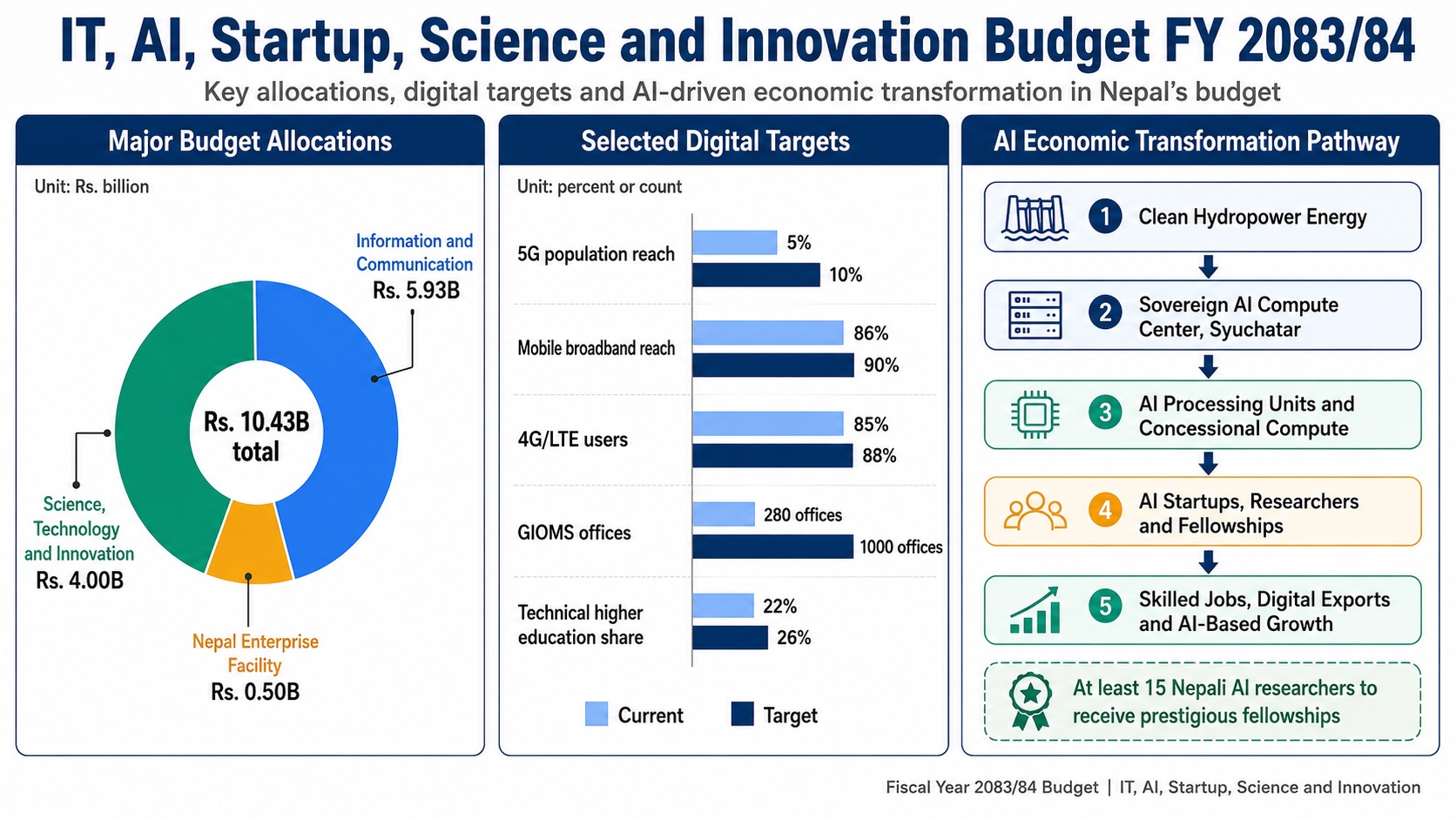
Rs. 5.93 billion has been allocated for the information and communication sector, Rs. 4 billion for science, technology and innovation, and Rs. 500 million for the Nepal Enterprise Facility.
Key Allocations
-
Rs. 5.93 billion allocated for the information and communication sector.
-
Rs. 4 billion allocated for science, technology and innovation.
-
Rs. 500 million allocated for the Nepal Enterprise Facility.
-
Rs. 4 billion and 400 thousand shown in the ministry-wise expenditure estimate for the Ministry of Science, Technology and Innovation.
-
Rs. 5.936 billion shown in the ministry-wise expenditure estimate for the Ministry of Information and Communication.
-
Total Rs. 218.305 billion allocated for the Ministry of Education and Sports; this also includes programs related to AI, ed-tech, innovation, skills, technical higher education and research.
Information Technology Infrastructure and Digital Services
-
The government has stated that special attention will be given to expanding information technology infrastructure.
-
The federal government will retain 66 percent shares in Nepal Telecom, and the remaining shares will be sold to the public by the end of Poush.
-
The amount received from the sale of Nepal Telecom’s remaining shares will be used to make Nepal a “tech hub.”
-
A provision has been made to allow investment abroad for the expansion of the information technology service sector.
-
Arrangements will be made to allow people living in Nepal to work for foreign employers.
-
Clear legal provisions will be arranged to attract remote work.
-
Information technology software used in government agencies will be procured through a single agency.
-
Investment in digital public infrastructure development will be increased.
-
A fintech marketplace will be established under the supervision of Nepal Rastra Bank.
-
Dozens of government services will be linked to the Nagarik App.
AI-Related Programs
-
The budget states that special initiatives will be launched to help Nepal enter the era of artificial intelligence with confidence.
-
The country’s first “Sovereign AI Compute Center” will be established at Syuchatar, Kathmandu.
-
Thousands of AI processing units will be purchased.
-
Concessional compute capacity will be made available to AI entrepreneurs and startups.
-
A proposal has been made to transform clean hydropower energy into high-value AI compute services.
-
Nepal’s energy strength will be used for the development of artificial intelligence to build the foundation for skilled employment, digital exports and AI-based economic transformation.
-
In the coming fiscal year, prestigious fellowships will be provided to at least 15 Nepali researchers who are building international recognition in the AI sector.
-
Those researchers will be invited to return to Nepal and contribute.
-
Academic disciplines, including mathematics, which will play an important role in the AI era, will be given high priority.
-
An AI factory has also been included among projects of strategic importance to be invested in through the Motherland Fund.
-
An e-assessment system using artificial intelligence will be developed for revenue investigation and audit.
-
Emphasizing the use of technology in Nepal Police investigation and prosecution processes, the budget states that investment will be increased in the use of artificial intelligence in investigation and the development of forensic laboratories.
Startups and Innovation
-
The budget has announced that new enterprises, or startups, innovation and entrepreneurship will be made the basis of economic transformation.
-
Startups will be aligned with identification, skills, market access and financial access.
-
Profit-linked tax concessions will be provided.
-
Early access will be provided in public procurement.
-
The startup operating system will be strengthened through digital registration and regulatory facilitation.
-
Startup financing will not be limited only to loans.
-
Grants will be arranged in the initial stage.
-
Concessional loans will be made available for enterprises with proven feasibility.
-
Growth capital will be arranged in the expansion stage.
-
Co-investment from the private sector and non-resident Nepalis will be encouraged.
-
A minimum of 1 percent of capital expenditure has been allocated for science, technology research and innovation.
-
The Nepal Enterprise Facility will be established as a platform to connect startups, small and medium enterprises with the national enterprise ecosystem.
-
The Nepal Enterprise Facility will move forward in an integrated manner with enterprise-related policy arrangements, identification of and access to innovative financial instruments, a support network including incubation, and a domestic enterprise campaign.
-
Startup facilities will be provided to 1,000 young entrepreneurs who want to operate agriculture and livestock-based enterprises.
Science, Technology, Research and Innovation
-
Funds have been allocated to operate a research, innovation and entrepreneurship enhancement program to provide young scientists with research opportunities within the country.
-
Funds have been allocated to establish an observatory center at Everest Base Camp to promote astronomical tourism.
-
Rs. 4 billion has been allocated for science, technology and innovation.
-
The ministry-wise expenditure estimate of the Ministry of Science, Technology and Innovation shows a total of Rs. 4 billion and 400 thousand.
-
Of this ministry’s allocation, Rs. 1.783 billion is under recurrent expenditure and Rs. 2.2174 billion is under capital expenditure.
-
The full amount for the ministry will be borne from the Government of Nepal/internal source.
Education, Ed-Tech and Skills-Related Provisions
-
Systemic restructuring will be carried out in the overall educational ecosystem.
-
National school mapping will be conducted.
-
School infrastructure audits will be conducted.
-
Teacher capacity testing will be conducted.
-
AI and ed-tech readiness assessment will be conducted.
-
Based on these, investment in school education will be increased to expand innovation- and skills-focused education.
-
The education system will be transformed into a “school-centered system.”
-
Higher education will be restructured as a center for research, innovation, knowledge production and national capacity building.
-
The current quotas imposed in various fields of higher education, including medicine, nursing and information technology, will be reviewed and significantly increased within the current fiscal year.
-
A demand-based skills system directly linked with industry and the labor market will be expanded.
-
The National Qualifications Framework will be implemented.
-
Recognition of prior learning will be implemented to formally recognize the skills of migrant, informal and experienced workers.
-
A paid internship system will be institutionalized.
-
Youths will be made skilled through short-term subject-based and workplace-based training in various areas.
-
A provision will be made for workers to go for foreign employment only after acquiring skills.
-
The Returnee Migrant Program will be implemented to utilize the knowledge, skills and competencies of those who have returned from foreign employment.
-
Youths in foreign employment will be provided study opportunities under the Open University.
-
Rs. 8.60 billion has been allocated for scholarships for targeted students from school level to higher education.
-
Rs. 1 billion has been allocated to map the infrastructure needs of community schools.
Information and Communication Sector Programs
-
The Telecommunications Authority Bill will be presented in Parliament.
-
Access to quality telecommunication services will be expanded by accelerating the use of the latest technology.
-
Quality telephone service and network expansion will be carried out in Karnali and Sudurpashchim provinces.
-
Various structures established for government printing will be merged to establish an integrated secure printing institution.
-
Business activities through social networks registered in Nepal will be encouraged.
-
Rs. 330 million has been allocated for public welfare advertisements through print and electronic media.
-
Rs. 5.93 billion has been allocated for the information and communication sector.
Tax, Investment and the Information Technology Industry
-
To move the information technology industry forward as the nation’s new economic engine, a 50 percent tax exemption has been provided on income earned from the export of such services.
-
A provision has been made to grant a 100 percent exemption in the calculation of taxable income for sweat equity amounts received by human resources working in the information technology sector.
-
A revenue policy has been adopted to develop the formal economy by connecting all economic transactions through digital means.
-
The objective is to develop an automated, technology-friendly, integrity-based and motivated tax administration.
-
A provision will be implemented under which consumers making purchases through digital payment will receive a 10 percent discount on value added tax at the time the invoice is issued.
-
The value added tax refund system will be automated.
-
Programs such as lotteries will be launched to encourage the culture of issuing and receiving invoices in the purchase and sale of goods or services.
-
All businesses with annual transactions above Rs. 100 million that issue electronic invoices will be mandatorily linked to the Central Invoice Monitoring System.
-
Small businesses will be encouraged to receive payments through electronic means.
-
Digital excise duty stamps will be introduced.
-
An electronic track and trace system will be introduced to control excise duty leakage.
-
Paperless, faceless and contactless revenue administration will be developed.
-
Arrangements will be made to provide services such as filing tax returns, making payments and receiving refunds automatically.
Fintech, Digital Finance and Capital Market
-
A fintech marketplace will be established under the supervision of Nepal Rastra Bank.
-
A personal credit scoring system will be implemented.
-
“Peer-to-peer,” or P2P, transactions will be operated with regulation.
-
National and international payment aggregators and the National Payment Switch will be made effective so that commercial banks and payment-related institutions can enter into agreements with international payment networks.
-
Legal and institutional arrangements will be made for the regulation of payment aggregators.
-
The capital market will be strengthened through a technology-friendly trading system.
-
Restructuring of the Nepal Stock Exchange will be taken forward, and intraday, short selling and derivative instruments will be introduced in phases.
Investment, Venture Capital and Intellectual Property
-
A limited liability partnership law will be formulated.
-
The budget states that this will encourage angel investment to invest in venture capital and private equity funds.
-
Convertible instruments, project-linked funding and other hybrid instruments will be included within the scope of foreign investment.
-
The process of sending service fees, royalties and technology-related payments abroad will be simplified.
-
A law related to intellectual property protection will be formulated soon.
-
A provision will be made to provide loans based on the credit assessment of individuals and businesses after analyzing overall past economic activities.
-
A separate tribunal will be established for the speedy resolution of commercial disputes.
Digital Government and Public Services
-
The Hello Sarkar mechanism will be developed as a government-citizen dialogue platform.
-
Digital time cards will be implemented in government offices.
-
The National Identity Card will be used as the basic identity document for public service delivery.
-
Systems related to citizen services such as land revenue, transport, passports, personal event registration and social security management will be strengthened.
-
The “Electronic Court Management System” will be expanded by making maximum use of information technology to make the justice system faster and more effective.
-
Concerned agencies will be linked to an integrated information system for the management of proceeds of crime.
-
A Governance Innovation Challenge Fund will be established to strengthen federalism and improve local services.
Technology, Digital Systems and Innovation in Other Sectors
-
The agricultural service system will be transformed into a “farmer-centered service system.”
-
Access to agricultural services at farmers’ doorsteps will be expanded year-round through agricultural technical services, digital agricultural information and private service providers.
-
Necessary funds have been arranged to provide underground irrigation facilities using smart technology in Sarlahi and Dhanusha districts.
-
Arrangements will be made to carry out land and house freezing and release, purchase and sale, and revenue payment through an online system.
-
Real-time information exchange will be carried out using drones and satellites for wildfire control.
-
Telemedicine services will be expanded in remote areas, including Karnali and Sudurpashchim, and specialist health services will be ensured through video consultation.
-
A one citizen, one digital profile system will be implemented for real-time monitoring in all health institutions.
-
Physical structures, digital technology, websites and software developed by government offices will gradually be developed in formats usable by persons with all types of disabilities.
-
In the labor sector, the budget mentions that standards for digital grievance management will be determined for services provided by institutions supplying construction, agriculture, hospitality, transport and industrial workers, in addition to security guards and domestic workers.
Information Technology Sector Targets
The budget’s target indicators include the following indicators related to communication and information technology:
-
Telephone access expansion, SIM users: from 102.48 percent to 103 percent.
-
Optical fiber expansion, 24 core and above: from 20,000 kilometers to 21,500 kilometers.
-
4G/LTE service users: from 85 percent to 88 percent.
-
Radio reach: from 95 to 96.
-
Television reach: from 82 percent to 86 percent.
-
Express Mail Service expansion: from 60 percent to 65 percent.
-
Countries where Express Mail Service has expanded: from 42 to 45.
-
Fixed broadband service expansion: from 52.1 percent to 52 percent.
-
Mobile broadband service expansion, including 3G, 4G and 5G: from 86 percent to 90 percent.
-
Population reached by 5G service: from 5 percent to 10 percent.
-
Government offices where the integrated government office management system, GIOMS, has been implemented: from 280 to 1,000.
-
Employment created through information technology: from 5,000 to 5,000.
-
Contribution of the information technology sector to gross domestic product: from 1.95 percent to 1.98 percent.
-
E-Government Development Index: from 0.59 to 0.61.
-
Global Cybersecurity Index: from 69.76 to 69.76.
-
Information technology systems linked to digital platforms: from 67 to 69.
-
Establishment of secure printing press: from 1 to 1.
Education, Skills and Technical Education Targets
-
Educational institutions with internet access for teaching and learning: from 70 percent to 75 percent.
-
Share of students studying technical subjects in higher education: from 22 percent to 26 percent.
-
Annual skills testing and certification: from 700,000 to 735,000.
-
Number receiving workplace-based training, Apprenticeship: from 3,423 to 3,983.
-
Number receiving vocational and skills development training per year: from 5,000 to 5,500.
-
Share of skilled workers going for foreign employment: from 76.2 percent to 77 percent.
-
Number receiving entrepreneurship, employment-oriented and skills development training: from 0 to 3,000.
Science, Research and Innovation Targets
-
Number of scientific research works: from 500 to 520.
-
National investment in research and technology development as a share of gross domestic product: from 0.5 percent to 0.6 percent.
-
National/international patent registrations: from 96 to 106.
-
Promotional programs in science, national/international conferences, competitions and Olympiads organized: from 27 to 30.
-
Patents registered in the industrial sector: from 2 to 5.
Enterprise, Startup and Employment Targets
-
Additional employment creation from large, medium, small domestic and micro enterprises: from 169,000 to 200,000.
-
Registration of large industries: from 1,547 to 1,617.
-
Registration of medium industries: from 2,233 to 2,283.
-
Industrial villages brought into operation: from 4 to 7.
-
Self-employment created through the Youth Self-Employment Fund: from 11,000 to 12,000.
-
Employment to be created through interest subsidy: from 200,000 to 230,000.
-
Employment creation from investment made in Sana Kisan Bikas Laghubitta Bittiya Sanstha: from 135,000 to 140,000.
-
Employment creation for marginalized, highly marginalized and Dalit women: 700 persons.
Related Ministries in the Gender-Responsive Budget
Amount in Rs. lakh:
Ministry of Science, Technology and Innovation
-
Direct benefit: 36,458.
-
Indirect benefit: 3,546.
-
Neutral: 0.
-
Total: 40,004.
Ministry of Information and Communication
-
Direct benefit: 0.
-
Indirect benefit: 15,911.
-
Neutral: 43,449.
-
Total: 59,360.
Ministry of Education and Sports
-
Direct benefit: 92,441.
-
Indirect benefit: 536,516.
-
Neutral: 0.
-
Total: 628,957.
Related Ministries in the Climate Change Budget
Amount in Rs. lakh:
Ministry of Science, Technology and Innovation
-
Direct benefit: 36,458.
-
Indirect benefit: 3,546.
-
Neutral: 0.
-
Total: 40,004.
Ministry of Information and Communication
-
Direct benefit: 0.
-
Indirect benefit: 0.
-
Neutral: 59,360.
-
Total: 59,360.
Ministry of Education and Sports
-
Direct benefit: 0.
-
Indirect benefit: 70,670.
-
Neutral: 558,287.
-
Total: 628,957.
.jpg)



Comments 0
No comments yet. Be the first to start the conversation.