



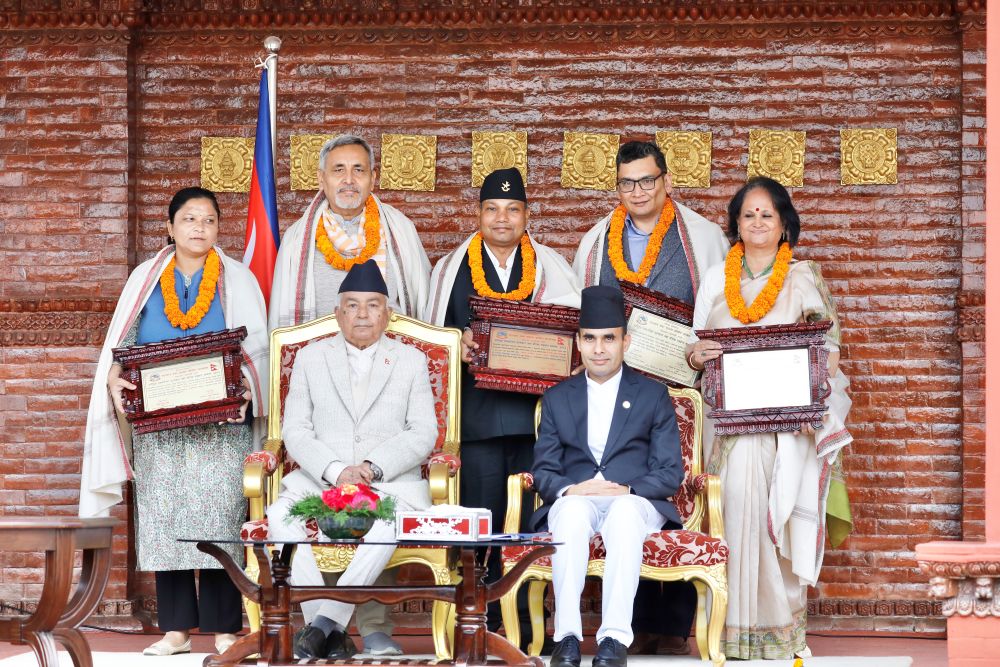
President Ramchandra Paudel Honors Five Journalists
Kathmandu, Baishakh 24: President Ramchandra Paudel honored and awarded five journalists on the occasion of National Journalism Day 2083. The awards were presented at a ceremony organized by the Ministry of Communications and Information Technology.
Senior journalists Chandrakishor Jha and Namrata Sharma were honored with the Senior Journalist Honor. Bhola Paswan, Umesh Shrestha, and Rupa Gahtoraj received the National Journalism Award.
All five honorees received Rs. 200,000 each along with a certificate of honor.
Addressing the program, President Paudel expressed confidence that a responsible press would play a more effective role in strengthening the federal democratic republic and fulfilling the contemporary aspirations for good governance, development, progress, and economic prosperity.
President Paudel recalled the remarkable role played by Nepali journalism in Nepal’s political, social, and cultural transformation. He said the Constitution guarantees press and freedom of expression and that it is the responsibility of the state to create an environment where journalists can disseminate news fearlessly and independently.
He said it is the duty of a responsible press to inform the public by disseminating truthful and factual news. He expressed confidence that the Nepali press would remain alert and vigilant in this regard.
Stating that journalism is a carrier of change and a strong medium for nation-building, he made it clear that democracy is an essential condition for independent, impartial, and neutral journalism.
President Paudel said the situation in which journalists feel unsafe merely for writing news must come to an end. He said all sides should pay attention to ensuring conditions where journalists can collect and disseminate news in a safe and risk-free environment.
He emphasized the need for coordination between the government and the private sector to protect the rights and interests of working journalists and ensure the financial sustainability of media houses.
Referring to the growing use of social media and citizen journalism along with the development of information technology, he said the risk of spreading baseless and false information has increased. He expressed confidence that the Nepali press would be capable of addressing this challenge through responsible journalism and information verification skills.
President Paudel said the Senior Journalism Honor and the National Journalism Award are state recognition of the path journalists have shown society through their writing for decades and the contribution they have made.
He expressed confidence that the dedication of the award-winning journalists would inspire the new generation of journalists to continue on the path of professional integrity and truth.
Independent and Dignified Journalism Is Necessary: Communication Minister
Speaking at the program, Minister for Communications and Information Technology Dr. Bikram Timilsina said independent, impartial, and dignified journalism is indispensable for strengthening democracy.
Addressing the National Journalism Day 2083 and award distribution ceremony, he said the Constitution of Nepal guarantees full press freedom.
Minister Timilsina made it clear that the government is not in favor of imposing any kind of restriction on the press. He said responsibility and accountability are also linked with freedom, and only journalism based on facts and truth can guide society in the right direction.
He said technology-friendly and responsible journalism in the digital age is a foundation of good governance. He added that this year’s National Journalism Day slogan, “Responsible Technology-Friendly Journalists as the Foundation of Good Governance,” provides direction for modern journalism.
Stating that the rapid global development of information technology has brought both opportunities and challenges to the communication sector, Minister Timilsina said the professionalism and sustainability of media outlets, from print media to online media, are government priorities.
He also informed that the ministry is preparing to formulate the Advertisement Policy 2083 to make policy arrangements in the interest of media outlets.
Referring to the risk of confusion and division in society due to misuse of social media and fake news, he pointed out the need to develop fact-checking as an important part of journalism.
Stating that the government is committed to the full implementation of the Working Journalists Act, he informed that more effective steps would be taken for journalists’ minimum remuneration, professional security, and career development.
Minister Timilsina said journalism is not only a carrier of information but also a catalyst for social justice and prosperity. He said media outlets have an important role in bringing issues of development, good governance, and social transformation to the people.
He said criticism should be fact-based, objective, and constructive.
He also informed that the government is preparing to formulate various laws related to the communication sector. He said the goal is to make the journalism sector more organized, dignified, and modern while promoting the welfare of journalists.
National Journalism Day has been observed in memory of the historic day when Gorkhapatra began publication on Baishakh 24, 1958 B.S.
Commitment to Make the Communication Sector Organized and Technology-Friendly
At the program, Ministry Secretary Laxmi Kumari Basnet expressed the ministry’s commitment to continuously facilitate media outlets for the strengthening of democracy, promotion of good governance, and protection of citizens’ right to be informed.
She said the ministry has prioritized the formulation and revision of new policies and laws to make the mass communication sector more organized, dignified, and technology-friendly through systemic guarantees.
Acting President of the Federation of Nepali Journalists, Deepak Acharya, said journalism has made a distinct contribution to social transformation. He urged that the media be regulated by amending the Press Council Act.
Honored journalist Bholakumar Paswan said the government should also include Dalit and marginalized communities while formulating communication policy.
.jpg)




Comments 0
No comments yet. Be the first to start the conversation.