



Private School Operators Demand Repeal of 3% Equity Education Service Fee and Express Dissatisfaction with Tenth Amendment to Education Rules
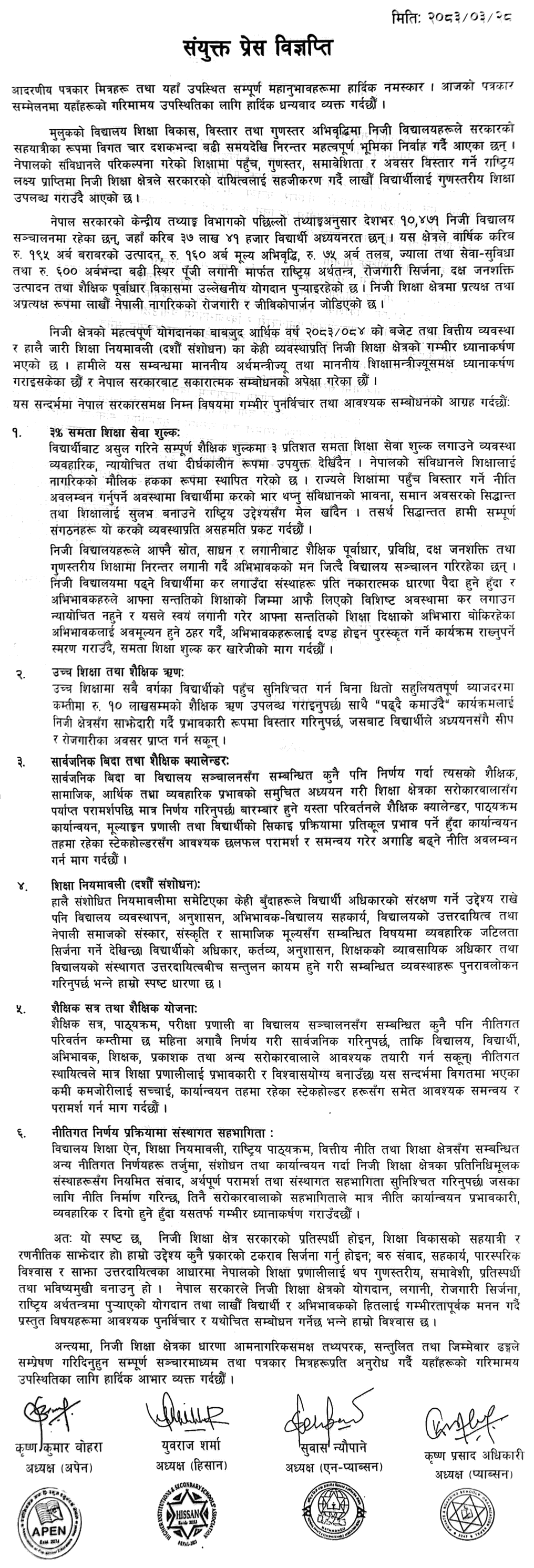
Four umbrella organizations active in the private education sector have expressed serious concern over certain provisions of the budget and financial arrangements for fiscal year 2083/84 and the recently issued “Education Rules (Tenth Amendment).” In a joint press statement issued on 28 Ashadh 2083 BS, they demanded that the government repeal the 3% Equity Education Service Fee collected from students and reconsider the provisions of the amended Rules.
The joint press statement was signed by Krishna Kumar Bohara, President of the Association of Private Educational Institutions Nepal (APEN); Yubaraj Sharma, President of the Higher Institutions and Secondary Schools’ Association Nepal (HISSAN); Subas Neupane, President of the National Private and Boarding Schools’ Association Nepal (N-PABSON); and Krishna Prasad Adhikari, President of the Private and Boarding Schools’ Organization Nepal (PABSON).
Citing the latest data from the Government of Nepal’s Central Bureau of Statistics, the statement said that 10,471 private schools are operating across the country, with approximately 3.741 million students enrolled. It presented data showing that the private education sector contributes significantly to the national economy and employment generation through annual output of approximately Rs. 195 billion, value addition of Rs. 160 billion, Rs. 75 billion in salaries, wages, and benefits, and more than Rs. 600 billion in fixed capital investment.
Despite these contributions, the organizations expressed dissatisfaction with the government’s approach and policies toward the private education sector and drew the government’s serious attention to the following six issues:
1. Demand to Repeal the 3% Equity Education Service Fee
The organizations concluded that the provision imposing a 3% Equity Education Service Fee on all educational fees collected from students is impractical and unjustified. They stated that adding a tax burden on students is inconsistent with the national objective and the spirit of the Constitution, which recognizes education as a fundamental right.
Expressing their disagreement with the provision, the organizations demanded that the fee be repealed. They said that parents who bear responsibility for their children’s education should be rewarded rather than penalized.
2. Higher Education and Educational Loan Provisions
The organizations demanded that students from all social and economic groups be provided access to education loans in Nepal of at least Rs. 10 lakh without collateral and at concessional interest rates to ensure access to higher education.
They also emphasized that the “Study While Earning” programme should be expanded effectively in partnership with the private sector.
3. Public Holidays and the Academic Calendar
The organizations demanded that any decision concerning public holidays or school operations be made only after adequate consultation with stakeholders in the education sector.
The statement noted that frequent changes of this nature adversely affect the academic calendar, curriculum implementation, and students’ learning processes.
4. Reconsideration of the Education Rules (Tenth Amendment)
The organizations stated that some provisions included in the recently amended Rules appear likely to create practical difficulties in matters concerning school management, discipline, parent-school cooperation, and school accountability.
They called for a review of the relevant provisions to ensure a balance among students’ rights, duties, and discipline; teachers’ professional rights; and schools’ institutional accountability.
5. Advance Notice of Academic Sessions and Educational Plans
The organizations demanded that any policy change related to the academic session, curriculum, examination system, or school operations be decided and made public at least six months in advance.
They said this would enable schools, students, parents, teachers, and publishers to make the necessary preparations.
6. Institutional Participation in Policy Decisions
The organizations demanded regular dialogue and institutional participation involving representative bodies from the private education sector when formulating, amending, or making policy decisions concerning the School Education Act, Education Rules, national curriculum, financial policies, and other related matters.
In conclusion, the organizations clarified that the private education sector is not a competitor of the government but a partner in education development and a strategic stakeholder. They stated that they were prepared to work through dialogue and cooperation to make Nepal’s education system more competitive and improve its quality.
Considering the sector’s contribution to the economy and the interests of millions of students and parents, the organizations requested the government to address their demands appropriately.

Comments 0
No comments yet. Be the first to start the conversation.