



TU Central Campus FSU Submits 21-Point Suggestions to Newly Appointed Vice-Chancellor
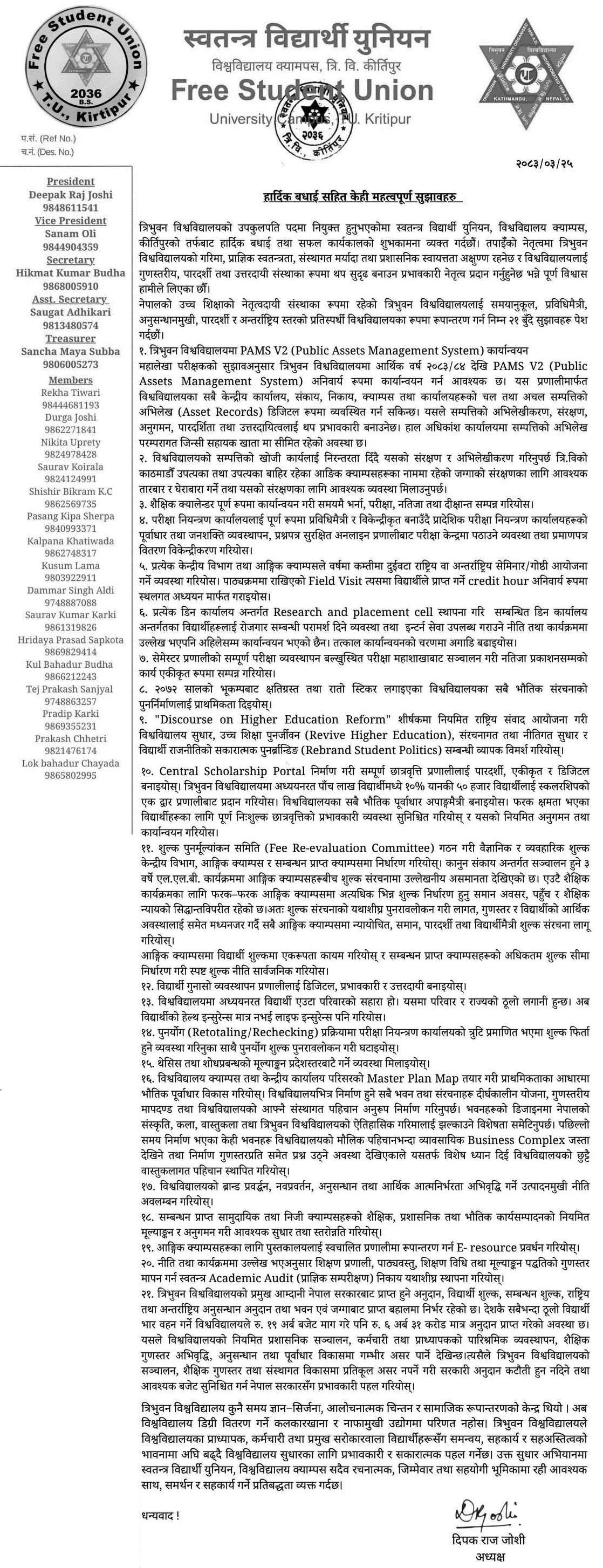
The Free Student Union (FSU) of Tribhuvan University (TU) Central Campus, Kirtipur, has congratulated the newly appointed Vice-Chancellor and extended best wishes for a successful tenure while submitting 21 important suggestions for TU reform. The suggestions were submitted through an attention letter dated 2083 Asar 25, signed by FSU President Deepak Raj Joshi.
The FSU has presented the following suggestions to transform TU into a timely, technology-friendly, research-oriented, transparent, and internationally competitive university:
Academic and Examination Reforms
The academic calendar should be fully implemented to complete admission, examinations, results, and convocation on time.
The Office of the Controller of Examinations should be made technology-friendly and decentralized by sending question papers to examination centers through an online system and decentralizing certificate distribution.
The entire examination management of the semester system should be operated from the Examination Division at Balkhu, and the work up to result publication should be carried out in an integrated manner.
In the retotaling/rechecking process, if an error by the Office of the Controller of Examinations is proven, there should be a provision for refunding the fee. The retotaling fee should also be reviewed and reduced.
Arrangements should be made to evaluate theses and dissertations from the provincial level itself.
Property Management and Physical Infrastructure
As suggested by the Office of the Auditor General, PAMS V2 (Public Assets Management System) should be mandatorily implemented in all TU central offices, faculties, bodies, and campuses, and records of movable and immovable assets should be managed digitally.
The university’s property should be identified, protected, and recorded, and land located inside and outside the valley should be fenced and enclosed.
Priority should be given to the reconstruction of all university physical structures damaged by the 2015 earthquake and marked with red stickers.
A Master Plan Map of the university campus and central office premises should be prepared, and physical infrastructure should be developed on a priority basis. New buildings should reflect Nepali culture, art, architecture, and TU’s historical dignity, and should not look like commercial business complexes.
Scholarship, Fees, and Student Welfare
A Central Scholarship Portal should be created to make the entire scholarship system transparent, integrated, and digital, and scholarship arrangements should be made for 10% of around 500,000 students, meaning 50,000 students.
Physical infrastructure should be made disability-friendly, and a full free scholarship should be arranged for students with different abilities.
A Fee Re-evaluation Committee should be formed to determine scientific and practical fees. Uniformity in fees should be maintained in constituent campuses, and the maximum fee limit for affiliated campuses should be determined and made public.
Students should have not only health insurance but also life insurance.
The student grievance management system should be made digital, effective, and accountable.
Research and Academic Quality
Each central department and constituent campus should organize at least two national or international seminars/conferences every year, and the credit hours students receive from field visits included in the curriculum should mandatorily be fulfilled through field-based study.
A Research and Placement Cell should be established and implemented under each Dean’s Office.
Regular national dialogue should be organized under the title “Discourse on Higher Education Reform,” with broad discussion on the revival of higher education and the positive rebranding of student politics. This is related to wider discussion on Nepal Higher Education Reform Priorities.
As mentioned in the policy and program, an independent Academic Audit body should be established as soon as possible to measure the quality of the teaching system, course content, teaching methods, and evaluation system.
E-resource should be promoted to transform libraries of constituent campuses into automated systems.
The academic, administrative, and physical performance of affiliated community and private campuses should be regularly evaluated and monitored for upgrading.
Budget and Policy Matters
TU’s main income depends on student fees and grants from the Government of Nepal. Drawing attention to the situation where the country’s largest university had requested a budget of Rs. 19 billion but received only Rs. 6.31 billion as a grant from the government, the FSU suggested that initiatives should be taken with the government to prevent budget cuts and ensure the required budget.
A production-oriented policy should be adopted to promote the university’s brand, innovation, research, and economic self-reliance.
The letter expresses the FSU’s commitment that, to ensure TU does not become merely a factory for distributing degrees but becomes a center of knowledge creation, critical thinking, and social transformation, the FSU will always provide support, backing, and cooperation in constructive and reform-oriented campaigns.
Note: Although the information entered by the user mentions the name of the Vice-Chancellor and the contexts of Kanti Boys Hostel and the Botany building, those details are not included in the uploaded official letter. Therefore, this news has been prepared based on the source.
.jpg)


Comments 0
No comments yet. Be the first to start the conversation.