



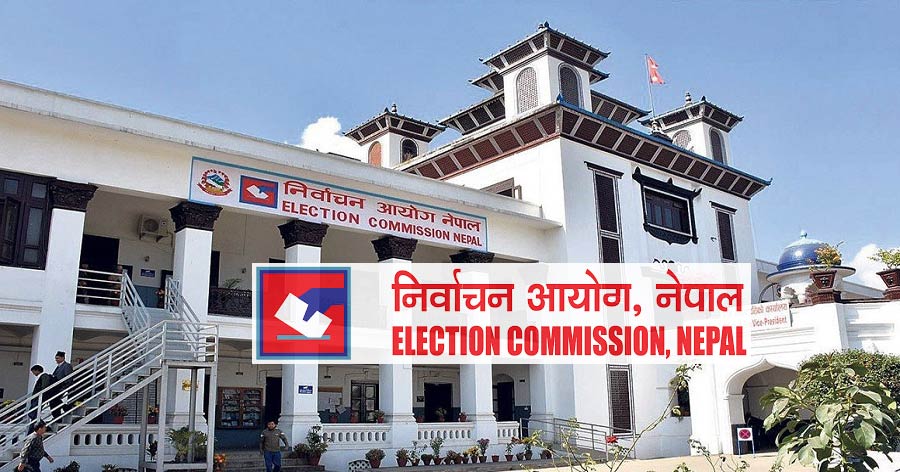
In any election, the value of a single vote remains extremely high for both victory and defeat. The Election Commission has repeatedly stated that, in each round of voting, around 5 to 15 percent of votes are invalid and wasted. Against this backdrop, the Commission has begun preparations to provide voter education nationwide.
As the House of Representatives election scheduled for March 5, 2026 [2082 Falgun 21] approaches, voters’ concern about how to cast a vote correctly without spoiling it has increased.
Voters’ concern and expectations for education
Sunmaya Maharjan, met in Sundhara, says, “This time I want to vote properly, but it seems the government has not come to teach us this time.” This reflects how practical and immediate public expectations are regarding voter education. Along with the right to vote, voters also need confidence in how to vote correctly.
Commission work plan to begin nationwide voter education
Spokesperson Narayan Prasad Bhattarai said the Commission is moving forward with a work plan to start nationwide voter education from February 15, 2026 [2082 Falgun 3]. Spokesperson Bhattarai noted that, compared to the past, the Commission wants invalid votes to decrease across every province and district.
Accordingly, Information Officer Suman Ghimire said the Commission has already instructed District Election Offices in all 77 districts to appoint volunteers for voter education and to appoint monitors for voter education.
According to him, many tasks that the Commission itself must carry out have been decreasing, while the workload for District Election Offices has been increasing. In practice, because many aspects of preparation are implemented at the district level, the operational burden is also increasingly concentrated there.
Digital voter education and the volunteer-to-doorstep model
Information Officer Ghimire said this time the focus is on “digital voter education.” He said, “This time we have emphasized digital voter education. First, volunteers receive the training, and then they go to voters’ homes and teach through digital methods.”
This model aims to expand access beyond paper materials, using devices such as mobile phones that people use daily. During the teaching process, voters will also be introduced to how to use available mobile technology to reach learning-oriented information issued by the Commission, which he said will be new for many voters this time.
Ghimire also clarified that this digital learning approach aims to strengthen citizens’ engagement with the Commission and build a sense of ownership. In that sense, the program appears to be an effort not only to cover the technical aspects of voting, but also to make the voter-Commission relationship more trust-based and participation-oriented.
For context on core skills needed for mobile-based learning, see digital literacy.
Environment-focused intent and practical practice using a sample ballot
In line with the intent to run an environment-friendly election by using less paper, the Commission has prepared District Election Offices accordingly. Along with this preparation, practical practice has also been included in voter education.
According to Ghimire, volunteers will have one sample ballot and will teach how to place the swastika stamp on election symbols, how to fold the ballot, and how to drop it separately into two boxes. Through practice with a sample ballot and the voting process, the approach appears intended to provide voters not only with what to do, but also clarity on how to do it.
Along with this, voters will learn and teach through the Commission’s social media pages on Facebook, X, TikTok, and other platforms, connecting via mobile phones to teach themselves and their community.
For related context on the role of platforms in elections, see social media and technology in elections.
Local plans, media use, and geographic realities
Some districts have also developed plans to educate voters in their areas. District Election Officer Dipendraman Adhikari of Solukhumbu said that, in addition to volunteer teaching in all 22 wards, there is a plan to bring local FM stations, radio, online media, and newspapers into voter education efforts.
However, practical barriers created by geography remain equally significant. He said, “In our area, one house is on one hill and another house or village is on another hill. In such a situation, it may not be possible to walk door to door and teach everything to voters within 15 days.”
Therefore, he said there is no alternative but to gather voters in one place to provide voting education, while repeatedly teaching how to vote through radio and online information at the household level. In other words, where doorstep education cannot be applied uniformly, community gatherings and repeated messaging through media are being used as alternative measures.
For understanding how to evaluate information quality during election messaging, see media literacy.
Expectation of fewer invalid votes and practical challenges
Information Officer Ghimire expressed the expectation that invalid votes will be significantly lower this time, because voters will not need to place a stamp on many symbols at once. He said it will be sufficient to place the swastika stamp once for the direct candidate and once on the proportional representation party symbol.
The Commission claims that the confusion voters faced during voting in past three-tier elections will not be present this time. However, local and district election officials say voter education may not be as simple as the Commission suggests. In most districts, providing voter education has become an increasingly pressing issue, and delivering voter education has now become a key responsibility for every election officer.
Time pressure and competition with political campaigning
In past elections, around one month was allocated for voter education. This time, with political party campaigning running in parallel, only 15 days has been maintained. An election officer said, “Time is already short, and on top of that, candidates’ gatherings and campaigning increase. How to meet voters and provide correct education is a major challenge.”
This makes clear the concern that a shorter period could limit program reach, repetition, and opportunities for hands-on practice.
Materials management and concerns about delayed sample ballots
Sarlahi election officer Rishiram Paudel said that although the process of selecting and training volunteers has begun, sample ballots have not yet arrived. He added that materials required to reach election offices in the Himalayan region often arrive later than in the lower regions, raising concern that voter education may not be able to start on time.
This signals another sensitive aspect of preparation: whether logistics and materials are available on time can be decisive for the effectiveness of voter education.
Expert suggestions on participation, access, and polling conditions
Experts suggest that the Election Commission must move forward with attention to multiple factors in order to ensure full voter participation. Former Election Commissioner Dr Ayodhi Prasad Yadav, in a conversation with Gorkhapatra Daily, said that even if the operational work is done by District Election Offices, greater responsibility ultimately lies with the Commission.
According to him, awareness must be instilled so that “No voters to be left behind.” He said, “It is not possible to bring all invalid votes to zero, but they can be reduced.”
Dr Yadav indicated that this should not be limited only to the question of educated versus uneducated voters, but should also be viewed practically. He noted that past elections show situations that feel difficult to accept when looking at voting percentages and invalid votes in an educated place like Kathmandu.
He also said that when frustration toward leadership rises during voting, the Commission should initiate efforts at this time to bring a law in the future to make voting mandatory. He said the government should increase voters’ participation by issuing calls and giving a larger role to local government.
According to him, in addition to voter awareness, factors behind invalid votes include the ballot size, geographic conditions, the polling room, and the surrounding environment. Rather than voting in a dark room, a more open space should be provided so people can vote without fear. Some people’s hands tremble while voting. If there are many election symbols, confusion increases. Errors can also happen when people are rushed.
He said a practice should be established to study how many invalid votes occurred in the past, where they occurred, and on what basis. The core of this suggestion is that, without improving the practical aspects of the voting environment and procedures alongside voter education, efforts to reduce invalid votes may not be fully effective.



Comments 0
No comments yet. Be the first to start the conversation.