



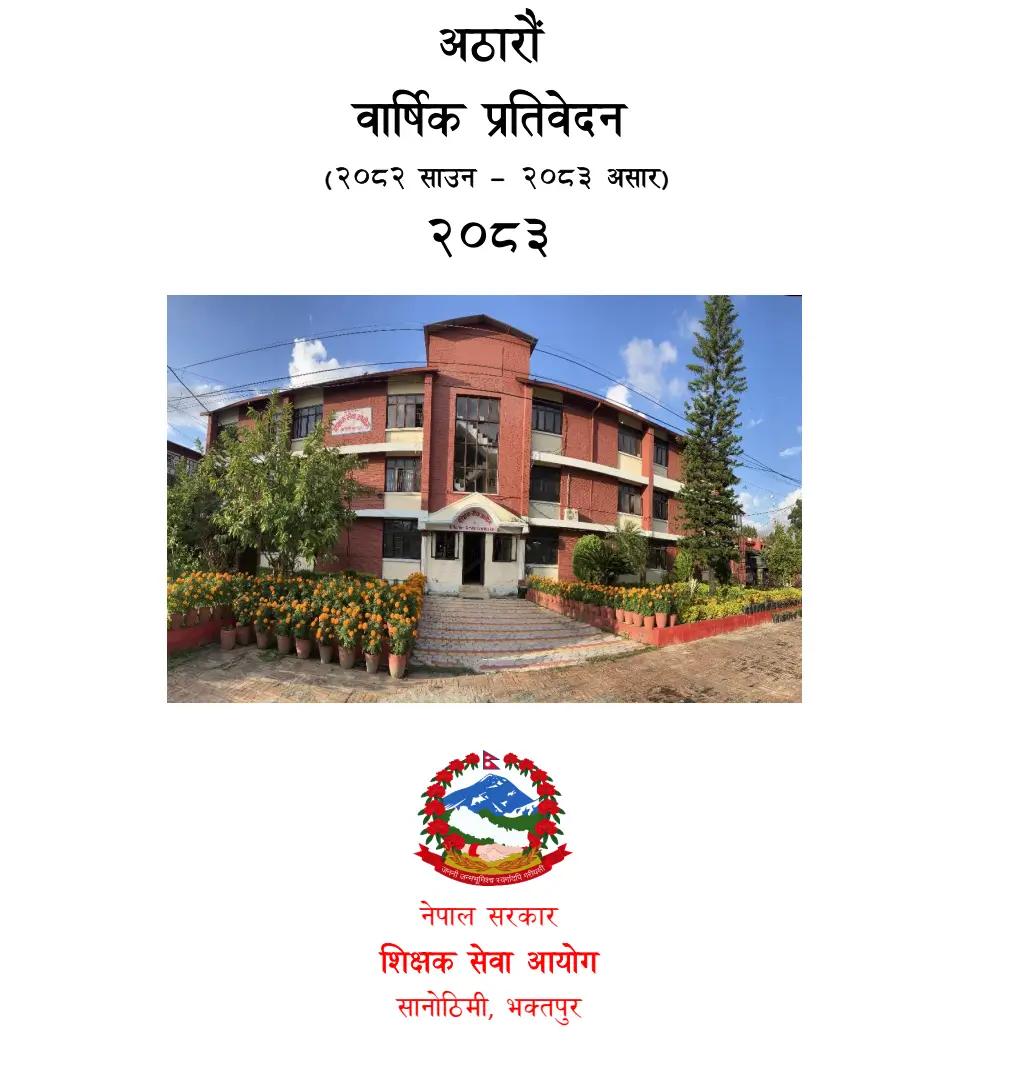
The Government of Nepal's Teacher Service Commission (TSC), Sanothimi, Bhaktapur, has released its 18th Annual Report (Shrawan 2082–Ashadh 2083), 2083, submitted to the Government of Nepal in accordance with Section 11(ञ) of the Education Act, 2028 (as amended).
The report provides detailed information on the Commission's activities, performance and achievements during fiscal year 2082/83.
Operating under the principles of merit, impartiality, fairness, objectivity and confidentiality, the Commission has covered its administrative and financial position, teaching licenses, open and internal competitive examinations, promotions based on performance evaluation, curriculum development, complaint and litigation management, problems and challenges, and future priorities.
Although the report covers one fiscal year, from Shrawan 2082 to Ashadh 2083, Annex 13 also presents major achievements recorded during the month following the assumption of office by the Commission's officials on 2083/05/26.
According to the report, the Commission's current office bearers are:
-
Chairperson: Dr. Hari Prasad Lamsal
-
Member: Ram Sharan Sapkota
-
Member: Bishnu Ghimire Rimal
-
Secretary (Acting Administrative Chief): Govinda Prasad Aryal
The Commission's central office is located in Sanothimi, Bhaktapur.
-
Telephone: 977-1-6637872
-
Technical Help Desk: 977-9851103299
-
Email: admin@tsc.gov.np
-
Official Website: www.tsc.gov.np (http://www.tsc.gov.np)
1. Historical Background, Establishment, Legal Basis and Jurisdiction
The Teacher Service Commission was established to recommend candidates for appointment and promotion to vacant teacher and staff positions approved by the Government of Nepal in community schools, and to issue teaching licenses to individuals seeking to enter the teaching profession.
Nepal's National Education System Plan, 2028 BS, first introduced a uniform teacher service system across the country.
In 2037 BS, regional and district teacher selection committees replaced the commissions operating at regional and district levels.
However, irregular vacancy announcements and delays in publishing recruitment results continued to affect teacher recruitment.
Following the recommendations of the High-Level Education Commission, 2055, the National Teacher Service Commission was established through the Sixth Amendment to the Education Act, 2028, dated 2055/10/01.
The Seventh Amendment to the Education Act on 2058/10/25 renamed the institution the Teacher Service Commission and introduced a provision prohibiting individuals without a teaching license issued by the Commission from becoming candidates for teaching positions.
Following the issuance of the Teacher Service Commission Regulations, 2057, the Commission began carrying out its regular functions.
Since 2076 BS, the Commission has collected applications for teaching licenses and teacher recruitment through its own Online Job Portal.
The explanation under Article 243(2) of the Constitution of Nepal indicates that the Teacher Service Commission is treated differently from an organized institution.
Composition of the Commission and Qualifications of Office Bearers
Under Section 11B of the Education Act, 2028 (as amended), the Commission consists of three office bearers: one Chairperson and two members, including at least one woman.
The Government of Nepal forms a recommendation committee to recommend appointments to these positions.
The recommendation committee consists of:
-
Chairperson of the Public Service Commission as Chairperson.
-
Vice-Chancellor of Tribhuvan University as a member.
-
Secretary of the Ministry as a member.
The tenure of the Commission's office bearers is five years.
Under Section 11C of the Act, an individual must meet the following requirements to be appointed as Chairperson or member:
-
Be a Nepali citizen.
-
Hold a master's degree from a university recognized by the Government of Nepal.
-
Have remained unaffiliated with any political party for at least two years before appointment.
-
Have completed 40 years of age.
-
For appointment as Chairperson, possess experience at the Special Class level of the Government of Nepal; for appointment as a member, possess at least 15 years of experience in law, education and administration.
Legal Basis, Functions, Responsibilities and Approved Procedures
The Commission performs its functions under the Education Act, 2028; Teacher Service Commission Regulations, 2057; Education Regulations, 2059; other prevailing laws and regulations; and the directives and procedures approved by the Commission.
Its principal functions include recommending teachers for permanent appointment and promotion, issuing teaching licenses, determining examination syllabuses, conducting examinations, and advising the Ministry on teachers' service conditions and benefits.
The Commission is also responsible for destroying examination-related documents one year after results are published, except where complaints have been filed; conducting inspections and inquiries; and submitting its annual report to the Government of Nepal.
The Commission has implemented the following seven procedures and directives:
-
Teacher Service Commission Operational Procedure, 2078.
-
Procedure Relating to Promotion of Teachers Based on Performance Evaluation, 2082.
-
Code of Conduct for Commission Employees and Experts, 2078.
-
Teaching License Distribution and Management Procedure, 2080.
-
Standards for Examination Monitoring Management, 2081.
-
Interview Conducting Directive, 2079.
-
Examination Conducting Directive, 2078.
2. Operational Procedures, Guiding Principles and Organizational Structure
The Commission ordinarily publishes its annual recruitment calendar on the first day of each fiscal year.
However, for FY 2083/84, the annual calendar was approved on 2083/06/01 because the positions of the Commission's office bearers had been vacant.
Under Rule 11(b) of the Teacher Service Commission Regulations, 2057, the Department of Education must collect information on vacant teaching positions in community schools from Education Development and Coordination Units across the country and submit it to the Commission by the end of Ashoj.
Following publication of advertisements, applications for open and internal competitive examinations are submitted online.
Applications for promotion based on performance evaluation are submitted to the Education Development and Coordination Unit in the district where the teacher is employed.
For written examinations, subject experts prepare raw question papers based on assigned codes. Other experts subsequently review and moderate these questions.
Written examinations are conducted using sealed question sets.
Answer sheets undergo a double-coding process, with first and second codes assigned in separate stages by different personnel before evaluation at the Commission's office.
Nine Guiding Principles of the Commission
The Commission follows nine guiding principles:
-
Principle of Merit.
-
Principle of Impartiality.
-
Principle of Fairness.
-
Principle of Equal Opportunity.
-
Principle of Inclusiveness. Women's reserved positions are divided into two categories: Dalit Women and Muslim Women.
-
Principle of Double Blinding.
-
Principle of Identity Masking. An answer sheet will be cancelled if a candidate writes identifying information on pages other than the designated page.
-
Principle of Non-Involvement.
-
Principle of Confidentiality.
Organizational Structure and Approved Staffing Positions
The Government of Nepal, Council of Ministers, originally approved the Commission's staffing structure through a decision dated 2075/03/03.
A subsequent Council of Ministers decision dated 2083/03/32 approved a reorganized structure with a total of 39 positions.
The Commission operates eight sections under the Administrative Chief (Joint Secretary):
-
Teaching License Section.
-
Written Examination Section.
-
Promotion Section.
-
Curriculum and Advertisement Section.
-
Question Paper Preparation and Moderation Section.
-
Interview and Recommendation Section.
-
Legal Affairs and Judgment Implementation Section.
-
Planning, Administration and Monitoring Section.
The approved staffing positions are detailed below.
-
Administrative Chief: Gazetted First Class, Education Service, Education Administration Group — 1 position.
-
Undersecretary: Gazetted Second Class, Education Service, Education Administration Group — 7 positions.
-
Undersecretary: Gazetted Second Class, Judicial Service, Law Group — 1 position.
-
Section Officer: Gazetted Third Class, Administration Service, General Administration Group — 1 position.
-
Accounts Officer: Gazetted Third Class, Administration Service, Accounts Group — 1 position.
-
Section Officer: Gazetted Third Class, Education Service, Education Administration Group, Inspection Subgroup — 6 positions.
-
Computer Engineer: Gazetted Third Class, Miscellaneous Service — 1 position.
-
Nayab Subba: Non-Gazetted First Class, Administration Service, General Administration Group — 3 positions.
-
Accountant: Non-Gazetted First Class, Administration Service, Accounts Group — 1 position.
-
Technical Assistant: Non-Gazetted First Class, Education Service, Education Administration Group — 3 positions.
-
Computer Operator: Non-Gazetted First Class, Miscellaneous Service — 1 position.
-
Light Vehicle Driver: Unclassified — 5 positions.
-
Office Assistant: Unclassified — 8 positions.
Total Approved Positions: 39.
3. Financial Position: Budget, Expenditure, Revenue and Audit Irregularities
The Teacher Service Commission recorded financial progress of only 57.09% during FY 2082/83.
According to the report, the departure of the Commission's office bearers towards the end of the fiscal year prevented the completion of scheduled written examinations, interviews and promotion reviews.
Of the total allocated budget of NPR 183,477,000, expenditure amounted to NPR 104,742,201.50.
According to Annex 11, the financial performance was as follows:
-
Recurrent Expenditure (Budget Subheading 35021012): Budget of NPR 163.777 million, with expenditure of NPR 99.989 million (61.05%).
-
Capital Expenditure: Budget of NPR 19.7 million, with expenditure of NPR 4.753 million (24.13%).
-
Total Budget: NPR 183.477 million.
-
Total Expenditure: NPR 104.742 million (57.09%).
Budget, Expenditure, Revenue and Deposits for the Past Five Fiscal Years
The following figures consolidate Tables 1 and 2 of the report under budget subheading numbers 350210123/4.
All amounts are in Nepali rupees (NPR).
1. FY 2078/79
-
Annual Budget: 134,450,004.00
-
Expenditure: 132,974,788.00 (98.90%)
-
Revenue Collected: 514,863,098.00
-
Deposit Amount: 150,000.00
2. FY 2079/80
-
Annual Budget: 185,514,996.00
-
Expenditure: 179,998,930.00 (97.02%)
-
Revenue Collected: 307,145,987.00
-
Deposit Amount: 27,734.00
3. FY 2080/81
-
Annual Budget: 204,852,110.00
-
Expenditure: 177,814,708.90 (86.80%)
-
Revenue Collected: 382,908,453.00
-
Deposit Amount: 27,734.00
4. FY 2081/82
-
Annual Budget: 197,939,000.00
-
Expenditure: 151,051,231.00 (76.31%)
-
Revenue Collected: 280,149,646.00
-
Deposit Amount: 27,734.00
5. FY 2082/83
-
Annual Budget: 183,477,000.00
-
Expenditure: 104,742,201.50 (57.09%)
-
Revenue Collected: 335,108,194.00
-
Deposit Amount: 111,088.00
Audit Irregularities and Settlement Status (Table 3)
According to the narrative section of the report, total audit irregularities recorded from FY 2060/61 onward amounted to NPR 28,903,713.
Of this amount, NPR 11,679,129 had been settled, leaving outstanding audit irregularities of NPR 17,224,588 by FY 2082/83.
Table 3 reports that NPR 6,724,063 in audit irregularities was settled during FY 2082/83.
The detailed figures are:
|
Fiscal year |
Total irregularities (NPR) |
Settled / outstanding (NPR) |
|---|---|---|
|
2060/61–2075/76 |
9,301,385 |
1,243,548 / 8,057,837 |
|
2076/77 |
7,432,669 |
1,850 / 7,430,819 |
|
2077/78 |
743,235 |
0 / 743,235 |
|
2078/79 |
1,574,682 |
1,338,703 / 235,979 |
|
2079/80 |
4,055,152 |
4,055,152 / 0 |
|
2080/81 |
756,718 |
0 / 756,718 |
|
2081/82 |
84,810 |
84,810 / 0 |
|
Total |
23,948,651 |
6,724,063 / 17,224,588 |
4. Curriculum Development and Examination Plans
Under Section 5 of the Teacher Service Commission Operational Procedure, the Commission has a Curriculum Committee consisting of:
-
The Commission's Chairperson or a designated member as Coordinator.
-
Administrative Chief as a member.
-
Head of the Curriculum Development Centre or a designated Director as a member.
-
One subject specialist or expert nominated by the Commission as a member.
-
The concerned Section Chief as Member-Secretary.
The Commission has developed and implemented 38 curricula covering teaching license examinations at the Secondary and Lower Secondary Levels, as well as various subjects for open and internal competitive written examinations at all three school levels.
For the internal competitive promotion examination covering 25% of promotion positions, the 100-mark examination consists of 40% objective questions and 60% subjective questions.
Teaching License and Open Written Examination Plans (Tables 4 and 5)
1. Teaching License Examination Plan
The examination covers objective knowledge, subject knowledge and professional knowledge.
-
Full Marks: 100
-
Pass Marks: 50
-
Number of Questions: 50
-
Marks Distribution: 2 × 50
-
Examination Type: Objective/Multiple Choice
-
Duration: 1 hour
2. Open General Written Examination
This examination applies to all subjects at the Secondary and Lower Secondary Levels and to the Primary Level.
-
Full Marks: 100
-
Pass Marks: 50
-
Number of Questions: 50
-
Marks Distribution: 2 × 50
-
Negative Marking: 20% of the marks for an incorrect answer will be deducted.
-
Additional Scoring Provision: 50% of the marks obtained by successful candidates in the general examination will be added to the subject-specific examination marks.
-
Examination Type: Objective/Multiple Choice
-
Duration: 1 hour
3. Open Subject-Specific Examination
This examination is conducted in the respective subjects at the Secondary and Lower Secondary Levels and as a level-based examination for the Primary Level.
-
Full Marks: 100
-
Pass Marks: 40
-
Number of Questions: 10
-
Marks Distribution: 10 × 10
-
Examination Type: Analytical
-
Duration: 3 hours
5. Teaching License Provisions and Distribution to Date
Since 2058 BS, provisions relating to teaching licenses have been amended twice under the Education Act, through its Seventh Amendment in 2058 and Eighth Amendment in 2073.
The Teacher Service Commission Regulations have been amended 11 times, resulting in amendments to nine rules, the repeal of three rules or subrules, and the addition of 17 rules or subrules.
Under the Higher Secondary Education Act, 2046, District Education Offices distributed 11,239 temporary teaching licenses without examination to teachers employed before 2073/03/15.
Another 1,319 teachers passed under Conditional Advertisement No. 35, dated 2076/03/02.
Between FY 2060/61 and FY 2082/83, the Commission issued teaching licenses to 894,159 individuals through 44 advertisements.
The distribution by level was:
-
Primary Level: 202,739 (23%)
-
Lower Secondary Level: 462,419 (52%)
-
Secondary Level: 229,001 (25%)
-
Total Teaching Licenses: 894,159
Note: The pie chart in Figure 7 shows 229,031 licenses at the Secondary Level, while Tables 6, 7 and 8 report 229,001.
Historical Teaching License Distribution and Advertisement Conditions (Tables 7 and 8)
1. FY 2060/61 — Advertisement Nos. 1, 2 and 3 (Open, Permanent)
-
Secondary Level: 18,218 successful candidates.
-
Lower Secondary Level: 32,590.
-
Primary Level: 70,180.
-
Conditions: Working teachers and other open applicants meeting the prescribed qualifications were required to have completed training. Women meeting the educational qualifications could apply even without training.
2. FY 2061/62 — Advertisement Nos. 4, 5 and 6 (Open, Permanent)
-
Secondary Level: 15,366.
-
Lower Secondary Level: 30,022.
-
Primary Level: 63,113.
-
Conditions: Applicants at all three levels had to meet the prescribed minimum educational qualifications and training requirements.
3. Year 2064 — Advertisement Nos. 7, 8 and 9 (Open, Permanent)
-
Secondary Level: 9,701.
-
Lower Secondary Level: 30,616.
-
Primary Level: 4,260.
-
Conditions: Applicants at all three levels were required to possess the prescribed minimum educational qualifications and complete 10 months of training.
4. Year 2066 — Advertisement Nos. 10, 11 and 12 (Open, Permanent)
-
Secondary Level: 14,356.
-
Lower Secondary Level: 53,035.
-
Primary Level: 18,996.
-
Conditions: Applicants at all three levels were required to meet the minimum educational qualifications and complete 10 months of training.
5. Year 2067 — Advertisement Nos. 13–15 (Open, Permanent) and 16–18 (Conditional, Internal)
Open category:
-
Secondary Level: 10,452.
-
Lower Secondary Level: 54,369.
-
Primary Level: 19,796.
Conditional category:
-
Secondary Level: 6,513.
-
Lower Secondary Level: 13,760.
-
Primary Level: 22,512.
The totals for 2067 shown in Table 8 are 16,965 at the Secondary Level, 68,129 at the Lower Secondary Level and 42,308 at the Primary Level.
For open examinations, minimum qualifications and 10 months of training were required.
Under the conditional provisions, teachers appointed before 2063/08/05 who remained continuously employed could apply without training. They could receive permanent teaching licenses if they completed the required training before 2075/07/22.
6. Year 2068 — Advertisement Nos. 21 and 22 (Open, Permanent) and 23 (Temporary, Conditional)
-
Secondary Level: 28,973.
-
Lower Secondary Level: 85,921.
-
Advertisement No. 23, Secondary Level: Data unavailable.
Advertisement Nos. 21 and 22 required the prescribed minimum qualifications and training.
Under Advertisement No. 23, teachers holding master's degrees but lacking B.Ed., M.Ed. or 10-month training qualifications could receive temporary teaching licenses on the condition that they completed training within two years.
7. Year 2070 — Advertisement Nos. 24 and 25 (Open, Permanent)
-
Secondary Level: 12,006.
-
Lower Secondary Level: 33,634.
-
Conditions: Applicants had to meet the prescribed minimum educational qualifications and training requirements.
8. Year 2071 — Advertisement Nos. 26, 27 and 28 (Open, Permanent)
-
Secondary Level, Advertisement No. 26: 11,132.
-
Secondary Level, Advertisement No. 28: 4,932.
-
Total Secondary Level: 16,064.
-
Lower Secondary Level, Advertisement No. 27: 28,294.
Advertisement Nos. 26 and 27 required the prescribed educational qualifications and training.
Advertisement No. 28 permitted candidates without training to participate in nine subjects: Science, Mathematics, English, Accounts, Computer, Civil Engineering, Electrical Engineering, Animal Husbandry and Crop Science.
9. Year 2072 — Advertisement Nos. 29 and 30 (Open, Permanent)
-
Secondary Level: 4,287.
-
Lower Secondary Level: 3,034.
-
Conditions: Prescribed minimum educational qualifications and training.
10. Year 2074 — Advertisement No. 31 (Open, Temporary)
-
Secondary Level: 954.
-
Conditions: Applicants with master's degrees but without B.Ed., M.Ed. or 10-month training qualifications could participate on the condition that they completed training within two years.
11. Year 2076 — Advertisement Nos. 32, 33, 34 and 36 (Open, Permanent) and 35 (Internal, Conditional)
-
Primary Level, Advertisement No. 32: 3,883 (Table 8 reports 3,882).
-
Lower Secondary Level, Advertisement No. 33: 4,737.
-
Secondary Level, Advertisement Nos. 34, 35 and 36: 8,421.
The main qualification conditions were:
-
Primary Level: Proficiency Certificate Level or equivalent, with 10 months of training or 400 marks in Education.
-
Lower Secondary Level: Proficiency-level qualifications in five prescribed subjects, including 200 marks, along with 10 months of training.
-
Secondary Level, Advertisement No. 34: Bachelor's degree, including 300 marks, and training.
-
Advertisement No. 35: Holders of temporary teaching licenses under the former Higher Secondary Level.
-
Advertisement No. 36: Bachelor's degree, including 300 marks. Candidates without training could participate on the condition that they completed training by the end of Chaitra 2081.
12. Years 2078/2079 — Advertisement Nos. 37 and 38 (Open, Permanent)
-
Secondary Level, Advertisement No. 37 (2078/79): 23,012.
-
Lower Secondary Level, Advertisement No. 38 (2079): 33,158.
Secondary Level candidates required a bachelor's degree and 10 months of training, although training was not mandatory for nine specified technical or specialized subjects.
Lower Secondary Level candidates required Grade 12 or Proficiency Certificate Level qualifications and 10 months of training.
13. Year 2080 — Advertisement Nos. 39 and 40 (Open, Permanent)
-
Secondary Level, Advertisement No. 39: 24,366.
-
Lower Secondary Level, Advertisement No. 40: 13,007.
Secondary Level applicants required a bachelor's degree and 10 months of training, except for nine specified subjects.
Lower Secondary Level applicants required Grade 12 or an equivalent qualification, including at least 200 marks or eight credit hours, and 10 months of training.
14. Year 2081 — Advertisement Nos. 41 and 42 (Open, Permanent)
-
Secondary Level, Advertisement No. 41: 12,729.
-
Lower Secondary Level, Advertisement No. 42: 10,974.
Applicants had to meet the requirements under Rules 6D(1), 9(1)(c) and 9(7) of the Regulations.
Lower Secondary Level applicants were required to have passed Grade 12 and completed 10 months of training or studied Education carrying 200 marks.
15. Year 2082 — Advertisement Nos. 43 and 44 (Open, Permanent)
-
Secondary Level, Advertisement No. 43: 23,583.
-
Lower Secondary Level, Advertisement No. 44: 35,268.
-
Cumulative Total Teaching Licenses: 894,159.
Secondary Level candidates had to meet the requirements under Rules 6D(1), 9(1)(c) and 9(7).
Lower Secondary Level applicants were required to have passed Grade 12 and completed 10 months of training or studied Education carrying 200 marks or eight credits.
Provincial Teaching License Results for FY 2082/83 and Five-Year Trends
During FY 2082/83, the Commission reported a total of 151,425 online applications for teaching licenses under two advertisements:
-
Advertisement No. 43/082/83, Secondary Level: 42,323 applications. The result was published on 2082/07/28.
-
Advertisement No. 44/082/83, Lower Secondary Level: 109,082 applications.
Note: The sum of 42,323 and 109,082 is 151,405, whereas page 9 of the report states 151,425.
The report states that 23,583 candidates passed the Secondary Level examination, with a reported pass rate of 66.5% and failure rate of 33.5%.
At the Lower Secondary Level, 35,268 candidates passed, with a reported pass rate of 37.5% and failure rate of 62.5%.
The provincial results were as follows:
|
Province |
Secondary: Appeared / Passed |
Lower Secondary: Appeared / Passed |
|---|---|---|
|
Koshi |
6,735 / 4,014 |
17,238 / 6,526 |
|
Madhesh |
6,749 / 3,279 |
16,716 / 3,526 |
|
Bagmati |
10,488 / 5,493 |
14,156 / 5,060 |
|
Gandaki |
2,934 / 2,021 |
6,886 / 2,804 |
|
Lumbini |
6,165 / 3,644 |
20,725 / 7,229 |
|
Karnali |
4,103 / 2,198 |
19,012 / 5,702 |
|
Sudurpashchim |
5,149 / 2,934 |
14,349 / 4,421 |
According to Figure 8, the historical application and pass figures were:
Lower Secondary Level
-
Advertisement No. 38 (2079): 206,680 applications; 33,158 passed.
-
Advertisement No. 40 (2080): 179,437 applications; 13,007 passed.
-
Advertisement No. 42 (2081): 119,699 applications; 10,974 passed.
-
Advertisement No. 44 (2082): 109,082 applications; 35,268 passed.
Secondary Level
-
Advertisement No. 37 (2078): 67,268 applications; 23,012 passed.
-
Advertisement No. 39 (2080): 59,075 applications; 24,366 passed.
-
Advertisement No. 41 (2081): 44,510 applications; 12,729 passed.
-
Advertisement No. 43 (2082): 42,323 applications; 23,583 passed.
Monthly Teaching License Services in FY 2082/83 (Table 9)
The report presents monthly figures for corrections, newly issued licenses, conversion of temporary licenses into permanent ones, duplicate copies and translation services.
The figures are listed in the following sequence: Corrections / New Issues / Converted to Permanent / Duplicate Copies / Translations / Total.
|
Month |
Corrections / New / Permanent Conversion |
Duplicates / Translations / Total |
|---|---|---|
|
Shrawan |
41 / 32 / 13 |
9 / 1 / 96 |
|
Bhadra |
27 / 20 / 6 |
12 / 0 / 65 |
|
Ashoj |
9 / 14 / 7 |
3 / 1 / 34 |
|
Kartik |
20 / 45 / 9 |
2 / 2 / 78 |
|
Mangsir |
23 / 42 / 8 |
6 / 0 / 79 |
|
Poush |
16 / 51 / 6 |
4 / 0 / 77 |
|
Magh |
303 / 71 / 6 |
6 / 1 / 387 |
|
Falgun |
124 / 29 / 0 |
4 / 1 / 158 |
|
Chaitra |
629 / 37 / 2 |
3 / 2 / 673 |
|
Baisakh |
599 / 82 / 1 |
9 / 3 / 691 |
|
Jestha |
164 / 32 / 1 |
4 / 3 / 204 |
|
Ashadh |
109 / 31 / 0 |
4 / 0 / 144 |
|
Total |
2,064 / 486 / 59 |
66 / 14 / 2,689 |
6. Teacher Vacancy Advertisements, Applications, Examinations and Results
During FY 2082/83, the Commission could not publish open recruitment advertisements for Primary Level teachers because it had not received details of vacant Primary Level positions from the Department of Education (formerly the Centre for Education and Human Resource Development).
For open recruitment, the Commission published 426 advertisements covering 1,128 vacant positions:
-
Lower Secondary Level: 679 positions.
-
Secondary Level: 449 positions.
For promotion, 216 advertisements covered 1,837 vacant positions:
-
Performance Evaluation (75%): 1,377 positions.
-
Internal Competition (25%): 461 positions.
The report also mentions 294 advertisements under performance evaluation-based promotion.
Advertised Posts, Applications and Three-Year Open Recruitment Trends (Table 10 and Figure 9)
1. Primary Level, Third Class (Open and Inclusive)
No advertisement was published because the Commission did not receive the required vacancy information.
Applications in previous fiscal years:
-
FY 2080/81: 104,071.
-
FY 2081/82: 0.
-
FY 2082/83: 0.
2. Lower Secondary Level, Third Class (Open and Inclusive)
-
Advertisement Date: 2082/12/24
-
Advertised Positions: 679
-
Applications: 88,816
The executive summary reports 89,022 approved applications.
Three-year application trend:
-
FY 2080/81: 77,318.
-
FY 2081/82: 48,988.
-
FY 2082/83: 88,816.
3. Secondary Level, Third Class (Open and Inclusive)
-
Advertisement Date: 2082/10/03
-
Advertised Positions: 449
-
Applications: 47,220
The combined number of open recruitment applications was 136,036.
Three-year application trend:
-
FY 2080/81: 43,888.
-
FY 2081/82: 35,353.
-
FY 2082/83: 47,220.
4. Internal Competitive Promotion (25%)
-
Levels and Classes: First and Second Classes of all three levels.
-
Advertised Positions: 461
-
Applications: 14,229
5. Performance Evaluation-Based Promotion (75%)
-
Levels and Classes: First and Second Classes of all three levels.
-
Advertised Positions: 1,377
-
Applications: 19,164
Note: Table 11 provides an example of how accumulated record marks from previous years are added or deducted when allocating 75% and 25% promotion positions for Primary Level Second Class teachers in the 10 districts of Gandaki Province during FY 2081/82.
The district figures in that example are Mustang 4, Myagdi 10, Baglung 20, Parbat 15, Kaski 10, Manang 2, Lamjung 3, Nawalparasi (Bardaghat Susta East) 12, Tanahun 10 and Gorkha 7.
Question Paper Preparation and Moderation (Table 12)
During FY 2082/83, the Commission prepared 51 moderated question paper sets.
Of these, 17 sets were used and 34 were retained securely in the question bank.
The distribution was:
-
Lower Secondary Level Subject-Specific Examination: 24 sets prepared; 8 used; 16 remaining.
-
Secondary Level Teaching License Examination: 3 sets prepared; 1 used; 2 remaining.
-
Internal Competitive Promotion Examinations (25%) for First and Second Classes at Primary, Lower Secondary and Secondary Levels: 18 sets prepared; 6 used; 12 remaining.
-
Lower Secondary Level Teaching License Examination: 3 sets prepared; 1 used; 2 remaining.
-
Secondary Level General Examination: 3 sets prepared; 1 used; 2 remaining.
Secondary Level General Examination and Lower Secondary Subject-Specific Examination Results (Tables 13 and 14)
During FY 2082/83, 38,124 candidates appeared in the Secondary Level General Examination.
Of these, 11,236 candidates passed, representing a pass rate of 29.47%. The subject-specific examination remained pending.
Similarly, the Lower Secondary Level Third Class subject-specific examination, conducted during the fiscal year under the open and inclusive advertisement dated 2081/12/14, had:
-
Required Positions: 686
-
Candidates Appearing: 6,990
-
Candidates Passing: 919
Provincial Results of the Secondary Level General Examination
|
Province |
Required positions |
Appeared / Passed (Pass rate) |
|---|---|---|
|
Koshi |
133 |
9,947 / 2,929 (29.45%) |
|
Madhesh |
38 |
3,428 / 788 (22.99%) |
|
Bagmati |
68 |
5,602 / 1,766 (31.52%) |
|
Gandaki |
121 |
8,826 / 2,995 (33.93%) |
|
Lumbini |
41 |
4,891 / 1,395 (28.52%) |
|
Karnali |
33 |
3,079 / 753 (24.46%) |
|
Sudurpashchim |
15 |
2,351 / 610 (25.95%) |
|
Total |
449 |
38,124 / 11,236 |
Subject-Wise Results of the Lower Secondary Level Examination
The following figures represent required positions / candidates appearing / candidates passing.
-
Nepali: 109 / 1,631 / 185.
-
English: 171 / 1,721 / 242.
-
Mathematics: 112 / 913 / 115.
-
Science: 101 / 514 / 130.
-
Social Studies: 109 / 1,945 / 183.
-
Mathematics and Science: 80 / 249 / 58.
-
Health and Physical Education: 1 / 13 / 4.
-
Sanskrit Grammar: 2 / 0 / 0.
-
Sanskrit Language: 1 / 4 / 2.
Total: 686 positions, 6,990 candidates appearing and 919 candidates passing.
7. Interviews, Recommendations for Permanent Appointment and Inclusive Recruitment
Under the Interview Conducting Directive, 2079, interview committees are formed with the following composition:
-
Lower Secondary and Secondary Levels: Two skilled persons or subject experts and one specialist.
-
Primary Level: Three experts, skilled persons or specialists.
Candidates dissatisfied with their subject-specific written examination results may apply for re-totaling within seven days of the publication of the results.
During FY 2082/83, the Commission recommended 980 candidates for permanent appointments under open and inclusive recruitment advertisements published in FY 2081/82.
The recommendations included:
-
Secondary Level: 356 candidates recommended against 370 positions, leaving 14 unfilled.
-
Lower Secondary Level: 624 candidates recommended against 686 positions, leaving 62 unfilled.
The Commission also published merit lists for temporary and contract appointments:
-
Secondary Level: 708 candidates.
-
Lower Secondary Level: 991 candidates.
Inclusive Recruitment Details (Table 16)
Of the 1,056 positions, 455 were allocated to inclusive categories, representing the number reported as 45%.
The Commission recommended 393 candidates for these positions.
At the Lower Secondary Level, 241 candidates were recommended against 300 inclusive positions, leaving 59 unfilled.
At the Secondary Level, 152 candidates were recommended against 155 inclusive positions, with 11 positions reported as unfilled.
No candidates were recommended under the Dalit Women and Muslim Women categories at either level.
Lower Secondary Level
-
Total Positions: 686
-
Inclusive Positions: 300
-
Other Women: 82 recommended.
-
Indigenous Nationalities: 70.
-
Madhesi: 51.
-
Dalit: 23.
-
Persons with Disabilities: 10.
-
Backward Regions: 5.
-
Total Inclusive Recommendations: 241.
Secondary Level
-
Total Positions: 370
-
Inclusive Positions: 155
-
Other Women: 58 recommended.
-
Indigenous Nationalities: 43.
-
Madhesi: 28.
-
Dalit: 16.
-
Persons with Disabilities: 7.
-
Backward Regions: 0.
-
Total Inclusive Recommendations: 152.
Combined Inclusive Recommendations
-
Other Women: 140.
-
Indigenous Nationalities: 113.
-
Madhesi: 79.
-
Dalit: 39.
-
Persons with Disabilities: 17.
-
Backward Regions: 5.
-
Total: 393.
Provincial and Subject-Wise Lower Secondary Level Recruitment and Recommendations (Tables 17 and 18; Annex 7)
The report provides details of 686 positions advertised during FY 2082/83 and 624 recommendations made during FY 2082/83 against advertisements published in FY 2081/82.
1. Koshi Province
-
Advertised Positions: Nepali 45, Mathematics 28, Science 16, Social Studies 44, English 53, Mathematics and Science 42, Sanskrit Language 1 and Sanskrit Grammar 1. Total: 230.
-
Recommended by Subject: Nepali 45, Mathematics 20, Science 15, Social Studies 44, English 53, Mathematics and Science 26 and Sanskrit Language 1.
-
Total Recommended: 204.
-
Recommendations by Category: Open 130, Women 24, Indigenous Nationalities 20, Madhesi 17, Dalit 6, Persons with Disabilities 3 and Backward Regions 4.
-
Unfilled Positions: 26.
2. Madhesh Province
-
Advertised Positions: Nepali 7, Mathematics 8, Science 7, Social Studies 6, English 7 and Mathematics and Science 1. Total: 36.
-
Recommended by Subject: Nepali 7, Mathematics 5, Science 7, Social Studies 6 and English 7.
-
Total Recommended: 32.
-
Recommendations by Category: Open 18, Women 4, Indigenous Nationalities 5, Madhesi 4 and Dalit 1.
-
Unfilled Positions: 4.
3. Bagmati Province
-
Advertised Positions: Nepali 16, Mathematics 26, Science 31, Social Studies 14, English 32, Mathematics and Science 4, and Health and Physical Education 1. Total: 124.
-
Recommended by Subject: Nepali 16, Mathematics 22, Science 30, Social Studies 14, English 31, Mathematics and Science 3, and Health and Physical Education 1.
-
Total Recommended: 117.
-
Recommendations by Category: Open 71, Women 16, Indigenous Nationalities 14, Madhesi 10, Dalit 4 and Persons with Disabilities 2.
-
Unfilled Positions: 7.
4. Gandaki Province
-
Advertised Positions: Nepali 26, Mathematics 28, Science 28, Social Studies 22, English 39, Mathematics and Science 15, and Sanskrit Grammar 1. Total: 159.
-
Recommended by Subject: Nepali 26, Mathematics 26, Science 28, Social Studies 22, English 35 and Mathematics and Science 8.
-
Total Recommended: 145.
-
Recommendations by Category: Open 86, Women 21, Indigenous Nationalities 17, Madhesi 11, Dalit 5, Persons with Disabilities 4 and Backward Regions 1.
-
Unfilled Positions: 14.
5. Lumbini Province
-
Advertised Positions: Nepali 6, Mathematics 11, Science 14, Social Studies 16, English 20 and Mathematics and Science 7. Total: 74.
-
Recommended by Subject: Nepali 6, Mathematics 11, Science 14, Social Studies 16, English 20 and Mathematics and Science 6.
-
Total Recommended: 73.
-
Recommendations by Category: Open 42, Women 10, Indigenous Nationalities 9, Madhesi 7, Dalit 4 and Persons with Disabilities 1.
-
Unfilled Positions: 1.
6. Karnali Province
-
Advertised Positions: Nepali 4, Mathematics 8, Science 3, Social Studies 4, English 12 and Mathematics and Science 6. Total: 37.
-
Recommended by Subject: Nepali 4, Mathematics 6, Science 1, Social Studies 4, English 12 and Mathematics and Science 4.
-
Total Recommended: 31.
-
Recommendations by Category: Open 21, Women 4, Indigenous Nationalities 3, Madhesi 1 and Dalit 2.
-
Unfilled Positions: 6.
7. Sudurpashchim Province
-
Advertised Positions: Nepali 5, Mathematics 3, Science 2, Social Studies 3, English 8 and Mathematics and Science 5. Total: 26.
-
Recommended by Subject: Nepali 5, Mathematics 2, Science 1, Social Studies 3, English 8 and Mathematics and Science 3.
-
Total Recommended: 22.
-
Recommendations by Category: Open 15, Women 3, Indigenous Nationalities 2, Madhesi 1 and Dalit 1.
-
Unfilled Positions: 4.
Combined Totals
-
Advertised by Subject: Nepali 109, Mathematics 112, Science 101, Social Studies 109, English 171, Mathematics and Science 80, Sanskrit Language 1, Sanskrit Grammar 2, and Health and Physical Education 1.
-
Total Advertised: 686.
-
Recommended by Subject: Nepali 109, Mathematics 92, Science 96, Social Studies 109, English 166, Mathematics and Science 50, Sanskrit Language 1, Sanskrit Grammar 0, and Health and Physical Education 1.
-
Total Recommended: 624.
-
Recommendations by Category: Open 383, Women 82, Indigenous Nationalities 70, Madhesi 51, Dalit 23, Persons with Disabilities 10 and Backward Regions 5.
-
Unfilled Positions: 62.
Secondary Level Third Class Open and Inclusive Recruitment by Subject and Province (Table 19 and Annex 8)
The figures below are presented as advertised positions / recommended candidates.
1. Nepali
-
Koshi: 19/19
-
Madhesh: 7/7
-
Bagmati: 6/5 (one Madhesi position unfilled).
-
Gandaki: 14/14
-
Lumbini: 3/3
-
Karnali: 1/1
-
Sudurpashchim: 1/1
-
Total: 51 advertised; 50 recommended; 1 unfilled.
2. English
-
Koshi: 32/32
-
Madhesh: 5/5
-
Bagmati: 14/14
-
Gandaki: 21/21
-
Lumbini: 9/9
-
Karnali: 1/1
-
Sudurpashchim: 2/2
-
Total: 84 advertised; 84 recommended; none unfilled.
3. Mathematics
-
Koshi: 27/24 (three unfilled: Women 2 and Persons with Disabilities 1).
-
Madhesh: 2/1 (one Women position unfilled).
-
Bagmati: 21/20 (one position for Persons with Disabilities unfilled).
-
Gandaki: 16/16
-
Lumbini: 7/7
-
Karnali: 2/1 (one Women position unfilled).
-
Sudurpashchim: 2/2
-
Total: 77 advertised; 71 recommended; 6 unfilled.
4. Science
-
Koshi: 32/31 (one Dalit position unfilled).
-
Madhesh: 10/9 (one Women position unfilled).
-
Bagmati: 23/23
-
Gandaki: 9/8 (one Madhesi position unfilled).
-
Lumbini: 4/4
-
Karnali: 2/2
-
Sudurpashchim: 4/4
-
Total: 84 advertised; 81 recommended; 3 unfilled.
5. Social Studies
-
Koshi: 17/17
-
Madhesh: 4/4
-
Bagmati: 7/7
-
Gandaki: 13/13
-
Lumbini: 5/5
-
Karnali: 3/3
-
Sudurpashchim: 3/3
-
Total: 52 advertised; 52 recommended; none unfilled.
6. Economics
-
Koshi: 1/1
-
Bagmati: 2/2
-
Total: 3 advertised; 3 recommended; none unfilled.
7. Office Management and Accounting
-
Koshi: 3/3
-
Madhesh: 1/1
-
Bagmati: 3/3
-
Gandaki: 1/1
-
Lumbini: 1/1
-
Karnali: 1/1
-
Total: 10 advertised; 10 recommended; none unfilled.
8. Sanskrit Grammar
-
Koshi: 1/1
-
Bagmati: 1/0 (one position unfilled).
-
Total: 2 advertised, 1 recommended and 1 unfilled.
Note: Annex 8 reports one Open-category recommendation in Sanskrit Grammar in Bagmati Province, while the subject-wise table reports none. The total row in Table 19 also records one advertised position instead of two.
9. Sanskrit Language
-
Madhesh: 1/1.
-
Total: 1 advertised; 1 recommended; none unfilled.
10. Health and Physical Education
-
Madhesh: 1/1.
-
Total: 1 advertised; 1 recommended; none unfilled.
11. Education Teaching
-
Sudurpashchim: 1/1.
-
Total: 1 advertised; 1 recommended; none unfilled.
12. Applied Astrology
-
Koshi: 1/0 (one Open-category position unfilled).
-
Total: 1 advertised; none recommended; 1 unfilled.
13. Shukla Yajurveda
-
Gandaki: 2/0 (one Open and one Women position unfilled).
-
Total: 2 advertised; none recommended; 2 unfilled.
Note: The total row of the source table records one advertised position instead of two.
14. Theoretical Astrology
-
Bagmati: 1/0 (one Open-category position unfilled).
-
Total: 1 advertised; none recommended; 1 unfilled.
Overall Secondary Level Recruitment Totals
-
Advertised Positions: 370
-
Candidates Recommended: 356
-
Unfilled Positions: 14
According to Annex 8, the provincial recommendation figures were Koshi 128, Madhesh 29, Bagmati 75, Gandaki 73, Lumbini 29, Karnali 9 and Sudurpashchim 13.
The category-wise figures were Open 204, Women 58, Indigenous Nationalities 43, Madhesi 28, Dalit 16 and Persons with Disabilities 7.
Historical Recommendations for Permanent Teacher Appointments (Table 20)
The report includes historical figures for teachers recommended for permanent appointments.
|
Fiscal year |
Secondary / Lower Secondary |
Primary / Total |
|---|---|---|
|
2061/62 |
2,067 / 2,441 |
7,565 / 12,073 |
|
2069/70 |
2,286 / 2,793 |
7,980 / 13,059 |
|
2071/72 |
1,378 / 1,873 |
0 / 3,251 |
|
2072/73 |
612 / 1,117 |
1,729 / 3,458 |
|
2073/74 |
1,478 / 1,909 |
10,883 / 14,270 |
|
2074/75 |
1,097 / 1,574 |
9,956 / 12,627 |
|
2078/79 |
1,182 / 1,959 |
10,353 / 13,494 |
|
2079/80 |
718 / 1,117 |
7,123 / 8,958 |
|
2080/81 |
435 / 787 |
5,284 / 6,506 |
|
2081/82 |
356 / 624 |
0 / 980 |
|
Reported Total |
11,606 / 16,194 |
60,873 / 88,676 |
Note: The source reports a cumulative Secondary Level figure of 11,606, while the sum of the figures in the listed rows is 11,609.
8. Teacher Promotions: 25% Internal Competition, 75% Performance Evaluation and Litigation
Under Rule 28 of the Teacher Service Commission Regulations, 2057, vacant First and Second Class teaching positions are filled through promotion using two methods:
-
Internal Competitive Examination: 25% of positions.
-
Performance Evaluation: 75% of positions.
A. Internal Competitive Promotion (25%) — Tables 15 and 21; Annex 10
During FY 2082/83, the Commission advertised 461 promotion positions under the 25% internal competition category.
A total of 9,712 candidates appeared in the written examinations, of whom 983 passed.
Because the Commission's office bearers had vacated their positions, the remaining recommendation procedures from FY 2082/83 were completed during FY 2083/84.
The written examination and interview/recommendation figures were as follows.
1. Secondary Level, First Class
-
Written Examination: 11 positions; 72 candidates appeared; 31 passed.
-
Interview and Recommendation (Annex 10): 14 positions; 39 candidates attended interviews; 14 recommended.
2. Secondary Level, Second Class
-
Written Examination: 70 positions; 1,808 candidates appeared; 173 passed.
-
Interview and Recommendation: 83 positions; 212 candidates attended; 83 recommended.
3. Lower Secondary Level, First Class
-
Written Examination: 9 positions; 62 candidates appeared; 23 passed.
-
Interview and Recommendation: 19 positions; 58 candidates attended; 19 recommended.
4. Lower Secondary Level, Second Class
-
Written Examination: 69 positions; 1,564 candidates appeared; 173 passed.
-
Interview and Recommendation: 79 positions; 204 candidates attended; 79 recommended.
5. Primary Level, First Class
-
Written Examination: 47 positions; 517 candidates appeared; 136 passed.
-
Interview and Recommendation: 78 positions; 208 candidates attended; 78 recommended.
6. Primary Level, Second Class
-
Written Examination: 255 positions; 5,689 candidates appeared; 447 passed.
-
Interview and Recommendation: 390 positions; 631 candidates attended; 390 recommended.
Overall Totals
-
Written Examination Positions: 461
-
Candidates Appearing: 9,712
-
Candidates Passing: 983
-
Positions Covered by Annex 10 Interviews: 663
- Candidates Attending Interviews: 1,352
- Candidates Recommended: 663




Comments 0
No comments yet. Be the first to start the conversation.