



PCL Nursing in Nepal: Admission, Seats, Colleges, Course and Career
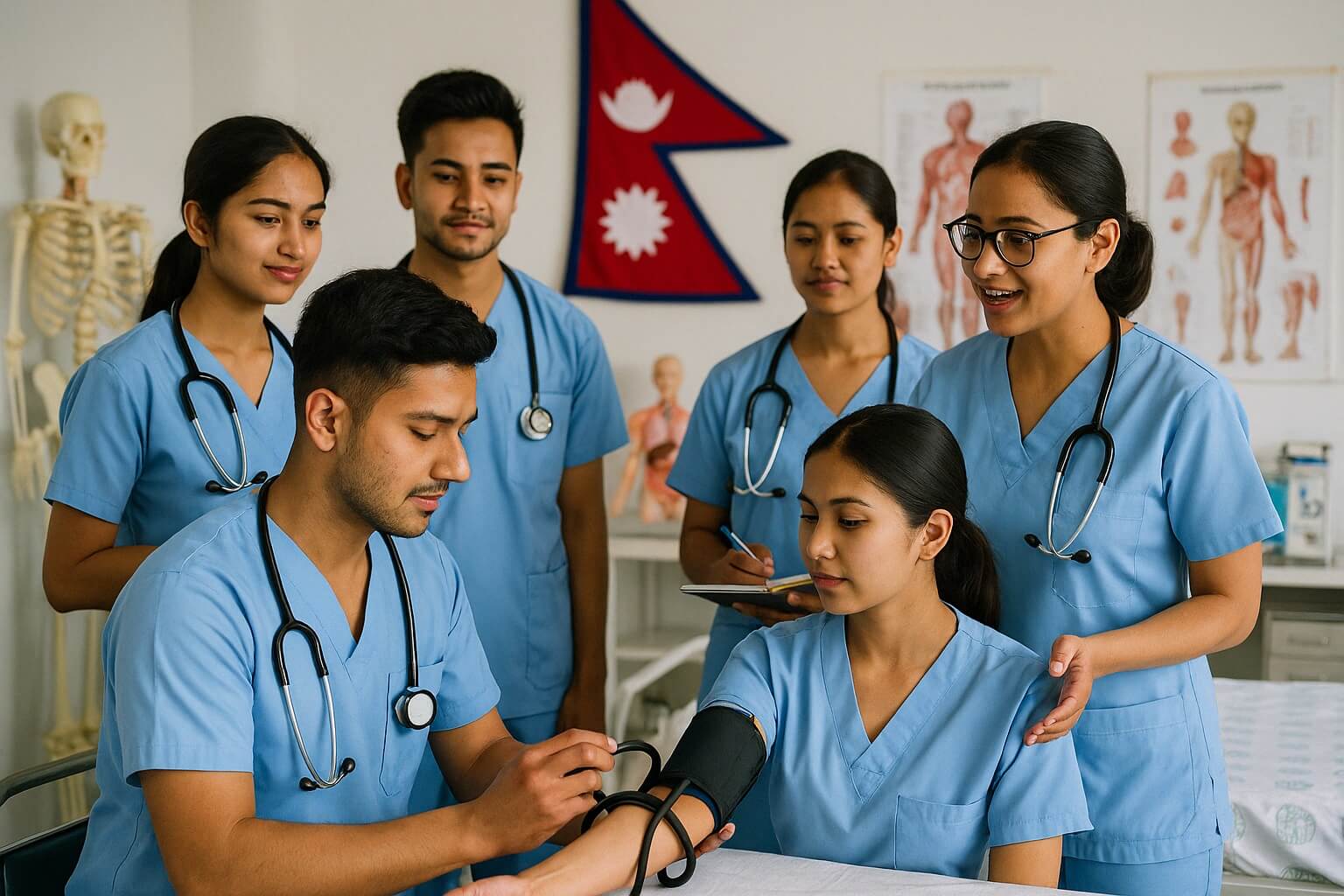
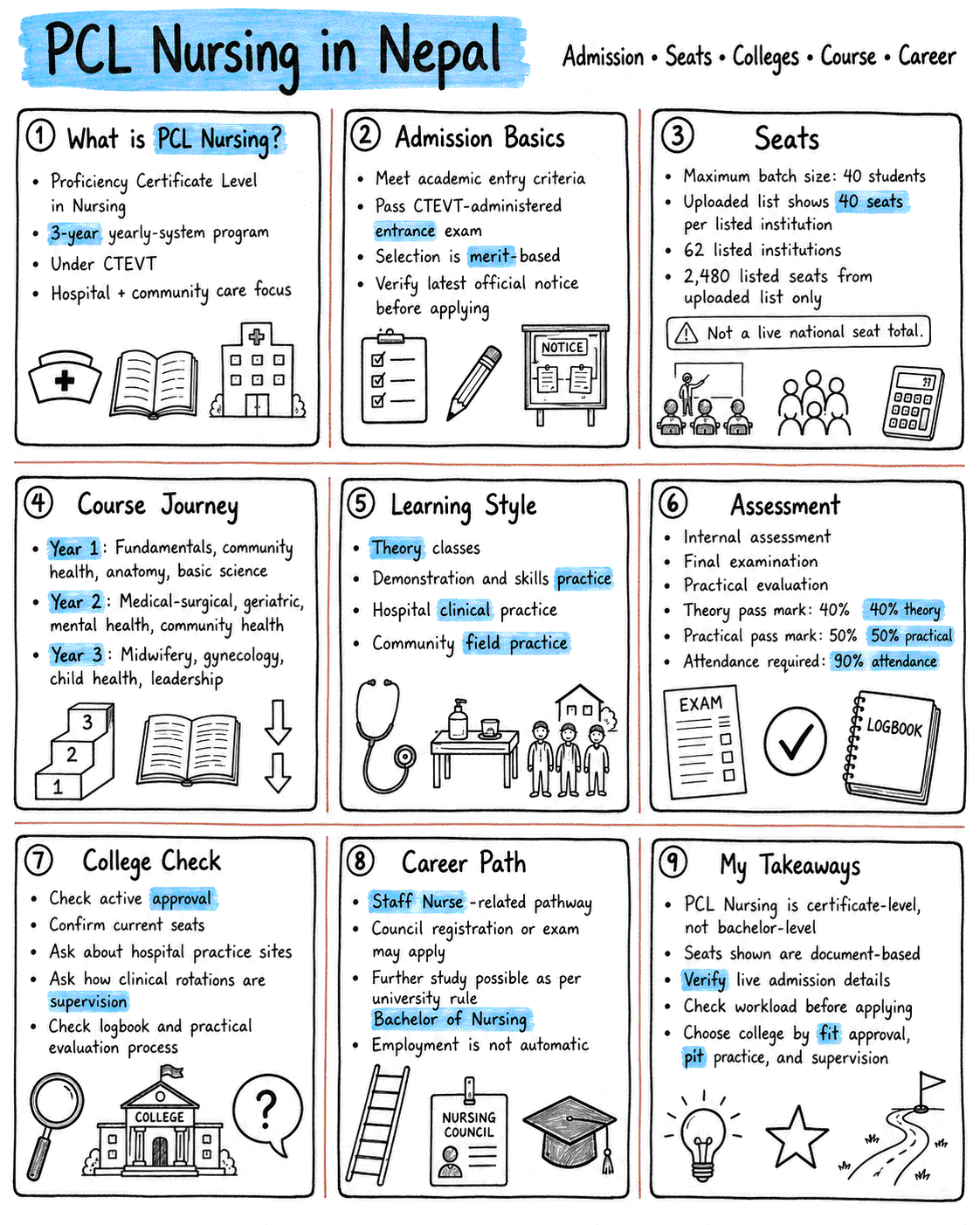
PCL Nursing-Staff Nurse in Nepal is a three-year Proficiency Certificate Level nursing program under the Council for Technical Education and Vocational Training (CTEVT). It is intended for students who want a certificate-level nursing route with theory classes, practical learning, clinical practice, and community health exposure.
Students comparing this program with other health education pathways may also review nursing courses in Nepal. The CTEVT curriculum identifies the course as “Proficiency Certificate Level in Nursing (PCL Nursing)” and states that the total duration is three academic years under the yearly system. It also sets the group size at a maximum of 40 students per batch.
This guide explains the program, admission criteria, listed seats, colleges, course structure, assessment, and career path using the curriculum and college list only. It does not treat any one-year admission notice, quota rule, fee structure, or scholarship provision as evergreen.
Summary
PCL Nursing in Nepal is a three-year certificate-level nursing program under CTEVT. The curriculum sets the program title, eligibility, duration, attendance rule, course structure, assessment system, certification, and career path. The college list shows institutions across seven provinces, each with 40 approved seats in that document. Students should verify current admission notices, fees, quotas, scholarships, and college approval before applying.
Key Takeaways
-
PCL Nursing means Proficiency Certificate Level in Nursing.
-
The program runs for three academic years under the yearly system.
-
The CTEVT curriculum sets a maximum batch size of 40 students.
-
The college list shows 40 approved seats for each listed institution.
-
Admission requires stated academic eligibility and a CTEVT-administered entrance examination.
-
Students need 90% attendance in each subject to appear in the final exam.
-
Graduates may pursue staff nurse-related pathways and further nursing study, subject to rules.

What is PCL Nursing in Nepal?
PCL Nursing is a certificate-level nursing program. The official curriculum title is “Proficiency Certificate Level in Nursing (PCL Nursing).”
The curriculum states that the program is designed to produce middle-level nursing workforce for hospital and community settings. It connects the course with care of individuals, families, and communities, and includes both theoretical and practical sessions.
For students, this means PCL Nursing is a practice-oriented route into nursing education. It includes classroom learning, skills training, clinical exposure, community field practice, internal assessment, final examination, and practical evaluation.
Certificate level versus bachelor level
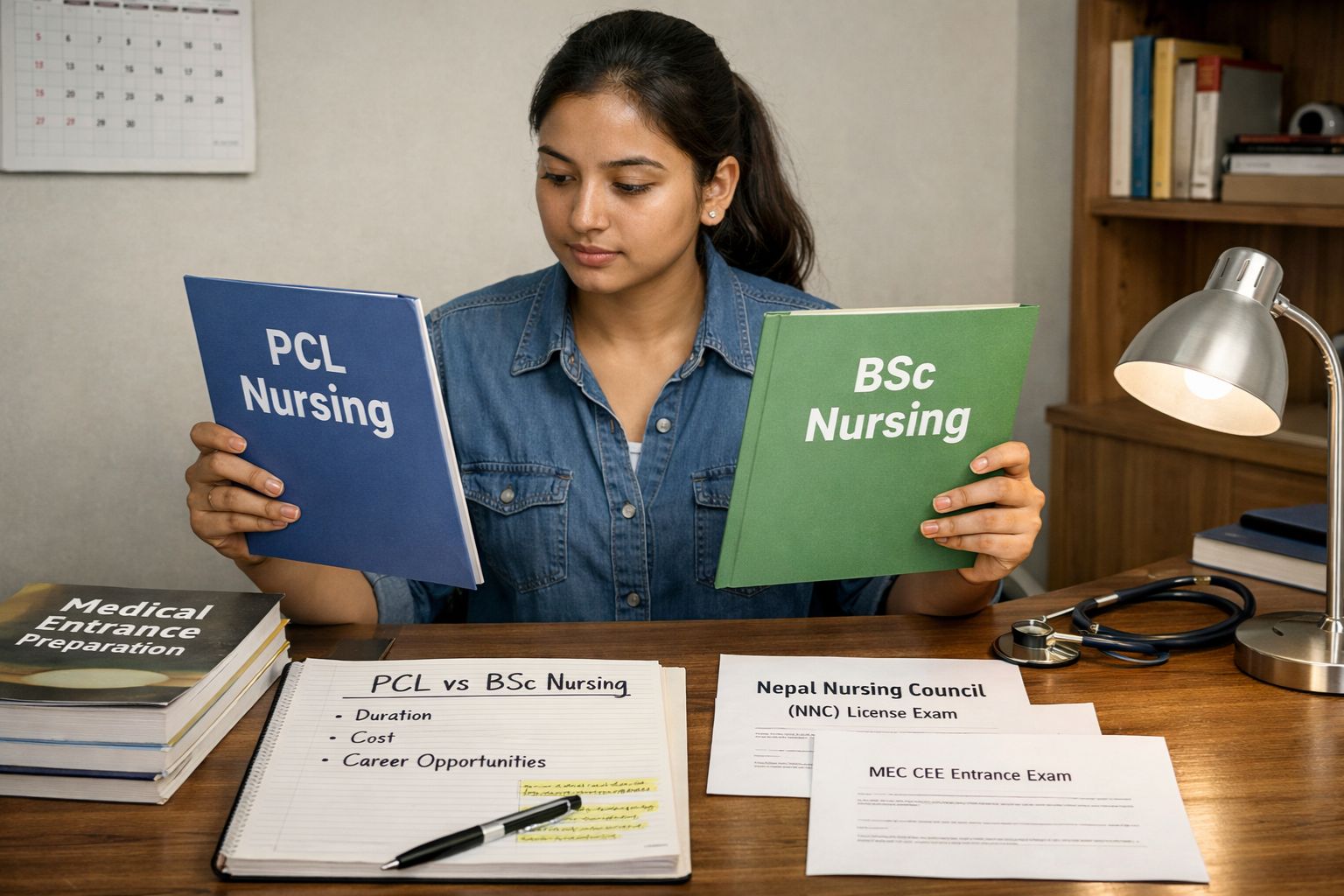
PCL Nursing is not a bachelor’s degree. The curriculum states that successful students are awarded “Proficiency Certificate Level in nursing.” It separately states that graduates are eligible to go for Bachelor of Nursing or an equivalent course as per university rule.
This distinction matters when planning a study pathway. PCL Nursing may support entry into staff nurse-related routes, while bachelor-level study depends on separate university rules, entrance criteria, and eligibility requirements.
Who can apply for PCL Nursing?
Students can apply when they meet the entry criteria and pass the entrance examination administered by CTEVT. The curriculum states that eligible applicants are selected for admission on a merit basis.
Academic eligibility
The curriculum lists the following entry criteria:
| Route | Requirement in the curriculum |
|---|---|
| SLC route | SLC in second division, 45%, with English, Science, and Mathematics |
| SEE route | SEE with minimum GPA 2.0 and C grade in Compulsory Mathematics, English, and Science |
| ANM technical route | SLC passed plus TSLC in Auxiliary Nurse Midwife with minimum 68.33% |
| Entrance requirement | Pass entrance examination administered by CTEVT |
These are curriculum-level criteria. Current notices may specify application dates, forms, quotas, scholarship categories, and institution-wise procedures.
Attendance requirement
Students must have at least 90% attendance in each subject to appear in the respective final examination.
This is a major readiness point. PCL Nursing requires regular attendance in theory classes, practical sessions, clinical postings, and field practice.
How does admission work?
Admission is based on eligibility, entrance examination, and merit selection according to the curriculum. The exact application process must be checked from the active CTEVT or institution notice.
A practical admission sequence is:
-
Check academic eligibility against the curriculum criteria.
-
Verify the current admission notice.
-
Confirm the college’s active approval and seat status.
-
Prepare academic and identity documents as required by the notice.
-
Complete the entrance or application process.
-
Follow merit-list and admission instructions from the concerned authority.
The curriculum confirms the entrance and merit basis, but it does not provide evergreen details for application deadlines, fees, quotas, or scholarship procedures. Those details are change-sensitive and need current verification.
How many seats are listed?
The CTEVT curriculum sets the group size at a maximum of 40 students in a batch. The college list also shows 40 approved seats for each listed institution.
In the college list, there are 62 listed institutions. Since each institution is shown with 40 approved seats, the listed seat total is 2,480. It should not be treated as a live national seat total without current verification.
| Province | Listed institutions | Seats shown per institution | Listed seat total |
|---|---|---|---|
| Koshi Province | 11 | 40 | 440 |
| Madhesh Province | 19 | 40 | 760 |
| Bagmati Province | 21 | 40 | 840 |
| Gandaki Province | 4 | 40 | 160 |
| Lumbini Province | 4 | 40 | 160 |
| Karnali Province | 1 | 40 | 40 |
| Sudurpashchim Province | 2 | 40 | 80 |
| Total list | 62 | 40 | 2,480 |
Which colleges are listed?
The PCL Nursing institutions are province-wise, each with 40 approved seats. Students should verify active approval, current seat status, and admission notice before applying.
Students comparing institution types can also read types of colleges in Nepal for broader context.
Koshi Province
| Institution | Location | Seats shown |
|---|---|---|
| Madan Bhandari Memorial Academy Nepal | Urlabari, Morang | 40 |
| Shailaja Acharya Memorial Polytechnic | Siswani, Morang | 40 |
| AMDA Institute of Health Science | Damak, Jhapa | 40 |
| Lifeline Hospital | Damak, Jhapa | 40 |
| Om Sai Pathibhara Nursing College | Bhadrapur, Jhapa | 40 |
| Purwanchal Health Co-Operative | Birtamod, Jhapa | 40 |
| Birat Health College | Biratnagar, Morang | 40 |
| Golden Hospital | Biratnagar, Morang | 40 |
| Koshi Health Institute | Biratnagar, Morang | 40 |
| Life Guard Hospital | Biratnagar, Morang | 40 |
| Neuro Cardio & Multispeciality Hospital | Biratnagar, Morang | 40 |
Madhesh Province
| Institution | Location | Seats shown |
|---|---|---|
| Gaur Polytechnic Institute | Gaur, Rautahat | 40 |
| Santa Alpa Mai Ram Narayan Yadav Nursing College | Malangwa, Sarlahi | 40 |
| BHC Medical College | Birgunj, Parsa | 40 |
| Chhinnamasta Educational Academy | Rajbiraj, Saptari | 40 |
| Evergreen Technical Institute of Health Science | Birgunj, Parsa | 40 |
| Gunaraj Pathak Memorial Nursing Campus | Parsa | 40 |
| Gyan Batika Institute of Technical & Medical Science | Bara | 40 |
| Janakpur Nursing Campus | Janakpur, Dhanusha | 40 |
| Lahan Sagarmatha Educational Academy | Lahan, Siraha | 40 |
| Medical Institute | Lahan, Siraha | 40 |
| Mirchaiya Health Nursing Campus | Siraha | 40 |
| Mithila Technical Academy | Janakpur, Dhanusha | 40 |
| National Human Resource Development Academy | Janakpur, Dhanusha | 40 |
| Nepal College of Nursing and Health Science | Birgunj-13, Parsa | 40 |
| Nepal Technical Institute | Janakpur, Dhanusha | 40 |
| Ram Janaki Health Foundation | Janakpur, Dhanusha | 40 |
| Subha Swastik Technical Institute | Mahottari | 40 |
| The Himal Institute of Health and Technical Science | Birgunj, Parsa | 40 |
| Unique Medical College and Teaching Hospital | Rajbiraj, Saptari | 40 |
Bagmati Province
| Institution | Location | Seats shown |
|---|---|---|
| A.P.F. Nepal Institute of Health Science | Balambu, Kathmandu | 40 |
| Nepal Police Hospital School of Health Science | Maharajgunj, Kathmandu | 40 |
| Iwamura College of Health Science | Sallaghari, Bhaktapur | 40 |
| Khwopa Poly-Technic Institute | Bhaktapur | 40 |
| Shradha Institute of Health Science | Thimi, Bhaktapur | 40 |
| Bharatpur Samudayik Hospital | Chitwan | 40 |
| Tsho Rolpa General Hospital | Dolakha | 40 |
| B.P. Memorial Health Institute and Research Center | Kathmandu | 40 |
| Helping Hands Community Hospital | Chabahil, Kathmandu | 40 |
| Kathmandu Model Hospital Institute of Health Sciences | Bagbazar, Kathmandu | 40 |
| Mahendra Narayan Nidi Memorial Health Institute | Kathmandu | 40 |
| Manmohan Memorial Institute of Medical Sciences | Soalteemode, Kathmandu | 40 |
| Nepal Bharat Maitri Hospital | Mitrapark, Kathmandu | 40 |
| Nepali Army College of Health Sciences | Sanobharyang, Kathmandu | 40 |
| Sahid Smarak Janaswastha Sahakari Sanstha | Kathmandu | 40 |
| Sushma Koirala Memorial Nursing Campus | Kathmandu | 40 |
| Green Tara College of Health Science | Sainbhu, Lalitpur | 40 |
| Nepal Institute of Medical Science and Technology | Gwarko, Lalitpur | 40 |
| Shankarapur Academy | Lalitpur-15, Satdobato, Lalitpur | 40 |
| Star Academy | Sanepa, Lalitpur | 40 |
| Asain College of Medical Science and Technology | Lalitpur | 40 |
Gandaki Province
| Institution | Location | Seats shown |
|---|---|---|
| Charak Institute of Health Science | Pokhara, Kaski | 40 |
| Fewacity Institute of Medical Science | Pokhara, Kaski | 40 |
| Fishtail Nursing Campus | Pokhara, Kaski | 40 |
| Kalika Medical and Technical Institute | Gaindakot, Nawalparasi East | 40 |
Lumbini Province
| Institution | Location | Seats shown |
|---|---|---|
| Tansen School of Health Science | Tansen, Palpa | 40 |
| AMDA Institute of Health Science | Butwal, Rupandehi | 40 |
| Western Hospital Pvt. Ltd., Nursing Campus | Banke | 40 |
| Deurali Janata Prabidhik Shikshalay | Butwal, Rupandehi | 40 |
Karnali Province
| Institution | Location | Seats shown |
|---|---|---|
| Gurbhakot Polytechnic Institute | Gurbhakot, Surkhet | 40 |
Sudurpashchim Province
| Institution | Location | Seats shown |
|---|---|---|
| Soojung Health and Technical Academy | Doti | 40 |
| Navajeevan College of Nursing and Health Sciences | Kailali | 40 |
What is taught in PCL Nursing?
PCL Nursing is taught across three academic years. The curriculum moves from basic nursing and community health to adult care, elderly care, mental health, maternal health, child health, and leadership.
First year
The first year focuses on basic nursing care in hospital and community settings. The course structure lists 720 theory hours and 840 practical hours, giving 1,560 total hours for the year.
First-year subjects include:
-
Fundamental of Nursing
-
Community Health Nursing I
-
Anatomy and Physiology
-
Basic Science Applied to Nursing
-
English
-
Nepali
Basic Science Applied to Nursing includes Pharmacology, Biochemistry, and Microbiology components in the curriculum.
Second year
The second year focuses on medical-surgical nursing, geriatric nursing, mental health and behavioral nursing, community health, and social science. The course structure lists 500 theory hours and 1,001 practical hours.
Second-year subjects include:
-
Medical and Surgical Nursing I
-
Medical and Surgical Nursing II
-
Geriatric Nursing
-
Mental Health and Behavioral Nursing
-
Community Health Nursing II
-
Social Science
The second year has more practical hours than theory hours, so students should expect a major clinical and field learning load.
Third year
The third year focuses on midwifery, gynecology, child health nursing, and leadership and management. The course structure lists 550 theory hours and 1,022 practical hours.
Third-year subjects include:
-
Midwifery Nursing I
-
Midwifery Nursing II
-
Midwifery Nursing III
-
Gynecology Nursing
-
Child Health Nursing
-
Leadership and Management
This year connects maternal, child, and management-related learning with practical exposure.
How are students assessed?
Students are assessed through internal assessment, final examination, and practical evaluation. The curriculum requires students to pass all subjects in theory and practical components for certification.
Internal and final assessment
The curriculum states that each subject has internal assessment at regular intervals. Students are allowed to appear in the final examination only after completing internal assessment requirements.
This means class performance, practical exposure, records, and internal evaluation are part of the formal study process.
Practical evaluation
Final practicum evaluation is based on:
| Component | Weight |
|---|---|
| Institutional practicum attendance | 10% |
| Logbook or practicum book maintenance | 10% |
| Spot performance | 40% |
| Viva voce by internal examiner | 20% |
| Viva voce by external examiner | 20% |
The curriculum also states that practical examination should be administered in an actual situation on the relevant subject, with internal and external evaluation arrangements.
Pass marks and grading
Students must secure minimum 40% marks in theory and 50% marks in practical. They must also meet minimum pass marks in internal assessment and final examination for each subject.
The grading system is:
| Grade category | Marks |
|---|---|
| Distinction | 80% and above |
| First division | 65% to below 80% |
| Second division | 50% to below 65% |
| Pass division | Pass marks to below 50% |
The curriculum includes a back paper provision, but students must pass all subjects of all years within six years from enrollment.
What career path is available after PCL Nursing?
The curriculum connects PCL Nursing with staff nurse-related roles and further nursing education, subject to the relevant authority’s rules.
Students planning the work side of this route may also read about building a nursing career in Nepal.
The curriculum states that graduates are eligible for a position equivalent to Non-gazetted 1st class technical as Staff Nurse, or as prescribed by the Public Service Commission of Nepal. It also states that graduates may register or take an examination with the related council in the grade provisioned in the related Council Act, if applicable.
For council-related preparation context, students may also review the Nepal Nursing Council licensing exam guide.
Graduates are also listed as eligible to go for Bachelor of Nursing or an equivalent course as per university rule.
This does not mean every graduate is automatically appointed to a job or admitted to a bachelor program. Employment, registration, licensing, public service eligibility, and university admission depend on the rules in force at the time.
How should students evaluate a PCL Nursing college?
Students should compare colleges using verifiable academic and training factors, not name recognition alone. For a broader decision framework, they may also read how to choose a college in Nepal.
Check approval and seats
Start by checking whether the institution has active approval to run PCL Nursing and whether the current admission notice confirms the number of seats. The college list shows 40 seats for each listed institution, but applicants should verify live status before applying.
Check clinical and field learning
The curriculum sets teacher-student ratios of 1:40 for theory, 1:10 for demonstration, 1:6–8 for hospital clinical practice, and 1:10–12 for community field practice.
Students can ask the college:
-
Which hospitals are used for clinical practice?
-
Which community settings are used for field practice?
-
How are student rotations supervised?
-
How are logbooks checked?
-
Who evaluates practical performance?
Check study workload
The program includes high practical-hour requirements, especially in the second and third years. Students should check whether they can manage attendance, clinical postings, field practice, assignments, internal assessment, and final examinations.
Check further study options
Students planning further study should ask universities or concerned authorities about Bachelor of Nursing or equivalent admission rules. The CTEVT curriculum mentions further study eligibility as per university rule, so the final decision depends on the receiving institution.
Conclusion
PCL Nursing in Nepal is a certificate-level nursing route with a three-year yearly structure, defined eligibility criteria, practical training, clinical exposure, internal assessment, final examination, and a staff nurse-related career pathway. The curriculum supports the main academic details, while the college list provides province-wise institutions and seats shown in that document.
Students should use this guide to understand the course and prepare questions. Before applying, they should verify the latest admission notice, college approval, seat status, fees, quotas, and council or university rules.





Comments 0
No comments yet. Be the first to start the conversation.