



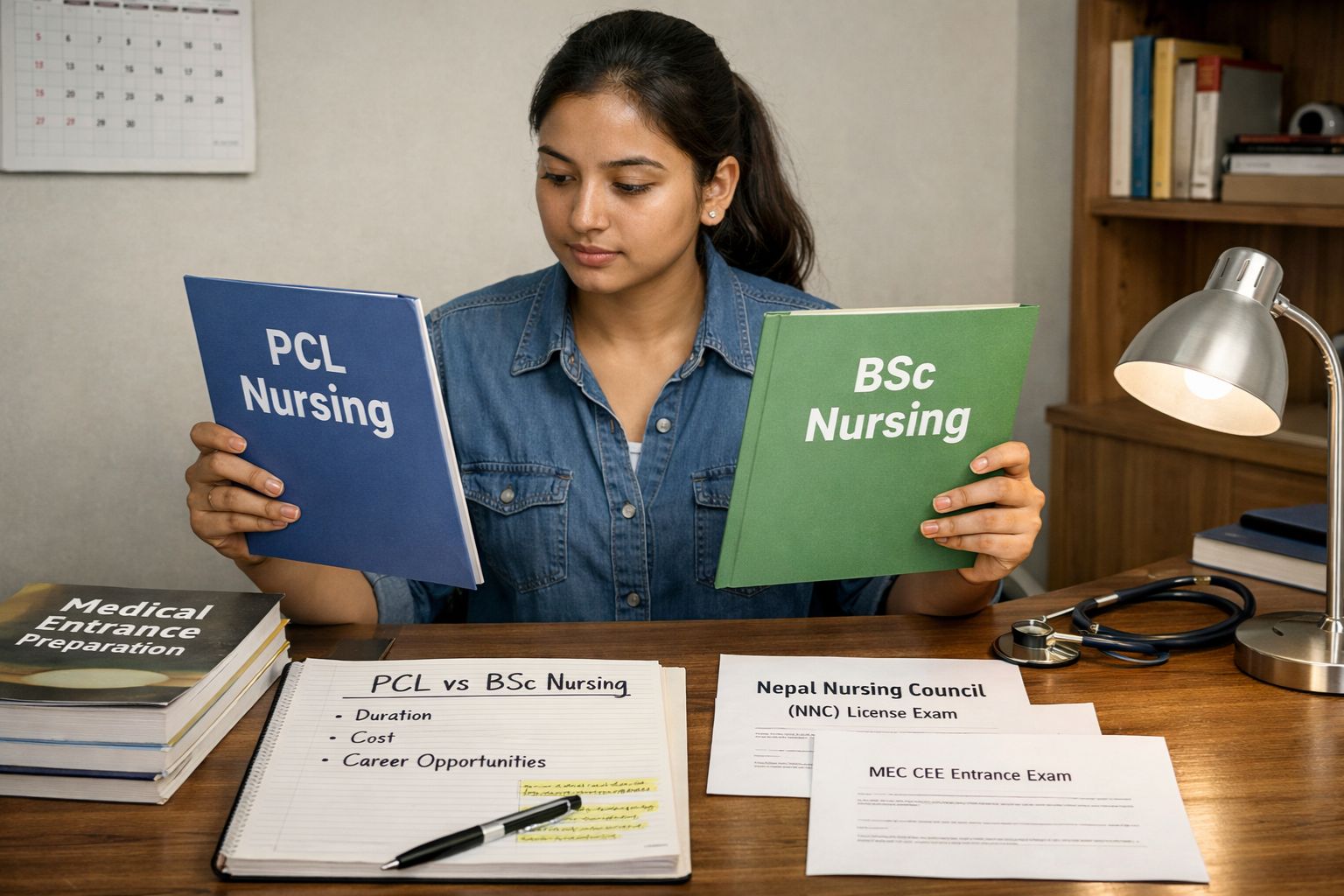
Nursing in Nepal: PCL vs BSc Nursing Career Map
In Nepal, the nursing profession is often seen as a symbol of respect, dignity, and a secure future. However, in today’s reality, studying nursing is not just about wearing a white apron. It also means maintaining strict discipline and being able to keep up with changing government policies and global health standards.
Many students get stuck in a dilemma: should they study PCL (Staff Nurse) or directly choose BSc Nursing? I have seen many cases where students chose the wrong path simply by relying on consultancy and college advertisements. That is why, instead of being driven by emotion, we should examine this profession using facts.
Today, based on the latest policies of the Medical Education Commission (MEC), Nepal Nursing Council (NNC), and the Ministry of Health, we will build a clear “blueprint” for your career.
Table of Content
- Nursing in Nepal: PCL vs BSc Nursing Career Map
- Problem Identification: Where Do Students Go Wrong?
- In-Depth Course Analysis: PCL Nursing vs BSc Nursing
- PCL vs BSc: Key Differences (In Facts)
- Is BSc Always Better? (Expert Insight)
- Career Reality: Nepal and Abroad
- Expert Roadmap: What Should You Do?
- Policy and Ethics
- Conclusion
Problem Identification: Where Do Students Go Wrong?
Before deciding to study nursing, you must find answers to the following three issues, which many students ignore:
-
Confusion about academic qualification: After PCL, can you directly go abroad (UK/USA/Australia), or is BSc mandatory?
-
Cost and return (ROI): After investing NPR 6 lakh to 15 lakh, what is the starting salary in Nepal—NPR 10,000 or NPR 40,000?
-
Nursing Council and license: What happens if you fail the NNC exam after graduation? (According to data, around 50–60% of students are failing the license exam on their first attempt.)
These problems can only be solved when we understand both courses in depth.
In-Depth Course Analysis: PCL Nursing vs BSc Nursing
For your convenience, I have comparatively analyzed the two educational pathways.
A) PCL Nursing (Staff Nurse) – CTEVT
This is a traditional and highly in-demand course, conducted by the Council for Technical Education and Vocational Training (CTEVT).
-
Goal: To produce “mid-level” health manpower capable of direct bedside nursing care in hospitals.
-
Duration: 3 years
-
Eligibility: SEE pass (minimum C grade in Mathematics, Science, and English, and GPA 2.0 is compulsory—since this can change over time, you must check the latest MEC notice).
-
Entrance exam: Now, MEC conducts a unified entrance examination for all health programs. The old practice of individual colleges taking their own entrance tests no longer exists.
-
Fees: Approximately NPR 4.5 lakh to 5.5 lakh (maximum limit set by the Government of Nepal/MEC)
B) BSc Nursing – University
This is a four-year academic course taught under Tribhuvan University (TU), Kathmandu University (KU), Pokhara University (Pu), and Purbanchal University (PU).
-
Goal: To produce leadership-oriented, research-focused, and specialist health professionals.
-
Duration: 4 years
-
Eligibility: Must have passed +2 (Science – Biology group) or equivalent, with at least 50% or 2.4 GPA (as per MEC rules).
-
Entrance exam: You must pass the CEE (Common Entrance Exam) conducted by MEC and secure a place in the merit list.
-
Fees: Approximately NPR 10 lakh to 12 lakh (varies by college and scholarship category)
PCL vs BSc: Key Differences (In Facts)
Below are the major differences between the two programs, presented clearly to help you decide:
Category-wise Comparison
-
Entry Point:
-
PCL Nursing (Staff Nurse): After SEE (Grade 10)
-
BSc Nursing: After +2 (Science)
-
-
Nature of Study:
-
PCL Nursing (Staff Nurse): Greater focus on clinical, practical skills
-
BSc Nursing: Focus on theoretical knowledge, research, and management
-
-
Higher Study Pathway:
-
PCL Nursing (Staff Nurse): To pursue a bachelor’s level, you must study “BN” or “BNS” (Bachelor in Nursing Science). You cannot go directly to a master’s degree.
-
BSc Nursing: You can directly pursue “MN” or “MSc Nursing”
-
-
Job Level in Nepal:
-
PCL Nursing (Staff Nurse): Assistant Level (5th Level)
-
BSc Nursing: Officer Level (6th/7th Level)
-
-
Overseas Opportunity:
-
PCL Nursing (Staff Nurse): Registration in many countries may be difficult without credit transfer or additional bridging courses
-
BSc Nursing: It is generally easier to take Registered Nurse (RN) exams (such as NCLEX-RN) and obtain recognition
-
Is BSc Always Better? (Expert Insight)
Many people think, “BSc is better because it is a degree.” But in my 20 years of experience, I have observed a different reality.
Real Scenario 1
If your family’s financial condition is moderate and you want to become self-reliant quickly (at a younger age), PCL Nursing is better suited. If you complete SEE at 16, you can become a staff nurse by 19. By 20, you can have a job in hand. After that, you can pursue a bachelor’s degree (BN/BNS) while earning.
Real Scenario 2
If you are interested in research, aim to join teaching or become a hospital administrator (Matron) in the future, and want an easier pathway to become a “registered nurse” in the UK/USA/Australia/Canada, then BSc Nursing is a stronger option. However, since it requires studying +2 with science, both time and investment become higher.
Career Reality: Nepal and Abroad

This is the area where students are misled the most. Let us look at the real situation.
A) Employment in Nepal
Thousands of nurses graduate in Nepal every year, but the balance between market demand and supply has weakened.
Government Jobs (Lok Sewa)
This is the safest and most respected option.
-
PCL: 5th level benefits (similar to Non-Gazetted First Class level)
-
BSc: Officer-level benefits (similar to Section Officer level)
Challenge: Extremely high competition. Thousands of applicants compete for a single quota.
Private Hospitals
This is the bitter reality. Many private hospitals in major cities, including Kathmandu, employ fresh nurses at very low salaries (in some places NPR 10,000 to 15,000). We can call this “labor exploitation in the name of experience.”
In many places, work is taken under the label of “volunteer,” which is legally prohibited, yet it continues in practice.
B) Foreign Employment (Global Opportunities)
It is true that demand for Nepali nurses is high abroad. However, it is important to understand the process.
-
UK: Currently, entering the NHS can be easier after passing IELTS/OET. Both PCL and BSc candidates get opportunities, but experience is required.
-
USA: You must pass the NCLEX-RN exam. In the US, BSc Nursing is directly recognized (after evaluation). However, PCL graduates sometimes face issues of insufficient credit hours, which may require additional courses.
-
Australia: PCL is considered a “Diploma,” and initial work is typically available as an “Enrolled Nurse” (EN) rather than a “Registered Nurse” (RN). To become an RN, you may need to study further at a university in Australia (which is expensive). For BSc graduates, becoming an RN is easier through the “IRON program” or the current “OBA” (Outcome Based Assessment).
Expert Roadmap: What Should You Do?
After studying the career tracks of thousands of students, I recommend the following action plan:
Take MEC Entrance Exams Seriously
Whether PCL or BSc, the era of “I will pay and study” is over. You must secure a name in the merit list. For that, revise the Grade 10 or Grade 12 course properly. Instead of relying on lightweight market “guide books,” depend on textbooks.
Start Preparing for the License Exam Alongside Your Study
It is a wrong habit to start preparing for NNC (Nepal Nursing Council) only after graduation. During your 4 years in college, study according to the license exam modality. Working without a license is illegal.
Understand the Importance of the Bridge Course (BN/BNS)
If you are studying PCL, do not stop there. After gaining 3 years of work experience, or after 2 years (rules keep changing, so stay updated), pursue BN or BNS. This provides recognition similar to BSc.
Aim to Become a “Specialized Nurse,” Not Just a “Nurse”
The future is not only about general nursing. Set goals such as ICU Nurse, Dialysis Nurse, Operation Theater (OT) Nurse, Pediatric Nurse, or Psychiatric Nurse. Specialization makes you a “High Value Asset” in the market.
Policy and Ethics
In Nepal, rules related to health education change frequently. While reading this article, always stay alert to the following points (which a college may not tell you):
-
Is your college registered with NNC and MEC?
Before admission, go to the Medical Education Commission website and confirm whether the college’s seat allocation is approved or not. If you study in an unregistered college, your certificate will be as worthless as a piece of paper. You will not be allowed to sit for the license exam. -
Scholarship:
MEC has allocated scholarships up to 75% (there may be some variation in PCL) for students who passed SEE/+2 from government schools. Do not be misled by a college. While filling the commission form, select the correct category.
Conclusion
Even though nursing may look “glamorous,” it is a profession of “sacrifice and dedication.”
If you want a practical, faster, employment-oriented path with moderate investment, choose PCL Nursing (Staff Nurse).
If you want a long-term, academic, research-focused pathway and want to directly progress to a higher level abroad, choose BSc Nursing.
No path is wrong. The difference is how much time and investment it takes to reach your destination.
Finally, as a responsible writer, my request is this: do not choose a subject by following rumors, friends’ influence, or external glamour. Decide only after evaluating your financial condition, learning capacity, and your vision of where you want to be 10 years from now.
(Note: This article is fully based on facts and has been prepared after a detailed study of Nepal’s existing education policies (MEC/CTEVT/Universities). Since rules can change over time, always verify official notices from the concerned authorities.)
Author: Ramesh Thapa






Comments 0
No comments yet. Be the first to start the conversation.