




Why Technical Vocational Education Is Necessary in Nepal
Technical and Vocational Education and Training (TVET) is necessary in Nepal because many learners need a practical bridge between school, skills, and work. It should not be treated as a shortcut to employment. Its value depends on credible courses, fair assessment, trained instructors, practical facilities, and links to real labour-market needs.
The Council for Technical Education and Vocational Training (CTEVT) defines TVET as education and training that provides knowledge and skills for employment. CTEVT also states that TVET includes formal, non-formal, and informal learning that prepares people with knowledge and skills required in the world of work.
This matters for SEE graduates, students who prefer applied learning, working adults, returnee migrants, and people with informal skills who need recognized qualifications. The Nepal Labour Force Survey 2017/18 reported an unemployment rate of 11.4 percent. It also reported youth unemployment of 21.4 percent among people aged 15–24 and a youth NEET rate of 35.3 percent for the same age group. These figures are from 2017/18 and should be read as official reference data, not current-year figures.
Table of Content
- Why Technical Vocational Education Is Necessary in Nepal
- What is technical vocational education in Nepal?
- Why does Nepal need TVET?
- What types of TVET programs are available in Nepal?
- How is TVET different from a degree?
- What makes a TVET program credible?
- What are the benefits of TVET in Nepal?
- What are the limits and risks of TVET in Nepal?
- How should students choose a TVET pathway?
- Realistic examples of TVET pathways
- Conclusion
Summary
Technical vocational education is necessary in Nepal because it helps learners build practical skills, supports sectors that need trained workers, and gives students more than one route after school. Its value depends on recognized providers, updated curricula, practical assessment, trained instructors, employer linkage, and realistic expectations. TVET should be treated as a credible pathway, not a fallback option.
Key Takeaways
-
TVET connects education with practical skills.
-
CTEVT is central to Nepal’s TVET system.
-
Course quality matters more than course labels.
-
TVET can support work readiness, not guarantee jobs.
-
Students should verify provider recognition before enrollment.
-
Short courses, pre-diplomas, diplomas, and degrees serve different goals.
-
Employer linkage and practical assessment affect learner outcomes.
What is technical vocational education in Nepal?
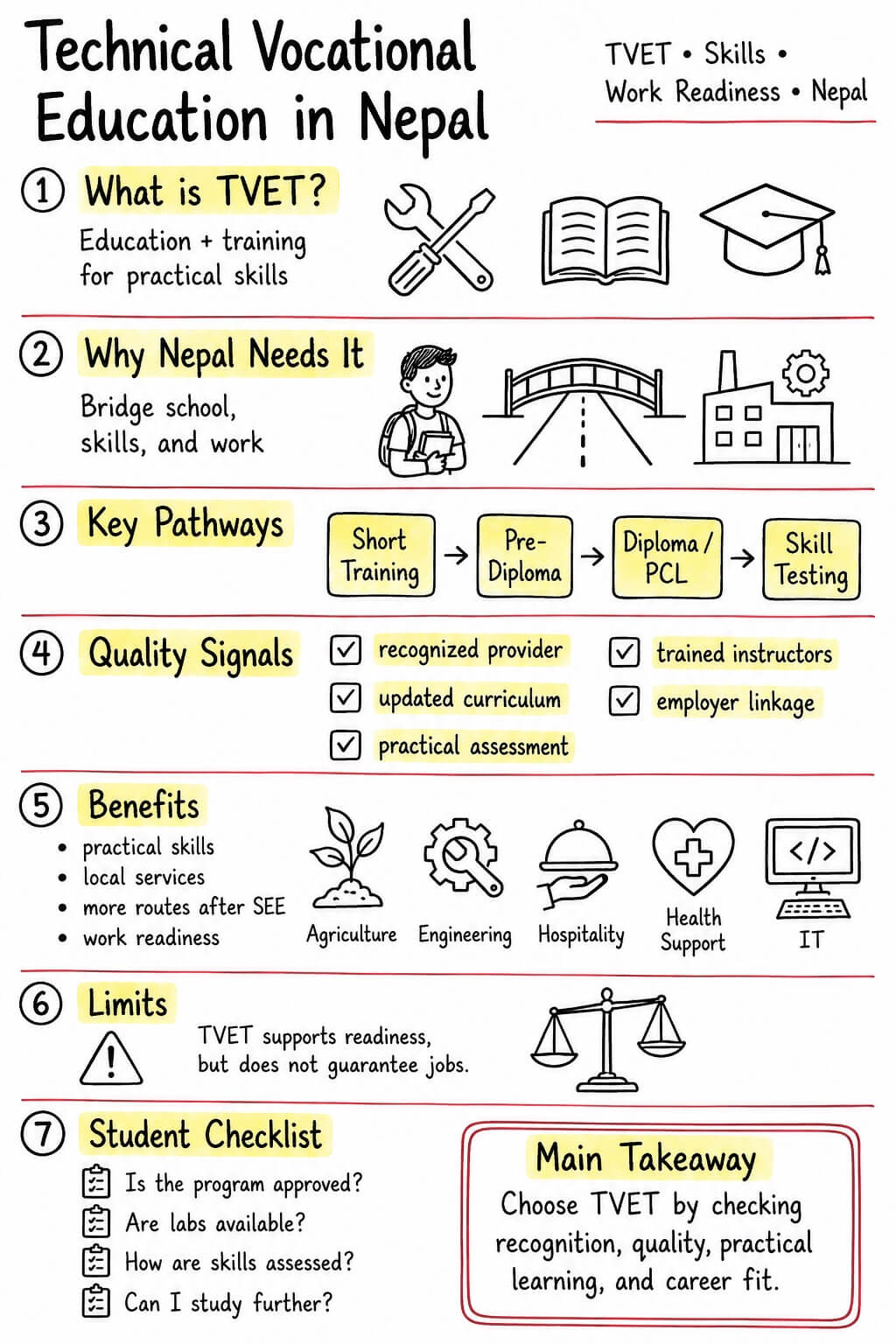
Technical vocational education in Nepal is learning designed to prepare people for skilled work, technical roles, self-employment, or further technical study. A strong TVET program combines knowledge, hands-on practice, assessment, and workplace exposure where relevant.
TVET can prepare learners for fields such as agriculture, engineering, hospitality, health-support roles, forestry, information technology, repair and maintenance, and office-related technical work. CTEVT lists programs across health, engineering, agriculture, hospitality, forestry, and other trades at diploma or proficiency certificate level, along with TSLC-level/Pre-Diploma Level programs in several trades.
The key point for students is that TVET is not only “training.” A credible program should teach concepts, practical skills, safety, work habits, and assessment-based competence.
Why does Nepal need TVET?
Nepal needs TVET because academic education alone does not meet every learner’s career goal or every employer’s skill need. A balanced education system should offer respected academic and vocational routes, with possible movement between them.
It helps bridge school and work
TVET helps learners move from general schooling to occupation-specific skills. A student interested in electrical work, civil construction, agriculture, food technology, hotel operations, or computer maintenance needs supervised practice, tools, safety knowledge, and assessment.
CTEVT curriculum listings show diploma/PCL programs with defined duration, entry qualification, and curriculum references, including several three-year diploma programs. This structure matters because learners and employers need to understand what a qualification represents.
It responds to youth transition concerns
Youth unemployment and youth outside employment, education, or training remain major education-to-work concerns in Nepal. The Nepal Labour Force Survey 2017/18 reported youth unemployment of 21.4 percent among people aged 15–24 and youth NEET of 35.3 percent. UNICEF’s Nepal country report also cited 35.3 percent of young people aged 15–24 as not in employment, education, or training in 2017/18, with a higher rate among young women than young men.
TVET does not solve these issues by itself. Labour demand, local industries, migration patterns, wages, gender barriers, transport, and family responsibilities also affect outcomes. TVET can reduce part of the gap when learners gain skills that employers or communities can use.
It supports local services and enterprises
Nepal needs skilled workers in construction, agriculture, hospitality, repair services, health-support services, information technology, and small enterprises. CTEVT’s program categories reflect several of these sectors.
A trained technician, junior agricultural worker, hospitality worker, computer technician, or health-support worker can contribute to local services when training is reliable. Poor training can leave learners with certificates but weak competence, so quality checks are essential.
What types of TVET programs are available in Nepal?
TVET in Nepal includes short-term training, pre-diploma or TSLC-level programs, diploma or proficiency certificate programs, and skill testing routes. The right type depends on the learner’s prior education, available time, career goal, and need for recognition.
Short-term training
Short-term training focuses on a specific skill or occupation. It may suit learners who need targeted skill development, but students should check whether the course is recognized and whether it supports further training, skill testing, or employment screening.
A short course can be useful for a learner who already works in a field and needs to strengthen one skill area. It may be less suitable for learners who need a broader technical foundation or a qualification linked to further study.
Pre-diploma and TSLC-level programs
Pre-diploma or TSLC-level programs are more structured than many short-term courses. CTEVT’s pre-diploma curriculum page lists programs with different entry qualifications and on-the-job training components in some fields.
These routes may fit learners who want applied learning after school but are not entering a full diploma pathway yet. Students should check the current admission notice because entry requirements can vary by program and intake year.
Diploma and proficiency certificate programs
Diploma and proficiency certificate programs usually provide broader technical preparation. CTEVT states that three-year certificate/diploma level programs require SEE passed. CTEVT also lists minimum GPA requirements for diploma/certificate admission categories, including health and non-health programs.
Students should not rely on a general article alone for admission decisions. Entry rules may vary by subject, intake notice, and year. Before applying, students should check the current official notice, institution approval, and exact program requirement.
Skill testing and occupational standards
Skill testing is important for people who have learned through work, informal training, or short courses. It can help workers show evidence of competence when they do not have a long formal study pathway behind them.
Students and workers should check whether a skill test is linked to a recognized body, occupational standard, or employer requirement. A test has more value when employers and training institutions understand what the certificate represents.
How is TVET different from a degree?
TVET and degrees serve different learning goals. TVET focuses more directly on occupational competence, while a degree usually provides broader academic study, theory, and longer-term progression options in some professions.
A TVET diploma may suit a learner who wants structured practical preparation after SEE. A short course may suit someone who already works and needs a specific skill. A degree may suit someone aiming for professions that require university-level study, licensing, research, teaching, or advanced specialization.
The better decision question is not “Which is better?” It is: “Which route fits the learner’s goal, entry level, finances, time, location, and further-study plan?”
What makes a TVET program credible?
A credible TVET program has recognized affiliation, current curriculum, qualified instructors, usable facilities, practical assessment, and links to work or further study. A course title alone is not enough.
Recognized provider and approved program
Students should verify whether the institution is approved for the exact program they want to join. CTEVT describes itself as a national autonomous apex body of Nepal’s TVET sector constituted in 1989.
Before enrollment, ask for the program’s affiliation, approval status, intake permission, curriculum, and examination or assessment route.
Curriculum depth and practical learning
A credible program should show what students will learn, how practical skills will be taught, and how competence will be assessed. CTEVT’s curriculum listings show program duration, entry qualification, and curriculum references for diploma/PCL programs.
Students should ask whether the course includes workshop practice, fieldwork, lab work, on-the-job training, safety procedures, and practical exams.
Employer linkage
Employer linkage helps programs stay connected to workplace needs. Nepal’s TVET Sector Strategic Plan 2023–2032 includes reform areas such as equity and access, quality and relevance, coherence and transferability, and governance and management.
Employer linkage may include workplace-based training, internships, site visits, industry feedback, guest trainers, or placement support. These features do not guarantee work, but they improve exposure to workplace expectations.
Recognition and further-study options
A good pathway should not trap learners. Students should check whether the certificate or diploma supports further study, skill testing, credit transfer, licensing where relevant, or employment screening.
The TVET Sector Strategic Plan includes coherence and transferability as a reform area, which shows that movement across TVET levels and recognition systems is a policy concern.
What are the benefits of TVET in Nepal?
TVET benefits Nepal when it gives learners practical competence and helps communities access trained workers. These benefits depend on provider quality and labour-market relevance.
Practical skills for work
TVET can help learners develop hands-on skills that are difficult to gain from textbook learning alone. In fields such as engineering trades, agriculture, hospitality, and health-support roles, learners need repeated practice, feedback, and assessment.
This practical focus can make TVET useful for students who know their occupational interest early. It can also help working adults strengthen skills they already use in daily work.
More learning routes after school
TVET gives students options beyond one academic track. This is useful for learners who prefer applied learning or need a route that connects more directly with work.
Access, however, is not only about seats. It also depends on location, cost, transport, safety, disability inclusion, gender barriers, and language. UNICEF’s Nepal country report links youth education and employability concerns with barriers such as poverty, access to schools, social exclusion, child marriage, school infrastructure, language, and emergencies.
Support for local development
Skilled workers support local services. A community needs people who can maintain equipment, support farms, prepare technical drawings, assist in health labs, manage hospitality services, repair devices, and run small technical enterprises.
TVET can contribute to these needs when planning is based on local demand rather than provider convenience alone.
What are the limits and risks of TVET in Nepal?
TVET has limits when courses are poorly equipped, weakly assessed, or disconnected from employers. Students should treat provider claims carefully and verify evidence before enrollment.
TVET is not a job guarantee
No course can guarantee employment. Jobs depend on competence, labour demand, location, economic conditions, employer screening, communication skills, work habits, and networks.
A TVET certificate may help a learner show training, but employers may still ask for practical proof. A portfolio, skill test, internship record, project work, or supervisor feedback can strengthen a learner’s profile.
Quality varies by provider
The same course name can mean different learning experiences at different institutions. Facilities, tools, instructor skill, assessment quality, and workplace exposure can vary.
A student should visit the institution where possible, inspect labs or workshops, speak to current learners or graduates, and compare the current curriculum with the provider’s claims.
Social perception remains a barrier
TVET is sometimes treated as a lesser option than academic education. That perception can discourage capable students from choosing technical pathways.
A better view is that academic and vocational routes both require discipline. The difference is purpose: one may emphasize theory and broad academic study; the other may emphasize occupational competence and applied learning.
Governance is complex
Nepal’s TVET system involves national bodies, provincial and local governments, institutions, employers, and assessment systems. The TVET Sector Strategic Plan identifies governance and management as one of its reform areas.
For learners, governance problems can appear as unclear recognition, weak coordination, uneven facilities, or limited progression routes. This is why official verification matters.
How should students choose a TVET pathway?
Students should choose a TVET pathway by matching the program to their goal, checking recognition, and testing whether the training has practical value. The decision should be based on evidence, not advertisements or peer pressure.
Student checklist before enrollment
Ask these questions before joining:
-
Is the institution approved for this exact program?
-
What is the current entry requirement?
-
Is the curriculum available?
-
How many practical hours are included?
-
Are workshops, labs, tools, or field sites available?
-
Who teaches the practical modules?
-
How are skills assessed?
-
Is on-the-job training included?
-
Are there employer links?
-
What further study or skill testing can follow?
-
What costs are official, and what extra costs may arise?
-
What evidence will I have after completion?
When TVET may be a suitable route
TVET may suit a learner who:
-
wants applied learning;
-
has a clear occupational interest;
-
wants a shorter route to a specific skill;
-
prefers workshop, lab, field, or workplace learning;
-
plans to build a portfolio or skill-test record;
-
wants to combine training with work over time.
When another route may fit better
A general academic or university route may fit better if the learner:
-
needs a degree for the target profession;
-
wants research or academic specialization;
-
is preparing for a field with licensing requirements;
-
wants broader theoretical study before choosing a career;
-
needs a qualification with wider transfer into higher education.
Realistic examples of TVET pathways
Real TVET pathways vary by learner. A good choice depends on prior education, career goal, family context, location, finances, and program recognition.
SEE graduate choosing a diploma
An SEE graduate interested in civil engineering, agriculture, IT, hospitality, or health-support fields can compare a CTEVT diploma with a general academic route. CTEVT lists diploma programs across agriculture, engineering, health/medical science, hospitality, and related areas.
The student should check entry requirements, provider approval, facilities, curriculum, and further-study options before applying.
Working adult seeking recognition
A working adult may already have practical skills in repair, construction, tailoring, agriculture, hospitality, or electrical work. Such a learner may need a short course, skill test, or formal certificate to make existing skills visible.
Recognition matters most when the assessment is accepted by employers, training institutions, or the relevant authority. Workers should check whether the certificate is linked to an occupational standard and whether it helps with their intended next step.
Returnee migrant planning local work
A returnee migrant may have work experience but need local certification, updated skills, or business knowledge. TVET may help if the learner first checks local demand and chooses training tied to a realistic service or employment route.
This route should be planned carefully. The learner should compare training time, cost, local demand, available tools, and whether the skill can lead to employment or self-employment in the chosen location.
Conclusion
Technical vocational education is necessary in Nepal because it gives learners practical routes into skilled work and helps communities access trained people. Its value depends on quality. A recognized provider, current curriculum, practical facilities, trained instructors, fair assessment, and employer linkage matter more than the course title.
Students and parents should treat TVET as a serious education choice, not a fallback. Compare it with academic routes, check official recognition, ask for evidence, and choose the pathway that fits the learner’s goal, capacity, and long-term plan.






Comments 0
No comments yet. Be the first to start the conversation.