



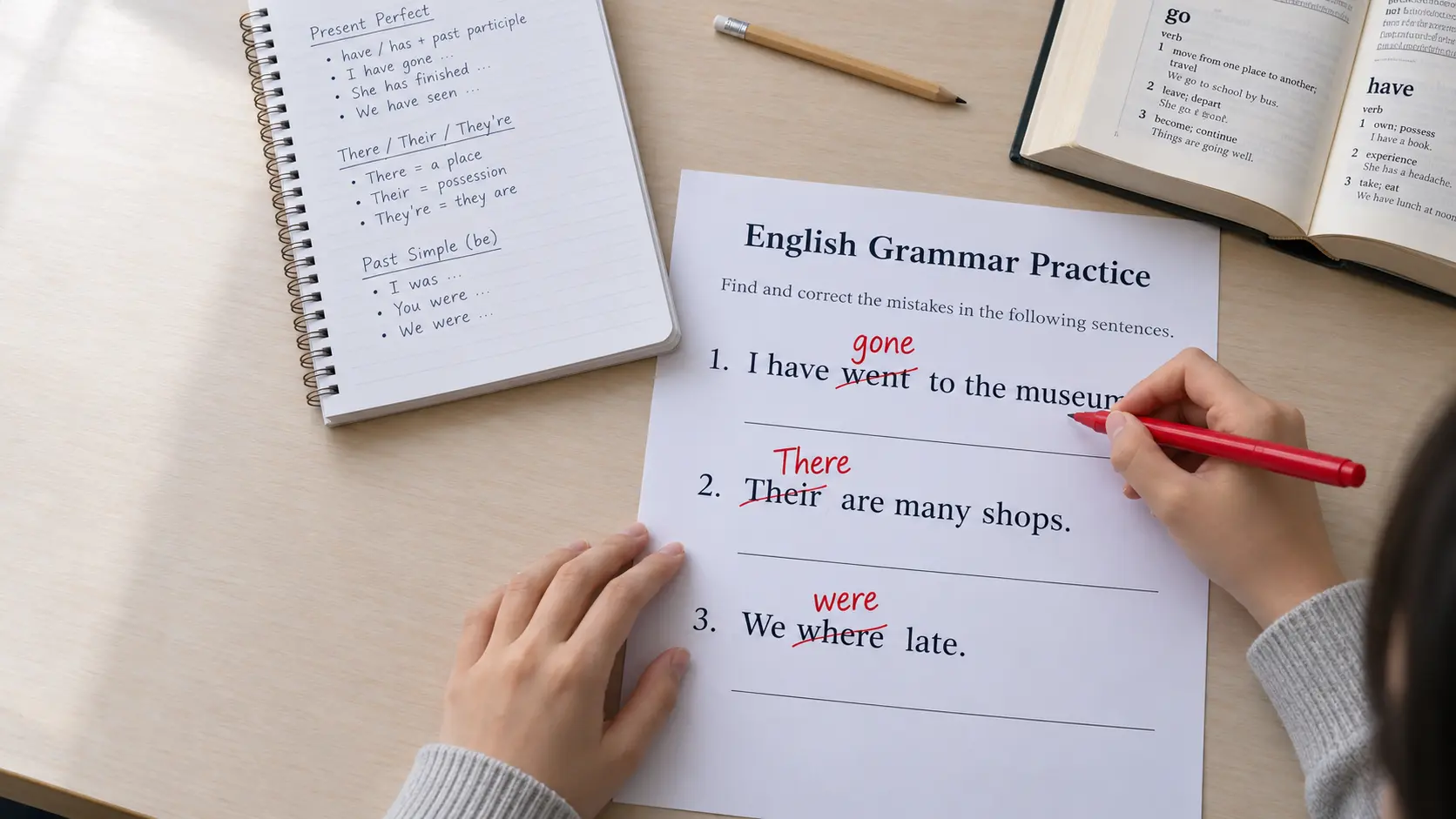
Everyone makes mistakes when they write in English. Even good students do. The good news is that most mistakes are the same few mistakes, again and again. If you learn to spot them, your writing becomes clearer very quickly.
In this lesson, we look at seven common mistakes. These are not random examples. Examiners who mark the Cambridge IGCSE English as a Second Language exam, which thousands of students around the world take every year, wrote about exactly these mistakes in their report on the June 2025 exam. If examiners notice them, readers notice them too.
For each mistake, you will see what goes wrong, why it is wrong, and the correct version.
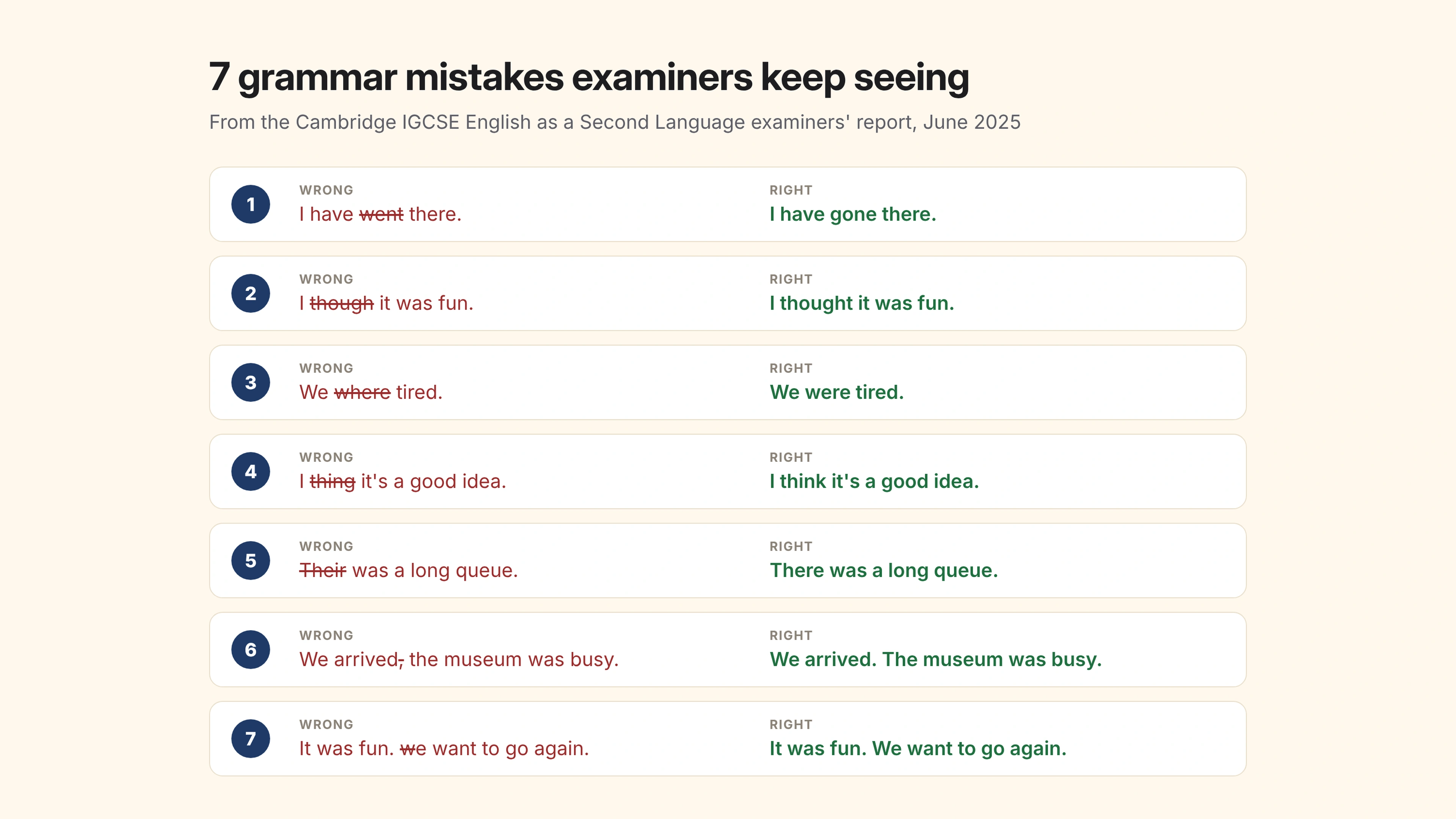
Seven common grammar mistakes in English writing, each with the wrong and right version
Why are grammar mistakes important?
Small mistakes can change your meaning or make your writing hard to follow. In an exam, they also cost marks. In the Cambridge exam, for example, the writing tasks give more marks for language than for content: up to 9 marks for language and up to 6 for content on each task. So clear, correct English really matters.
Mistake 1: “have went” and “had went”
This was one of the mistakes examiners pointed out. Students wrote “have went” or “had went”.
• Wrong: I have went to the museum.
• Right: I have gone to the museum.
• Wrong: We had went home before it rained.
• Right: We had gone home before it rained.
Why? After have, has or had, we use the past participle (the third form of the verb). The verb go is irregular: go → went → gone. Went is the simple past, so we use it alone: I went to the museum.
You can practise more verbs like this in our lesson on regular and irregular verbs.
Mistake 2: “though” and “thought”
These two words look almost the same, but they are completely different.
• though = however, even if. It was cold, though it was sunny.
• thought = the past of think. I thought the trip was great.
• Wrong: I though the exhibition was boring.
• Right: I thought the exhibition was boring.
Mistake 3: “where” and “were”
• where = a question word for place. Where is the museum?
• were = the past of are. We were tired after the trip.
• Wrong: The students where very excited.
• Right: The students were very excited.
Tip: If you can replace the word with was, you probably need were.
Mistake 4: “think” and “thing”
• think is a verb. I think it’s a good idea.
• thing is a noun. The best thing about the trip was the food.
• Wrong: I thing we should go again.
• Right: I think we should go again.
Mistake 5: “their”, “there” and “they’re”
This is one of the most common mistakes in English, even for native speakers.
|
Word |
Meaning |
Example |
|
their |
belongs to them |
The students forgot their tickets. |
|
there |
a place, or “there is / there are” |
There were lots of paintings. |
|
they’re |
they are |
They’re coming with us. |
• Wrong: Their was a long queue at the entrance.
• Right: There was a long queue at the entrance.
Mistake 6: commas instead of full stops
Examiners noticed that some students “substituted commas for full stops throughout the whole piece”. This makes very long sentences with no capital letters.
• Wrong: We arrived at ten, the museum was busy, we saw the dinosaurs first, then we had lunch.
• Right: We arrived at ten. The museum was busy. We saw the dinosaurs first, and then we had lunch.
Why? A comma cannot join two complete sentences on its own. Use a full stop, or join the sentences with a word like and, but or so.
Mistake 7: forgetting a capital letter after a full stop
This often goes together with Mistake 6.
• Wrong: The trip was fun. we want to go again.
• Right: The trip was fun. We want to go again.
Rule: Every new sentence starts with a capital letter. So do names, days, months and the word I.
Quick check: find the mistakes
Can you correct these sentences? Answers are below.
1. I have went there three times.
2. Their are many shops in my town.
3. I though you were coming.
4. We where late, the bus was slow.
5. I thing this is the best idea.
Practise with a real exam task
The best way to stop making these mistakes is to write, then check your own work for the seven mistakes above. Here is a real task from the Cambridge IGCSE English as a Second Language exam (May/June 2023):
Your school is running a competition to find the best idea for a business that could be started by teenagers. One of the competition rules is that you must enter together with another student. Write an email to a friend about the competition. In your email, you should: describe what your business idea is; explain what you have to do to enter the competition; say why you think your friend is the best person to enter with. Your email should be between 150 and 200 words long.
Write your email, then read it slowly and look for each mistake one by one. For more practice, you can read earlier papers and the examiners’ reports online for free on SchoolNinja; the reports list the most common mistakes each year. Save My Exams also has revision notes for the same course.
Answers
1. I have gone there three times.
2. There are many shops in my town.
3. I thought you were coming.
4. We were late. The bus was slow. (or: We were late because the bus was slow.)
5. I think this is the best idea.
Keep practising, and remember: everyone makes mistakes. Good writers just learn to check for them.
References
1. Cambridge International. Principal Examiner Report for Teachers: Cambridge IGCSE English as a Second Language 0510, June 2025.
2. Cambridge International. Cambridge IGCSE English as a Second Language 0510: Mark Scheme, June 2025.
3. Cambridge International. Cambridge IGCSE English as a Second Language 0510/21, Reading and Writing (Extended), May/June 2023.





Comments 0
No comments yet. Be the first to start the conversation.