




You finish studying a chapter and feel confident. The definitions are familiar, the examples make sense, and you can remember the answers your teacher explained. But when a question is worded differently, you struggle to decide what to do.
Sometimes the opposite happens. You understand an explanation during class but cannot reproduce the reasoning when you study alone. You remember seeing the information, yet cannot explain it without reopening the book.
These difficulties reveal an important difference between following information, remembering it, and understanding how to use it.
Studying for understanding means developing accurate knowledge of a subject, recognizing how its ideas are connected, explaining the reasoning behind them, and applying that knowledge when appropriate. It also involves retaining enough of what you learned to use it later.
This does not mean abandoning memorization or treating examinations as unimportant. Students still need to remember definitions, formulas, procedures, and other required information. They also need to prepare for the specific demands of their assessments.
The aim is to avoid confusing familiarity with knowledge or memorized answers with the ability to reason independently.
A useful change is to stop measuring your learning entirely by how much material you have covered. Instead, examine what you can recall, explain, and do with that material.
Answer Summary: To study for understanding, learn the essential facts, identify how the ideas connect, and explain the reasoning behind them. Then close your notes and check what you can recall independently. Practise applying the knowledge to relevant questions, compare your answers with reliable explanations, and revisit the material after a delay. Use memorization for necessary information and exam practice for assessment readiness, but check understanding through explanation, appropriate application, and accurate reasoning.
Why remembering an answer is different from understanding it
Remembering an answer shows that you can reproduce information. Understanding involves knowing what that information means, how its parts relate, and when it applies.
These abilities can develop together, but one does not automatically establish the other.
Consider a mathematics lesson about rectangles.
A student may remember that area is calculated by multiplying length by width. If the rectangle measures 6 cm by 4 cm, the student can calculate its area as 24 cm².
Now imagine a question asking how much material is needed to make a border around the same rectangle.
The student needs to recognize that the question concerns perimeter, not area. Adding the lengths of all four sides gives a perimeter of 20 cm.
Both calculations depend on familiar mathematical knowledge. The difference lies in recognizing what the question requires and selecting the appropriate calculation.
A learner who repeatedly calculates area correctly but uses the area formula for a perimeter question needs more than formula practice. The learner needs to understand what each measurement represents.
The distinction applies beyond mathematics.
In history, recalling an event differs from explaining how the available evidence supports an interpretation. In science, naming the stages of a process differs from explaining their relationships. In language learning, remembering a word's meaning differs from using it appropriately in a sentence.
None of these examples makes factual memory unnecessary. Instead, they show why factual knowledge and conceptual understanding need to develop together.
The National Academies of Sciences, Engineering, and Medicine explains in How People Learn II (2018) that memory, prior knowledge, reasoning, and connections among ideas contribute to learning. The report also emphasizes that effective learning depends on the material, the learner's existing knowledge, and the learning objective.
Why familiar material can create misleading confidence
An explanation often becomes easier to follow after you have read it several times. You recognize the terminology, anticipate the next step, and feel less confused.
That familiarity has value. It may indicate that you are becoming more comfortable with the material.
However, it does not establish that you can reconstruct the explanation independently.
Nicholas Soderstrom and Robert Bjork examined this distinction in their 2015 review, Learning Versus Performance. They explain that performance during learning activities does not necessarily reflect lasting learning. Immediate success can differ from later retention or the ability to transfer knowledge to another task.
This helps explain why a student may complete familiar exercises smoothly but struggle with a later assessment.
The useful response is not to distrust every feeling of confidence. It is to check confidence against something observable: an accurate answer, an independent explanation, or a correctly solved problem without the original example visible.
How to tell whether you understand what you studied
You can examine understanding by checking what you can recall, explain, apply, and retain without relying entirely on visible notes.
A single correct answer does not establish complete mastery. Still, different questions can reveal different learning gaps.
|
What you can do |
What it tells you |
What to check next |
|---|---|---|
|
Recognize information while reading |
The material is familiar |
Can you reproduce it without looking? |
|
Recall facts or procedures independently |
You can retrieve the information |
Do you understand its meaning and purpose? |
|
Explain relationships and reasoning |
You can reconstruct aspects of the concept |
Is your explanation accurate and complete? |
|
Apply knowledge to a changed question |
You can select or use the idea in that situation |
Can you explain why the approach fits? |
|
Recall and use knowledge later |
Some learning remains available after a delay |
Can you repeat the relevant task accurately? |
These are practical distinctions for self-assessment, not a formal or universally validated test of understanding.
Try explaining without copying the textbook
Choose a concept you recently studied. Close your book and explain the main idea using language you understand.
If the subject involves a procedure, explain why each step is necessary.
If it involves a comparison, identify the differences that matter.
If it involves a scientific relationship, explain how the relevant parts are connected.
Then check your explanation against reliable course material.
An explanation that sounds clear but contains incorrect reasoning is not evidence of accurate understanding.
For instance, you may remember every stage of a scientific process but explain the relationships between those stages incorrectly. Repeating that explanation more fluently will not correct the misunderstanding.
Find the precise point where your reasoning differs from the accepted explanation.
Check whether you can use the idea
After explaining a concept, attempt a relevant question that differs from the example you studied.
The difference should require an appropriate decision, not merely replacement of one number with another.
For the rectangle example, changing the dimensions tests whether you can perform the calculations again. Asking whether a problem requires area or perimeter checks a different skill: selecting the correct concept.
That is why varied practice matters.
A learner may remember a procedure accurately but remain uncertain about when to use it. Questions that require choosing between related procedures can expose this gap more clearly than repeated exercises that announce the method in advance.
An incorrect answer does not necessarily mean you misunderstood the entire topic. It may reveal a missing definition, an error in calculation, or difficulty recognizing the conditions under which a principle applies.
Those problems require different corrections.
How to study for understanding in practice
A productive study session should help you acquire accurate knowledge and find out what you can do independently.
The method depends on the difficulty of the material and your current knowledge. Someone encountering algebra for the first time needs different support from someone who already understands the procedures but struggles to select them in unfamiliar questions.
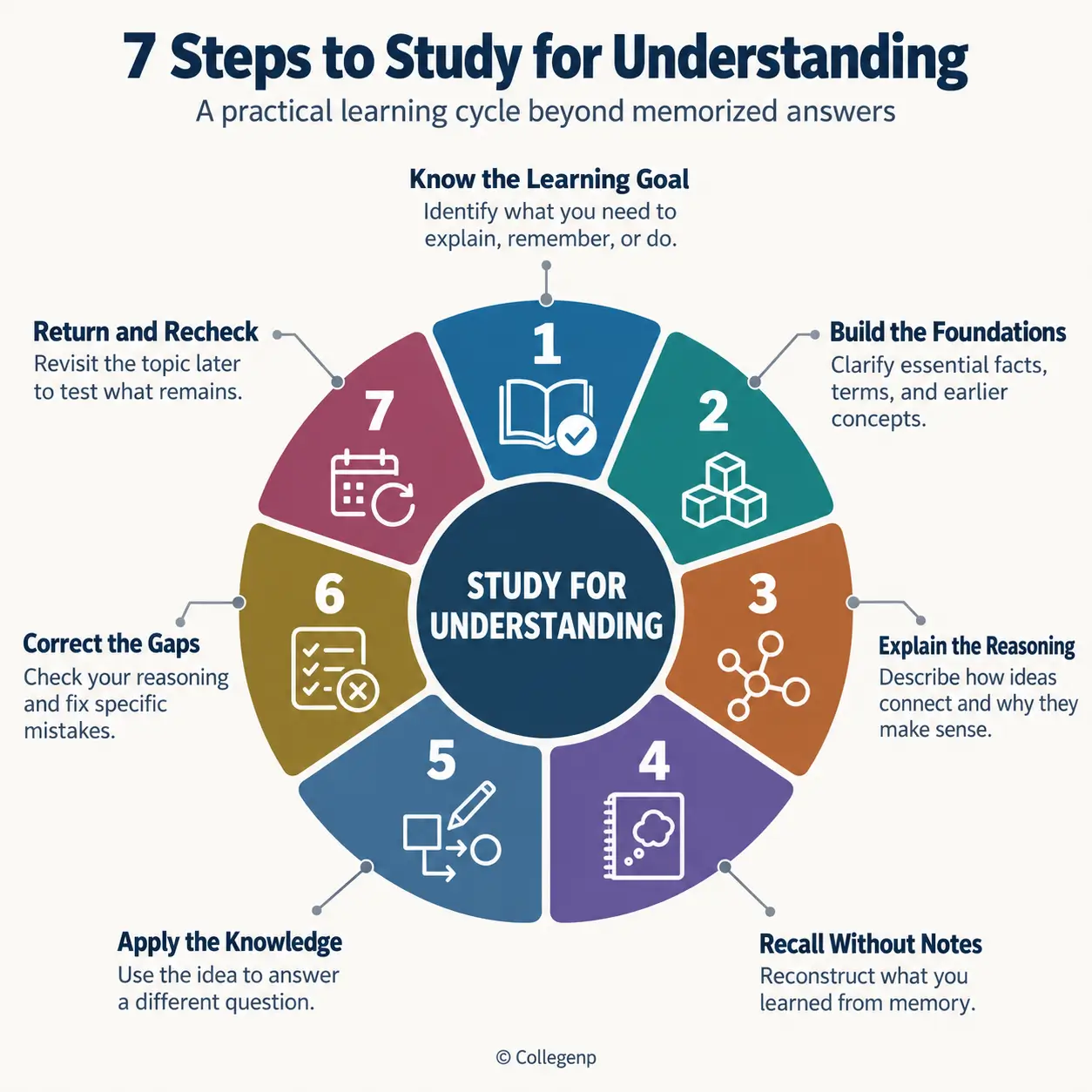
Start with what the topic requires you to learn
Before studying a chapter, examine its learning objectives, syllabus requirements, or representative questions.
Identify the kind of knowledge expected.
Does the assessment require you to define a term, explain a process, compare two theories, solve a calculation, interpret evidence, or evaluate an argument?
These tasks require different forms of preparation.
For example, if the objective is to explain a process, remembering its stages is necessary but may be insufficient.
You also need to understand what happens at each stage and how the stages relate.
If the objective is to solve a mathematical problem, knowing the relevant formula matters, but so does identifying when it applies and performing the calculation correctly.
Turn the objective into a question you should eventually be able to answer.
Instead of writing a study task such as "complete the chapter on area," ask: "Can I identify when area is required, select the correct calculation, and explain what the answer measures?"
This creates a clearer test of learning than finishing a predetermined number of pages.
Learn the foundations before attempting complex explanations
When a topic makes little sense, the difficulty may lie in knowledge the explanation assumes you already possess.
A student learning algebra may struggle because an earlier arithmetic procedure is unfamiliar. A student reading a science chapter may understand the individual sentences but misunderstand an essential technical term.
Repeatedly reading the more advanced explanation may not resolve the underlying gap.
Locate the earliest term, relationship, or step you cannot explain. Review that foundation and check whether you can use it.
For unfamiliar procedures, an accurate worked example can help.
Research discussed by Van Gog, Paas, and Sweller (2010) indicates that worked examples can support novice learners by allowing them to study a correct solution without managing all the demands of independent problem solving at once.
Examine the worked solution carefully. Identify what each step accomplishes and why it is appropriate.
Then attempt a similar problem without copying the example.
As the procedure becomes more familiar, reduce your reliance on the worked solution and attempt questions requiring greater independence.
This distinction matters because repeatedly examining solved problems can improve familiarity with their steps without adequately preparing you to select and perform those steps alone.
Explain the reasoning, not merely the result
Once you understand the basic terminology and procedure, examine why the information makes sense.
Ask questions that reveal relationships:
-
Why does this step follow from the previous one?
-
Which rule or principle supports this answer?
-
Under what conditions does the explanation apply?
-
How does this idea differ from a related concept?
-
What part of the reasoning can I not explain?
This is related to self-explanation, a learning activity examined in cognitive science research.
In their 1989 study, Chi and colleagues analyzed how students explained worked examples while learning to solve mechanics problems. Students who generated more useful explanations connected solution steps with relevant principles and developed stronger understanding of those problems. The research illustrates the importance of explaining how procedures relate to underlying knowledge.
The implication for studying is straightforward: do not stop at describing what happens. Where the subject requires reasoning, identify why it happens or why a particular method is appropriate.
This does not mean speaking at length about every detail.
A short explanation identifying the correct principle may show clearer understanding than a lengthy paragraph containing unnecessary information.
It also matters whether the explanation is correct. Check uncertain reasoning before repeating it.
Recall what you learned without looking
After studying an explanation, put the source aside and try to produce the important information from memory.
This is retrieval practice, also known as active recall.
You may answer a question, reproduce an essential definition, explain a process, draw a diagram, construct an essay outline, or solve a problem.
Choose the activity according to what you need to learn.
A flashcard asking for a definition checks whether you can retrieve that definition. A question asking why the concept applies to a situation requires additional reasoning.
Research provides substantial support for retrieval practice.
In a 2013 review of ten learning techniques, Dunlosky and colleagues gave practice testing and distributed practice high utility assessments. A systematic review by Agarwal, Nunes, and Blunt (2021) also found benefits from retrieval practice across a range of classroom settings, although the research was not equally representative of every country or educational context.
Retrieval practice should not become a collection of shallow questions that check factual memory while ignoring the reasoning required by the subject.
For a topic involving relationships, try reconstructing an explanation.
For a mathematical procedure, solve a relevant problem without the worked solution visible.
For an argument-based subject, attempt to organize the claim, supporting evidence, and reasoning independently.
If you cannot remember the essential information because the material is still unfamiliar, return to the explanation before attempting more demanding recall questions.
For a fuller comparison of learning activities, Collegenp's active recall versus rereading article examines their different purposes and limitations.
Use questions that require you to select and apply ideas
Once you can explain an idea accurately, practise identifying when and how it applies.
Start with questions that resemble the examples used during instruction. Then introduce meaningful variations.
These variations may involve different conditions, missing information, alternative interpretations, or the need to choose between related principles.
A learner studying mathematics could practise deciding which of several familiar procedures fits a problem.
A science student could explain how changing a stated condition affects a process.
A student preparing an analytical essay could examine whether the evidence supports a particular conclusion and identify what remains uncertain.
The goal is not novelty for its own sake. The question should require reasoning connected to the knowledge being studied.
Research by Karpicke and Blunt (2011) found that retrieval practice supported comprehension and inference on the science-text tasks examined in their experiments. The findings show that retrieval practice can contribute to conceptual learning, although they do not establish that every recall activity produces transferable understanding.
This distinction is important. Remembering a principle and being able to select it under relevant conditions are related abilities, but they are not identical.
Practise both when the subject requires both.
Use feedback to identify what went wrong
Checking an answer means examining more than whether it matches the answer key.
When a response is incorrect, find the part of the thinking that needs correction.
Suppose you solve a mathematics problem incorrectly.
If you chose the wrong formula, review how the problem's conditions determine which formula applies.
If you chose the correct formula but made an arithmetic error, check the calculation and the relevant operation.
If you followed the correct procedure but misunderstood what the result represented, review the underlying concept and units.
Repeating the same kind of question without distinguishing these errors may leave the original difficulty unresolved.
The same principle applies to written subjects.
An essay response may contain accurate facts but fail to answer the precise question. In another case, the argument may be relevant, but the evidence may not support the conclusion.
These are different weaknesses.
Compare your answer with reliable explanations, worked solutions, marking criteria, or feedback from an educator.
Then attempt another suitable question to check whether the correction makes sense.
Revisit the topic after a delay
Being able to explain a concept immediately after studying does not establish that you will remember it later.
Return to important material in another session and try to recall or apply it before reopening your notes.
If you can explain the topic accurately, move to an appropriate question or another area needing attention.
If essential information has been forgotten, review the missing parts and check them again later.
This is the principle behind spaced or distributed practice.
Cepeda and colleagues' 2006 review examined how distributing learning across time affected later verbal recall. The findings showed that the intervals between study sessions and the intended retention period both influenced results. They do not establish a single ideal revision schedule for every subject or learner.
The practical point is to avoid depending entirely on what remains familiar immediately after a study session.
Your course timeline and performance can guide when material needs further attention.
Collegenp's spaced repetition guide explains ways to organize later review.
Match your study method to what the subject demands
Studying for understanding does not require every learner to use an identical activity.
A definition, a mathematical procedure, a scientific explanation, and an evidence-based argument demand different forms of knowledge.
For subjects requiring precise factual knowledge
Accurate recall is important when the task requires terminology, definitions, symbols, dates, or other specific information.
Use questions that require you to produce the answer before checking it.
Where necessary, add questions about meaning, comparison, or appropriate use.
For example, remembering two scientific terms is useful. Explaining how the corresponding concepts differ can reveal whether you understand their relationship.
Do not make an accurate factual task unnecessarily complicated. Some information genuinely needs to be remembered precisely.
For mathematics and procedural subjects
Learn the relevant facts and rules, examine correct worked examples, and practise performing the procedure independently.
Once the basic method is familiar, include questions that require deciding which method applies.
Pay attention to the difference between knowing the procedure and recognizing the conditions that call for it.
If a problem exposes a missing prerequisite, return to that foundation before attempting increasingly complicated examples.
For science and other concept-heavy subjects
Focus on understanding processes, relationships, conditions, and explanations.
A diagram may help organize information, but copying a diagram does not establish that you can explain what it represents.
Try reconstructing the important parts and explaining how they connect.
If a process has several stages, identify what occurs in each stage and how the stages relate.
When appropriate, practise explaining what changes when a relevant condition changes.
Check these explanations carefully, particularly where a mistaken relationship can make an entire answer incorrect.
For history, literature, and argument-based subjects
Accurate knowledge of the material remains necessary, but analytical tasks also require interpretation and reasoning.
Rather than memorizing a complete essay, examine the question, identify the relevant information, and organize an argument that responds to it.
Distinguish a claim from the evidence supporting it.
Ask whether the conclusion follows from that evidence and whether other reasonable interpretations need consideration.
Practise constructing answers to varied questions rather than relying entirely on a previously memorized response.
This can help you prepare for assessments that require independent analysis while preserving the factual accuracy expected in the subject.
How to prepare for exams without sacrificing understanding
Examination preparation and meaningful learning can support each other when study activities match the assessment requirements.
The important distinction is between practising the knowledge and reasoning a course requires and memorizing particular answers without understanding when they apply.
Start with the syllabus, assessment instructions, and representative questions.
Identify whether the examination requires factual recall, calculations, explanation, interpretation, or application.
Then prepare for those demands directly.
When the exam mainly tests memorization
If an examination requires precise factual answers, spend adequate time learning and recalling those facts.
For definitions, technical vocabulary, and other necessary information, retrieval practice can help you check accuracy.
Understanding the relationships among facts remains useful where those relationships are part of the curriculum.
However, there is no reason to turn every simple recall objective into an elaborate explanation.
The study activity should match the learning requirement.
When the exam tests application and reasoning
Practise questions that require more than reproducing familiar examples.
Check whether you can identify the relevant principle, select a suitable method, and explain why it applies.
Do not rely exclusively on questions that announce which procedure to use.
If the examination includes written explanations, practise expressing your reasoning clearly and within the expected response format.
If the examination involves calculations, practise accuracy and method selection.
Even when your conceptual understanding is sound, you still need to understand the rules and format of the assessment.
When the examination is close and your foundations are weak
Limited preparation time creates a genuine trade-off between covering the required syllabus and developing deeper understanding.
Trying to examine every topic in maximum detail may leave essential assessed material unfinished.
Begin by identifying which required topics depend on knowledge you lack.
Repair the prerequisites that prevent you from answering important questions. Use accurate worked examples where necessary, then attempt representative problems independently.
Prioritize the learning outcomes specified by the course rather than trying to predict exact examination questions.
Do not confuse a temporary ability to reproduce an answer with lasting understanding. Equally, do not abandon necessary factual preparation because you are focusing on concepts.
The aim under time pressure is to make the strongest reasonable use of the available preparation period, without assuming that a shortened study process produces the same learning as sustained practice.
For a broader discussion of catching up with unfinished coursework, see how to study when you are behind.
What to do when you still do not understand
When studying repeatedly fails to produce the expected result, identify the particular difficulty before changing methods.
More reading, additional questions, or longer study sessions will not necessarily address the same problem.
You understand the explanation while reading but cannot reproduce it
You may be depending on the visible explanation to guide your thinking.
Try reconstructing one manageable part without looking.
When you become uncertain, identify the missing step and return to that section. Check it, then attempt the explanation independently.
This provides a more specific learning target than rereading the entire chapter without knowing what is missing.
You remember the facts but cannot answer unfamiliar questions
The difficulty may involve recognizing when the knowledge applies.
Examine the differences between the questions you can answer and those you cannot.
Does the unfamiliar question require choosing between related concepts? Does it omit a familiar cue? Does it ask for a different type of explanation?
Practise identifying those conditions before attempting the full answer.
If you still cannot establish which principle applies, seek a clearer explanation of the underlying relationship.
You can explain a method but repeatedly make errors
Determine whether the errors involve reasoning, selecting the correct procedure, or carrying it out accurately.
A learner who understands why a formula applies but repeatedly miscalculates needs a different type of practice from someone who performs calculations correctly but selects the wrong formula.
Review the part of the task where the error occurs.
Use accurate feedback and attempt another suitable problem to check whether the correction has been understood.
You understand the topic but forget it later
Revisit the material without immediately reopening your notes.
Try recalling the important facts and reconstructing the explanation. Include an application question if the subject requires one.
Review the parts you cannot retrieve accurately.
A later successful explanation provides additional evidence of retention, although it does not establish that the knowledge will remain equally accessible under every future condition.
You need more explanation than independent study provides
Not every difficulty can be resolved by changing a study technique.
If the material remains unclear, ask an educator to explain the relevant prerequisite or relationship. Compare the explanation with the prescribed learning material and attempt a manageable task afterward.
Students also differ in language background, educational access, and familiarity with subject terminology.
If you are studying through a language in which you are still developing fluency, separate uncertainty about vocabulary from uncertainty about the concept. Learn the correct technical terms while seeking explanations you can understand and verify.
The objective is accurate understanding, not producing complicated language that gives the appearance of understanding.
A practical check for your next study session
Choose one topic you have already covered rather than attempting to change your entire study routine immediately.
Look at what the syllabus expects you to know or do.
Begin by attempting a relevant question without notes. Observe exactly where you have difficulty.
If you cannot remember essential facts, review them and practise recall.
If the facts are available but the explanation is unclear, study the missing relationship and check your reasoning.
If you understand the explanation but cannot decide when to use it, practise questions requiring method selection or appropriate application.
If you can complete the task accurately, revisit it in another session to check whether the learning remains available.
There is no need to force every topic through an elaborate sequence. Use the activities that address what you still need to learn.
This approach changes the evidence you use to judge a study session. Rather than relying on the number of pages completed or the ease of rereading, you examine whether you can produce accurate knowledge and use it for the task that matters.
Conclusion
Studying for understanding does not require choosing between memorization and reasoning. Both contribute to learning.
You need facts and procedures that can be recalled accurately. You also need to understand their meaning, recognize when they apply, and explain the relationships that make them useful.
Examinations remain important, but a familiar answer on a practice sheet does not establish that the same knowledge will be available in a different question or at a later time.
A useful way to study is to identify what the topic requires, learn the foundations, practise explaining and applying the ideas, check errors carefully, and return to the material after a delay.
The aim is to understand what you have learned well enough to use it appropriately, rather than depending entirely on recognizing the answers you have already seen.
References
1. Soderstrom, N. C., and Bjork, R. A. (2015). Learning Versus Performance: An Integrative Review. Perspectives on Psychological Science, 10(2), 176–199.
2. National Academies of Sciences, Engineering, and Medicine. (2018). How People Learn II: Learners, Contexts, and Cultures. National Academies Press.
3. Dunlosky, J., Rawson, K. A., Marsh, E. J., Nathan, M. J., and Willingham, D. T. (2013). Improving Students' Learning With Effective Learning Techniques. Psychological Science in the Public Interest, 14(1), 4–58.
4. Agarwal, P. K., Nunes, L. D., and Blunt, J. R. (2021). Retrieval Practice Consistently Benefits Student Learning: A Systematic Review of Applied Research in Schools and Classrooms. Educational Psychology Review, 33, 1409–1453.
5. Chi, M. T. H., Bassok, M., Lewis, M. W., Reimann, P., and Glaser, R. (1989). Self-Explanations: How Students Study and Use Examples in Learning to Solve Problems. Cognitive Science, 13(2), 145–182.
6. Van Gog, T., Paas, F., and Sweller, J. (2010). Cognitive Load Theory: Advances in Research on Worked Examples, Animations, and Cognitive Load Measurement. Educational Psychology Review, 22, 375–378.
7. Karpicke, J. D., and Blunt, J. R. (2011). Retrieval Practice Produces More Learning Than Elaborative Studying With Concept Mapping. Science, 331(6018), 772–775.
8. Cepeda, N. J., Pashler, H., Vul, E., Wixted, J. T., and Rohrer, D. (2006). Distributed Practice in Verbal Recall Tasks: A Review and Quantitative Synthesis. Psychological Bulletin, 132(3), 354–380





Comments 0
No comments yet. Be the first to start the conversation.