




You read two reports about a subject you care about. One supports your existing opinion. The other challenges it. Both appear credible, yet the first seems more convincing.
You examine the opposing report more critically, question its methods, or search for another source supporting your original view. After reading more information, you feel increasingly confident in what you believed before.
The problem is not necessarily that your conclusion is wrong. It is that the evidence supporting it may have received more favorable treatment than the evidence challenging it.
This is how confirmation bias can influence reasoning, even when someone sincerely wants to be fair.
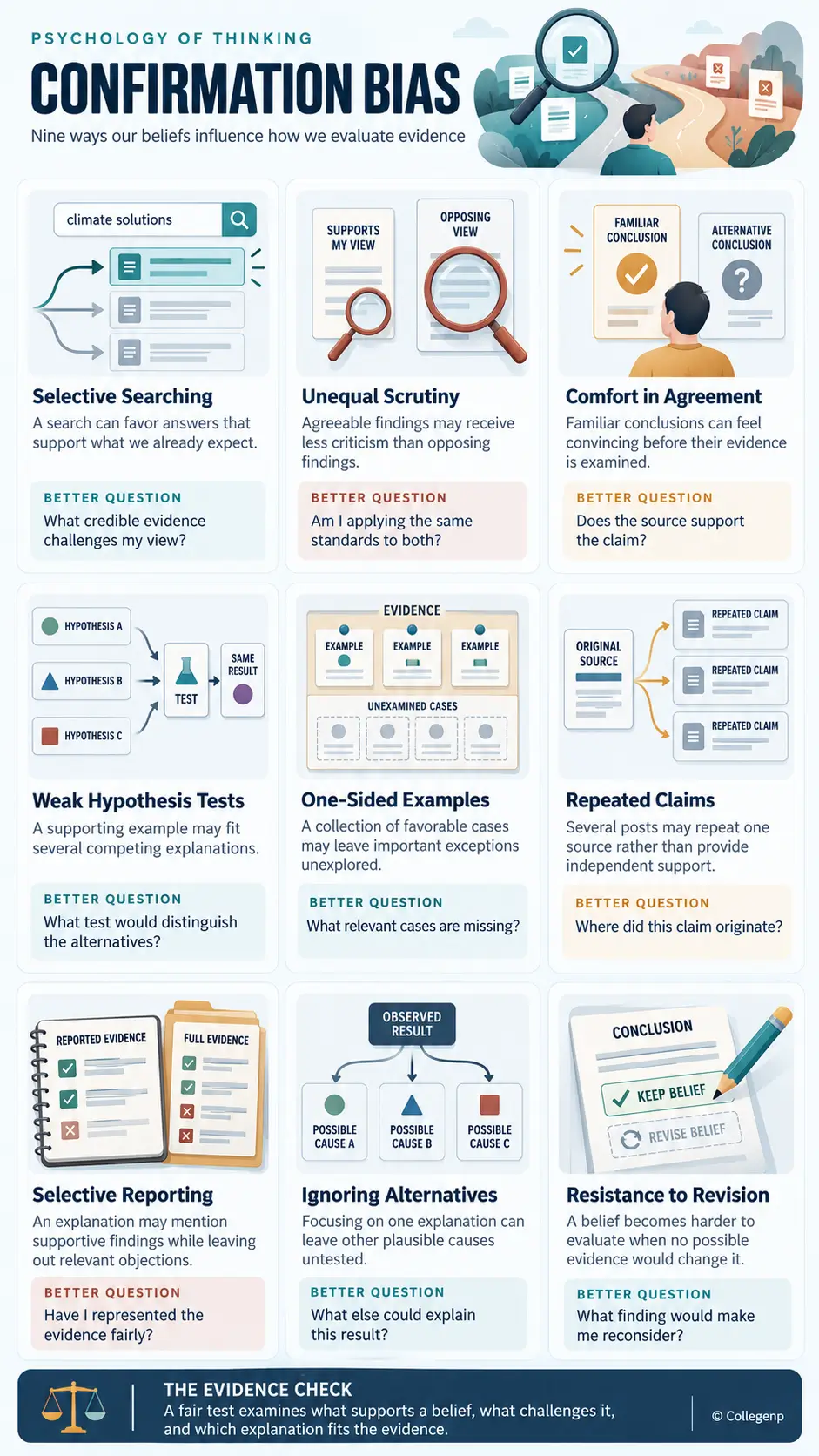
Confirmation bias is the tendency to seek, interpret, or give greater weight to information that supports existing beliefs, expectations, or hypotheses. It can affect academic research, everyday judgments, online information evaluation, and decisions involving competing explanations.
Psychological research offers important qualifications. Seeking confirming evidence is not inherently a mistake. Contradictory information is not automatically more trustworthy. Even memory does not consistently favor information that matches expectations.
Understanding these distinctions helps you identify when your judgment deserves closer examination without treating every personal belief as suspicious.
Answer Summary: Confirmation bias occurs when existing beliefs influence which evidence we seek, how we interpret it, or how much importance we assign to it. Research shows that people can prefer agreeable information and evaluate conflicting evidence differently, although these tendencies depend on the situation. Reducing their influence involves examining credible alternative explanations, applying consistent standards to evidence, and identifying what information would change a conclusion. The goal is fairer reasoning, not complete neutrality.
Key Takeaways:
-
Confirmation bias concerns how evidence is handled, not whether an existing belief is false.
-
People can favor supporting information during searching and evaluation.
-
A confirming example may fit several explanations without distinguishing between them.
-
Research does not establish that people consistently remember confirming information better.
-
Fair reasoning requires consistent evidence standards, not equal trust in opposing positions.
-
Examining credible alternatives can reveal weaknesses in a conclusion, although no method eliminates bias in every situation.
What Is Confirmation Bias?
Confirmation bias is a tendency to favor evidence consistent with an existing belief or hypothesis while giving less appropriate consideration to relevant alternatives.
Psychologist Raymond Nickerson described this tendency in his 1998 review, Confirmation Bias: A Ubiquitous Phenomenon in Many Guises. His analysis examined how existing beliefs and expectations can influence evidence seeking and interpretation.
An important feature of the concept is that confirmation bias describes a reasoning process. It does not establish whether the resulting belief is true or false.
Consider a student who believes a particular study method improves examination performance.
The student finds several accounts of successful learners using that method. These examples appear to support the belief.
But the examples alone cannot establish that the method caused the reported outcomes. The students may differ in prior knowledge, preparation time, instruction, or other relevant factors.
If the student searches exclusively for favorable accounts and overlooks credible contradictory findings, the evaluation may be incomplete.
However, finding supporting evidence is not itself proof of confirmation bias. The student may have examined alternative explanations and still reached a reasonable conclusion.
The distinction is between having evidence for a belief and evaluating that evidence fairly.
Confirmation Bias Is Not the Same as Having an Opinion
Existing knowledge and beliefs are part of ordinary reasoning.
They help people identify relevant questions, recognize familiar patterns, and formulate explanations worth investigating.
A student who expects a scientific hypothesis to produce a particular result has not necessarily made a reasoning error. The expectation becomes a problem when the student designs tests that cannot meaningfully challenge the hypothesis or dismisses contradictory results without adequate grounds.
Similarly, someone can hold a strong opinion after carefully examining competing evidence.
Confidence is not proof of bias. The question is whether that confidence reflects the strength of the available evidence.
Why Does Supporting Evidence Seem More Convincing?
Supporting evidence can appear more persuasive because existing beliefs influence different stages of reasoning: what information we choose, how we evaluate it, and how we later remember or report it.
These processes are related, but psychological research does not establish that they occur together in every situation.
1. We May Prefer Information That Agrees With Us
The preference for information consistent with an existing belief is called selective exposure.
Imagine researching a qualification you already want to pursue.
You read favorable graduate experiences, encouraging course descriptions, and positive accounts of related career opportunities.
These sources may contain useful information. However, your search might overlook qualification requirements, curriculum limitations, or credible comparisons with alternative pathways.
The result is a collection of favorable evidence that does not necessarily address the full decision.
Research provides support for this pattern.
In a 2009 meta-analysis, William Hart and colleagues examined studies in which participants selected between information consistent and inconsistent with their existing attitudes, beliefs, or behaviors.
The analysis found an overall preference for agreeable information, with an average standardized effect of d = 0.36.
This is a statistical measure of the observed preference across the studied conditions. It does not mean that 36% of people display confirmation bias.
The findings also showed that information preferences changed according to circumstances and motivations.
When challenging information was useful for accomplishing a current goal, participants sometimes favored it over agreeable information.
This qualification matters. People do not necessarily avoid disagreement in every situation. The usefulness of information and the purpose of the search can affect what they choose to examine.
2. We May Evaluate Conflicting Evidence Unequally
Confirmation bias can influence judgment even after someone has encountered evidence supporting both sides of an issue.
A person may examine weaknesses in opposing evidence carefully while accepting favorable evidence with fewer questions.
Psychologists Charles Lord, Lee Ross, and Mark Lepper investigated this pattern in a 1979 experiment involving 48 undergraduates with opposing attitudes toward capital punishment.
Participants evaluated two purported research studies that presented conflicting findings about the death penalty's deterrent effects.
The researchers found that participants tended to regard evidence consistent with their prior attitudes as more convincing. Their evaluations also contributed to increased disagreement under the experimental conditions.
The experiment examined how participants responded to research descriptions presented during the study. It did not determine which position on capital punishment was correct.
Its broader lesson concerns the evaluation process.
Two people can encounter the same conflicting information yet assess its strength differently because they approach it with different existing beliefs.
A similar difficulty can occur in academic research.
Suppose two studies examine the same teaching method. One reports favorable results; the other finds no clear advantage.
If the favorable study matches your expectations, you may readily accept its conclusion. Meanwhile, you scrutinize the second study's sample, methods, and limitations.
Critical examination is appropriate. The concern arises when comparable weaknesses are treated differently depending on which conclusion they support.
The practical standard is straightforward: evidence should receive scrutiny according to its quality, not its agreement with your preferred position.
3. Does Confirmation Bias Affect What We Remember?
Existing expectations can influence memory, but the relationship is more complicated than the claim that people remember supporting information better.
A 1992 meta-analysis by Charles Stangor and David McMillan examined 54 experiments concerning memory for information consistent or inconsistent with expectations.
Across the studies, recall and recognition-sensitivity measures generally favored information that contradicted expectations.
However, recognition measures that did not correct for response bias showed a tendency to report expectation-consistent information as previously encountered.
These findings distinguish different processes.
Remembering an event accurately is not the same as being inclined to say that an expected event occurred. Neither is identical to selectively mentioning favorable information when explaining an opinion.
Someone might accurately remember contradictory evidence but choose not to discuss it. Another person might misremember a detail without deliberately favoring their existing view.
For this reason, it is misleading to claim that confirmation bias means we consistently forget everything that challenges our beliefs.
When reviewing your own reasoning, consider three separate questions:
-
Which information did I choose to read or examine?
-
How did I evaluate it when I encountered it?
-
How am I remembering or presenting it now?
Each question concerns a different stage at which the treatment of evidence can become uneven.
What Does the Wason Experiment Reveal About Confirmation Bias?
Peter Wason's 1960 rule-discovery experiment illustrates why repeatedly finding examples that support an explanation may fail to test whether that explanation is correct.
In the experiment, participants attempted to discover a hidden rule governing acceptable numerical sequences.
They received an initial sequence and could propose additional sequences to receive feedback about whether each satisfied the rule.
A familiar illustration begins with:
2 – 4 – 6
You might infer that the rule is to add two to each successive number.
To test your hypothesis, you propose:
8 – 10 – 12
The sequence is accepted.
You then try:
14 – 16 – 18
That sequence is also accepted.
Both results seem encouraging. Yet neither establishes that your proposed rule is correct.
The hidden rule is broader: the numbers must appear in ascending order.
Your examples fit both rules, so they cannot distinguish between them.
A more informative test would use:
2 – 5 – 9
This sequence does not follow the add-two rule, but it does follow the ascending-order rule.
If accepted, it shows that the narrower hypothesis is incorrect.
Wason's original study involved 29 participants. According to the published abstract, six reached the correct conclusion without previously announcing an incorrect rule, while others made one or more incorrect conclusions or did not reach a conclusion.
The results illustrate the difficulty of testing a hypothesis when someone repeatedly selects examples that fit the explanation already in mind.
The experiment does not establish how frequently this reasoning pattern occurs in the general population.
Why a Confirming Test Is Not Necessarily a Bad Test
The Wason experiment is sometimes interpreted as evidence that searching for confirmation is inherently poor reasoning.
That interpretation is too broad.
In their 1987 analysis, Joshua Klayman and Young-Won Ha explained that a positive-test strategy—testing instances expected to possess a particular property—can be informative under appropriate conditions.
Its usefulness depends on the hypothesis, the available alternatives, and what different test results would reveal.
For example, if two explanations make different predictions, testing whether one prediction occurs can help distinguish between them.
But when several explanations predict the same result, observing that result may provide limited information about which explanation is correct.
The lesson is not to avoid confirming evidence.
It is to ask whether a test provides information capable of separating competing explanations.
This distinction matters whenever someone is evaluating an uncertain claim.
A successful example may support a hypothesis without establishing that it is the most convincing explanation.
How Confirmation Bias Appears in Everyday Life
Confirmation bias becomes easier to recognize when you examine how an existing preference affects the questions you ask and the conclusions you draw.
The following situations are illustrative applications of the research, not documented individual case studies.
Academic Research: Finding Sources for a Thesis
A student begins an assignment with a preferred argument.
They search for publications supporting it and collect quotations that appear persuasive.
The problem may remain hidden because the student has gathered credible material rather than obviously unreliable information.
However, credible sources can still provide an incomplete picture when selected for a one-sided purpose.
The student may overlook evidence that limits the argument, alternative explanations, or weaknesses in the original research.
A more informative approach is to identify the strongest credible objection to the thesis and investigate whether the available evidence addresses it.
This does not mean abandoning the initial argument. It means allowing the research to determine how confidently the argument can be presented.
Sometimes the strongest defensible conclusion is narrower than the original thesis.
Educational Decisions: Researching a Preferred Option
A student considering two academic programs may already prefer one because of its subjects, location, or personal appeal.
They find favorable reviews about that program and accept them readily.
When the alternative receives positive feedback, they question whether the reviewers are representative.
Meanwhile, they dismiss criticism of their preferred program as isolated or unimportant.
This creates an uneven comparison.
A more useful assessment begins with the student's actual requirements.
Relevant criteria may include curriculum content, academic recognition, progression requirements, affordability, learning format, and personal interests.
Different readers may reasonably assign different importance to these factors.
Confirmation bias becomes a concern when the same type of evidence receives different treatment depending on which option it favors.
A fair comparison may still support the original preference.
Online Claims: Mistaking Repetition for Independent Support
Imagine encountering several posts that repeat a claim consistent with your opinion.
The repetition creates the appearance of broad agreement.
But several accounts may be repeating information from the same original source.
The number of posts does not establish that independent evidence supports the claim.
A useful response is to trace the information to its origin and determine whether credible sources have independently examined it.
The distinction matters because finding many agreeable statements is different from finding several independent investigations that reach the same conclusion.
For readers evaluating unfamiliar online information, checking claims before sharing provides a related source-verification process.
Personal Judgments: Interpreting Ambiguous Behavior
Suppose someone believes a colleague is unreliable.
A missed message appears to confirm that belief. Several timely responses receive less attention because they do not fit the existing impression.
The missed message is a genuine observation, but it may not establish a broader pattern.
Before drawing a conclusion about the colleague, consider the available record and whether similar behavior would receive the same interpretation from someone else.
The aim is not to dismiss concerns or invent favorable explanations.
It is to avoid treating one ambiguous event as decisive evidence of a person's character.
When Does Seeking Confirmation Become a Reasoning Problem?
Seeking confirmation becomes problematic when it produces an incomplete or unfair assessment of relevant evidence.
Finding information consistent with a belief is not sufficient to establish that bias has occurred.
A more concerning pattern appears when someone repeatedly searches for supporting examples without examining credible alternatives, applies unequal standards to conflicting evidence, or excludes relevant findings because they challenge a preferred conclusion.
The quality of the evidence remains central.
A well-conducted study and an unsupported assertion do not deserve equal confidence merely because they present opposing positions.
Likewise, rejecting a weak contradictory claim can be reasonable.
Fair reasoning does not require treating every perspective as equally credible. It requires applying consistent standards and allowing stronger evidence to carry more weight.
This also explains why changing one's opinion is not the necessary outcome of examining confirmation bias.
After reviewing the available evidence fairly, someone may retain their original conclusion with good reason.
What matters is whether the conclusion has survived meaningful examination rather than repeated reassurance.
How to Reduce Confirmation Bias When Evaluating Evidence
Confirmation bias cannot be reliably eliminated through a single exercise, but examining alternative explanations and applying consistent evaluation standards can help reveal weaknesses in reasoning.
Research provides some support for deliberately considering competing possibilities.
In 1984, Charles Lord, Mark Lepper, and Elizabeth Preston investigated a strategy involving consideration of evidence or explanations opposing an existing judgment.
Their experiments found corrective effects on the particular social-judgment tasks studied.
The findings support the value of considering alternatives under those experimental conditions. They do not establish that a brief exercise will remove confirmation bias across every real-world decision.
The following process translates these research principles into practical questions. It is editorial guidance, not a separately validated psychological intervention.
Start With a Claim That Can Be Examined
A broad belief such as “This teaching method works” leaves too much room for different interpretations.
A more useful question identifies the outcome and the circumstances being evaluated.
For example:
“Does this teaching method improve understanding of the material compared with the alternative being considered?”
Now the investigation has a clearer purpose.
You can identify relevant research, examine how learning was measured, and determine whether the evidence addresses the comparison.
If the claim is vague, almost any favorable observation can seem supportive.
A specific claim makes it easier to recognize which findings provide meaningful information.
Identify the Strongest Credible Alternative
Before collecting more evidence for your preferred explanation, ask what else might account for the observations.
Consider a study method associated with favorable examination results.
Possible explanations include the effectiveness of the method, differences in preparation time, prior knowledge, or another relevant factor.
These alternatives should not be accepted without evidence.
Their purpose is to identify what needs investigation.
The key question is whether the available evidence distinguishes the proposed explanation from credible competitors.
If several explanations fit the same observations, further confirmation of those observations may not resolve the uncertainty.
Examine Opposing Evidence With Equal Care
Find credible evidence that challenges your preferred interpretation.
The goal is not to search indefinitely for disagreement. It is to test whether your conclusion remains defensible when relevant contradictory information receives proper attention.
Apply the same questions to supporting and challenging sources:
-
Who produced the evidence, and can its origin be verified?
-
Does it address the claim being evaluated?
-
How was the information obtained?
-
What limitations affect its interpretation?
-
Are the findings supported by independent evidence?
-
Would I consider this source credible if its conclusion were reversed?
These questions do not require every source to receive equal trust.
They help ensure that evidence quality, rather than agreement with a preferred conclusion, determines its weight.
Decide What Finding Would Change Your Conclusion
Before continuing the search, identify what evidence would lead you to reconsider your view.
For instance, a student who believes one course is necessary for a particular academic pathway might decide that official eligibility requirements are the decisive evidence.
If the relevant authority confirms that an alternative qualification also satisfies the requirement, the student has a concrete reason to revise the original belief.
This does not determine which course the student should prefer. It changes what can reasonably be claimed about necessity.
An important advantage of identifying a revision condition is that it helps distinguish meaningful new evidence from repetition.
Without that distinction, someone can keep collecting favorable examples without learning much more about the original question.
Know When the Available Evidence Is Enough
Bias checking should support a reasoned conclusion, not create an obligation to research every possible objection.
For a limited, reversible decision, a proportionate evidence check may be sufficient.
A decision involving substantial academic, professional, or personal consequences deserves closer examination of relevant evidence and uncertainty.
A reasonable stopping point is reached when you have clarified the claim, examined the strongest relevant evidence, considered credible alternatives, and identified important uncertainties.
The conclusion may be confident, qualified, or unresolved.
If uncertainty remains, state what is known and what additional information would matter.
You do not need certainty about every detail to make a responsible decision.
A Four-Question Confirmation Bias Check
When an existing belief feels especially convincing, ask:
-
What evidence supports my conclusion, and how reliable is it?
-
What credible alternative explanation fits the available information?
-
What observation or finding would distinguish my explanation from that alternative?
-
Would I evaluate the same evidence differently if it supported the opposite conclusion?
These questions are intended to improve examination of evidence. They cannot certify that a judgment is unbiased.
They are especially useful before defending an academic argument, accepting an uncertain online claim, or making a decision that would be difficult to reverse.
Why Is Bias Easier to Recognize in Other People?
People can identify possible bias in someone else's reasoning while considering their own judgment objective.
This tendency is associated with the bias blind spot.
In research published in 2002, Emily Pronin, Daniel Lin, and Lee Ross examined how people perceived cognitive and motivational biases in themselves and others.
Across the studied situations, participants tended to regard other people as more susceptible to bias than themselves.
This creates a practical difficulty during disagreements.
You know your own intentions and the reasons that seem convincing to you. You may remember making a sincere effort to evaluate the issue fairly.
When examining someone else, you see their statements and conclusions but have less access to the reasoning behind them.
Neither perspective establishes that one person's judgment is free from bias.
For this reason, accusing someone of confirmation bias is often less useful than examining the specific evidence under discussion.
Two people may disagree because they have different information, interpret uncertain evidence differently, or assign different importance to legitimate considerations.
Disagreement alone does not demonstrate that either person is biased.
A more productive discussion focuses on the claims being made, the evidence supporting them, the standards used to evaluate that evidence, and what remains unresolved.
What Are the Limits of Confirmation Bias?
Confirmation bias explains certain patterns of information seeking and evaluation, but it should not become a label for every strongly held belief or incorrect conclusion.
Several limits are important.
First, observing a person seek supporting evidence does not establish that their overall reasoning is biased. Positive tests can provide useful information when they help distinguish credible hypotheses.
Second, the existence of conflicting evidence does not mean the available evidence is evenly balanced. Some conclusions are substantially better supported than their alternatives.
Third, memory findings vary according to what is measured. Research does not justify the blanket claim that people consistently remember agreeable information more accurately.
Fourth, laboratory findings depend on the participants, tasks, and conditions studied. Results from particular experimental populations cannot automatically establish the same effects in every culture, profession, or personal situation.
Finally, confirmation bias does not reveal whether someone is intelligent, honest, knowledgeable, or acting in good faith.
A person may reach a mistaken conclusion because important information was unavailable. Another person may reach a correct conclusion despite using an uneven evaluation process.
The most useful application of the concept is examining how evidence was selected, interpreted, and weighed.
It is not diagnosing another person's character or treating disagreement as proof of defective reasoning.
Conclusion
Confirmation bias can influence judgment when existing beliefs affect which evidence receives attention and how conflicting information is evaluated.
The research shows why supporting examples can feel convincing without adequately testing an explanation. It also establishes important limits: positive tests can be informative, contradictory evidence is not automatically stronger, and memory does not consistently favor expected information.
A fairer approach begins by clarifying the claim, identifying credible alternatives, and looking for evidence that can distinguish competing explanations.
Apply consistent standards to favorable and unfavorable findings. Where the evidence is incomplete, acknowledge the uncertainty rather than forcing a confident answer.
An existing belief may survive this examination. It may also need qualification or revision.
Either outcome can reflect sound reasoning when the conclusion follows the strength of the available evidence.
References
-
Nickerson, R. S. (1998). Confirmation Bias: A Ubiquitous Phenomenon in Many Guises. Review of General Psychology, 2(2), 175–220.
-
Wason, P. C. (1960). On the Failure to Eliminate Hypotheses in a Conceptual Task. Quarterly Journal of Experimental Psychology, 12(3), 129–140.
-
Klayman, J., & Ha, Y.-W. (1987). Confirmation, Disconfirmation, and Information in Hypothesis Testing. Psychological Review, 94(2), 211–228.
-
Hart, W., Albarracín, D., Eagly, A. H., Brechan, I., Lindberg, M. J., & Merrill, L. (2009). Feeling Validated Versus Being Correct: A Meta-Analysis of Selective Exposure to Information. Psychological Bulletin, 135(4), 555–588.
-
Lord, C. G., Ross, L., & Lepper, M. R. (1979). Biased Assimilation and Attitude Polarization: The Effects of Prior Theories on Subsequently Considered Evidence. Journal of Personality and Social Psychology, 37(11), 2098–2109.
-
Stangor, C., & McMillan, D. (1992). Memory for Expectancy-Congruent and Expectancy-Incongruent Information: A Review of the Social and Social Developmental Literatures. Psychological Bulletin, 111(1), 42–61.
-
Lord, C. G., Lepper, M. R., & Preston, E. (1984). Considering the Opposite: A Corrective Strategy for Social Judgment. Journal of Personality and Social Psychology, 47(6), 1231–1243.
-
Pronin, E., Lin, D. Y., & Ross, L. (2002). The Bias Blind Spot: Perceptions of Bias in Self Versus Others. Personality and Social Psychology Bulletin, 28(3), 369–381.






Comments 0
No comments yet. Be the first to start the conversation.