




A problem becomes difficult when the next action is unclear, the cause is uncertain, or several possible solutions have competing consequences.
A student may understand a mathematical concept but struggle when a question presents it in an unfamiliar way. An employee may repeatedly correct the same mistake without understanding why it keeps happening. A team may spend considerable time discussing an issue yet fail to agree on what needs to change.
In each situation, the difficulty extends beyond finding an answer. The person must understand what is happening, identify what information matters, examine possible explanations, and decide which response is appropriate.
Problem-solving skills help with these decisions. They involve analytical thinking, critical judgment, practical knowledge, creativity, and the ability to reconsider an approach when circumstances change.
A systematic approach provides structure without requiring every problem to follow an identical sequence. Some difficulties need a straightforward procedure. Others demand investigation, cooperation, or decisions made with incomplete information.
Learning to recognize these differences is as important as learning individual problem-solving techniques.
Answer Summary: Problem-solving skills involve identifying a difficulty, understanding its causes or requirements, evaluating possible responses, taking appropriate action, and assessing the outcome. An effective approach separates facts from assumptions, examines alternative explanations, and considers practical constraints before committing to a solution. Different problems require different levels of investigation. When a response fails or circumstances change, reviewing the evidence and revising the approach is part of solving the problem.
Key Takeaways:
-
Define the actual difficulty before choosing a solution.
-
Separate confirmed information from assumptions and possible explanations.
-
Investigate underlying causes when problems repeatedly occur.
-
Compare alternatives using evidence, constraints, and likely consequences.
-
Choose actions that can be carried out and meaningfully evaluated.
-
Reconsider the original explanation when an attempted solution fails.
What Are Problem-Solving Skills?
Problem-solving skills are the abilities used to recognize a difficulty, understand its requirements or causes, identify possible responses, make decisions, and evaluate the results.
They become especially relevant when the appropriate action is not immediately obvious.
The American Society for Quality (ASQ) describes problem solving as a process involving problem definition, investigation of underlying causes, selection and application of solutions, and the continuation of improvements.
This approach is useful for investigating recurring problems, although not every difficulty requires a formal examination of its causes.
For example, someone struggling with an unfamiliar mathematics question may need to identify the relevant concepts and work through the relationships. Someone investigating repeated mistakes in a workplace process may need to determine which conditions contribute to those mistakes.
Both situations involve problem solving, but the knowledge and methods required differ.
Skills Involved in Effective Problem Solving
Problem solving combines several related abilities.
|
Skill |
How it contributes |
|---|---|
|
Analytical thinking |
Breaks complicated issues into understandable parts |
|
Critical thinking |
Examines evidence, assumptions, and competing explanations |
|
Creative thinking |
Identifies alternatives beyond familiar responses |
|
Decision-making |
Compares options and selects an appropriate course of action |
|
Communication |
Clarifies problems, gathers perspectives, and explains decisions |
|
Self-monitoring |
Helps recognize errors and reconsider ineffective approaches |
These abilities work together rather than functioning as independent stages.
A person may identify several possible solutions through creative thinking, then use evidence and practical constraints to decide which one deserves consideration.
Someone may understand a problem accurately but struggle to communicate it to the people responsible for addressing it.
Effective problem solving therefore involves both individual reasoning and, when necessary, cooperation with others.
Problem Solving Is Not the Same as Finding a Quick Answer
An immediate answer may address a visible difficulty without resolving the condition causing it.
Consider a recurring reporting error.
Correcting the latest report addresses the immediate mistake. Investigating why the report repeatedly contains incorrect information addresses a different question.
The first action may be necessary, particularly when work cannot continue until the report is corrected. However, repeated correction without investigation may leave the same difficulty unresolved.
This distinction matters whenever an issue returns despite previous attempts to fix it.
It is less relevant when the problem has a known solution and no underlying failure requires investigation. The appropriate amount of analysis depends on the nature and consequences of the problem.
How to Approach Problems Systematically
A systematic approach helps organize reasoning from the initial difficulty to a response that can be evaluated.
The following process draws on principles from ASQ's problem-solving guidance, the Organisation for Economic Co-operation and Development's (OECD) adaptive problem-solving framework, and established improvement methods.
The stages are practical guides rather than rigid rules. New evidence may require returning to an earlier stage.
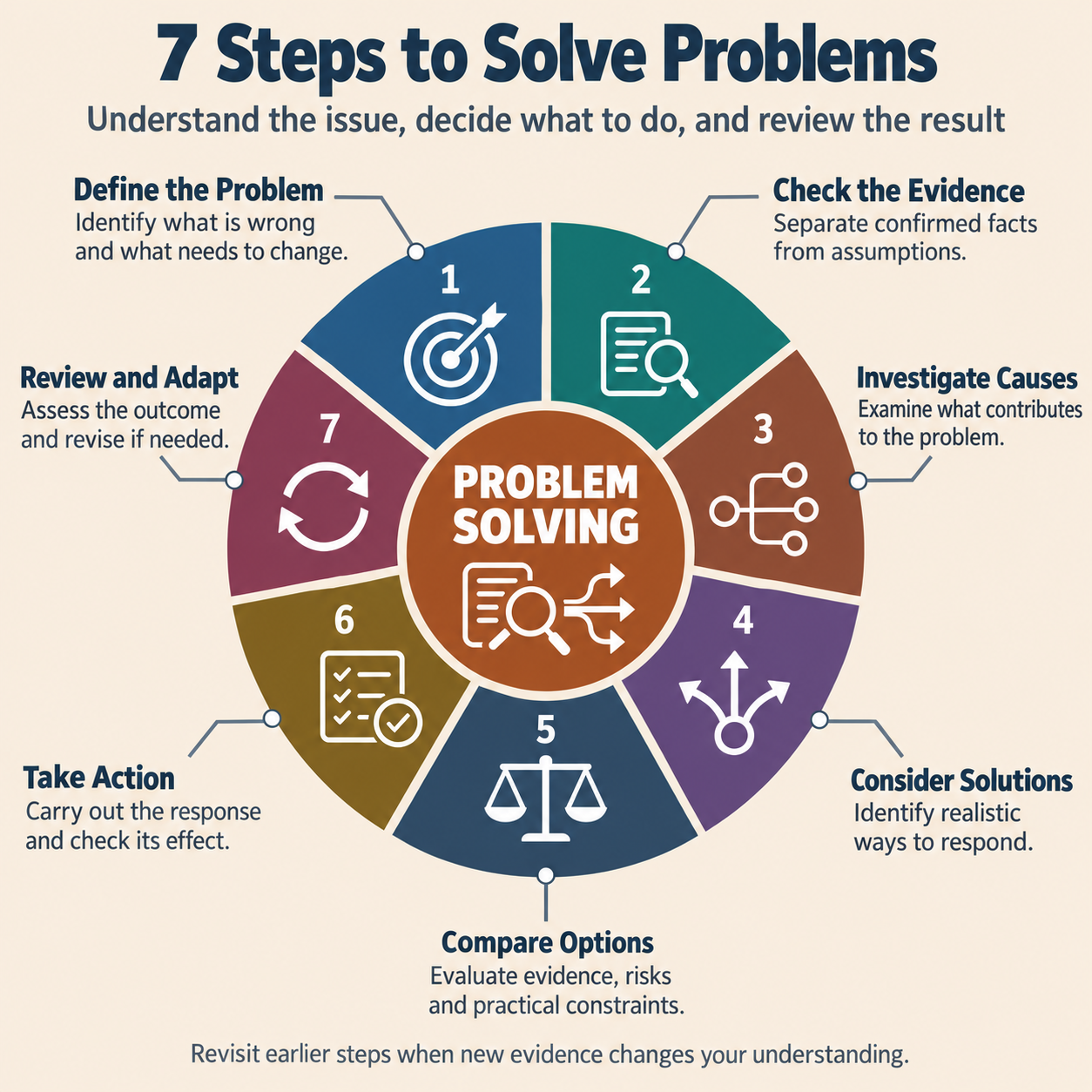
1. Define the Problem Clearly
Begin by describing what is happening and how it differs from the desired situation.
A statement such as “our teamwork is poor” may express a genuine concern, but it does not identify the particular difficulty.
A more useful description would explain that information needed to complete a shared assignment is reaching team members after their work is due to begin.
This identifies an observable issue that can be investigated.
A useful problem statement should clarify:
-
What is happening?
-
What should be happening instead?
-
Where or when does the difficulty occur?
-
Who is affected?
-
Which constraints or requirements matter?
Avoid presenting a preferred solution as the problem itself.
For instance, “we need another meeting” is a proposed action. It does not establish whether the underlying issue concerns communication, missing information, unclear responsibilities, or something else.
Defining the problem carefully reduces the risk of spending time on an action that does not address the actual difficulty.
2. Identify What You Know and What Remains Uncertain
Once the problem is defined, examine the information supporting your understanding.
A common difficulty is confusing an observation with an explanation.
Suppose a shared task is repeatedly delayed.
The delay may be confirmed through submission records. However, the explanation that someone is not working hard enough remains an assumption unless evidence supports it.
Other possibilities deserve consideration. The person may be receiving required information late, dealing with conflicting instructions, or waiting for another task to finish.
Distinguish three categories of information:
-
Confirmed facts supported by appropriate evidence
-
Possible explanations that require checking
-
Important questions that remain unanswered
This prevents a convenient explanation from becoming an accepted conclusion without investigation.
The information collected should also be relevant to the decision. Extensive research has limited practical value when it does not clarify the problem or change the available options.
ASQ's guidance recommends examining how the affected process works and gathering information from people familiar with it. This can reveal difficulties that are not apparent from the final result alone.
3. Investigate the Underlying Causes
Recurring problems often require examining the conditions that allow them to happen.
An underlying cause is a factor that contributes to the problem. It is different from the symptom through which the problem becomes visible.
Consider an illustrative workplace situation involving incomplete forms.
The immediate response may be to remind employees to check their entries. Before relying on that response, a more careful investigation would examine several possibilities.
Are the instructions clear? Is the required information available when the form is completed? Does the form contain ambiguous fields? Is responsibility for reviewing submissions understood?
Different causes require different responses.
If people do not understand a requirement, clearer instructions may address the difficulty. If the required information is unavailable, additional instructions alone will not resolve that limitation.
A useful investigation considers competing explanations and asks what evidence would support or challenge each one.
Some problems involve several contributing factors rather than a single underlying cause. ASQ explicitly recognizes this possibility in its guidance on investigating complex problems.
The aim is not to produce the most convincing explanation. It is to identify an explanation sufficiently supported by evidence to guide an appropriate response.
4. Develop Possible Solutions Before Choosing One
Once the problem is understood, consider reasonable alternatives.
Choosing the first familiar response may save initial effort, but it can exclude options that address the difficulty more effectively.
Return to the incomplete-form example.
Depending on the verified cause, possible responses may include clarifying instructions, revising confusing fields, changing when information is collected, or assigning responsibility for checking submissions.
These are alternatives for consideration, not established solutions.
It is also useful to distinguish an immediate correction from a longer-term measure.
Correcting an incomplete submission may be necessary to finish the current task. Revising the process may help address similar difficulties in later submissions.
Both actions can be appropriate, but they serve different purposes.
When developing alternatives, consider whether assistance, additional information, or involvement from another person is required.
Some problems cannot be resolved effectively by an individual acting alone, particularly when the necessary decisions involve shared responsibilities.
5. Evaluate the Options and Their Consequences
A suitable solution must address the identified difficulty while remaining realistic within the available constraints.
The option that appears easiest is not necessarily the most appropriate. A response may be inexpensive but ineffective, or effective in one area while creating difficulties elsewhere.
Compare alternatives against the factors that matter for the specific situation.
These may include:
-
How directly the response addresses the supported cause
-
Whether sufficient information exists to evaluate it
-
Available time, resources, and authority
-
Consequences for other people or activities
-
Possible risks or unwanted effects
-
Whether the response can be revised if it proves unsuitable
The relative importance of these factors changes with the circumstances.
For a minor, reversible inconvenience, a cautious trial may be reasonable. For a consequential decision affecting safety or other people's welfare, stronger evidence and appropriate approval may be necessary before acting.
A decision can be reasonable even when uncertainty remains. What matters is whether the uncertainty has been recognized and whether the chosen response is proportionate to the potential consequences.
6. Put the Selected Solution Into Practice
An appropriate decision needs a clear action plan.
The plan should identify what will change, who is responsible, what resources are required, and how the result will be evaluated.
Complex planning is unnecessary for straightforward problems. A brief written plan may be sufficient.
For a shared assignment, the group might agree on clearer responsibilities and an earlier internal information-sharing point.
The important question is whether the proposed change addresses the difficulty identified during investigation.
Before taking action, identify what observable improvement would look like.
If the problem concerns delayed information, the relevant evidence is whether the required information reaches the responsible person at the agreed point. General satisfaction with the new arrangement does not establish that the original problem has been resolved.
Where the circumstances permit, a limited and reversible trial may provide useful information before a change is adopted more widely.
The Institute for Healthcare Improvement describes a structured approach called Plan-Do-Study-Act (PDSA), which involves planning a change, trying it, studying the results, and deciding what to do next.
Although developed for organized improvement work, the underlying distinction between prediction, observation, and revision is relevant to evaluating ordinary process changes.
7. Review the Outcome and Adjust the Approach
An action should be evaluated against the problem it was intended to address.
Compare what happened with the original goal and the evidence available before the change.
If the problem has improved, examine whether the improvement is consistent and whether the response has introduced other difficulties.
If the problem remains, avoid assuming that repeating the same action will produce a different outcome.
Instead, distinguish among three possibilities.
The selected solution may not have been carried out as intended. The solution may have been carried out correctly but failed to address the actual cause. Alternatively, the conditions surrounding the problem may have changed.
Each possibility suggests a different next action.
Weak execution may require clearer responsibilities or support. An ineffective solution may require reconsidering the explanation or comparing other options. Changed circumstances may require redefining the problem.
This review prevents an unsuccessful attempt from becoming a repeated routine without further learning.
How Different Problems Require Different Approaches
The appropriate method depends on whether the difficulty concerns missing knowledge, uncertain causes, competing choices, or changing conditions.
Applying the same detailed procedure to every problem can create unnecessary work.
When the Problem Has a Clear Answer but the Method Is Unfamiliar
Some problems require learning an established procedure rather than generating several alternative solutions.
A student encountering an unfamiliar mathematical operation, for example, may benefit from understanding the relevant principle, studying a correct worked example, and applying the method to related questions.
An investigation into multiple possible causes is unlikely to help if the immediate obstacle is missing subject knowledge.
The priority is to identify what the task requires and which knowledge or procedure is needed.
When a Problem Keeps Returning
A recurring difficulty calls for investigation into why earlier responses have not prevented it.
Repeated errors, missed handovers, or incomplete work may involve unclear processes, unsuitable methods, or several contributing conditions.
Here, evidence about when and where the problem occurs is more useful than selecting another immediate correction without examining previous failures.
The investigation should remain open to multiple causes rather than forcing the problem into a single explanation.
When Several Solutions Are Reasonable
Some problems have no universally preferable response.
A person deciding how to organize a shared project may need to balance available time, individual responsibilities, communication requirements, and the risk of delays.
Several arrangements may be workable.
The task is to identify the criteria that matter, compare the alternatives, and explain why the selected arrangement fits the circumstances.
When the Problem Changes During the Process
A changing problem requires reassessing whether the original plan still addresses the current conditions.
The OECD's 2024 Survey of Adult Skills – Reader's Companion describes adaptive problem solving as dealing with situations in which a method is not immediately available and information, resources, or constraints may change.
Its assessment framework emphasizes defining the problem, searching for relevant information, applying a response, and monitoring the situation.
A plan that was reasonable when first developed may become unsuitable after new information appears.
Continuing with it without reconsideration is not necessarily evidence of effective problem solving.
Problem-Solving Techniques and Their Limitations
Structured techniques can make a problem easier to examine, but their usefulness depends on choosing the right tool for the difficulty.
The Five Whys Technique
The Five Whys technique involves repeatedly asking why a problem occurs to investigate possible underlying causes.
For example, if a task is repeatedly delayed, the investigation might begin by asking why the responsible person cannot begin on time.
The answer may lead to a further question about when required information becomes available, which may reveal another issue requiring investigation.
The questioning process continues while it produces relevant explanations.
ASQ explains that the technique may involve fewer or more than five questions.
Its limitation is that a sequence of plausible answers does not establish causation. Important explanations need supporting evidence, and a single chain of questions can overlook other contributing factors.
Cause-and-Effect Diagrams
A cause-and-effect diagram, often called a fishbone diagram, organizes possible causes into categories.
It can help when a problem involves several people, activities, materials, or environmental conditions.
For instance, a team investigating incomplete records may group possible causes according to instructions, information availability, responsibilities, and the form itself.
The diagram helps organize questions for investigation.
It does not establish which proposed cause is responsible. That still requires appropriate evidence.
Decision Matrices
A decision matrix compares alternatives against agreed criteria.
It is useful when several solutions appear reasonable and the difficulty lies in choosing between them.
For example, a team comparing two working arrangements may consider available time, coordination requirements, cost, and expected reliability.
A matrix makes those comparisons visible.
Its limitation is that selecting criteria, assigning importance, and evaluating each option involve judgment. Adding numerical scores does not make uncertain assumptions objective facts.
Small-Scale Testing and Review
Testing a proposed change can help determine whether it works under the relevant conditions.
A limited trial may be appropriate when the action is permitted, manageable, and does not expose people to unacceptable risks.
The Institute for Healthcare Improvement's PDSA guidance emphasizes making a prediction, observing what happens, and using the findings to revise the proposed change.
The result of one limited trial may not establish that a response will work under every condition.
For high-stakes situations, formal procedures, authorization, and qualified oversight take priority over informal experimentation.
How Students Can Develop Problem-Solving Skills
Students can develop problem-solving abilities through subject-specific learning, appropriate practice, feedback, and reflection on their reasoning.
The goal is not simply to complete more exercises. It is to understand why a method works, recognize when it applies, and identify what went wrong when an attempt fails.
Work Through Unfamiliar Problems Carefully
Familiar exercises often make the required procedure obvious.
Unfamiliar questions require students to recognize the relevant concepts and determine how to apply them.
Consider a mathematics word problem.
A student may know the required calculation but struggle to identify which quantities are related and which information matters.
A useful approach is to restate the question, identify relevant facts, represent relationships where appropriate, and select a method based on the underlying mathematical concept.
After completing the calculation, the student should check whether the answer fits the question and its conditions.
The US Institute of Education Sciences' What Works Clearinghouse recommends helping students monitor their reasoning, use visual representations, examine different strategies, and articulate mathematical concepts.
These recommendations are specifically presented for mathematical problem solving in grades 4–8. They should not be treated as evidence that identical methods produce the same results across every age group or subject.
Examine Errors Instead of Memorizing Corrections
An incorrect answer provides information only when the learner examines why it occurred.
Different errors require different responses.
A misunderstanding of the question may require closer reading. A conceptual error may require additional instruction. A calculation mistake may call for checking the relevant procedure.
If a student writes down a correct solution without examining the original mistake, the difficulty may remain hidden.
A more useful review identifies the point where the reasoning stopped matching the task and determines what knowledge or decision needs correction.
Explain Why a Method Works
Students may complete familiar exercises successfully while struggling to recognize the same underlying principle in an unfamiliar setting.
Explaining why a method fits a question helps make the reasoning explicit.
This may involve describing the relationships between quantities, explaining why a particular formula applies, or comparing two methods that produce the same answer.
The National Research Council's How People Learn discusses how subject knowledge is organized and how learning can transfer to new situations.
Its discussion emphasizes that applying knowledge beyond the original learning context is not automatic.
Problem-solving practice should therefore remain connected to the subject being learned rather than relying entirely on general reasoning exercises.
Learn to Plan, Monitor, and Evaluate
Students also benefit from examining their approach while working.
This involves planning how to begin, checking whether the selected method remains appropriate, and evaluating the completed response.
The Education Endowment Foundation's 2025 guidance on metacognition and self-regulated learning discusses these processes in classroom education.
Metacognition means awareness and regulation of one's own thinking and learning.
For a student, this can mean recognizing that repeated use of the same unsuccessful method is not helping and identifying a more appropriate next action.
It does not require lengthy reflection after every question. The amount of monitoring should fit the difficulty of the task.
Students seeking additional practice can refer to practical problem-solving activities for students.
How Professionals Can Apply Problem-Solving Skills at Work
Workplace problem solving requires understanding the work process, considering affected people, and selecting actions that fit organizational responsibilities.
The person who notices a problem may not control every factor contributing to it.
For example, someone responsible for preparing a report may receive important information from several colleagues.
If the report is repeatedly late, working faster may not resolve the difficulty when essential information arrives after preparation should have begun.
Investigating the timing and responsibilities involved can help identify where the process breaks down.
The response may involve changing the information-sharing arrangement, clarifying responsibilities, or revising the reporting procedure.
However, such changes may require agreement or authorization from others.
Effective workplace problem solving includes recognizing these limits rather than attempting to change processes without appropriate authority.
Understand the People Affected by a Solution
A response that improves one person's work may create difficulties for someone else.
Moving a deadline earlier, for instance, may help the final reviewer but create a new problem for the person responsible for supplying information.
Before adopting a change, consider how it affects the full sequence of work.
People who perform different parts of a process may identify constraints that are not visible to the person making the decision.
Consulting them helps clarify feasibility and potential consequences.
Explain the Problem Before Presenting a Recommendation
A recommendation is more useful when other people can understand the evidence behind it.
Instead of stating that a process is ineffective, describe the observable difficulty, its consequences, the information examined, and the options considered.
If the cause remains uncertain, identify that uncertainty.
This allows others to question the reasoning, provide missing information, and make decisions within their responsibilities.
Problem-solving competence includes presenting an issue accurately, not merely proposing an answer.
Common Mistakes That Make Problems Harder
Several recurring weaknesses in problem-solving approaches arise from moving too quickly between observation, explanation, and action.
Treating Assumptions as Established Causes
People may accept an explanation because it seems familiar or fits an earlier experience.
For example, repeated mistakes may be attributed to carelessness without examining unclear instructions or missing information.
A useful correction is to identify what evidence supports the explanation and what alternatives remain plausible.
Investigating Without a Clear Decision in Mind
Research becomes unproductive when additional information is collected without considering how it will affect the next action.
Before seeking more information, identify the question it should answer.
If the information cannot reasonably change the understanding of the problem or the available options, it may not deserve immediate attention.
This does not mean avoiding uncertainty. It means directing investigation toward uncertainty that matters.
Choosing a Solution Without Considering Constraints
An idea may appear effective in principle while being unsuitable for the actual situation.
Time, available knowledge, institutional procedures, limited resources, and effects on others can change which response is appropriate.
These factors should be considered before committing to an action rather than discovered after difficulties appear.
Confusing Activity With Improvement
Holding additional meetings, preparing longer reports, or introducing new procedures may create visible activity without resolving the underlying difficulty.
The appropriate measure is whether the original problem has improved.
A response should be evaluated against relevant observations rather than the effort spent carrying it out.
Continuing With a Plan After Conditions Change
A plan depends on assumptions about the situation.
If new information changes those assumptions, the original decision may need reconsideration.
Revising a plan in response to reliable evidence can represent sound judgment rather than inconsistency.
Applying Problem-Solving Skills in Everyday Situations
Formal techniques are not necessary for every ordinary difficulty.
A brief written assessment can provide enough structure to clarify what needs attention.
Before choosing a response, consider the following questions:
-
What exactly is happening, and what outcome do I want?
-
Which parts of my understanding are supported by evidence?
-
What important information or explanation remains uncertain?
-
What realistic actions are available?
-
Which constraints, risks, or effects on other people matter?
-
How will I recognize whether the chosen response worked?
-
What should I reconsider if the result differs from what I expected?
The questions need not be answered in a fixed order. Their purpose is to prevent important considerations from being overlooked.
Knowing When to Stop Investigating
Not every uncertainty requires further research.
When a decision is minor, reversible, and supported by sufficient information, additional analysis may add work without improving the outcome.
When the consequences are significant, unresolved questions may justify further investigation or specialist guidance.
A useful consideration is whether obtaining additional information would change the decision.
If the answer is yes, identifying that information may be the appropriate next action.
If the information is unlikely to affect a low-risk decision, proceeding cautiously and reviewing the outcome may be reasonable.
Knowing When to Seek Help
Problem solving does not require handling every difficulty independently.
Help may be necessary when the issue involves unfamiliar knowledge, responsibilities outside one's authority, or consequences that require specialized judgment.
A student may need a teacher to clarify a mathematical concept. An employee may need a supervisor to authorize a process change. A technical problem may require someone with the relevant expertise.
A useful request for help explains the difficulty, the evidence already examined, and the specific uncertainty preventing further action.
Medical, legal, financial, and safety-critical decisions require appropriate professional guidance and applicable procedures. General problem-solving techniques are not substitutes for qualified assessment.
Conclusion
Problem-solving skills involve more than identifying an answer. They help people understand difficulties accurately, examine evidence, consider alternatives, make appropriate decisions, and learn from the results.
The method should fit the problem.
An unfamiliar academic task may require stronger subject knowledge. A recurring workplace error may require investigation into several contributing causes. A decision involving competing priorities may demand careful comparison rather than a single correct answer.
The practical starting point is to describe the difficulty clearly and identify what information is needed before choosing a response.
From there, the quality of the reasoning matters more than following a particular number of steps. An effective approach remains open to correction when the evidence, outcome, or circumstances change.
Sources and References
The following seven sources support the article's discussion of systematic problem solving, cause investigation, adaptive reasoning, solution testing, and educational practice.
1. Organisation for Economic Co-operation and Development (OECD). (2024). Survey of Adult Skills 2023 – Reader's Companion: Measuring Cognitive Skills in the 2023 Survey of Adult Skills. OECD Publishing.
2. American Society for Quality (ASQ). Problem Solving: Steps, Process and Techniques. ASQ Quality Resources.
3. American Society for Quality (ASQ). Five Whys and Five Hows. ASQ Quality Resources.
4. Institute for Healthcare Improvement (IHI). How to Improve: Model for Improvement – Testing Changes. IHI.
5. Institute of Education Sciences, What Works Clearinghouse. (2012; revised 2018). Improving Mathematical Problem Solving in Grades 4 Through 8. US Department of Education.
6. Education Endowment Foundation. (2025). Metacognition and Self-Regulated Learning. Second Edition. EEF.
7. National Research Council. (2000). How People Learn: Brain, Mind, Experience, and School: Expanded Edition. National Academies Press. Relevant chapters: How Experts Differ from Novices and Learning and Transfer.







Comments 0
No comments yet. Be the first to start the conversation.