




Critical thinking becomes difficult at the moment it matters most: a claim sounds convincing, two sources disagree, a statistic seems impressive, or you need to decide before you have perfect information.
For a student, critical thinking means clarifying what is being claimed, examining the evidence, checking whether the source fits the claim, testing the reasoning, considering credible alternatives, and matching confidence to the strength of the evidence. It is not a habit of rejecting everything. It is a way of deciding what deserves belief, what remains uncertain, and what information you still need.
The same reasoning appears in assignments and everyday life. You may need to judge whether an exam notice is genuine, whether a video represents a research paper accurately, whether two articles truly conflict, or whether your own first explanation has ignored a stronger alternative.
The aim is to make your reasoning visible enough that you can inspect it, explain it, and revise it when better evidence appears.
Answer Summary: Critical thinking for students means separating claims from evidence, checking whether sources are appropriate, testing the link between evidence and conclusion, looking for credible alternatives, and being honest about uncertainty. A useful routine is to clarify the question, examine evidence and assumptions, investigate sources, search for counterevidence, judge the strength of support, and state what would change your mind. Research indicates that these habits can improve through instruction and practice, but transfer across subjects is not automatic.
Table of Content
- What Critical Thinking Means for a Student
- A Seven-Step Process for Thinking Critically
- How to Check Online Sources and Viral Claims
- Why Subject Knowledge Matters
- How Critical Thinking Improves With Practice
- Common Thinking Traps
- Four Student Scenarios
- A Seven-Question Critical-Thinking Check
- What to Do Next
- Reference
Key Takeaways:
-
State the exact claim or decision first.
-
Separate evidence from the assumption connecting it to a conclusion.
-
Judge a source by whether it suits the specific claim.
-
Investigate beyond the original page when checking online information.
-
Search for credible counterevidence, not only support for your first view.
-
Treat uncertainty as information rather than a reasoning failure.
-
Practice the same reasoning move across different subjects and situations.
What Critical Thinking Means for a Student
Critical thinking is purposeful judgment: interpreting information, analyzing relationships, evaluating evidence, drawing inferences, explaining reasoning, and monitoring your own thinking.
An influential 1990 Delphi project led by Peter Facione brought together 46 participants from philosophy, education, the social sciences, and the physical sciences to develop an expert-consensus account of critical thinking. The project distinguished cognitive skills from dispositions: a student may know how to evaluate an argument but still avoid doing so when the conclusion feels familiar or convenient.
That difference matters. You may know that one source is insufficient yet stop searching when the first source agrees with you. You may understand that evidence has limits yet write with more certainty than it permits. Critical thinking requires reasoning skills and the habit of using them when the result challenges your first impression.
Claim, evidence, reasoning, and conclusion are different
An argument becomes easier to evaluate when you separate its parts.
-
A claim is the statement someone wants you to accept.
-
Evidence is the information offered in support.
-
Reasoning is the connection between the evidence and the claim.
-
A conclusion is the judgment reached after weighing the case.
Suppose a video says, “Students who take handwritten notes remember more, so laptops should not be used for note-taking.” Even if it refers to genuine research, the broad conclusion still needs examination. Who participated? What task was measured? What did the comparison involve? Does the evidence support a limited finding under particular conditions, or the wider rule stated in the video?
Evidence can be genuine while the conclusion drawn from it is too broad.
Critical thinking is not permanent doubt
Good judgment requires proportionate trust.
An official examination body may be the appropriate source for an exam schedule. A peer-reviewed review may be more suitable for a broad claim about learning. A first-person account may explain an experience but may not support a claim about how common that experience is.
Instead of asking only, “Can I trust this source?”, ask, “Is this source appropriate for this claim, and what evidence does it provide?”
A Seven-Step Process for Thinking Critically
A repeatable process turns a vague impression into questions you can examine.
1. Clarify the claim, question, or decision
State the issue in one sentence.
“This website is unreliable” is vague. “This article misrepresents the research it cites” is testable. “Which project topic should we choose?” becomes clearer as “Which topic can we investigate accurately with the time, evidence, and skills available to our group?”
If the issue cannot be stated clearly, the discussion may drift around it.
2. Identify evidence and hidden assumptions
Ask what information supports the claim and what must be true for that evidence to justify the conclusion.
If a friend says, “This course is right for you because I enjoyed it,” the friend's experience is evidence about one person's experience. The hidden assumption is that the conditions that made the course suitable for the friend also apply to you.
Assumptions are not automatically wrong. The problem is leaving important assumptions invisible.
3. Check whether the source fits the claim
Evaluate relevance before reputation.
A source can be credible in one context and weak in another. A university's admissions page is appropriate for its own application rules. An independent research review is better suited to a broad claim about an educational method.
Ask:
-
Who is responsible for the claim?
-
What relevant expertise or direct access do they have?
-
What evidence do they provide?
-
Is the information current enough for the question?
-
Is there a conflict of interest that affects how cautiously you should read it?
A professional design, domain ending, follower count, or confident tone cannot replace these checks.
4. Trace the evidence beyond the original page
For unfamiliar online sources, investigate the wider information environment.
Wineburg and McGrew compared 10 professional fact-checkers, 10 PhD historians, and 25 Stanford undergraduates as they evaluated live websites. The fact-checkers tended to open other tabs and investigate who was behind a site before spending much time on the site's own presentation. The researchers described this behavior as lateral reading.
Use a simple sequence:
-
Identify the exact claim.
-
Search independently for the person, organization, or event.
-
Find stronger coverage or an authoritative source.
-
Trace quotations, screenshots, statistics, and study claims to the original.
-
Compare the original material with the version you first encountered.
Several posts copying the same screenshot are repetitions of one evidence chain, not independent confirmation.
For a fuller workflow, see Collegenp's guide to verifying online claims.
5. Look for alternatives and counterevidence
Test your preferred explanation by asking what else may account for the evidence.
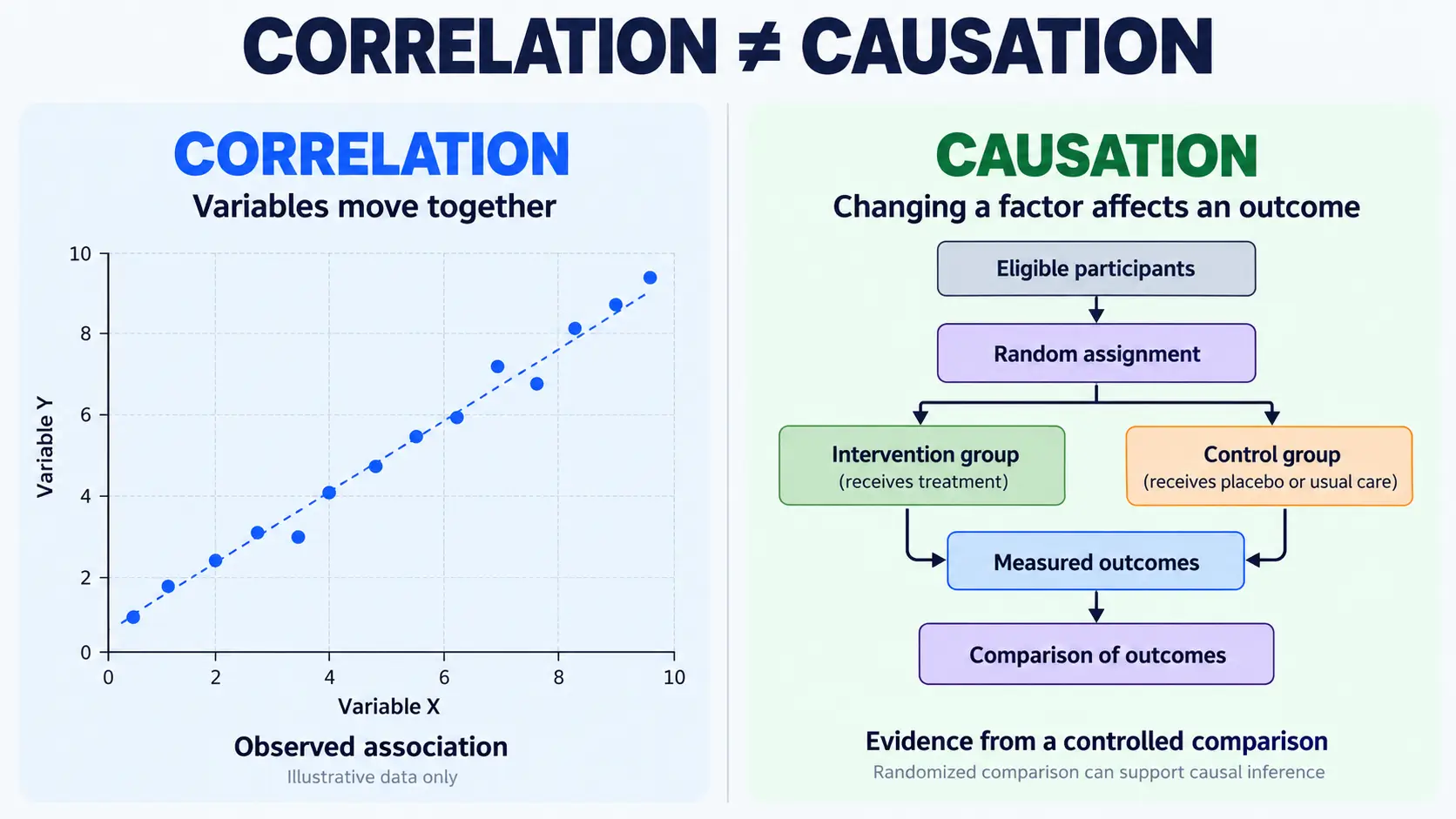
If one class performs better after a new teaching method is introduced, the method may have helped. Other relevant explanations may include prior differences between groups, teacher experience, attendance, assessment design, or what students already knew.
Focus on alternatives that would materially change the conclusion. Then search deliberately for credible evidence that challenges your first view. This gives you a concrete way to test confirmation bias instead of relying on the vague instruction to “be unbiased.”
6. Match confidence to the evidence
Your conclusion should be no stronger than the support behind it.
-
Strong support: relevant evidence from suitable sources points in the same direction, and major alternatives have been examined.
-
Partial support: useful evidence exists, but meaningful limitations remain.
-
Uncertain: evidence is incomplete, mixed, indirect, or too weak for a firm judgment.
-
Unsupported: available material does not adequately support the claim.
These labels are a decision aid, not a validated assessment scale.
“I do not know yet” can be an accurate conclusion. It means the next task is to gather better evidence.
7. State what would change your mind
Record why you reached your conclusion and what evidence would make you revise it.
A short note can say: “I currently accept this claim because A and B support it. C limits how far I can generalize. I would revise my view if stronger evidence showed D.”
This keeps you from changing the standard of proof after seeing evidence you dislike.
How to Check Online Sources and Viral Claims
Online source evaluation works better when you treat the webpage itself as something to investigate.
Research on civic online reasoning has documented substantial difficulty among students in the United States. In one national study, 3,446 high-school students completed six online reasoning tasks and struggled across them. This finding applies to that study population and those tasks; it is not a global estimate of students' abilities.
Verification behavior can also be taught. A 2022 district-wide field study taught high-school government students six 50-minute lessons that included lateral reading. Students in the treatment classrooms improved more in judging the credibility of digital content than matched students in regular classes.
When you encounter an online claim:
-
Search the source's name separately.
-
Check who funds, owns, or operates it when that affects the claim.
-
Find the original study, document, speech, dataset, or notice.
-
Compare independent reporting chains instead of counting repeated posts.
-
Read beyond headlines and screenshots when missing context can change meaning.
-
Check dates when an older true statement may no longer describe the present situation.
For academic research, Collegenp's guide on how to develop research skills covers a broader evidence-finding process.
Why Subject Knowledge Matters
General reasoning habits help, but critical thinking is not independent of what you know about the subject.
The OECD's work on complex skills emphasizes that critical thinking takes place in a context and depends partly on relevant domain knowledge. Students need enough subject knowledge to recognize plausible evidence, generate meaningful alternatives, and understand the limits of a claim.
This explains why a student may reason carefully in history yet struggle to evaluate an unfamiliar chemistry claim. The prompt “consider alternative explanations” is reusable, but generating good alternatives requires knowledge of the topic.
Transfer also needs caution. In a higher-education physics study, instruction designed to support critical thinking improved domain-specific performance, while gains did not simply carry over to domain-general critical-thinking tasks. Halpern's work on transfer similarly emphasizes explicit practice with reasoning structures and metacognitive monitoring rather than assuming that a skill learned in one setting will appear by itself elsewhere.
The practical response is to build subject knowledge while practicing the same reasoning moves in several contexts.
How Critical Thinking Improves With Practice
Critical thinking can improve through instruction and practice, but the evidence does not support one technique that works equally well for every student, subject, and situation.
A 2015 meta-analysis by Abrami and colleagues synthesized 341 effect sizes from experimental and quasi-experimental studies using standardized critical-thinking outcomes. The weighted average effect was positive but modest, and results varied substantially across studies. The review highlighted explicit attention to critical thinking, dialogue, authentic or situated problems, and mentoring among useful instructional features.
A separate 2013 meta-analysis focused on college students also found a statistically significant but small average effect, with differences across studies.
For a student, that evidence supports practice that is specific.
Use real material from your subjects
Take an argument from an essay, a graph from science, an interpretation in history, or a recommendation in a group project. Ask what claim is being made, what evidence supports it, what assumption is present, and what alternative deserves attention.
Make your reasoning visible
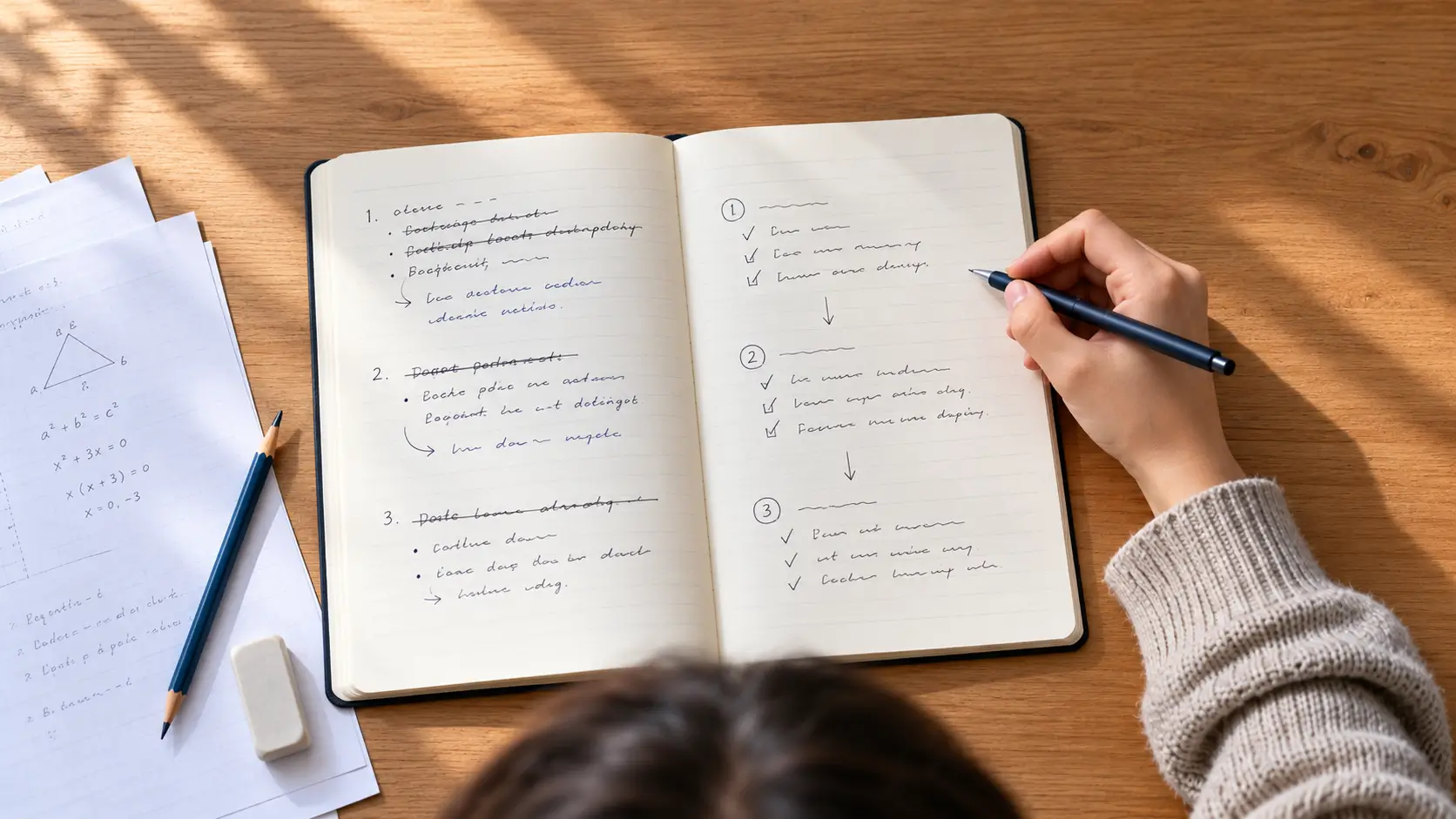
Write a short claim-evidence-reasoning chain, annotate an article, draw an argument map, or explain your conclusion to someone who can question it.
If the conclusion depends on an unstated assumption, missing source, or weak inference, making the reasoning visible gives you something concrete to inspect.
For academic texts, Collegenp's guide to critical reading skills applies these checks to reading.
Repeat the reasoning move in a different context
After testing alternative explanations in science, apply the same move to a historical interpretation, an online claim, or a study decision.
Name the reasoning move you are practicing. Deliberate reuse makes transfer more likely than exposure alone.
Ask for feedback on the reasoning
Instead of asking only “Is my answer correct?”, ask:
-
Which part of my reasoning is weakest?
-
Which assumption needs evidence?
-
Does my source fit the claim?
-
What counterargument is hardest to answer?
-
Where am I more confident than the evidence permits?
Common Thinking Traps
A small set of recurring problems is more useful than memorizing a long catalogue of fallacies.
Confirmation bias
The risk is giving more attention to information that fits your existing view.
Search deliberately for credible evidence against your position and decide beforehand what evidence would make you revise it.
Overconfidence
The risk is expressing more certainty than the evidence supports.
Use a confidence label and state the main limitation beside it.
Authority shortcut
The risk is treating status, credentials, or institutional reputation as proof.
Ask whether the person or institution has relevant expertise for the specific claim and whether the supporting evidence can be checked.
False balance
The risk is treating opposing claims as equally supported merely because both exist.
Compare evidence quality, relevance, methods, and independent support. Fairness does not require weak evidence to receive the same weight as strong evidence.
Surface credibility
The risk is trusting a page because it looks professional or familiar.
Investigate outside the page. Appearance is not evidence quality.
Four Student Scenarios
These scenarios are illustrative. They show the reasoning process without presenting invented events as documented facts.
1. A forwarded exam notice
A class-group message says an exam has been postponed and includes a screenshot.
State the claim: the exam date has changed. Identify the authority responsible for the exam and find its official notice channel. Compare the date, notice number, wording, and complete document with the screenshot.
If the official notice cannot be located, treat the message as unconfirmed. Acting on an unverified screenshot may cause a student to miss an exam.
2. “A study proves” a study technique works
A video says a particular study method produces a dramatic improvement in memory.
Find the cited research. Check who participated, what task was tested, what comparison was used, what outcome was measured, and whether the video's wording matches the paper's scope.
The research may support a narrower conclusion under specific conditions. Keep that limitation attached to the claim.
3. Two assignment sources disagree
One article says a policy succeeded; another says it failed.
Check whether they define success the same way. Compare outcomes, dates, populations, datasets, and methods. The apparent contradiction may shrink if the sources address different consequences or time periods.
If a genuine conflict remains, explain it rather than hiding it.
4. A group project has competing topic choices
Your group prefers an interesting topic, but another topic has clearer evidence and fits the assignment more closely.
Compare the options using the same criteria: relevance, source availability, time, group knowledge, scope, and unresolved uncertainty.
The decision is a trade-off among interest, feasibility, evidence quality, and the assignment requirements.
A Seven-Question Critical-Thinking Check
Use this before accepting an important claim, citing a source, or making a decision:
-
What exactly is the claim, question, or decision?
-
What evidence supports it?
-
Who is the source, and are they appropriate for this claim?
-
What assumptions connect the evidence to the conclusion?
-
What credible alternative or counterevidence exists?
-
How strong is the evidence overall?
-
What would make me change my mind?
This checklist is a practical prompt, not a psychological test or a guarantee of sound judgment. Its value comes from making hidden parts of your reasoning easier to inspect.
What to Do Next
Use the checklist on one real task: an assignment source, an online claim, or a decision you are currently making.
If you find a weak source, trace the original evidence. If you find an assumption, ask whether it has support. If credible evidence points in different directions, lower your confidence instead of forcing agreement.
The standard is not certainty. The standard is whether your conclusion fits the evidence, whether you can explain the reasoning that produced it, and whether you are prepared to revise it when stronger evidence appears.
Reference
-
Facione, Peter A. (1990). Critical Thinking: A Statement of Expert Consensus for Purposes of Educational Assessment and Instruction. American Philosophical Association / ERIC ED315423.
-
Abrami, Philip C., et al. (2015). “Strategies for Teaching Students to Think Critically: A Meta-Analysis.” Review of Educational Research, 85(2), 275–314.
-
Niu, Lian, Linda S. Behar-Horenstein, and Cyndi W. Garvan (2013). “Do Instructional Interventions Influence College Students’ Critical Thinking Skills? A Meta-Analysis.” Educational Research Review, 9, 114–128.
-
OECD (2023). Innovating Assessments to Measure and Support Complex Skills. OECD Publishing.
-
Tiruneh, Dawit T., et al. (2016). “Systematic Design of a Learning Environment for Domain-Specific and Domain-General Critical Thinking Skills.” Educational Technology Research and Development, 64, 481–505.
-
Halpern, Diane F. (1998). “Teaching Critical Thinking for Transfer Across Domains: Dispositions, Skills, Structure Training, and Metacognitive Monitoring.” American Psychologist, 53(4), 449–455.
-
Wineburg, Sam, and Sarah McGrew (2019). “Lateral Reading and the Nature of Expertise: Reading Less and Learning More When Evaluating Digital Information.” Teachers College Record, 121(11).
-
Breakstone, Joel, et al. (2021). “Students’ Civic Online Reasoning: A National Portrait.” Educational Researcher, 50(8), 505–515.
-
Wineburg, Sam, Joel Breakstone, Sarah McGrew, Mark D. Smith, and Teresa Ortega (2022). “Lateral Reading on the Open Internet: A District-Wide Field Study in High School Government Classes.” Journal of Educational Psychology, 114(5), 893–909.




Comments 0
No comments yet. Be the first to start the conversation.