




Studying creates a difficult judgment problem. You have to decide whether you understand the material, whether your current method is working, when to keep practising, when to change approach, and when you are ready to move on.
Those decisions are harder than they appear. A chapter may feel familiar because you have read it several times. A worked solution may seem obvious while it remains on the page. Notes may look clear because you wrote them yourself. You may spend a long time studying and interpret the effort as evidence that the material has been learned.
The real test often comes later, when you have to retrieve an answer without notes, solve an unfamiliar problem, explain an idea clearly, or apply knowledge under assessment conditions.
Metacognition helps students manage this gap between the feeling of learning and evidence of learning. It involves knowing something about your own thinking and regulating what you do in response. In practical study terms, that means planning a task, monitoring what is happening while you learn, evaluating the result, and adjusting the next attempt.
The purpose is not constant self-analysis. It is better decision-making.
Answer Summary: Metacognition is the process of noticing and regulating how you learn. Students use it to decide what a task requires, choose an appropriate strategy, check learning against evidence, identify errors, and change what they do next. Research supports structured metacognitive and self-regulated learning instruction across school and university settings, although effects vary. A useful rule is to compare confidence with performance rather than treating familiarity, effort, or confidence alone as proof of learning.
Table of Content
- What Metacognition Means for a Student
- What Research Says About Metacognition and Learning
- Why Familiarity Can Mislead You
- How to Check Confidence Against Evidence
- The Plan-Monitor-Evaluate-Adjust Study Cycle
- What Metacognition Looks Like Across Different Subjects
- When Your Own Reflection Is Not Enough
- Common Metacognition Mistakes
- A Metacognitive Check You Can Reuse
- What the Evidence Does and Does Not Establish
- What to Take Into Your Next Study Session
- Reference
Key Takeaways:
-
Metacognition is about regulating learning, not passive reflection.
-
Cognition is doing the learning task; metacognition helps you decide how to approach, check, and change it.
-
Confidence is more useful when compared with retrieval, explanation, application, problem solving, or feedback.
-
Planning, monitoring, evaluating, and adjusting form a practical study cycle.
-
The same cycle can work across subjects, but the evidence of learning changes with the task.
-
Self-monitoring can be inaccurate, so answer keys, rubrics, worked solutions, teachers, and other external standards still matter.
-
Metacognition supports learning decisions; it does not replace subject knowledge, practice, motivation, time, or appropriate instruction.
What Metacognition Means for a Student
Metacognition concerns knowledge about cognition and the monitoring and regulation of cognitive activity. John H. Flavell’s foundational work helped establish this distinction in psychology. For students, the idea becomes useful when it affects a real decision.
A student using metacognition asks questions such as:
-
What am I expected to know or do?
-
What do I already understand?
-
Which study method fits this task?
-
How will I know whether that method is working?
-
Where is my understanding breaking down?
-
What should I change before the next attempt?
This is more precise than the familiar phrase “thinking about your thinking.” Thinking about studying can remain passive. Metacognition becomes useful when observation leads to regulation.
The Education Endowment Foundation (EEF) describes planning, monitoring, and evaluating as central metacognitive processes and emphasizes connecting them with subject learning rather than teaching them as detached thinking exercises.
Cognition and metacognition are different
The distinction matters because many study techniques are cognitive activities rather than metacognitive ones.
Suppose you answer a practice question from memory. Retrieving the answer is a cognitive activity.
The metacognitive work begins when you examine what happened:
-
Was the answer correct?
-
Which part was uncertain?
-
Did you remember the concept but misuse the procedure?
-
Were you unable to retrieve the information at all?
-
Did you recognise the answer only after seeing it?
-
What type of practice should follow?
Metacognition is not another study technique sitting beside retrieval practice, worked examples, or note-making. It helps you decide when a technique fits, whether it is producing the required result, and when another response is needed.
That is why a broader guide to evidence-based learning strategies and a guide to metacognition serve different purposes. One explains learning methods; the other helps you judge which method to use and what its results mean.
Metacognition is part of self-regulated learning
Metacognition and self-regulated learning are closely related, but they are not complete synonyms.
Self-regulated learning covers a wider set of processes. Alongside metacognitive planning and monitoring, it can involve motivation, attention, effort, behaviour, time, and management of learning resources.
This distinction matters in daily study. You may diagnose a learning gap accurately and still have trouble acting on that information because you are tired, distracted, short on time, under pressure from several deadlines, or missing the resources needed to continue.
A 2021 meta-analysis covering 49 studies and 5,786 university students reported positive average effects from extended self-regulated learning training programs on academic performance and several learning processes, including metacognitive strategy use. The studies examined structured programs with different designs. They do not establish that a brief reflection exercise will produce the same outcome for every learner.
What Research Says About Metacognition and Learning
Research supports metacognitive and self-regulated learning approaches, but the evidence needs careful interpretation.
A 2014 meta-analysis by Donker and colleagues examined 58 studies from primary and secondary education. The interventions included cognitive, metacognitive, motivational, management, and metacognitive-knowledge components. Outcomes varied by subject and by how performance was measured.
A 2018 meta-analysis by de Boer and colleagues examined 48 metacognitive strategy-instruction interventions that included follow-up assessment. It found positive average effects at post-test and follow-up, while also showing variation across interventions and learner groups.
Longitudinal evidence adds another piece. A 2024 meta-analysis covering 28 independent studies and 71,171 students found that earlier metacognition was positively associated with later academic achievement. The analysis also found evidence in the opposite direction: earlier achievement predicted later metacognition after prior levels were taken into account.
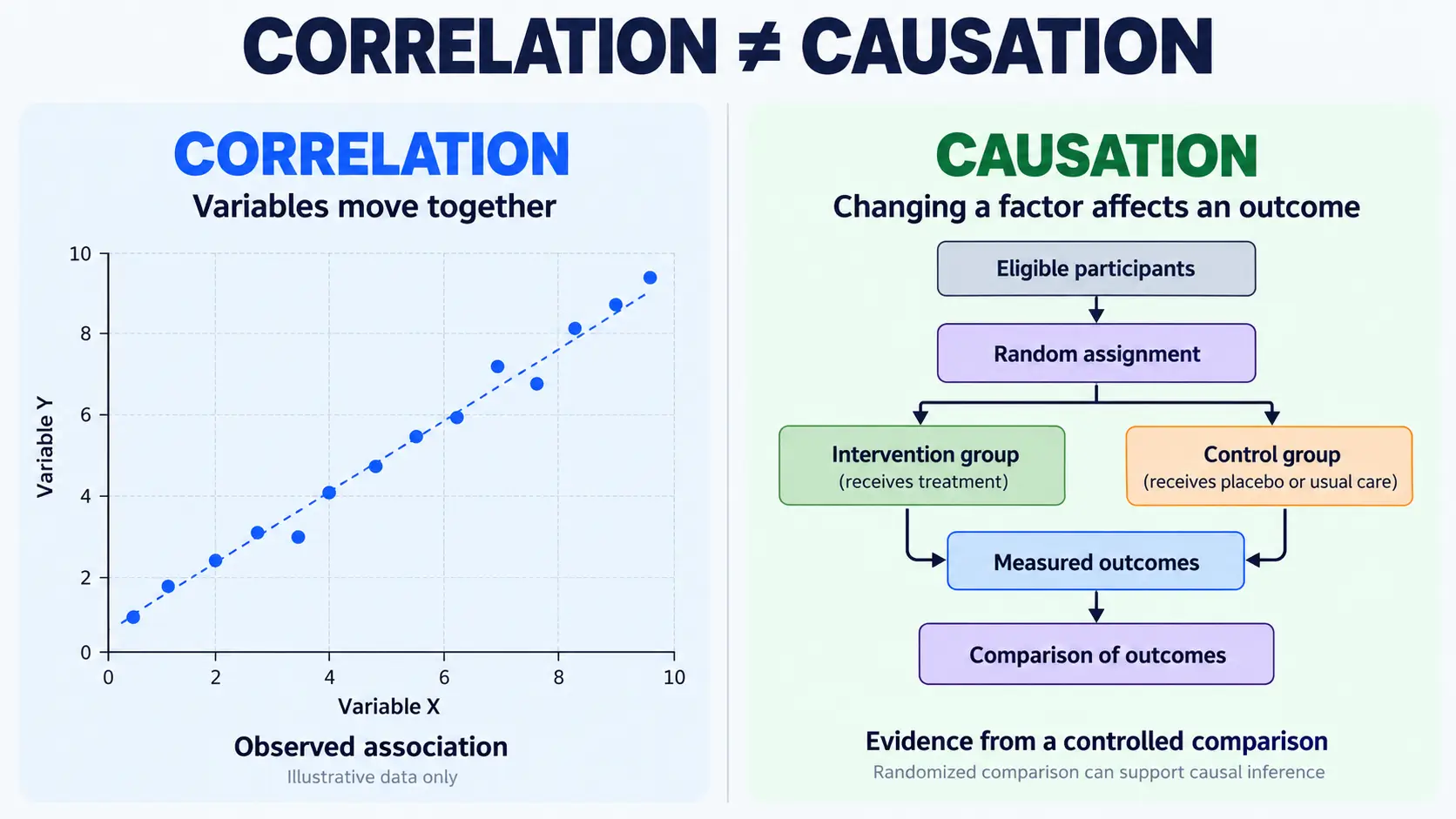
That reciprocal pattern matters. It argues against a simple claim that metacognition alone causes academic success.
Mathematics research shows why subject context also matters. A 2024 meta-analysis synthesized 147 studies across age groups from preschool through university and found a positive association between metacognition and mathematics achievement. The association varied with factors including age, mathematical domain, and culture. Because this is correlational evidence, it does not prove that metacognition by itself causes a particular increase in mathematics performance.
Taken together, the research supports a practical position: metacognitive processes can contribute to learning when they are connected with appropriate strategies, subject knowledge, feedback, practice, and meaningful opportunities to adjust.
Why Familiarity Can Mislead You
One of the most useful applications of metacognition is learning to separate familiarity from independent performance.
Repeated exposure often makes information easier to process. A page you have read several times can feel obvious. That ease can influence your judgment even when you have not checked whether you can produce or apply the knowledge without support.
A 2009 study by Karpicke, Butler, and Roediger surveyed 177 college students and found that study choices did not necessarily align with strategies supported by learning research. The study came from one college sample and should not be treated as evidence about the current study habits of students worldwide. Its relevant lesson is narrower: learners can make study decisions based on inaccurate beliefs about what they know and what will help them remember.
A useful distinction is:
-
Recognition: “This looks familiar.”
-
Retrieval: “I can produce it without seeing it.”
-
Explanation: “I can explain why it is true or how it works.”
-
Application: “I can use it in another question or situation.”
Recognition has a legitimate place in learning, but it is weak evidence when the later task requires independent production.
Try before you look
When the goal is to know whether you can perform without support, attempt the performance before reopening the source.
For example:
-
Before rereading a definition, write it from memory.
-
Before reviewing a worked problem, try the next problem independently.
-
Before reopening an essay source, outline the argument you intend to make.
-
Before rereading a chapter summary, explain the main idea aloud or on paper.
-
Before checking a diagram, reconstruct its important relationships from memory.
This does not make rereading useless. Rereading can help with first-pass understanding, dense material, exact wording, and repair after an error. The metacognitive question is whether rereading fits the current need.
A deeper comparison of active recall instead of relying on rereading can help when the main goal is deciding between recognition-based review and retrieval.
How to Check Confidence Against Evidence
Confidence is information about your judgment, not proof that the judgment is correct.
Researchers use the idea of calibration to examine how closely confidence corresponds with performance. Miscalibration can move in either direction. You may feel confident and perform poorly, or feel uncertain and perform accurately.
Research on judgments of learning has found that predictions made after some separation from the original study material can be more accurate than judgments made while the material is still readily available. The lesson is not to follow a fixed waiting period. The useful principle is to judge learning using information that resembles the performance you will later need.
A study involving 98 secondary-school students learning from text also found that retrieval practice was associated with more accurate confidence judgments for previously tested material in that setting. The result came from one task and population, so it should not become a universal claim about every form of self-testing.
For everyday study, you can turn calibration into a short routine:
-
Predict how well you can perform the task.
-
Attempt it without the answer in front of you.
-
Compare your prediction with your performance.
-
Identify the reason for any mismatch.
-
Choose the next action from the error you found.
-
Check again later if long-term retention matters.
The fourth step is often the most useful. “I got it wrong” tells you less than knowing why.
The Plan-Monitor-Evaluate-Adjust Study Cycle
A practical metacognitive cycle combines the EEF’s planning, monitoring, and evaluating model with an explicit adjustment step. Adjustment makes clear what evaluation is for: changing the next learning decision.
| Phase | Main question | Evidence to use |
|---|---|---|
| Plan | What must I do, and which approach fits? | Task requirements, prior knowledge, rubric, previous attempt |
| Monitor | Is the approach producing the required learning? | Retrieval, explanation, practice, errors, feedback |
| Evaluate | What worked, what failed, and why? | Corrected work, answer key, rubric, result, error pattern |
| Adjust | What should change next? | Error diagnosis, missing prerequisite, task difficulty, need for support |
Plan: define performance before study time
A vague goal such as “study chemistry” gives you no clear finishing point.
A stronger goal identifies the performance required:
-
explain how a process works without notes;
-
solve three unfamiliar problems using the correct method;
-
compare two theories using stated criteria;
-
recall key terms and distinguish them accurately;
-
write an argument that meets the assignment rubric.
Then decide what evidence will count.
If the assessment requires problem solving, rereading formulas alone is weak evidence. If the task requires close interpretation of a source, exact rereading may still matter. If you need to remember information days later, your plan should include a later check rather than relying on immediate performance.
Monitor: inspect the result while there is time to change
Monitoring is not repeatedly asking whether you “understand.”
It means checking the performance that matters.
For a concept, try to explain it without copying its wording. For a procedure, complete the next step without following the example line by line. For factual material, retrieve it without cues. For writing, compare the draft with the actual criteria rather than with your impression of how polished it sounds.
Useful monitoring questions include:
-
Which part can I perform without help?
-
Where do errors begin?
-
Am I retrieving or recognising?
-
Am I repeating this activity because it is useful or because it feels comfortable?
-
Does this practice resemble what I will later have to do?
A single incorrect answer does not automatically mean that the entire topic is weak. Look for the type and pattern of the error.
Evaluate: diagnose rather than label
Evaluation works better when an error becomes specific.
Consider these different problems:
-
Missing knowledge: you cannot recall a required fact or rule.
-
Conceptual misunderstanding: you remember information but understand the relationship incorrectly.
-
Procedural error: you know the concept but apply the wrong sequence or method.
-
Incomplete explanation: the idea is partly correct but important reasoning is absent.
-
Transfer difficulty: you succeed on familiar examples but struggle when the problem changes.
-
Careless execution: you know what to do but lose accuracy in carrying it out.
Those errors call for different responses. More repetition of the same study activity is not a precise response to all six.
Adjust: make the next attempt different for a reason
Adjustment closes the cycle.
If knowledge is missing, relearn the specific material and retrieve it again. If a concept is misunderstood, compare your explanation with a reliable source or ask for clarification. If a procedure keeps breaking at one step, return to an appropriate worked example and then retry independently. If transfer is the problem, use varied examples that require you to identify when a method applies.
If immediate recall is accurate but you need the material later, return to it after a delay. Spaced repetition is relevant when the goal is maintaining retrievability over time.
The important point is that the next action follows from evidence rather than habit.
What Metacognition Looks Like Across Different Subjects
The cycle remains similar across subjects, but good evidence of learning is task-specific.
Reading a difficult chapter
Imagine that you have read a dense section twice and it now feels familiar.
Instead of starting a third full reading immediately, close the text and state the main claim. Explain how the important ideas connect. Write down what remains unclear.
Then reopen the source for comparison.
If your explanation misses one relationship, you have identified a specific reading target. Return to that section rather than restarting the entire chapter.
This is metacognition because the result of your explanation determines what you read next.
Solving mathematics or science problems
A worked solution is useful for learning a method, but understanding each displayed step does not establish that you can generate the steps yourself.
After studying the example, attempt another suitable problem without copying the model.
If the solution fails, locate the first point where your reasoning diverged. Was the issue choosing the equation, understanding the concept, carrying out an operation, interpreting the question, or transferring the method to a different format?
Your next practice should address that error.
The mathematics research discussed earlier reinforces this subject-specific approach: metacognition is associated with mathematics achievement, yet the relationship varies across domains and populations.
Writing an essay or long answer
Writing can feel especially difficult to judge because there is rarely one answer key.
That makes external criteria important.
Before drafting, translate the rubric or instructions into a few concrete requirements: argument, evidence, reasoning, structure, accuracy, and any required conventions.
During revision, ask whether each paragraph performs a necessary job. After receiving feedback, look for patterns. Several comments about unsupported claims point to a different problem from several comments about organisation.
The aim is not to collect comments. It is to identify what the comments change about your next draft.
When Your Own Reflection Is Not Enough
Metacognition does not mean trusting every thought you have about your own learning.
Self-monitoring can be inaccurate. You may use the wrong standard, miss a misconception, or feel certain about an incorrect answer. Younger students and learners who are new to a subject may need more modelling, prompts, examples, and external support.
Use an external standard when the quality of your own judgment is uncertain:
-
an answer key for objective questions;
-
a worked solution for a multi-step procedure;
-
a rubric for writing or projects;
-
teacher or tutor feedback for misconceptions;
-
a model response for comparison against stated criteria;
-
peer explanation when another person can question your reasoning;
-
practice performance that resembles the real assessment.
Independent learning does not require learning in isolation.
This also protects against judging the wrong feature. If you evaluate an essay by length while the rubric evaluates evidence and reasoning, careful reflection can still lead to a poor decision because the standard itself is wrong.
Common Metacognition Mistakes
Several habits make metacognition less useful.
-
Reflecting without changing action. If every study session ends with “I need to work harder” but the study method remains unchanged, the reflection has not diagnosed the problem.
-
Checking understanding while the answer is visible. This favors recognition over independent performance.
-
Treating confidence as proof. Confidence can be accurate, too high, or too low.
-
Treating effort as proof. Time spent studying tells you how long you worked, not what you can retrieve or apply.
-
Using one study method for every task. Strategy choice should follow the demands of the material and assessment.
-
Ignoring external feedback. A misconception can survive repeated self-checking when the standard used for checking is also mistaken.
-
Treating an error as a verdict on ability. An error is more useful when it identifies missing knowledge, a faulty procedure, weak transfer, or another specific problem.
-
Turning reflection into paperwork. Long journals and repeated prompts lose value when they consume study time without changing a decision.
-
Choosing strategies from fixed learning-style labels. A major review found insufficient evidence for the claim that matching instruction to a declared visual, auditory, or similar learning style improves learning. Preferences can exist, but they are not evidence that one fixed mode should determine how you study.
A Metacognitive Check You Can Reuse
You do not need a long worksheet. These six questions cover the main decisions:
-
What does the task require me to produce?
-
What relevant knowledge can I already retrieve or use?
-
Which strategy fits this task, and why?
-
What evidence will show whether it is working?
-
Where did my performance break down?
-
What will I change in the next attempt?
For a larger task, write the answers briefly. For routine studying, the questions can remain mental.
The usefulness of the check lies in the final question. Reflection earns its place when it changes what you do.
What the Evidence Does and Does Not Establish
Research gives good reasons to take metacognition seriously, but it does not support unlimited claims.
Evidence from school and university settings indicates that structured metacognitive and self-regulated learning instruction can improve academic outcomes on average. Longitudinal research also links metacognition with later academic achievement.
Those findings do not mean that metacognition guarantees higher grades for an individual student.
Meta-analyses combine studies that differ in age, subject, teaching approach, duration, support, outcome measures, and research design. Average effects describe groups of studies, not the future result of one learner.
Metacognition also cannot substitute for subject knowledge. You need something meaningful to monitor. A student who has not learned the underlying mathematics cannot repair that absence through reflection alone.
Nor does metacognition remove other barriers to learning. A student may identify the correct next action but still face limited time, competing responsibilities, low motivation, stress, poor access to support, or an unsuitable learning environment. These issues belong to the wider process of self-regulated learning and, in some situations, require changes beyond study strategy.
The evidence supports a narrower and more useful claim: metacognition can help students make better-informed learning decisions when judgments are connected to task demands, performance evidence, appropriate strategies, and external feedback where needed.
What to Take Into Your Next Study Session
The most useful metacognitive question is not “Do I feel like I know this?”
Ask what evidence you have.
Before studying, define what you will need to retrieve, explain, solve, compare, analyse, or create. While studying, test the relevant performance rather than relying on familiarity. When something goes wrong, identify the type of error. Then change the next attempt in response to that diagnosis.
If confidence and performance disagree, investigate the gap. If you cannot judge quality reliably on your own, use an answer key, rubric, worked solution, teacher, tutor, or another appropriate source of feedback.
Metacognition is useful because learning requires decisions. The aim is not to monitor every thought. It is to make the next learning decision from better evidence.
Reference
-
Flavell, J. H. (1979). Metacognition and Cognitive Monitoring: A New Area of Cognitive-Developmental Inquiry. American Psychologist.
-
Education Endowment Foundation. Metacognition and Self-Regulated Learning: Guidance Report, Second Edition (2025).
-
Education Endowment Foundation. Teaching and Learning Toolkit: Metacognition and Self-Regulation.
-
Donker, A. S., et al. (2014). Effectiveness of Learning Strategy Instruction on Academic Performance: A Meta-Analysis. Educational Research Review.
-
de Boer, H., et al. (2018). Long-Term Effects of Metacognitive Strategy Instruction on Student Academic Performance: A Meta-Analysis. Educational Research Review.
-
Theobald, M. (2021). Self-Regulated Learning Training Programs Enhance University Students’ Academic Performance, Strategies, and Motivation: A Meta-Analysis. Contemporary Educational Psychology.
-
He, et al. (2024). The Association Between Initial Metacognition and Subsequent Academic Achievement: A Meta-Analysis of Longitudinal Studies. Educational Psychology Review.
-
Xie, Zeng, and Yang (2024). Meta-analysis on metacognition and mathematics achievement.
-
Karpicke, J. D., Butler, A. C., and Roediger, H. L. III (2009). Metacognitive Strategies in Student Learning: Do Students Practise Retrieval When They Study on Their Own? Memory.
-
Pyc, M. A., Rawson, K. A., and Aschenbrenner, A. J. (2014). Metacognitive Monitoring During Criterion Learning: When and Why Are Judgments Accurate?
-
Rhodes, M. G., and Tauber, S. K. (2011). The Influence of Delaying Judgments of Learning on Metacognitive Accuracy: A Meta-Analytic Review. Psychological Bulletin.
-
Testing and Metacognition: Retrieval Practice Effects on Metacognitive Monitoring in Learning From Text (2018).
-
Roebers, C. M., Schmid, C., and Roderer, T. (2009). Research on metacognitive monitoring and control in primary-school test performance.
-
Pashler, H., McDaniel, M., Rohrer, D., and Bjork, R. (2008). Learning Styles: Concepts and Evidence. Psychological Science in the Public Interest.





Comments 0
No comments yet. Be the first to start the conversation.