



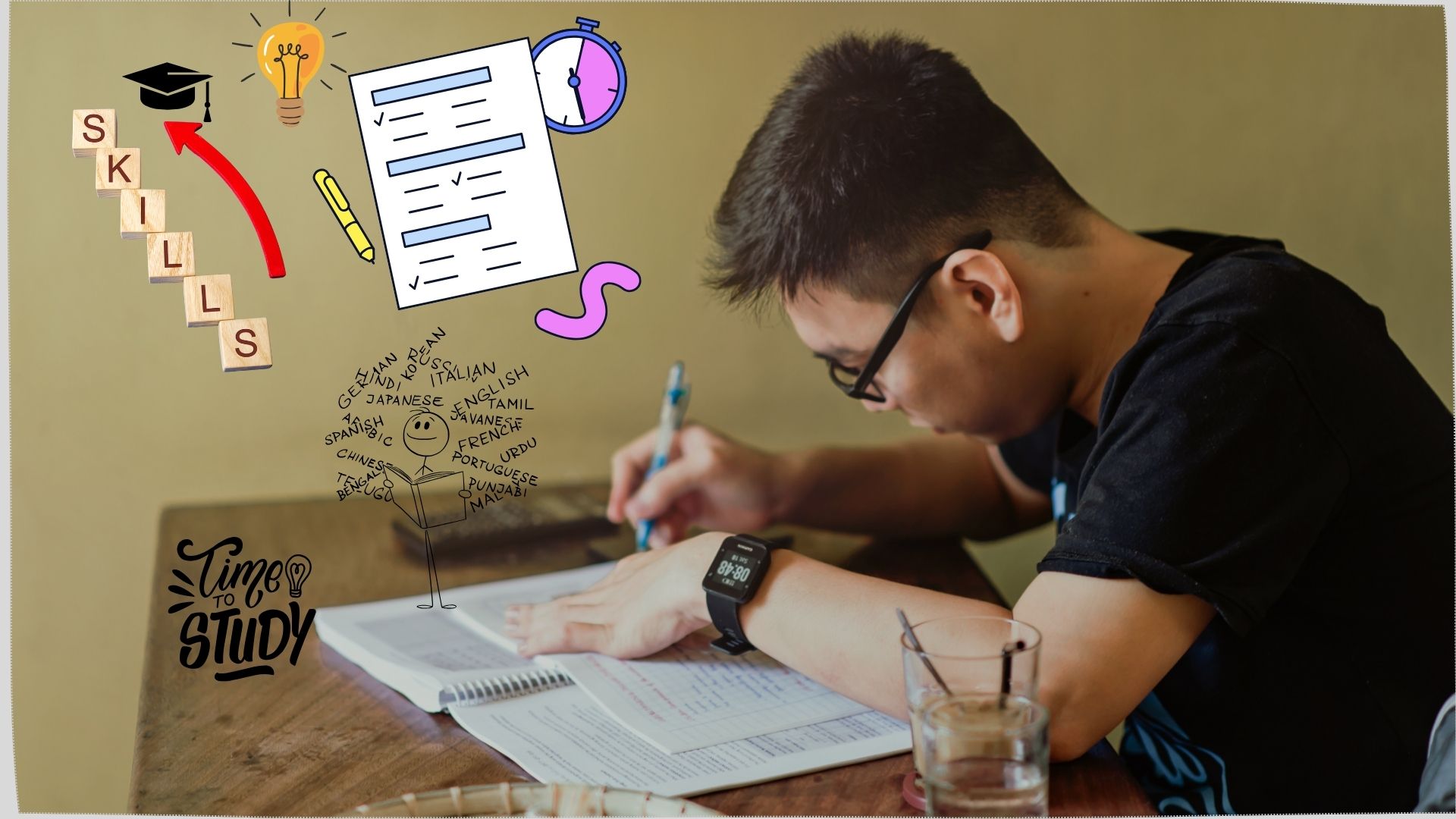
Focus Skills for Students: Deep Work With Phone, Noise, Interruptions
Deep work for students is the ability to stay with one demanding study task long enough for real learning to occur—without getting pulled away by a phone, nearby conversations, or constant interruptions. Cal Newport defines deep work as focusing without distraction on a cognitively demanding task. Students rarely struggle because they “don’t care.” More often, they struggle because their environment keeps inviting task switches: a notification arrives, someone speaks nearby, a group chat lights up, and attention breaks.
Attention breaks have costs that are larger than the seconds spent glancing at a screen. Cognitive research on task switching finds performance costs when people alternate tasks rather than staying with one. Research on attention residue adds that after switching, part of attention can remain stuck on the previous task, which makes the return feel slow or mentally messy. This is why students often reread the same paragraph, restart the same math step, or lose their writing thread after “quick” interruptions.
Noise is a second, underestimated factor. WHO guidance for learning spaces includes a low background-noise target for classrooms, reflecting how noise affects teaching and understanding. Research on noise near schools has linked chronic aircraft noise exposure with weaker reading comprehension outcomes. Even in everyday study, a meta-analysis of auditory distraction during reading reports small but reliable negative effects from background speech, noise, and music on reading performance.
This guide helps you evaluate three practical trade-offs: how strict your phone rules need to be, how to study when “quiet” is not available, and how to build interruption rules that work in real student settings.
Answer Summary
Deep work for students is protected attention on demanding study tasks. Research on task switching and attention residue explains why frequent “quick checks” can reduce study quality, and experiments show notifications can disrupt attention even without responding. Noise can also affect learning, with speech often being the most disruptive for language tasks. A workable deep work system uses focus blocks, phone rules, interruption boundaries, and a task-matched sound plan.
Table of Content
- Focus Skills for Students: Deep Work With Phone, Noise, Interruptions
- Explain: What is deep work for students?
- What research says about phone distraction
- What research says about noise and studying
- Practical Insight: Build a deep work study system
- Practical Insight: Deep work in common student settings
- Outcomes and limitations: What to expect
- Conclusion
- FAQs
- Sources Used
Key Takeaways
-
Deep work improves when you reduce task switching and protect attention from cues.
-
Notifications can disrupt attention even if you do not reply.
-
Phone presence research is mixed; removing salience is still a practical default for demanding tasks.
-
Background speech is often harder to ignore than steady sound during reading and writing.
-
A task-matched sound plan can reduce perceived disturbance in shared study spaces.
-
Clear interruption rules reduce the stress and time pressure that often follow disruptions.
Explain: What is deep work for students?
Deep work for students is sustained focus on a cognitively demanding task long enough to build understanding or produce quality work. It fits tasks where attention quality matters: solving problems, writing, reading difficult material, and practicing past questions with feedback.
Deep work vs shallow study time
Deep work is study that forces active thinking; shallow study time is supportive work that does not require the same depth of attention.
Deep work examples:
-
Writing an essay section with a clear argument
-
Solving problem sets and checking solutions
-
Reading a chapter while producing notes and self-questions
Shallow study examples:
-
Formatting notes
-
Organizing files and tabs
-
Copying definitions without retrieval practice
Students often mix these and feel busy without getting the learning return they expected. The fix is not to remove shallow work entirely, but to place it deliberately so it does not fragment deep work hours.
What breaks focus in student life
Focus breaks most often come from three sources: phone cues, noisy environments, and interruptions from people and apps. Practical guidance from universities highlights that students often underestimate how much the environment distracts them, which is why environment design matters.
Why attention is harder to rebuild than expected
Returning to a task can feel harder than starting because switching has cognitive costs. Task-switching research documents performance costs when alternating tasks. Attention residue research adds that part of attention can remain with the previous task, which reduces performance on the next task and makes re-entry slower. For students, that looks like rereading, re-deriving steps, and losing a writing outline after an interruption.
What research says about phone distraction
Phone distraction is not only “time lost on apps”; it is also attention lost to cues that trigger switching. Experimental work shows that notifications can disrupt attention even when people do not interact with the phone.
Notifications can disrupt attention even without replying
Notifications can disrupt attention because they are attention cues, not only information. Stothart and colleagues reported that receiving a notification alone disrupted performance on an attention-demanding task, even without interacting with the phone. This supports a practical student rule: fewer incoming alerts during deep work is often better than relying on self-control after alerts arrive.
Task switching costs and attention residue
Task switching reduces performance because switching forces the brain to reconfigure goals and rules. Rubinstein, Meyer, and Evans measured switching costs across experiments where participants alternated tasks versus repeating one task. Leroy’s work on attention residue adds that unfinished tasks or partial switches can leave attention stuck on the previous task. If your phone pull leads to an unfinished loop (half a reply, half a scroll), residue is more likely.
Phone presence research: what it suggests and what replications add
Phone presence research is mixed, so students should treat it as a probability issue, not a guarantee. Ward and colleagues reported poorer performance when a phone was more salient compared with being farther away. A later replication using the same tasks and conditions did not reproduce the effect and found no performance difference across phone location conditions. The practical takeaway remains usable: if you want higher odds of deep focus on demanding tasks, reduce phone salience during the block (out of sight and harder to reach).
What research says about noise and studying
Noise affects studying most when it competes with the mental processes your task needs, and speech is often the most disruptive sound for language tasks.
Why background speech disrupts language tasks
Background speech can interfere with verbal working memory, which is involved in reading, writing, and memorizing. Research on the irrelevant speech effect links irrelevant speech to reduced immediate recall of visually presented material and changes in brain activity tied to verbal working memory. This is one reason students often find a talking room harder than steady noise.
Noise and reading: what meta-analyses report
Auditory distraction during reading appears small but reliable across many studies. A Bayesian meta-analysis of auditory distraction during reading reported that background noise, speech, and music have a small but reliably detrimental effect on reading performance. This supports a student strategy: treat reading and writing as “high sensitivity” tasks for your environment.
What “quiet enough” means for learning spaces
Learning spaces benefit from low background noise because understanding speech and teaching depend on a good signal-to-noise ratio. WHO guidance for community noise includes a classroom background noise recommendation intended to support teaching and learning conditions. At the school level, research on aircraft and road traffic noise reported that chronic aircraft noise exposure was linked with weaker reading comprehension, reinforcing that sustained high noise is not only unpleasant but educationally relevant.
Practical Insight: Build a deep work study system
A deep work system is a repeatable set of rules that reduces decisions during study time and lowers switching. It works best when it covers four points: the task, the time block, the phone rules, and the environment (noise and interruptions).
Choose the right task for deep work
Deep work works best when your task is specific and measurable. Choose one primary task such as:
-
“Solve 10 algebra problems and check solutions”
-
“Draft the introduction and one body paragraph”
-
“Read 6 pages and produce 6 self-questions”
Avoid starting a deep work block with open-ended “setup” work (organizing, browsing, cleaning notes). Those tasks can trigger early switching before momentum forms.
Set a focus block length you can repeat
A good focus block is one you can repeat across days, not only on a perfect day. Many guides suggest using timed focus periods (short sprints or longer blocks) and making the duration explicit before starting. Start with a block length you can finish without breaking your own rules, then extend only after consistency improves.
Practical options:
-
Short blocks: 20–30 minutes for difficult starts or noisy settings
-
Medium blocks: 45–60 minutes for stable environments
-
Longer blocks: reserved for times you can reduce interruptions more strongly
Create phone rules you can follow
Phone rules work when they reduce cues and make switching less convenient. Notification research supports reducing alerts during focus because alerts alone can disrupt attention.
Three levels of phone rules (low, medium, high)
Low restriction (use when you must stay reachable)
-
Phone out of sight (bag/drawer), not on the desk
-
Alerts limited to urgent contacts only
Medium restriction (good default for many students)
-
Phone outside arm’s reach (across the room)
-
All non-urgent notifications silenced for the block
High restriction (deadlines, exam prep, writing)
-
Phone in another room
-
Scheduled message checks between blocks, not during blocks
This is not about “willpower.” It is about reducing salience and cues so your attention is not repeatedly tested.
Reduce interruptions from people and apps
Interruptions have costs beyond time lost because they can increase stress and time pressure. Mark and colleagues reported that people often compensate for interruptions by working faster, with higher stress and frustration. Students can reduce interruption costs by setting simple boundaries that others can understand.
People-interruption boundaries:
-
A visible note: “Focus block until 6:30”
-
A short script: “I’m studying until 6:30; I can talk after”
-
A shared-room agreement: quiet windows during exam weeks
App-interruption boundaries:
-
Close chat apps for the block
-
Keep only the tabs you need open
-
If you must search the web, write what you are searching first to prevent drifting
Use a capture list to prevent self-interruptions
Self-interruptions often happen because you fear forgetting. Use a capture list:
-
Keep a page titled “Later”
-
When an urge appears (“reply,” “look up,” “check”), write it down
-
Return to the task and handle the list between blocks
This reduces the mental pressure that often drives switching and keeps attention residue smaller by closing loops later on purpose.
Use a task-matched sound plan
A sound plan works when it reduces speech interference during language tasks and keeps your environment consistent.
Match sound choices to reading vs problem-solving
Reading, writing, memorizing
-
First choice: reduce speech (change seat, face away, close doors)
-
Second choice: mask speech with steadier sound (fan-like noise or instrumental audio)
Speech is a common disruptor for verbal working memory tasks, which is consistent with research on irrelevant speech effects and reading distraction.
Problem-solving, calculations, diagrams
-
Some students tolerate background sound better here, but switching still matters
-
Keep sound consistent rather than changing tracks often
In open-plan study environments, experimental work has examined how background sound scenarios affect disturbance during “studying for an exam” tasks, supporting the idea that sound context changes perceived disturbance, especially for reading tasks.
Use if–then plans for common distraction triggers
If–then plans work because they pre-decide the action you will take when a trigger occurs, reducing mid-block decision-making. Use simple versions:
-
IF I want to check my phone, THEN I write it on the capture list and continue until the timer ends.
-
IF someone starts talking to me, THEN I use the same one-sentence boundary and return to the task.
-
IF I get stuck, THEN I mark the exact step I am stuck on and try one more attempt before looking anything up.
Practical Insight: Deep work in common student settings
Deep work becomes easier when the rules fit the setting rather than assuming perfect quiet and perfect self-control.
Noisy home or family space
A noisy home can still support deep work if you match task type to noise level and reduce speech exposure. WHO guidance emphasizes low classroom noise for learning conditions, which supports taking noise seriously when studying.
Practical approach:
-
Use your quietest daily window for reading and writing
-
Use noisier windows for practice problems or review tasks
-
Sit farther from speech sources and face away from them
-
Use a steady sound mask during language tasks if speech cannot be reduced
Hostel/dorm and shared rooms
Shared rooms require shared expectations. Use:
-
A daily focus window that everyone knows
-
Headphone rules during exam weeks
-
A “talk break” schedule between focus blocks
Noise experiments in open-plan study settings show that perceived disturbance varies by task, so task planning matters in shared spaces.
Library and campus study areas
Libraries often support deep work best when you also control phone cues. Set phone rules before you sit down and keep your work surface simple: only the current materials. This aligns with practical guidance that students benefit from managing distractions by shaping the environment, not only by trying harder.
Café and commuting study
Cafés and commuting are better for short, structured blocks than for deep writing. Use:
-
A single task with a clear end point
-
Short blocks with breaks between them
-
Minimal device switching (one app/document at a time)
Group study without constant derailments
Group study works better when collaboration and deep focus have separate time slots. A simple pattern:
-
Focus sprint: silent work on assigned pieces
-
Discussion window: questions, corrections, planning
This reduces random interruptions and lowers the stress that can follow frequent disruptions.
Outcomes and limitations: What to expect
Deep work tends to change study quality by reducing switching and protecting attention from cues, but outcomes depend on consistency and the fit between the system and your environment.
What changes you can measure in your own study
Track outcomes you can observe without guessing numbers:
-
Completed deep work blocks per week
-
Units finished (problem sets, pages with notes, draft sections)
-
Number of mid-block phone checks
-
How quickly you can return after an interruption
If your data shows frequent breaks, adjust the environment before extending block length.
Trade-offs and realistic limits
No system removes every distraction. Some days are noisy, schedules shift, and responsibilities interrupt. Phone presence research also varies across studies; both original findings and replications suggest the effect depends on context, so practical rules should be tested in your own routine. If concentration struggles are persistent and interfere with daily functioning, it may help to talk with a trusted adult, teacher, or counselor; this article is educational and not medical advice.
Conclusion
Deep work for students is protected attention: one demanding task, fewer cues to switch, and a study environment that supports the task’s mental demands. Newport’s definition is a useful anchor, but the day-to-day gains come from reducing switching and lowering interruption frequency. Notification experiments support limiting alerts during focus blocks because alerts alone can disrupt attention.
Noise matters in predictable ways: speech is often the hardest sound for reading and writing, and evidence on reading distraction supports taking study sound seriously. Start with one change you can repeat daily—clear phone placement rules, one focus block, and a simple capture list—then adjust block length and environment as consistency improves.
FAQs
1) What is deep work for students?
Deep work for students is focused effort on a demanding study task without distraction, aimed at improving learning quality rather than adding more hours.
2) Do notifications distract even if I do not open them?
Notifications can distract even without opening them; experiments report attention costs from receiving a notification alone.
3) Should I keep my phone on the desk if it is silent?
Keeping a phone visible can increase distraction risk for some tasks; research findings vary, and a replication did not reproduce the original effect, so “out of sight and harder to reach” is a practical default to test for demanding study.
4) What type of noise is hardest for studying?
Background speech is often hardest for reading and writing because it can interfere with verbal working memory, and research on reading distraction reports negative effects from speech and other sounds.
5) How do I stop interrupting myself while studying?
Self-interruptions drop when you use a capture list for urges and set a simple if–then response for common triggers, so you do not make decisions mid-block.
Sources Used
-
Newport, Cal. “Deep Work: Rules for Focused Success in a Distracted World” (definition post, 2015). Cal Newport website.
-
Rubinstein, J. S., Meyer, D. E., & Evans, J. E. “Executive Control of Cognitive Processes in Task Switching” (2001). Journal of Experimental Psychology: Human Perception and Performance (APA).
-
Leroy, Sophie. “Why is it so hard to do my work? The challenge of attention residue when switching between work tasks” (2009). Organizational Behavior and Human Decision Processes (Elsevier).
-
Stothart, C., Mitchum, A., & Yehnert, C. “The attentional cost of receiving a cell phone notification” (2015). Journal of Experimental Psychology: Human Perception and Performance (PubMed record).
-
Ward, A. F., Duke, K., Gneezy, A., & Bos, M. W. “Brain Drain: The Mere Presence of One’s Own Smartphone Reduces Available Cognitive Capacity” (2017). Journal of the Association for Consumer Research.
-
Ruiz Pardo, A. C. R., et al. “Reexamining the ‘brain drain’ effect: A replication of Ward et al. (2017)” (2022). Acta Psychologica (PubMed record).
-
Ohly, S., et al. “Effects of task interruptions caused by notifications from communication applications on strain and performance” (2023). Journal of Occupational Health (PubMed record).
-
Mark, G., Gudith, D., & Klocke, U. “The Cost of Interrupted Work: More Speed and Stress” (2008). CHI Conference paper (PDF).
-
World Health Organization (WHO) Europe. “Noise” fact sheet (classroom background noise guidance).
-
Stansfeld, S. A., et al. “Aircraft and road traffic noise and children’s cognition and health” (2005). The Lancet (PubMed record).
-
Vasilev, M. R., et al. “Auditory Distraction During Reading: A Bayesian Meta-Analysis” (2018). Psychological Bulletin (PMC).
-
Gisselgård, J., et al. “The irrelevant speech effect and working memory load” (2004). NeuroImage (PDF).
-
Braat-Eggen, E., et al. “The Effect of Background Noise on a ‘Studying for an Exam’ Task in an Open-Plan Study Environment” (2021). Frontiers in Built Environment.
-
Bournemouth University. “How to avoid distractions while studying, according to science” (2019). Bournemouth University news/opinion.


Comments 0
No comments yet. Be the first to start the conversation.