




Handwriting may support memory in some learning situations, but research does not show that writing by hand is always better than typing. The outcome depends on the learner, the task, the type of memory being measured, whether the notes are reviewed, and how comfortably the person uses each tool.
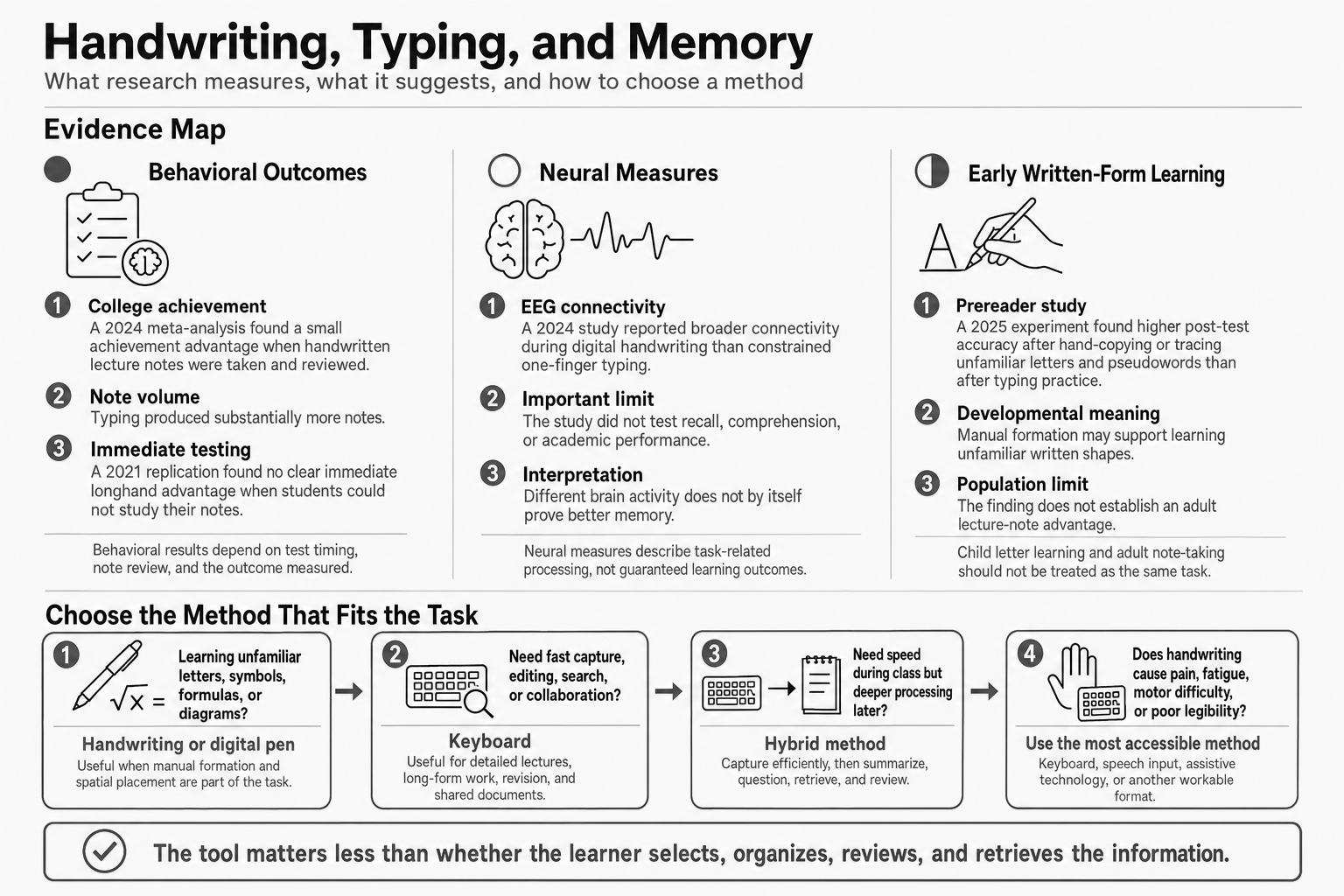
The clearest college-level evidence comes from a 2024 meta-analysis of handwritten and typed lecture notes. Across 24 studies reported in 21 articles, students who took and reviewed handwritten notes showed a small achievement advantage, while students who typed produced substantially more notes. A 2021 direct replication found no immediate longhand advantage when participants completed a quiz without first studying their notes. These findings address different stages of learning rather than directly contradicting each other.
Brain-recording studies also identify differences between handwriting and typing. However, electrical activity measured during a task does not establish that one method produces stronger recall, understanding, or academic performance. Developmental research addresses another question: whether manually forming unfamiliar written symbols helps children learn letters and words.
Answer Summary: Handwriting may help when it encourages selection, manual letter formation, diagrams, spatial organization, or later review. Typing may be more suitable for fast capture, editing, search, collaboration, long-form writing, and accessibility needs. Neither method guarantees stronger memory. The appropriate choice depends on the learning task, the learner’s fluency and comfort, the quality of the notes, and how the information will be reviewed and retrieved.
Table of Content
- What Does It Mean to Shape Memory?
- What Does the Evidence Show at a Glance?
- Are Handwritten Notes Better Than Typed Notes in College?
- Does Handwriting Help Long-Term Memory?
- Does Handwriting Activate the Brain Differently?
- Is Handwriting More Important for Children?
- Paper, Digital Pen, or Keyboard?
- Why Do Handwriting and Typing Studies Disagree?
- Which Note-Taking Method Fits Which Task?
- When May Handwriting Be Useful?
- When May Typing Be the Better Choice?
- A Practical Hybrid Method
- What Does the Research Not Prove?
- Final Answer
Key Takeaways:
-
Handwriting has no universal memory advantage.
-
Note review changes how college findings should be interpreted.
-
Typing usually produces more notes, but volume is not the same as understanding.
-
EEG differences do not prove stronger memory.
-
Handwriting has a clearer role in learning unfamiliar written forms.
-
Accessibility, fatigue, fluency, and task demands should guide tool choice.
What Does It Mean to Shape Memory?
“Memory” can refer to several outcomes, and studies do not always measure the same one.
Encoding: The initial process of taking in and organizing information.
Recall: Producing information without being shown the answer.
Recognition: Identifying information that was encountered before.
Retention: Maintaining access to information after a delay.
Understanding: Explaining, connecting, or applying ideas rather than simply repeating them.
Academic achievement: Performance on a quiz, examination, assignment, or another course measure.
Electroencephalography, or EEG, records electrical activity through sensors placed on the scalp. It can show that two tasks involve different activity patterns, but it does not directly reveal how much a learner will remember later.
A study measuring immediate recognition therefore answers a different question from one examining achievement after students review their notes. An EEG connectivity study addresses another question again. These outcomes should not be combined into one general claim about memory.
What Does the Evidence Show at a Glance?
The evidence supports a conditional conclusion. Results change with the population, task, timing, review opportunity, and measured outcome.
| Evidence context | Main finding | Main limitation |
|---|---|---|
| College lecture notes | A 2024 meta-analysis found a small achievement advantage for taking and reviewing handwritten notes; typing produced more note volume. | College achievement is not equivalent to every form of memory. |
| Immediate lecture test | A 2021 replication found no clear immediate longhand advantage when participants could not study their notes. | It did not test delayed review or long-term retention. |
| EEG connectivity | A 2024 study found broader connectivity patterns during digital handwriting than during constrained one-finger typing. | It included no test of learning or memory. |
| Early letter and word learning | A 2025 experiment found higher post-test accuracy in handwriting conditions than typing conditions among prereaders. | It concerns early written-form learning, not adult lecture memory. |
These studies used different designs and should be interpreted within their original populations and conditions.
Are Handwritten Notes Better Than Typed Notes in College?
Handwritten notes may support later achievement when students review them, but the writing medium alone does not determine note quality or learning.
The 2024 meta-analysis reported higher achievement for students who took and reviewed handwritten notes, with Hedges’ g = 0.248. Students who typed produced more notes, with Hedges’ g = 0.919. Both effects were statistically significant in the synthesis.
The achievement effect was small, while the difference in note volume was much larger. This does not mean that fewer notes are always better. Detailed notes may preserve information that a learner would otherwise miss. Shorter notes may be useful when the learner selects central ideas and records them clearly.
The tool does not guarantee either strategy. A typist can summarize, reorganize, and question information. A handwriter can copy phrases without processing their meaning.
Students and educators seeking broader guidance can read Collegenp’s article on how to teach students the art of note-taking.
Why Note Review Changes the Interpretation
Taking notes and studying from notes are separate stages. A method that shows little immediate benefit may become useful when the learner later reviews, reorganizes, and retrieves the information.
The 2021 replication included 74 laptop participants and 68 longhand participants. After watching a lecture and completing a short distraction task, participants took a quiz without an opportunity to study their notes. Laptop users recorded more words and more verbatim content, but the study did not find evidence that longhand improved immediate learning through encoding.
The replication and meta-analysis examined different conditions. The replication focused on an immediate test without note review. The meta-analysis synthesized achievement findings from college studies in which taking and later reviewing notes formed part of the comparison. One result therefore does not automatically cancel the other.
Does Handwriting Help Long-Term Memory?
Evidence for a general long-term-memory advantage remains limited. Many studies assess immediate performance, a short delay, or academic achievement rather than retention over an extended period.
The college meta-analysis supports a small achievement advantage when handwritten notes are taken and reviewed. It does not isolate handwriting as the sole cause of later performance. Note quality, review behavior, prior knowledge, assessment design, and other study activities may also contribute.
A careful conclusion is that handwriting may form part of an effective study process under certain conditions. It does not automatically create stronger long-term memory. A learner who actively reviews and retrieves information from typed notes may retain more than someone who writes notes by hand and never returns to them.
Does Handwriting Activate the Brain Differently?
Handwriting and typing can involve different patterns of neural activity. Those differences are relevant to how the tasks are performed, but they do not establish superior memory without a suitable learning test.
A 2024 high-density EEG study recorded brain activity in 36 university students. Participants repeatedly wrote 15 familiar words in cursive with a digital pen or typed them using the right index finger. The researchers reported broader connectivity patterns during handwriting. The experiment did not test later recall, recognition, comprehension, or academic performance.
A 2025 methodological commentary identified several limits affecting broader interpretation. The task involved repeated production of familiar words, the typing condition did not resemble ordinary multi-finger typing, and the study contained no learning or memory assessment. The commentary concluded that the EEG findings could not establish that handwriting improves classroom learning.
What the EEG Evidence Measured
| Evidence | What was measured | What it cannot establish |
|---|---|---|
| 2024 EEG study | Connectivity while adults wrote familiar words digitally or typed with one finger | Better recall, understanding, or grades |
| 2025 commentary | Methodological limits affecting interpretation of the EEG experiment | That neural differences have no scientific value |
| Combined interpretation | Differences in task-related processing | A universal memory advantage for handwriting |
EEG findings can help researchers examine how writing tools change task-related processing. Behavioral tests are still needed to determine whether those differences lead to stronger memory.
Is Handwriting More Important for Children?
Handwriting has a more direct role in early written-form learning than the adult note-taking evidence suggests.
A 2025 prereader experiment involved 50 children who learned unfamiliar letters and pseudowords through hand-copying, tracing, or typing conditions. Post-tests assessed several aspects of letter and word learning. The handwriting groups showed higher accuracy across the reported tasks than the typing groups.
Manual letter production requires the learner to reproduce a form rather than select a ready-made symbol on a keyboard. The study therefore supports a developmental distinction between forming unfamiliar written shapes and recording familiar-language lecture content.
The population boundary matters. The result concerns prereaders learning new letters and pseudowords. It does not establish that older students or adults remember every subject better when they use a pen.
A 2026 corrigendum corrected an incorrect citation in the introductory section of the original article. It did not concern the sample or outcome summary used in this article.
Paper, Digital Pen, or Keyboard?
Paper, digital pens, and keyboards offer different practical features. Their suitability depends on the task and the person using them.
Paper allows free placement of words, arrows, formulas, and diagrams. Its contents are harder to search, duplicate, or reorganize.
A digital pen preserves manual letter formation while adding digital storage and annotation. Its usefulness may depend on the writing surface, software, and the learner’s familiarity with the device.
A keyboard supports fast capture, editing, search, collaboration, and long-form writing. Fast typing can also make near-verbatim transcription easier, which may or may not suit the learning goal.
When handwriting causes pain, fatigue, motor difficulty, or a substantial legibility burden, an accessible alternative may reduce demands unrelated to the material. Accessibility is part of method selection, not an afterthought.
Why Do Handwriting and Typing Studies Disagree?
Studies differ because they do not all examine the same question.
Relevant variables include:
-
Learner group: Prereaders learning unfamiliar letters are not equivalent to university students taking notes.
-
Task: Copying a word, tracing a symbol, recording a lecture, and composing an essay involve different processes.
-
Test timing: An immediate test may produce a different result from an assessment after review.
-
Review opportunity: Notes that are studied later serve a different function from notes that are never reopened.
-
Tool fluency: An unfamiliar keyboard, stylus, or writing surface may consume attention.
-
Note strategy: Summarization differs from verbatim transcription.
-
Measured outcome: EEG activity, recognition, recall, and achievement are separate measures.
-
Accessibility: Pain, fatigue, motor demands, and assistive-technology needs can change which method is workable.
The findings become more coherent when each result is kept within its original task, population, and outcome.
Which Note-Taking Method Fits Which Task?
No single method fits every learning activity.
| Learning situation | Method to consider | What to check |
|---|---|---|
| Learning unfamiliar letters or symbols | Handwriting or digital pen | Whether manual formation is comfortable and accurate |
| Recording a fast, detail-heavy lecture | Keyboard or hybrid method | Whether the learner is summarizing or only transcribing |
| Drawing diagrams, formulas, or maps | Paper or digital pen | Whether free spatial placement supports the task |
| Preparing concise review notes | Any accessible method | Whether the notes identify relationships and questions |
| Producing a long assignment | Keyboard | Whether editing and source management are required |
| Collaborative note-taking | Shared digital document | Whether the notes remain organized and attributable |
| Managing handwriting fatigue or motor difficulty | Keyboard, speech input, or assistive technology | Whether the method reduces unrelated effort |
| Revising for an assessment | Any format combined with retrieval | Whether the learner can recall without looking |
Screen notifications and unrelated multitasking are separate from typing as a motor activity. Collegenp discusses the broader issue in when technology can hurt student learning.
When May Handwriting Be Useful?
Handwriting may suit tasks in which manual production or spatial organization forms part of the learning activity, including:
-
learning unfamiliar letters, symbols, or notation;
-
drawing diagrams and connecting ideas spatially;
-
working through equations or labelled processes;
-
creating a short summary from a longer source;
-
annotating material with arrows, questions, and margin notes;
-
preparing a compact set of notes for later review.
Slower production may encourage selection, but it can also cause information to be missed. The method should be judged by the quality and usability of the resulting notes rather than by speed alone.
When May Typing Be the Better Choice?
Typing may suit tasks requiring speed, editing, search, collaboration, portability, or long-form production.
It can help when a learner needs to:
-
capture detailed information accurately;
-
reorganize sections after a lecture;
-
search notes across several subjects;
-
share or combine notes with classmates;
-
use speech input, screen readers, or other assistive tools;
-
produce essays, reports, or research documents;
-
maintain a legible digital archive.
Typing becomes less useful for learning when it turns into unselective transcription. A learner can address this by pausing at natural breaks and adding a short summary, question, or connection in their own words.
A Practical Hybrid Method
A hybrid workflow can combine efficient capture with later processing.
-
Record the main ideas using the most accurate and accessible tool.
-
Mark unclear points instead of trying to copy every sentence.
-
Reduce the notes to a shorter structure in your own words.
-
Add diagrams, comparisons, questions, or worked examples where useful.
-
Close the notes and retrieve the main points from memory.
-
Check the source and correct omissions or misunderstandings.
-
Return to the questions after a delay.
This is general study guidance rather than a single experimentally tested protocol. It treats the note-taking tool, note quality, review, and retrieval as separate parts of the learning process.
For more on the review stage, see Collegenp’s article on active recall versus passive review.
What Does the Research Not Prove?
The available research does not prove that:
-
handwriting always produces better memory than typing;
-
broader EEG connectivity automatically means stronger learning;
-
handwriting guarantees higher grades;
-
typing damages memory or intelligence;
-
laptops should be banned from classrooms;
-
one fixed percentage applies to every learner;
-
results from prereaders establish an adult lecture-note advantage;
-
paper is always superior to digital handwriting;
-
every learner should use the same method.
The evidence supports a narrower conclusion: handwriting can change how information is recorded and may support some outcomes under specified conditions. Typing can also support learning when it fits the task and the learner.
Final Answer
Handwriting can shape memory, but its effect is conditional.
It may help when a learner forms unfamiliar written material, selects central ideas, draws spatial relationships, or prepares notes for later review. Typing may suit rapid capture, editing, search, collaboration, long-form work, and accessibility needs.
The relevant question is not whether pen or keyboard wins in every situation. It is whether the selected method helps the learner understand, preserve, review, and retrieve the material without adding unnecessary difficulty.





Comments 0
No comments yet. Be the first to start the conversation.