



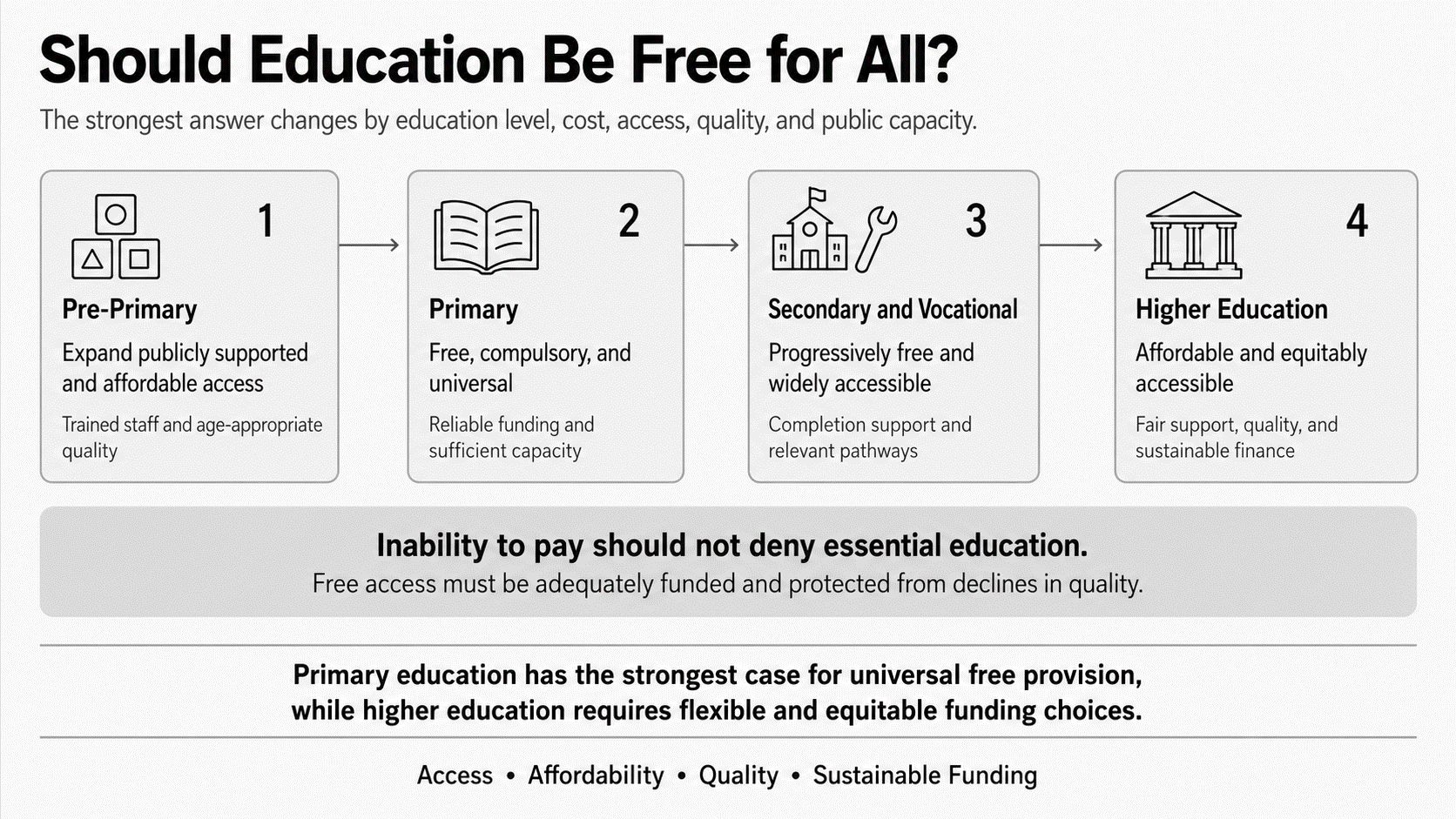
Education should be free and compulsory through primary school. Governments should also work toward free and widely accessible secondary education because access to foundational learning should not depend on a family’s ability to pay school fees.
Higher education requires a different policy judgment. Governments should protect affordable and equitable access, especially for learners with limited financial resources, but universal zero tuition is not the only reasonable approach. Publicly funded places, grants, low tuition, living-cost support, and income-contingent repayment can also contribute to an equitable system.
The phrase “free education for all” therefore raises three practical questions:
-
Which level of education is covered?
-
Which costs are removed?
-
Who funds the system?
These questions lead to a more useful answer than a simple choice between fully free and fully paid education.
Answer Summary: The strongest legal and policy case supports free, compulsory, and adequately funded primary education. Secondary and vocational education should become progressively free and widely accessible. Pre-primary education also merits stronger public support. In higher education, the main objective should be affordable and equitable participation rather than one mandatory global funding model. Every approach must protect educational quality, institutional capacity, and support for expenses beyond tuition.
Table of Content
- What Does “Free Education for All” Mean?
- Is Free Education a Human Right?
- What Are the Strongest Arguments for Free Education?
- What Are the Main Arguments Against Universal Free Education?
- Arguments and Counterarguments at a Glance
- What Does the Evidence Show?
- Should Education Be Free at Every Level?
- How Can Governments Fund Free or Affordable Education?
- How Should a Free-Education Policy Be Evaluated?
- A Balanced Verdict
Key Takeaways:
-
Free education removes some costs, not every expense.
-
Primary education has the clearest international legal protection.
-
Secondary education should become progressively free and accessible.
-
Removing fees can increase participation without guaranteeing learning.
-
Tuition is only one barrier faced by learners.
-
Higher-education funding should reflect equity, institutional capacity, and public resources.
-
Access and educational quality must be financed together.
What Does “Free Education for All” Mean?
Free education generally means that learners do not pay direct tuition or compulsory school fees. It does not mean that education has no cost or that families automatically receive support for every related expense.
Schools, colleges, and universities still require teachers, facilities, learning materials, administration, technology, maintenance, assessment, and student services. These costs may be covered through public budgets, taxation, institutional income, international support, private contributions, or a combination of sources.
Key Terms
-
Free education: Education provided without direct tuition or compulsory fees at the point of access.
-
Tuition-free education: A system that removes instructional fees but may leave other costs to students or families.
-
Fully cost-free education: A broader arrangement that may also cover materials, transport, meals, housing, devices, examinations, or other participation expenses.
-
Universal provision: Support available to everyone in an eligible population without an income test.
-
Publicly funded education: Education financed mainly through taxation, government revenue, or other collective public funding.
-
Affordable access: A system combining tuition policy with grants, scholarships, loans, living-cost support, or protections for learners with limited income.
-
Quality education: Access supported by qualified teachers, relevant curricula, suitable materials, safe facilities, inclusion, and accountability.
Tuition-Free Is Not Always Fully Cost-Free
A student may pay no tuition and still be unable to participate because of transport, accommodation, meals, books, uniforms, devices, examinations, childcare, or lost working time.
This distinction is especially important in higher education. Students in some low- or no-tuition systems still rely on loans to cover living expenses rather than academic fees. The OECD’s review of tertiary education financing shows how tuition, grants, loans, living costs, and repayment rules interact across the countries and economies included in its data.
Free but not fully cost-free: A policy should be judged by whether learners can enroll, attend, learn, and complete their education—not only by whether tuition has been removed.
Universal Access Is Not Universal Admission
Universal access means that everyone should have a fair opportunity to participate in the relevant level of education. It does not mean that every applicant must be admitted to every selective university or program.
Primary education is intended as a universal stage. Higher education may apply academic, professional, or capacity-based admission standards. A fair higher-education policy must therefore examine both financial access and the rules that determine who can enter.
Is Free Education a Human Right?
Education is recognized internationally as a human right, but international standards do not impose the same immediate free-education requirement at every level.
Article 13 of the International Covenant on Economic, Social and Cultural Rights states that primary education should be compulsory and available free to all. It addresses secondary education, including technical and vocational education, through general availability and accessibility, particularly through the progressive introduction of free education. Higher education should be equally accessible on the basis of capacity, also through progressive movement toward free provision.
Free and Compulsory Primary Education
Primary education has the strongest international legal baseline. It should be compulsory and available free to all.
This principle reflects the foundational role of literacy, numeracy, communication, social participation, and basic knowledge. A child should not be excluded from primary education because a household cannot pay direct school fees.
Legal recognition alone does not guarantee meaningful access. Schools may remain distant, overcrowded, unsafe, inaccessible, or inadequately funded. Informal charges may also replace official fees. Governments must therefore finance the conditions required for children to attend and learn.
Secondary and Higher Education Involve Progressive Obligations
International standards distinguish secondary and higher education from the immediate requirement applied to primary education.
Secondary education should be made generally available and accessible, including through the progressive introduction of free education. Higher education should be equally accessible on the basis of capacity, also through appropriate measures and progressive movement toward free provision.
The distinction can be summarized as follows:
-
Free primary education has the clearest immediate legal foundation.
-
Free secondary education is a strong progressive objective.
-
Higher-education funding remains a policy choice shaped by access, public resources, institutional capacity, and national systems.
What Are the Strongest Arguments for Free Education?
The strongest argument is that essential learning opportunities should not depend on household income. The case is most convincing when fee removal is supported by adequate funding and quality protection.
Access Should Not Depend on Family Income
Direct fees can prevent enrollment, interrupt attendance, or force households to decide which child continues studying. The burden may be especially difficult where several children attend school or household income is unstable.
The scale of exclusion remains substantial. UNESCO’s 2026 Global Education Monitoring Report states that 273 million children and young people were out of school in 2024. It also cautions that this total may undercount children in some conflict-affected settings. Fees are not the only cause: conflict, poverty, population growth, location, disability, social norms, and limited educational capacity also affect participation. The 2026 Global Education Monitoring Report provides the underlying global context.
Removing compulsory fees cannot solve every barrier. It can, however, prevent a public education system from formally excluding learners who cannot pay.
Education Creates Benefits Beyond the Individual
Education can support employment, skills development, health knowledge, social participation, institutional capacity, and economic activity.
These benefits extend beyond the individual learner and provide a rationale for public investment. However, the benefits depend on whether students acquire meaningful knowledge and skills rather than merely spending time in an institution.
Further background is available in Collegenp’s article on the importance of education for a country’s economy. It is included as related reading rather than as the primary evidence for this article.
Removing Direct Fees Can Widen Participation
Evidence from individual countries shows that direct charges can be a major enrollment barrier.
The Democratic Republic of Congo introduced free primary education in September 2019. In June 2020, the World Bank reported that an additional 2.5 million children from disadvantaged backgrounds had been able to attend school following the reform. The same account described significant pressures on financing, staffing, and educational quality. The World Bank’s account of the reform provides the country-specific evidence.
This example does not prove that every fee-removal policy will have the same effect or that the increase resulted from fees alone. It shows that removing direct charges can release substantial unmet demand and that institutions must prepare for higher enrollment.
Universal Provision Can Reduce Administrative Barriers
Universal programs do not require families to prove that they are poor enough to receive support. This can reduce paperwork, delays, stigma, and exclusion caused by documentation or application requirements.
The main limitation is cost. Universal provision also supports households that may have the ability to contribute. Whether this is equitable depends on how the system is financed, who pays taxes, which groups participate, and whether disadvantaged learners receive enough support to complete their education.
What Are the Main Arguments Against Universal Free Education?
The principal objections concern public cost, institutional capacity, distributional fairness, and the risk of concentrating on tuition while neglecting other barriers. These arguments question the design of free education rather than the value of education itself.
Public Funding Has an Opportunity Cost
Free education is paid through taxation, public revenue, borrowing, international assistance, or reduced spending elsewhere. Governments must finance education while also supporting health services, infrastructure, social protection, and other public responsibilities.
UNESCO estimates that low- and lower-middle-income countries face an annual financing gap of US$97 billion in meeting their national Sustainable Development Goal 4 targets by 2030. This estimate concerns the broader education system, not tuition abolition alone. UNESCO’s education-financing overview explains the scale and context of the gap.
A government that removes fees without replacing the lost revenue may weaken the institutions it is trying to make more accessible.
Rapid Expansion Can Strain Quality and Capacity
When fees are removed, enrollment may grow faster than the supply of teachers, classrooms, learning materials, laboratories, or student services.
Possible pressures include:
-
crowded classrooms;
-
heavier teacher workloads;
-
shortages of learning materials;
-
reduced individual support;
-
pressure on facilities;
-
delayed or inadequate institutional funding.
Fee removal does not inherently reduce educational quality. Problems arise when a government expands access without increasing the resources required to serve additional learners.
Universal Higher-Education Subsidies May Not Target Need
Higher education is often selective, and access may already be unequal before tuition is considered. Learners from wealthier households may have had greater access to strong schools, tutoring, technology, and application support.
Where higher-income students are more likely to qualify for university, a universal subsidy may direct public funds toward people who were already more likely to enroll. This is a policy risk, not a universal conclusion. A country-specific judgment requires evidence about admissions, enrollment, completion, taxation, and who receives the subsidy.
Tuition Is Only One Part of Affordability
A zero-tuition system can remain unaffordable when students must pay for accommodation, food, transport, childcare, equipment, learning materials, or lost earnings.
OECD data show that even students in some tuition-free systems borrow primarily for living expenses. The implication is not that tuition-free education has failed. It is that tuition policy and student-support policy must be assessed together.
Arguments and Counterarguments at a Glance
Each argument becomes clearer when considered alongside its main limitation or policy condition.
| Argument | Why it matters | Limitation or condition |
|---|---|---|
| Education should not depend on income | Direct fees can exclude learners | Hidden and indirect costs may remain |
| Society benefits from education | Public benefits support collective funding | Benefits depend on quality and relevance |
| Universal support is simpler | It reduces applications and eligibility errors | It also supports people who may be able to pay |
| Fee removal can expand access | It removes a direct financial barrier | Capacity must grow with enrollment |
| Public budgets can fund education | Costs are shared collectively | Revenue must be stable and sufficient |
| Higher education should be affordable | Financial barriers can prevent participation | Universal subsidies may not target need |
| Some tertiary costs may be shared | Graduates can receive private benefits | Repayment must protect low earners |
What Does the Evidence Show?
The evidence supports three qualified conclusions: fees can prevent participation, removing fees can increase enrollment, and neither access nor enrollment automatically produces meaningful learning.
Fee Removal Can Improve School Access
The Democratic Republic of Congo case indicates that removing direct fees can be followed by a substantial increase in participation when many households previously faced financial barriers.
The same example also demonstrates the limits of using enrollment as the only measure of success. A sudden increase in attendance can place pressure on teachers, facilities, materials, and public budgets.
A responsible evaluation should therefore consider:
-
enrollment;
-
attendance;
-
progression;
-
completion;
-
learning outcomes;
-
differences among learner groups;
-
pressure on teachers and facilities.
Access Is Not the Same as Learning
A place in a classroom is necessary but not sufficient. Learners also need qualified teachers, suitable materials, safe facilities, relevant curricula, appropriate language support, fair assessment, and assistance when they fall behind.
Non-fee barriers may be especially serious for rural learners, children with disabilities, displaced populations, and students with household or work responsibilities.
Collegenp’s article on access to quality education for rural students provides related background on distance, infrastructure, transport, poverty, and teacher availability. It is included for internal navigation, not as primary evidence for global claims.
Higher-Education Systems Use Different Funding Models
The OECD groups the countries and economies included in its 2025 data into four broad tertiary-financing models:
-
low or no tuition with high public student support;
-
high tuition with developed financial-aid systems;
-
moderate tuition with targeted support;
-
relatively high tuition with limited public support.
Each arrangement involves trade-offs among institutional resources, affordability, access, debt, public expenditure, and educational quality. The comparison covers OECD countries and participating economies, not the entire world.
The central lesson is that tuition cannot be evaluated in isolation. Grants, loans, living expenses, institutional funding, admissions, and repayment rules shape the real cost faced by learners.
Should Education Be Free at Every Level?
The policy case changes by education level. Primary education has the strongest claim to universal free provision, while higher education requires a more flexible assessment of access, public benefit, private benefit, cost, and capacity.
| Education level | Recommended policy baseline | Main safeguard |
|---|---|---|
| Pre-primary | Expand publicly supported and affordable access | Trained staff and age-appropriate quality |
| Primary | Free, compulsory, and universal | Reliable funding and sufficient capacity |
| Secondary and vocational | Progressively free and widely accessible | Completion support and relevant pathways |
| Higher education | Affordable and equitably accessible | Fair support, quality, and sustainable finance |
Pre-Primary Education
Pre-primary education has a strong equity rationale because access often differs by household income and location. Public support can help children receive early learning opportunities before entering primary school.
Expansion should not be limited to creating places. Programs also need trained staff, safe environments, age-appropriate learning, family involvement, and inclusion for children with disabilities.
Primary Education
Primary education should be free, compulsory, universal, and adequately funded. This conclusion follows both the international legal baseline and the foundational role of primary education.
Governments should prevent informal charges from replacing official fees. Schools need reliable funding for staff, learning materials, facilities, maintenance, and support services so that essential costs are not transferred back to families.
Secondary and Vocational Education
Secondary education should move toward free and widely accessible provision. Support should focus on both entry and completion.
At this level, learners may face expenses related to transport, examinations, devices, uniforms, materials, or lost work. Effective policy may therefore include:
-
removing compulsory fees;
-
transport or meal support;
-
flexible learning pathways;
-
career guidance;
-
academic and vocational options;
-
assistance for learners at risk of leaving school.
Vocational education should be relevant, safe, recognized, and connected to employment or further study. It should not be treated as an automatically inferior pathway.
Higher Education
Higher education should be affordable and equitably accessible, but universal zero tuition is not the only possible model.
Countries may use:
-
universal public tuition funding;
-
targeted grants;
-
subsidized public places;
-
low tuition;
-
scholarships;
-
living-cost support;
-
income-contingent repayment;
-
mixed public and private funding.
A higher-education policy should be judged by whether students with limited income can enter and complete their studies, whether debt remains manageable, whether institutions have sufficient resources, and whether public support is distributed fairly.
Collegenp’s article on problems with the college education system offers related discussion of accessibility, student costs, and institutional pressures. It is included as internal navigation rather than evidence for the claims in this article.
How Can Governments Fund Free or Affordable Education?
Governments can combine taxation, public budgets, grants, scholarships, tuition policies, and repayment systems. Every approach requires decisions about who contributes, who receives support, and how educational quality will be protected.
| Funding model | Learner protection | Main risk |
|---|---|---|
| General taxation | Removes or reduces direct payment | Insufficient or unstable budgets |
| Targeted grants | Directs support toward defined need | Eligible learners may be missed |
| Universal support | Reduces stigma and application barriers | Higher public cost |
| Low tuition with aid | Shares costs while protecting access | Support gaps may remain |
| Income-contingent repayment | Links payment to later earnings | Longer repayment and public fiscal cost |
| Mixed funding | Combines several protections | Complexity and weak coordination |
General Taxation and Public Budgets
Tax funding spreads education costs across society. A progressive tax system can place a greater contribution on households or organizations with more financial capacity.
The main condition is budget reliability. Schools and institutions cannot plan staffing, maintenance, learning resources, or expansion when funding is delayed or unpredictable.
Grants, Scholarships, and Living-Cost Support
Grants can target learners facing the greatest financial barriers. They may cover tuition, materials, transport, housing, or other participation expenses.
Targeted programs work only when learners can understand and complete the application process. Complex documentation, narrow eligibility rules, or poor communication can exclude intended recipients.
Low Tuition and Income-Contingent Repayment
Low tuition may allow governments to direct more resources toward institutions, grants, or other public services.
Under income-contingent repayment, graduates begin repaying after their income reaches a specified threshold. OECD evidence indicates that this can provide greater protection for lower earners than fixed repayment, although it may lengthen repayment periods and increase fiscal costs for governments.
Such systems require clear terms, reliable income reporting, fair treatment of low earners, and protection against unmanageable debt.
Protecting Quality and Accountability
Funding should reflect the actual cost of education rather than only the appeal of announcing free access.
Important safeguards include:
-
qualified teachers and fair working conditions;
-
safe and accessible facilities;
-
adequate learning materials;
-
suitable technology;
-
transparent institutional budgets;
-
support for disadvantaged learners;
-
credible assessment and quality assurance;
-
reporting on enrollment, completion, equity, and learning.
A system that removes fees while reducing learning quality does not fully solve the access problem. It changes the form of disadvantage.
How Should a Free-Education Policy Be Evaluated?
A free-education policy should be assessed by what learners receive, who benefits, how the policy is financed, and whether it can continue without weakening quality.
Five Questions for Policy Evaluation
-
Which costs are removed?
Check whether the policy covers only tuition or also compulsory fees, materials, transport, meals, housing, devices, and examinations. -
Which learners benefit?
Determine whether support is universal, means-tested, restricted by age, limited to public institutions, or connected to admission requirements. -
Who pays?
Identify whether the system relies on taxation, public revenue, international assistance, borrowing, employer contributions, student repayment, or mixed funding. -
Can institutions maintain quality?
Examine teacher supply, class size, facilities, learning materials, student support, and the reliability of institutional funding. -
What outcomes are measured?
Enrollment should be considered alongside attendance, progression, completion, learning, equity, and transition to further study or work.
A Framework for Essays and Debates
Students and debate participants can build a defensible position by separating legal facts from policy judgment.
A balanced argument can follow this sequence:
-
define what “free” and “for all” mean;
-
distinguish primary, secondary, vocational, and higher education;
-
explain the rights and equity case;
-
examine cost, quality, capacity, and targeting;
-
compare universal and targeted funding;
-
state a level-by-level conclusion.
A defensible thesis could argue that primary education should be universally free, secondary education should become progressively free, and higher education should be made affordable through the model that most effectively protects access and quality in each national context.
This is a reasoning framework, not a claim that one policy design will suit every education system.
A Balanced Verdict
The legal baseline and the policy judgment should remain separate.
As a matter of international law, primary education has the clearest protection as free and compulsory education. Secondary and higher education are addressed through accessibility and progressive movement toward free provision.
As a policy judgment, primary education should be universally free and adequately funded. Secondary and vocational education should move toward free and broad access, supported by measures addressing transport, learning materials, technology, and completion.
Higher education should be affordable and equitably accessible. Universal free tuition may be appropriate in some systems. Other countries may achieve equitable access through targeted grants, low tuition, living-cost support, income-contingent repayment, or mixed funding.
The strongest general principle is not that every form of education must use one financing formula. It is that inability to pay should not deny a learner essential education and that access policies must be adequately funded and protected from declines in quality.







Comments 0
No comments yet. Be the first to start the conversation.