



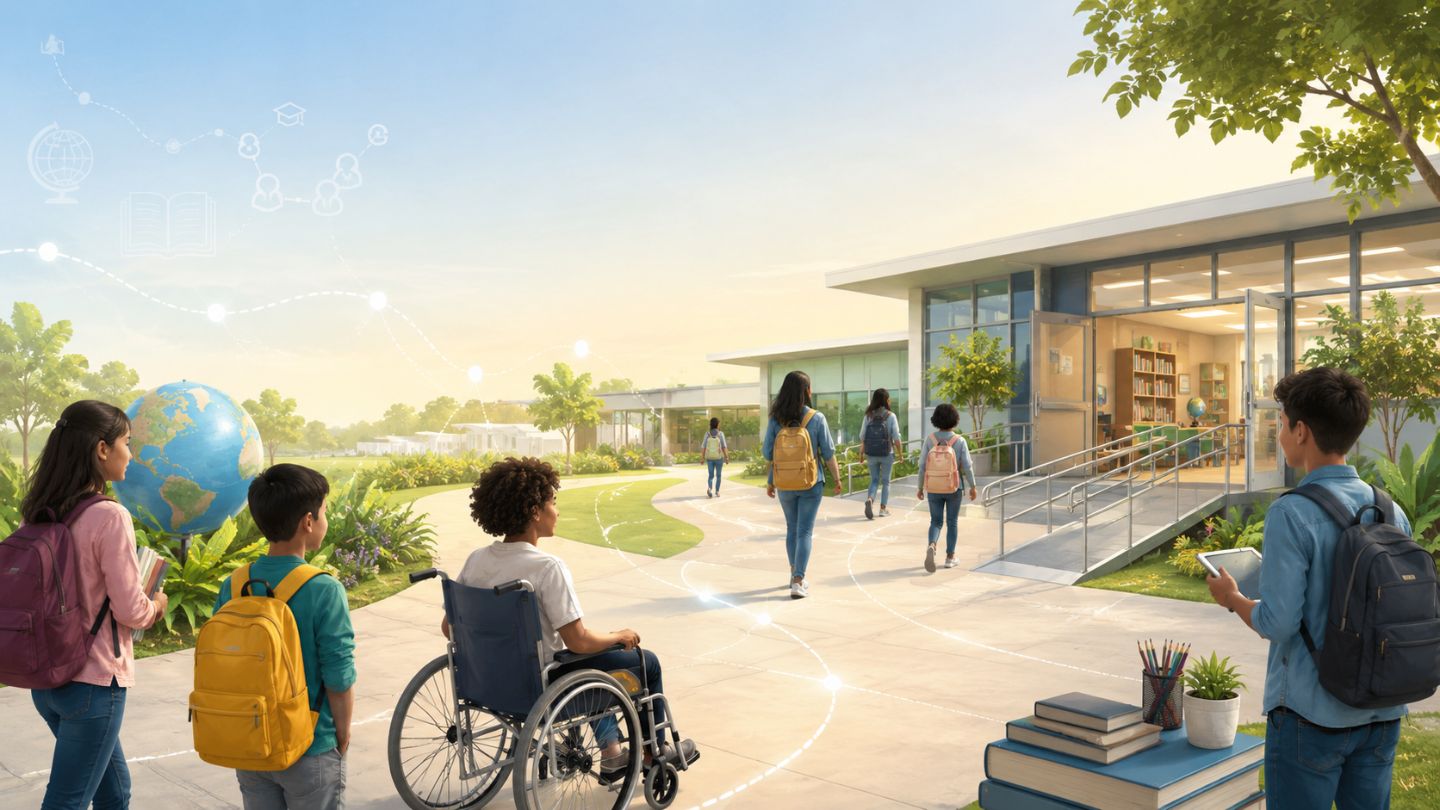
Equal access to education systems means that every learner should have a fair chance to enter, participate in, progress through, and benefit from quality education without discrimination or avoidable barriers. It is not limited to school admission. A learner may be enrolled on paper but still be excluded in practice through cost, distance, unsafe travel, inaccessible buildings, language barriers, discrimination, weak teaching support, or lack of digital access.
UNESCO defines equal access to education as the principle that every individual has the right to education without discrimination or barriers. It specifically notes that factors such as socioeconomic status, gender, or disability should not hinder access to educational resources and institutions.
For readers, the useful question is not only “Can children go to school?” It is also “Can learners attend regularly, feel safe, understand instruction, receive support, complete each stage, and gain meaningful skills?” That wider question makes equal access a systems issue involving policy, funding, infrastructure, teachers, data, inclusion, and accountability.
Answer Summary:
Equal access to education systems means learners can enter and use education opportunities without unfair barriers. It includes enrollment, attendance, affordability, safety, disability access, language support, teacher capacity, learning quality, and progression. Equal access does not always mean identical treatment. In many cases, equitable support is needed so learners facing different barriers can participate and learn.
Table of Content
- What Equal Access to Education Systems Means
- Equality, Equity, Inclusion, and Quality
- Why Equal Access Matters
- Main Barriers to Equal Access
- What Education Systems Can Do
- How Equal Access Is Measured
- Common Misconceptions About Equal Access
- Practical Checklist for Evaluating Equal Access
- What Readers Should Verify Carefully
- Conclusion
Key Takeaways:
-
Equal access is broader than school enrollment.
-
Equity and inclusion help make access real for learners facing different barriers.
-
Poverty, distance, disability exclusion, language, safety, crisis, and digital gaps can block participation.
-
Quality matters because attendance without learning is incomplete access.
-
Data should show who is left behind, not only national averages.
-
Technology can help only when access, design, safety, and teacher support are addressed.
-
Country-specific rights, fees, eligibility rules, and services should be verified from official national sources.
What Equal Access to Education Systems Means
Equal access means education opportunities are available, reachable, usable, and meaningful for learners. A system supports access when learners can enroll, attend, participate, receive support, move through education levels, and gain relevant learning outcomes.
A practical definition has three parts. First, education opportunities must exist: schools, teachers, learning materials, programs, and pathways. Second, learners must be able to use those opportunities without discrimination or avoidable barriers. Third, access must connect to learning quality, not only physical presence.
This is why equal access is different from a narrow admission rule. A child in a remote area, a learner with a disability, a refugee adolescent, a low-income student, a minority-language speaker, and an urban student may all need different forms of support. The goal is not to make their circumstances identical. The goal is to remove barriers that prevent fair participation.
Equality, Equity, Inclusion, and Quality
Equal access is closely linked to equality, equity, inclusion, and quality, but these terms do not mean the same thing. Understanding the differences prevents weak policy and unclear writing.
| Term | Meaning in education | Why it matters |
|---|---|---|
| Equality | Giving learners the same formal rule or opportunity | It can remove open discrimination but may not address different barriers |
| Equity | Giving support according to need | It explains why targeted funding, transport, assistive tools, or language support may be fair |
| Inclusion | Designing systems so diverse learners can belong and participate | It reduces exclusion linked to disability, poverty, language, displacement, gender, ethnicity, or identity |
| Quality | Ensuring teaching, curriculum, assessment, safety, and support lead to learning | Access without quality can raise attendance without improving outcomes |
Equality vs equity in education
Equality gives the same formal opportunity. Equity asks whether that opportunity is usable for learners with different needs and barriers.
For example, the same textbook may not serve a learner who needs braille, audio, large print, or sign-language support. The same school calendar may not work for learners affected by displacement, seasonal work, or care duties. The same exam format may not fairly assess a learner who needs an approved accommodation.
Equity does not mean lowering expectations. It means removing barriers that prevent learners from meeting meaningful expectations.
Inclusive education and learners with disabilities
Inclusive education is a central part of equal access. The World Bank defines inclusive education as creating systems and environments that enable all students to have equal access to education and learning.
Inclusive education should not be reduced to ramps. Physical access matters, but so do teaching methods, materials, assessment design, classroom attitudes, school leadership, support services, and reliable data. A school may be open to all learners in policy while still excluding some learners through inaccessible materials, stigma, or unsupported classroom practice.
Access and learning outcomes
Equal access is necessary, but it does not automatically produce equal learning outcomes. Learners may attend school but still fail to develop foundational skills if teaching quality is weak, materials are unavailable, language support is missing, or classrooms are unsafe.
This is why education access should be discussed with attendance, completion, transition, inclusion, and learning quality. A system that raises enrollment but leaves many learners unable to read, calculate, communicate, or continue learning has not solved the access problem.
Why Equal Access Matters
Equal access matters because education affects how people read, count, communicate, work, participate in public life, and understand their rights and responsibilities. It can expand opportunity, but it should not be described as a single solution to poverty, discrimination, conflict, or weak labor markets.
At the global policy level, Sustainable Development Goal 4 calls for inclusive and equitable quality education and lifelong learning opportunities for all. Its targets include free, equitable, and quality primary and secondary education; early childhood development; equal access to technical, vocational, and tertiary education; reduced disparities; qualified teachers; and safe, inclusive learning environments. UN SDG 4
This broad framing matters because access gaps appear across the full learning pathway. Some children miss early learning. Some enter primary school late. Some leave before secondary education. Some young people cannot reach technical, vocational, or tertiary education. Some adults need literacy or skills pathways. Some displaced learners need flexible ways to return to learning.
Main Barriers to Equal Access
Barriers to equal access often overlap. A learner may face cost, distance, disability exclusion, language barriers, and unsafe travel at the same time.
Poverty, fees, and hidden costs
Even when tuition is officially free, families may face indirect costs such as uniforms, transport, textbooks, meals, exam charges, learning devices, internet access, or lost household income. These costs can reduce attendance and completion, especially for low-income households.
A serious access strategy looks beyond the headline price of schooling. It asks whether learners can afford to attend regularly, participate fully, and continue through the next stage.
Geography, transport, and infrastructure
Distance to school, poor roads, unsafe routes, seasonal weather, and limited transport can make education hard to use. Rural and remote areas may also face teacher shortages, fewer subject choices, weaker connectivity, and fewer support services.
This is not only a location problem. It is also a planning, staffing, financing, and infrastructure problem.
Disability, language, gender, ethnicity, and identity
Learners may be excluded when schools lack accessible toilets, ramps, assistive technology, sign-language support, accessible reading materials, trained teachers, or anti-discrimination systems. Others may face barriers linked to language of instruction, gender norms, care responsibilities, early marriage, racism, caste discrimination, ethnicity, Indigenous identity, migration status, or poverty.
The exact mix varies by country and community. Global articles can identify common barriers, but national policy details should be checked from official sources.
Conflict, displacement, climate shocks, and emergencies
Emergencies can interrupt education when schools are damaged, records are lost, families move, teachers are displaced, or safety risks rise. Refugee, migrant, and internally displaced learners may also face documentation problems, curriculum differences, language barriers, and difficulty transferring school records.
Education continuity planning is part of access. Systems need flexible documentation rules, catch-up learning, safe temporary learning spaces, teacher support, and learning options that do not exclude students without reliable internet or devices.
The digital divide
Digital tools can support access when they are affordable, accessible, safe, and connected to effective teaching. They can also deepen inequality when learners lack electricity, devices, internet, quiet study space, accessible platforms, digital skills, or trained teachers.
Technology should be treated as one tool in a wider access strategy. It should not be presented as an automatic solution to exclusion.
What Education Systems Can Do
Education systems improve equal access when policy, funding, school practice, data, and accountability work together. One isolated program rarely removes all access barriers.
Use equitable financing and targeted support
Education budgets need to reach learners and schools facing greater barriers. Depending on context, targeted support may include transport, school meals, fee waivers, accessible infrastructure, assistive technology, language support, catch-up learning, safe facilities, or support for learners affected by emergencies.
The right response depends on local evidence. A rural transport problem needs a different solution from a disability-access problem or a language-of-instruction problem.
Support teachers and school leaders
Access depends on people as well as buildings. Teachers need preparation for mixed-ability classrooms, multilingual learners, learners with disabilities, and students affected by interrupted schooling or displacement. School leaders need systems to track attendance, identify early warning signs, coordinate with families, and connect learners with support.
Teacher support is not an extra feature. It is part of making access usable.
Make learning environments accessible and safe
Accessible schools need more than an entrance gate. They need usable toilets, safe routes, appropriate classroom layouts, accessible materials, anti-bullying systems, fair discipline, flexible assessment where justified, and clear reporting channels for discrimination or abuse.
Safety and belonging affect whether learners attend regularly and whether families trust the school.
Use data to identify who is left behind
National averages can hide inequality. A country may report high enrollment while certain groups remain excluded. Data should be disaggregated where safe and appropriate by wealth, gender, disability, location, language, ethnicity, migration or displacement status, and school level.
The World Inequality Database on Education highlights how circumstances such as wealth, gender, ethnicity, and location shape education opportunities across and within countries. It brings together data from household surveys and learning assessments from more than 160 countries. World Inequality Database on Education
Data should help answer practical questions: Who is not enrolling? Who attends irregularly? Who drops out? Who completes each level? Who is learning? Which groups are missing from the data? The purpose is to make exclusion visible and respond to it.
How Equal Access Is Measured
No single indicator captures equal access. A careful review uses several measures together.
| Measure | What it shows | What it may miss |
|---|---|---|
| Enrollment | Whether learners are formally registered | Attendance, safety, support, and learning |
| Attendance | Whether learners are regularly present | Whether they are learning or included |
| Completion | Whether learners finish a level | Quality of learning and reasons for dropout |
| Transition | Whether learners move to the next level | Barriers inside the next level |
| Learning outcomes | Whether learners gain expected skills | Barriers before assessment |
| Disaggregated data | Differences by learner group or context | Groups not captured well by records |
Current global evidence shows why statistics should be checked by source year. The 2026 UNESCO Global Education Monitoring Report states that 273 million children and youth are still out of school.
Exact figures should be updated when new UNESCO, UIS, GEM, UNICEF, World Bank, or national data are released.
Common Misconceptions About Equal Access
Equal access means identical treatment
Identical treatment can preserve disadvantage when learners face different barriers. Equal access often requires equitable support so learners can participate and learn.
Free education solves access
Free tuition can help, but it may not remove transport costs, uniforms, meals, books, exam charges, device costs, connectivity gaps, safety risks, disability barriers, or language barriers.
Enrollment equals access
Enrollment is only one access indicator. Attendance, safety, inclusion, completion, transition, and learning outcomes also matter.
Online education automatically improves access
Online education can expand options for some learners, but it can exclude others when devices, electricity, internet, accessible design, digital skills, and teacher support are missing.
Equal access guarantees equal outcomes
Equal access improves the conditions for participation, but outcomes are shaped by teaching quality, health, language, safety, household conditions, discrimination, labor markets, and wider social factors.
Practical Checklist for Evaluating Equal Access
Use this checklist to assess whether a system is moving beyond formal access.
Availability
Are schools, teachers, materials, programs, and learning pathways available for the learners served?
Accessibility
Can learners physically, digitally, linguistically, and socially use education opportunities?
Affordability
Are direct and hidden costs low enough for low-income learners to attend regularly?
Acceptability
Are learning environments safe, respectful, relevant, and free from discrimination?
Adaptability
Can the system adjust for disability, language, displacement, age, work, care duties, interrupted schooling, or emergency conditions?
Accountability
Is there a way to monitor exclusion, respond to complaints, correct errors, and update policy when evidence changes?
What Readers Should Verify Carefully
Global definitions and frameworks are useful, but country-specific details can change. Readers should verify national laws, compulsory education rules, disability accommodations, school fees, scholarship eligibility, admission rules, equivalency processes, refugee or migrant documentation rules, and complaint procedures from official government or institutional sources.
This article is informational. It does not provide legal advice about education rights or national policy.
Conclusion
Equal access to education systems is not only about opening schools or allowing enrollment. It is about whether learners can realistically enter education, stay connected to it, receive support, learn safely, complete each stage, and move to the next opportunity.
A credible approach treats access as a chain. If one link breaks—cost, distance, disability access, language, safety, teacher support, data, crisis planning, or learning quality—the learner may still be excluded. The practical goal is fair access supported by equity, inclusion, quality, and evidence.






Comments 0
No comments yet. Be the first to start the conversation.