



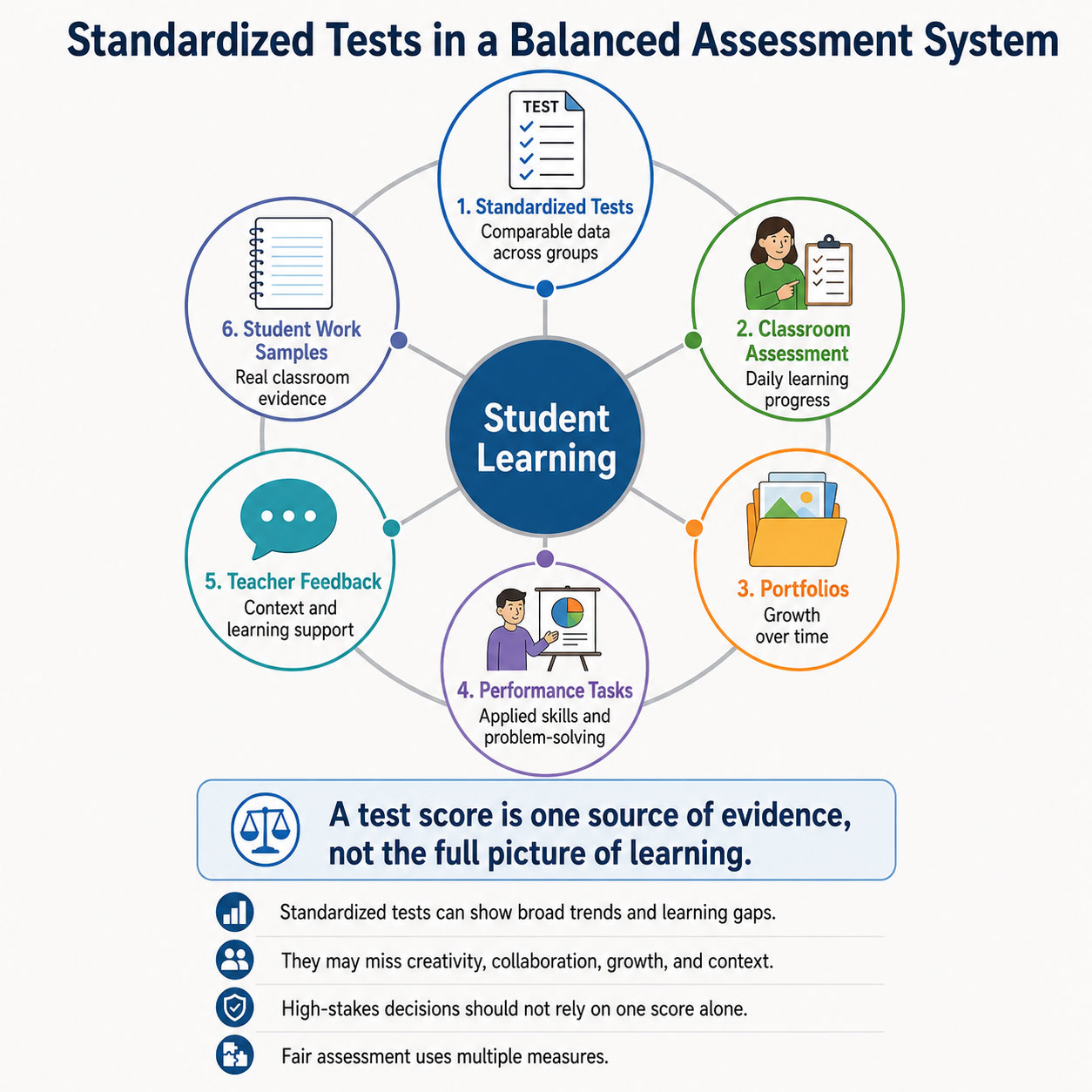
Standardized tests are used because education systems need some way to compare learning across classrooms, schools, regions, or countries. A test given under similar conditions and scored by consistent rules can provide useful information that ordinary classroom grades may not show.
The problem is not simply that standardized tests exist. The larger issue is what happens when one score is treated as a complete picture of a student, teacher, school, or education system. A test score can show something real and still miss something important.
For global readers, this topic needs careful framing. A school-leaving exam, a college admissions test, an international assessment, and a low-stakes diagnostic test are not the same. They differ in purpose, design, stakes, and consequences.
For readers who want the basic distinction first, Collegenp’s guide to Standardized and Nonstandardized Assessments is a useful related reference.
Answer Summary:
The main problems with standardized tests are overreliance, limited measurement of complex learning, unequal preparation opportunities, high-stakes pressure, curriculum narrowing, and misuse of scores in accountability or admissions. Standardized tests can still provide useful comparable data when designed well and interpreted with other evidence. The fairest approach is not to treat one score as the final judgment.
Table of Content
- What Are the Main Problems with Standardized Tests?
- What Is a Standardized Test?
- What Standardized Tests Can Measure Well
- Major Problems with Standardized Tests
- How Standardized Testing Affects Different Groups
- Common Misconceptions About Standardized Tests
- Alternatives and Complements to Standardized Testing
- How to Use Test Scores Responsibly
- Final Takeaway
Key Takeaways:
-
Standardized tests are not automatically useless or unfair.
-
Problems grow when one score carries too much consequence.
-
Equal testing conditions do not guarantee equal learning opportunity.
-
Test scores need context, especially for high-stakes decisions.
-
Alternative assessments also need quality controls.
-
A balanced assessment system uses multiple types of evidence.
What Are the Main Problems with Standardized Tests?
The main problems with standardized tests are that they can reduce complex learning to a narrow score, encourage teaching to the test when stakes are high, reflect unequal learning opportunities, increase pressure for some students, and be misused as if one result fully defines ability or school quality.
They are not automatically bad. A well-designed standardized test can provide comparable data, reveal broad learning gaps, and help education systems monitor progress. UNESCO describes system-level learning assessment as a way to understand, measure, and improve the quality and equity of education.
The safer interpretation is this: standardized tests should be treated as one source of evidence, not the final answer about a learner, teacher, school, or education system.
What Is a Standardized Test?
A standardized test is an assessment designed so that test takers face the same or comparable tasks, timing, instructions, administration rules, and scoring criteria. Standardization is meant to reduce random differences in how a test is given or marked.
Professional testing standards emphasize that test scores should be interpreted according to their intended use, with attention to validity, reliability, administration, scoring, accessibility, and fairness. The Standards for Educational and Psychological Testing are a joint product of the American Educational Research Association, the American Psychological Association, and the National Council on Measurement in Education.
Standardized Test vs Classroom Test
A classroom test is usually written, adapted, and graded by a teacher for a specific group of learners. It can reflect what was recently taught and can give detailed feedback.
A standardized test is designed for broader comparison. That comparison can be useful, but it usually gives less detail about daily learning, effort, curiosity, collaboration, creativity, and classroom context.
Standardized Test vs High-Stakes Test
A standardized test is not always high-stakes. Some standardized assessments are low-stakes diagnostic tools. Others affect promotion, graduation, admissions, school ratings, funding, or teacher evaluation, depending on the education system.
Many standardized testing problems become more serious when the result carries major consequences. The issue is not only the test format. It is also how much power the score is given.
Why This Distinction Matters
Many debates become confusing because people use “standardized testing,” “multiple-choice testing,” “annual testing,” and “high-stakes testing” as if they mean the same thing. They do not.
A standardized test can include multiple-choice, short-answer, writing, oral, or performance-based items if administration and scoring are consistent. A high-stakes test is defined by consequence, not only by format. Keeping these terms separate helps readers judge the real problem: test design, test use, score interpretation, or policy pressure.
What Standardized Tests Can Measure Well
Standardized tests can be useful when the goal is to collect comparable evidence across large groups. They can show whether students are performing at expected levels in selected subject areas. They can also help policymakers identify broad learning gaps that may need attention.
This is why many education systems use large-scale assessments. Without any comparable data, weak learning outcomes can remain hidden. Collegenp’s article on Weak Learning Outcomes Raise Assessment Concerns connects with this issue.
| Standardized tests can show | They often miss or show only partly |
|---|---|
| Performance on selected knowledge or skills under test conditions | Creativity, collaboration, persistence, curiosity, and long-term growth |
| Broad trends across schools, regions, or years | Why a specific student or school performed that way |
| Learning gaps that may need attention | Whether gaps reflect teaching, resources, language, disability access, or test design |
| A snapshot of performance at one time | Day-to-day learning progress and improvement over time |
Standardized testing is more useful as a monitoring tool than as a single basis for high-consequence decisions. It can raise useful questions, but it usually cannot answer all of them.
Major Problems with Standardized Tests
The most serious problems with standardized tests come from limited measurement, unequal opportunity, score overuse, and high-stakes consequences. These issues can appear separately or together.
One Score Can Look More Precise Than It Is
A score can feel exact because it is expressed as a number, percentile, grade, or level. But a test score is still an estimate.
It can be affected by the items selected, the scoring model, the student’s condition on test day, language demands, timing, and familiarity with the format. Small score differences should therefore be interpreted carefully, especially when the decision is important.
This does not mean scores are meaningless. It means they should be read within the limits of what the test was designed to measure.
Validity: Does the Test Measure the Right Thing?
Validity asks whether the evidence supports the interpretation being made from the score. A mathematics test may measure mathematical reasoning, but it may also partly measure reading load, speed, or familiarity with item formats.
A language test may capture grammar and reading but miss oral communication, cultural context, or extended writing ability. This is one of the core standardized testing problems: results are sometimes treated as measures of broad ability even when the test was designed to measure a narrower skill.
Reliability and Measurement Error Matter
Reliability concerns how consistent a score is across equivalent testing conditions. If a student’s result would change substantially with a different set of comparable questions, different timing, or a different rater, the score needs careful interpretation.
This matters most when scores are used for pass-fail decisions, admissions thresholds, scholarships, public rankings, or school accountability. The higher the stakes, the stronger the evidence should be.
Equal Testing Conditions Do Not Guarantee Equal Opportunity
Standardized testing is often defended as fair because students receive the same test under similar rules. Equal administration can help, but fairness also depends on access to quality teaching, books, technology, language support, disability accommodations, time to study, and preparation resources.
The OECD’s PISA 2022 equity analysis reported that, on average across OECD countries, about 15% of the variation in mathematics performance could be attributed to students’ economic, social, and cultural background. The same OECD chapter also notes that this relationship varies across education systems.
This does not mean test scores only measure privilege. Many students perform strongly despite disadvantage, and many tests measure real academic skills. The careful point is that score interpretation should not ignore the learning conditions that came before the test.
High-Stakes Testing Can Increase Pressure
Tests can motivate study, but high-stakes testing can also increase pressure for some students. Pressure may rise when results affect promotion, graduation, admission, scholarships, family expectations, or school reputation.
A study on test anxiety and a high-stakes standardized reading comprehension test found lower reading comprehension performance among children with higher test anxiety in that specific testing context.
This evidence should not be stretched into a claim that every standardized test harms every student. The careful claim is that high-stakes tests can contribute to anxiety for some students, and anxiety can affect performance in some contexts.
Teaching to the Test Can Narrow Learning
Teaching tested skills is not automatically bad. Students should learn the knowledge and skills that assessments are intended to measure.
The problem begins when accountability pressure makes the tested slice of the curriculum feel like the whole educational experience. Schools may focus heavily on test formats, short-term score gains, and repeated practice on likely question types. This can reduce time for deeper discussion, projects, arts, physical education, local content, and broader problem-solving.
The National Academies reviewed test-based incentive programs and found that, in the programs studied, overall effects on achievement were often small when evaluated using low-stakes measures less likely to be inflated by the incentives themselves.
The lesson is not that accountability data has no value. It is that incentives shape behavior, and poorly designed incentives can distort what schools prioritize.
Scores Can Be Misused in Accountability or Admissions
Standardized scores are sometimes used to compare schools, judge teachers, admit students, or award opportunities. These uses are tempting because scores look clear and comparable. But a test result rarely explains causes by itself.
A school’s average score may reflect teaching quality, but it may also reflect prior achievement, community resources, language background, student mobility, enrollment patterns, or access to academic support.
In admissions, tests may provide one common data point across applicants from different schools. But using them alone can hide context. Removing them completely can also create challenges if grades, essays, interviews, or portfolios are themselves unequal or difficult to compare. The responsible question is whether the decision system uses multiple measures fairly and transparently.
Standardized Tests Often Miss Growth and Context
A student may make major progress and still remain below a benchmark. Another student may score well while not being challenged. A school may serve students with greater needs and show lower average scores despite doing meaningful work.
For a fuller picture, test results should be read alongside classroom evidence, teacher feedback, attendance, student work, learning conditions, and the broader classroom environment. Collegenp’s article on How Classroom Environment Affects Student Learning is relevant here.
How Standardized Testing Affects Different Groups
Standardized testing affects students, teachers, schools, parents, and policymakers differently. The same score can be useful for one purpose and misleading for another.
Students
Students may use results to understand strengths and gaps, but they can also feel reduced to a number. A low score should be treated as evidence of a current learning need, not as proof of low ability or fixed potential.
Students should ask what the test measured, what it did not measure, whether they were prepared for the format, and what kind of support would help next.
Teachers
Teachers can use score patterns to identify areas for support. If many students struggle with the same concept, the result may point to a curriculum gap, unclear instruction, or a need for more practice.
The problem appears when scores dominate teacher evaluation. In that situation, teachers may feel pressure to prioritize test performance over broader learning.
Schools
Schools and policymakers need reliable information about learning outcomes. Weak or missing data can hide problems and delay support.
Still, school-level scores become risky when used mainly for ranking, blame, or punishment without examining context. A score should start an investigation, not end one.
Parents
Parents should avoid treating one test result as a permanent label. A useful response is to ask what skills were tested, how the score compares with classroom performance, and what practical learning steps should follow.
A test can identify a concern. It should not replace conversation with teachers or careful attention to daily learning.
Policymakers
Policymakers need system-level evidence, but they also need safeguards against misuse. A testing policy should be judged by what it improves, what it distorts, who it affects, and whether it gives schools useful information rather than only pressure.
Common Misconceptions About Standardized Tests
Many misunderstandings come from treating all tests and all score uses as the same. A more accurate view separates what a test can show from what people sometimes claim it shows.
| Misconception | Better interpretation |
|---|---|
| The same test is automatically fair. | Same conditions help, but fairness also depends on access, accommodations, language, opportunity, and valid score use. |
| A high score proves full ability. | It shows strong performance on what the test measured, not every form of learning or potential. |
| A low score means a student cannot succeed. | It may signal a learning need, context barrier, or mismatch between the test and the learner’s strengths. |
| Standardized tests measure nothing useful. | Some provide useful comparable data, but they should not be treated as complete evidence. |
| Alternative assessments are always better. | They can show broader skills, but they need clear rubrics, trained raters, and fairness controls. |
Alternatives and Complements to Standardized Testing
The better response is usually not to replace one imperfect measure with another single measure. A more reliable approach is to build a balanced assessment system.
That system may include formative assessment, classroom projects, portfolios, performance tasks, oral presentations, teacher observations, and periodic standardized tests for system-level monitoring.
Formative Assessment
Formative assessment helps teachers adjust instruction while learning is still happening. It can show what students understand, where they are confused, and what support they need next.
This differs from using assessment mainly for certification, ranking, or punishment. Collegenp’s article on Assessment as a Basis for Better School Learning is relevant for readers who want to connect assessment with improvement.
Performance Tasks and Portfolios
Performance tasks ask students to apply knowledge in more complex situations. Portfolios collect evidence over time. These methods can capture writing, problem-solving, creativity, collaboration, and growth better than many standardized tests.
Their limitation is that they require time, clear rubrics, trained evaluators, and safeguards against inconsistent scoring. Without those controls, alternative assessments can also become unfair.
Multiple-Measure Systems
A multiple-measure system combines different types of evidence. Standardized data can identify broad learning gaps. Classroom assessments can guide instruction. Student work samples can show deeper performance.
This reduces overreliance on one score, but each measure still needs quality checks. A weak portfolio system is not automatically fairer than a weak standardized test.
How to Use Test Scores Responsibly
Responsible score use means matching the score to the purpose it can support. It also means checking the score against other evidence before making major decisions.
For Students and Parents
Read the score as a signal, not a sentence. Ask what skills were tested, what the result does not show, how it compares with classroom performance, and what concrete learning steps should follow.
Avoid treating one result as a permanent label. A score can point to a need. It should not define the person.
For Teachers and Schools
Use score patterns to ask better questions. Which skills are weak across many students? Which groups need more support? Are accommodations working? Are there curriculum gaps? Do classroom assessments confirm the same pattern?
Large decisions should not be made from one data point unless the test was clearly designed and validated for that purpose.
For Policymakers and Admissions Teams
Use standardized scores only for purposes the test can support. Avoid attaching consequences that exceed the evidence. Check whether score use increases inequality, narrows instruction, or rewards short-term preparation over durable learning.
When stakes are high, multiple measures, transparent review rules, and regular fairness checks matter.
Final Takeaway
The debate about problems with standardized tests should not be reduced to “tests are bad” or “tests are objective truth.” Standardized tests can provide useful comparable evidence, especially at scale. But they can also narrow learning, increase pressure, reflect opportunity gaps, and invite misuse when scores are treated as complete judgments.
A fair approach is to design tests carefully, interpret scores modestly, avoid excessive stakes, use multiple measures, and keep the focus on learning rather than score production. A test can help start an educational conversation. It should not be allowed to end it.







Comments 0
No comments yet. Be the first to start the conversation.