



Weak Learning Outcomes Raise Questions Over Teacher Preparation and Assessment System
Weak quality in school education has become a matter of concern. Although stakeholders need to play a strong role in improving quality, the main responsibility for students’ learning achievement is linked to teachers. From early childhood classes to the secondary level, classroom teaching appears ineffective when there is no regular assessment of what students learned, what they could not learn, and why they could not learn.
Parents have major expectations when they enroll their children in school. They want their children to move toward cultured behavior, civility, and quality learning. However, when there is no progress in learning, it is natural for parents to become concerned. At a time when giving birth to children, raising them, and educating them are becoming costly and difficult, the lack of expected learning from schools has become a major education-related concern.
Table of Content
- Weak Learning Outcomes Raise Questions Over Teacher Preparation and Assessment System
- Weak Foundation in Early Childhood Classes
- Situation Shown by Grade Five and Grade Eight Results
- Continuous Assessment Limited to Paper
- Teacher Skill and Behavior Are Linked to Learning
- Family, Parents, and Reinforcement
- Teachers Capable on Paper, Weak Understanding in Class
- Planning Is Needed Before Entering the Classroom
- Libraries, Laboratories, and Exams Also Unused
Weak Foundation in Early Childhood Classes
The practice of sending children to school at the age of three or four has increased. It is believed that a child who has studied for one year in early childhood classes and completed five years of age should be capable of entering Grade One. However, a research report of the Department of Education states that only 49.15 of children who studied for one year in an early childhood class and completed five years of age were capable of entering Grade One. This shows that the learning foundation is weak from the early grades.
Children enrolled in early childhood classes come to school after leaving their mother’s lap and the affection of their family. Therefore, it is the school’s responsibility to create an environment that attracts them to the classroom. The need has been shown to connect children with school through activities such as a joyful environment, materials children like, games, songs, stories, poems, and conversations.
However, the issue of lack of training among early childhood teachers or personnel who look after early childhood classes has been raised. Low learning achievement from the lower level of school itself is considered unfortunate. When weaknesses seen at the early level spread to higher grades, public complaints that quality in education has not improved become widespread.
The condition of early childhood classes in schools from accessible to remote areas of Nepal has been described as poor. It has been stated that very few schools have quality physical and educational conditions, and this affects children’s attraction toward school. Even after children are enrolled in school, the situation of not wanting to attend regularly and dropping out in the middle of the academic session is said to be increasing.
Situation Shown by Grade Five and Grade Eight Results
A few years ago, the Research Center of the Department of Education conducted a standardized examination of Grade Eight and Grade Five students and analyzed the results. In the study, which selected sample schools from districts in the Himalayan, Hill, and Terai regions, Grade Eight and Grade Five students were tested in five major subjects: Nepali, English, Mathematics, Science, and Social Studies. The examination was conducted in the selected schools using question papers of the same nature.
After the answer sheets were checked and the results assessed, it was stated that marks in almost all subjects were below 50.5. It was also stated that Grade Eight and Grade Five students could not score more than 50.5 even in Nepali. The report mentioned that they scored below 45.5 in subjects such as English, Mathematics, Science, and Social Studies, and that the scores of students from the Himalayan and Terai regions were even lower.
Continuous Assessment Limited to Paper
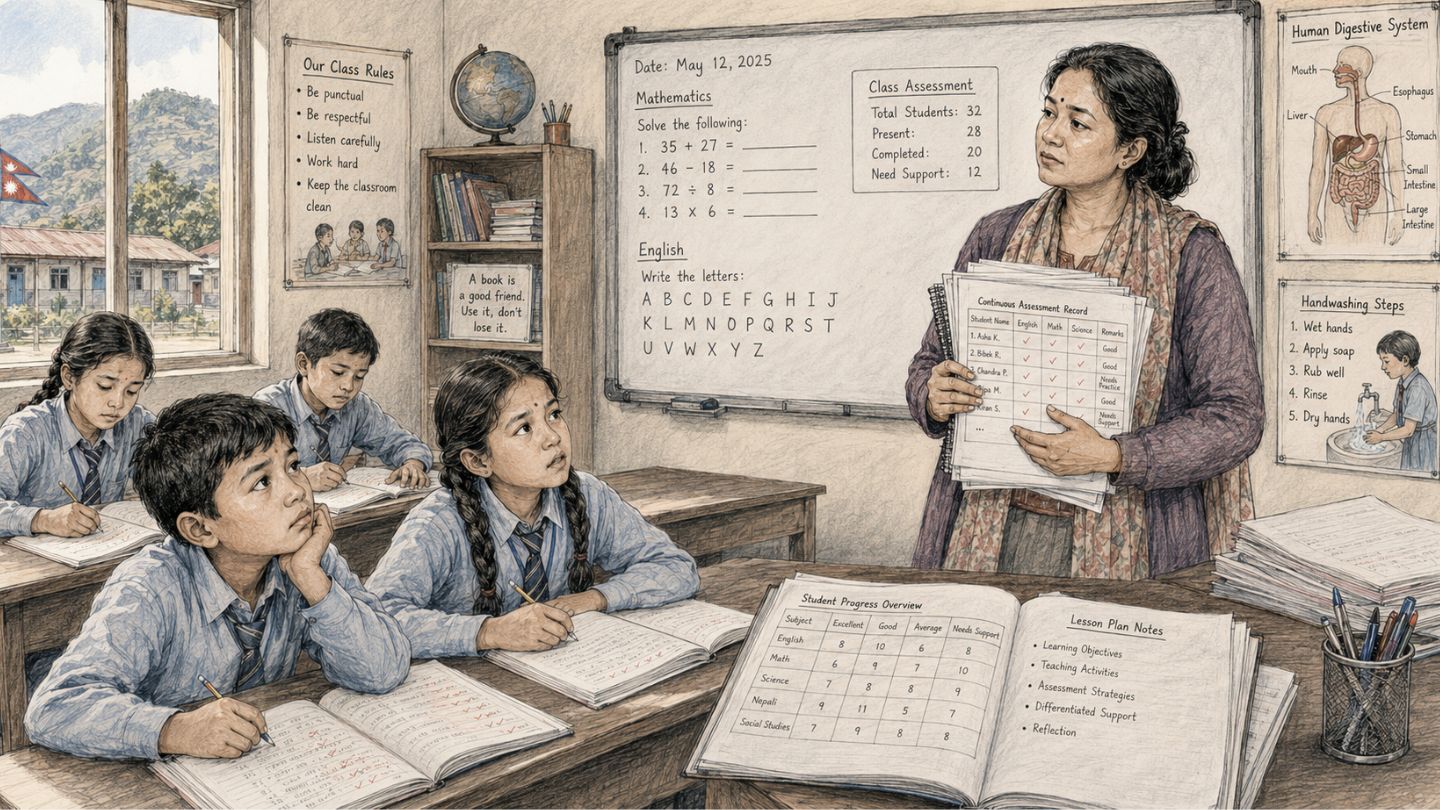
It has been emphasized that the progress and assessment of students enrolled in school should be carried out by teachers themselves. Since teachers know more about what students present in class learned or could not learn on a given day, it is considered necessary to assess student learning along with daily teaching.
However, from early childhood classes to the secondary level, the practice of recording which student learned and which student could not learn by the time they leave the classroom is weak. Continuous student assessment has remained limited to paper, and instead of identifying students’ actual ability and learning achievement, marking is often done randomly.
The main question has become what the teacher taught today rather than what the student learned today. Students observe every activity of their teachers. Therefore, it has been stated that teachers need to pay attention not only to the subject they teach, but also to their speech, habits, behavior, handwriting, drawings, presentation, and conduct.
Teacher Skill and Behavior Are Linked to Learning
A skilled and good teacher has been compared to a skilled sculptor. Just as a skilled sculptor can make an attractive statue from soft clay or stone, teachers can make students skilled and capable. However, if teachers themselves are unable to write clearly, draw pictures, or present subject matter clearly, it becomes difficult to make students capable and competent.
It has been stated that teachers must present themselves as models because students try to copy the numbers, letters, and drawings shown by teachers on the whiteboard. Since students may imitate teachers’ speech, clothing, eating habits, walking style, and conduct, teachers’ behavior is also considered part of the teaching and learning process.
Not all students develop the ability to review and assess the subject matter presented by teachers in class. A student may sit in class and return home without learning anything. Saying that students learned nothing has also been linked to the conclusion that teachers did not attempt to teach. It has been stated that teaching and learning can be considered to have taken place through a skilled and capable teacher only when all students in the class become competent, skilled, and able to obtain high marks.
Family, Parents, and Reinforcement
Family members also have a role in making students good listeners and learners. The contribution of the family is considered necessary to make children capable citizens with civility, culture, good speech, and good habits. However, the work of developing the skills needed to become civilized citizens and making them mature is also linked to teachers.
Along with classroom teaching, teachers must assess students and provide reinforcement to those who are falling behind in learning. It has been stated that the goal of teaching and learning should be for all students to achieve equal outcomes. The need has been pointed out to measure students’ learning achievement, personal conduct, and different activities, and to maintain individual records.
Such records should include extracurricular activities, continuous assessment, and learning achievement records of all students in the class. It has been stated that if all aspects are recorded, it becomes easier to measure and assess students at the time of grade promotion, and if continuous assessment is implemented in an organized way, the possibility of students falling behind in learning decreases.
Teachers Capable on Paper, Weak Understanding in Class
When the qualifications and training of teachers teaching in schools are assessed, all teachers appear capable on paper. However, classroom observation during teaching presents a situation in which around 50.5 students in the class do not properly understand the subject matter. The need has been shown to develop an assessment system based on how much students know, understand, can say, and can do along with teaching.
It has been commented that teachers have not been made competent and responsible in teaching, learning, assessment, and record-keeping. To improve quality in school education, the need has been raised to provide refresher training to teachers and make them capable and responsible for measurement and assessment along with teaching and learning.
Questions have been raised about the tendency of teachers to protect themselves by saying that students do not know, cannot learn, and cannot read or write. It has been stated that teachers should develop the skill to investigate and research why students did not learn, why they could not speak and write, and what weaknesses those students have.
Planning Is Needed Before Entering the Classroom
Before entering the classroom, teachers should prepare a plan on what they will teach today, what subject matter they will make students competent in, and what kinds of skills they will develop. However, it has been stated that such planning does not happen. Since some students do not even want to look at textbooks during classroom teaching, teachers need to find ways to attract them toward learning.
The question of who is responsible when students fail in examinations has also been raised. Teachers who do not teach well, parents who do not show concern, and students who do not attend school regularly and do not study are all connected to learning outcomes. However, a warning has been given that innocent students should not be left unable to acquire quality education and face a dark future.
Libraries, Laboratories, and Exams Also Unused
Teaching and learning have been presented as an interrelationship between students and teachers. It has been stated that teachers should try to deliver subject matter to students’ minds through various materials. Even complex subject matter can be made easier through two-way discussion between teachers and students.
Teachers should be aware of which strategy to adopt and how to teach so that students can understand the subject matter easily. Issues have been raised that although schools have libraries, library books are not used; there is a lack of readers; science labs exist but are not used; and even though three or four examinations are held in a year, achievement is not assessed.
The result of all this is linked to students’ failure. The conclusion presented is that the main reason more students fail is the inability to make teachers competent in subject teaching and assessment. To improve learning achievement in school education, teacher preparation, classroom behavior, continuous assessment, record-keeping, reinforcement, and parental concern need to move forward as one process.






Comments 0
No comments yet. Be the first to start the conversation.