



Assessment as the Basis for Learning Improvement in School Education
The Changing Meaning of Assessment
For a long time, assessment in the teaching-learning process was understood only as an examination used to measure students’ achievement. The common practice was to determine a student’s academic status on the basis of how much subject matter the student remembered, how well the student wrote answers in the question paper, and how many marks the student obtained in the examination. But the meaning of assessment is not limited to this. Assessment is also a process of understanding the state of learning, identifying weaknesses, showing the path for improvement, and revising teaching methods.
In school education, the need to view assessment in connection with the curriculum, teaching methods, and students’ learning has increased. Assessment is necessary to measure the impact of any purposeful work. In teaching and learning as well, assessment helps teachers understand what students have learned after instruction, where they faced difficulties, which topics need more practice, and how effective the teaching method was.
In this sense, assessment is not only an examination; it is a basis for improving learning. It shows not only students’ achievement but also the teacher’s teaching style, use of the curriculum, use of learning materials, and participation inside the classroom. Therefore, assessment should be taken beyond a tool for producing final results and understood as a process for continuously improving learning.
Table of Content
- Assessment as the Basis for Learning Improvement in School Education
- Types and Objectives of Assessment
- Traditional Examination-Oriented Practice
- Limits of Examination-Oriented Assessment
- Assessment as Learning
- Rubrics, Feedback, and Self-Assessment
- Students’ Role and the Teacher’s Role as Facilitator
- Need for Continuous Assessment
- Challenges Seen in Implementation
- Context of Grades 4 and 5
- Teacher Training, Curriculum Orientation, and Assessment Materials
- Conclusion
Types and Objectives of Assessment
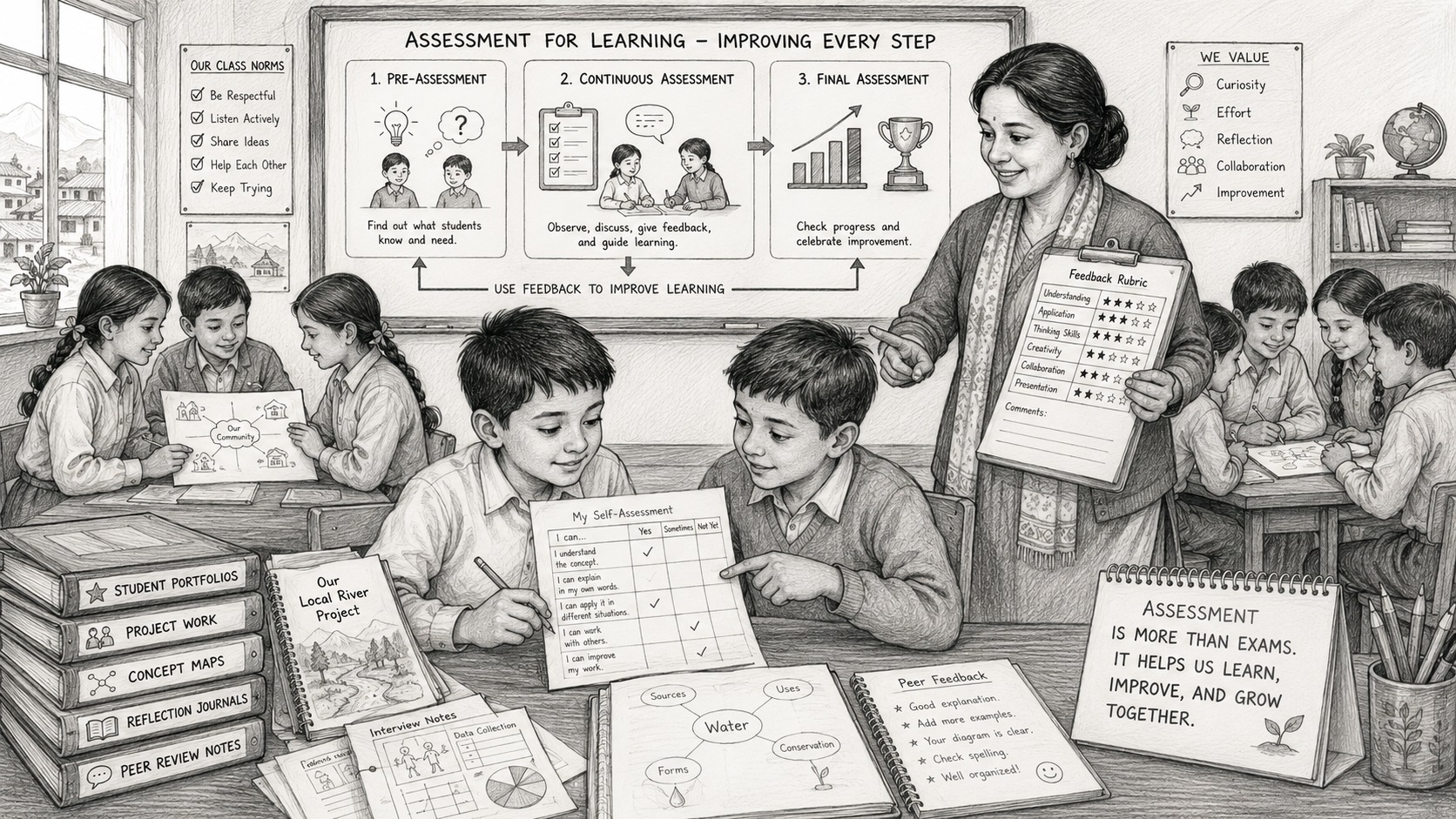
Assessment is generally classified into three forms: pre-assessment, continuous assessment, and final assessment. Although the objectives of these three types of assessment are different, their common goal is to understand students’ learning status and make necessary improvements.
Pre-assessment helps identify students’ initial level. Before starting a new lesson, it helps determine what students already know, what basic knowledge they have, and which areas need additional support. This helps teachers plan learning activities.
Continuous assessment is a process carried out while learning is taking place. It helps identify students’ progress, participation, weaknesses, interests, and learning difficulties. It also helps provide students with immediate feedback and opportunities for improvement.
Final assessment is a means of measuring the achievement students have gained after a certain period of study. It can show students’ overall results, but it offers limited opportunity for improvement during the learning process itself. Therefore, relying only on final assessment can make it difficult to fully understand students’ actual learning status.
The purpose of assessment is not only to give marks to students or decide whether they should be promoted to the next grade. It helps teachers receive feedback, increase students’ motivation, correct learning weaknesses, and prepare curriculum and teaching practices that match learners’ psychology. Assessment is also useful for identifying the success, failure, strengths, and weaknesses of a program or project.
Traditional Examination-Oriented Practice
In the traditional teacher-centered teaching method, assessment was mostly linked with examinations. Teaching by the teacher, listening by the students, memorizing subject matter, and writing answers in examinations were treated as the main basis of learning. The practice of measuring students’ achievement on the basis of marks obtained in annual, half-yearly, and quarterly examinations has been used for a long time.
In this system, a fixed question paper is prepared. Students write answers within the given time. Then the answer sheets are checked, marks are given, and students are declared successful or unsuccessful on the basis of those marks. Decisions on promotion or non-promotion to the next grade are also usually based on the same result.
Such a practice is judgment-oriented in nature. It can show whether students achieved the expected learning outcomes, but it is not sufficient to enter into the learning process and understand students’ real status. Examination results do not always provide clear feedback on where students made mistakes, why they made them, and how they can improve.
Examination-oriented assessment also places teachers in a limited role. The teacher’s work may be confined to preparing question papers, conducting examinations, and giving marks. But to improve teaching and learning, teachers also need to observe students’ continuous progress, classroom participation, practice, interests, and learning problems.
Limits of Examination-Oriented Assessment
Examination is one means of assessment, but many limitations appear when assessment is limited only to examinations. The biggest limitation is that students do not receive feedback during the learning process itself. Students know the result only after taking the examination. By that time, the immediate opportunity to improve learning may become weak.
Another weakness of examination-oriented assessment is that students may obtain good results simply by writing memorized or rote-learned content. Students may write answers according to the question paper, but that does not provide a complete picture of deep understanding, practical application, life skills, and creative ability.
Students’ immediate circumstances and psychology are also not sufficiently included in an examination-oriented system. A student may have participated well in regular classes, but the student’s condition may be different on the day of the examination. Similarly, some students may perform well in oral expression, project work, or group learning, but the same ability may not appear in a written examination.
Therefore, treating examination marks as the final basis of a student’s entire achievement requires caution. Examinations can be useful, but if they are not connected with the continuous process of learning improvement, students’ holistic development cannot be reflected.
Assessment as Learning
In modern teaching methods, assessment has begun to be understood as a process connected with learning itself. From this perspective, assessment is not only a separate task carried out by a third party; it is a tool for making students’ learning systematic, intensive, and improvement-oriented.
When assessment is conducted as learning, students become active participants in the learning process. They do not only receive the lesson given by the teacher; they also learn to think about their own learning. Gradually, students begin to understand what they have learned, what they have not understood, which areas need improvement, and how to move forward.
In this method, students’ achievement is not measured only by a one-time examination. Learning activities, classroom participation, presentations, discussions, writing, project work, concept maps, peer interaction, and portfolio development can also become bases for assessment.
The main objective of assessment as learning is not merely to classify students. Its objective is to strengthen students’ learning. When students receive feedback while they are still learning, they can correct their weaknesses quickly. This helps change the situation in which students know the result only after the examination is over.
Rubrics, Feedback, and Self-Assessment
Clear criteria are necessary to make learning-based assessment effective. For this, rubrics or predetermined assessment bases are considered useful. If teachers clarify the assessment criteria before students begin any task, presentation, writing, project, or other activity, students can understand what is expected of them.
Rubrics provide clarity to both teachers and students in assessment. Students know the basis on which their work will be reviewed. Teachers can also assess students’ achievement on fixed criteria instead of giving marks only in a subjective manner.
Feedback is another important part of this process. Feedback is not only about pointing out mistakes. It should show students the path for improvement. Students should be able to understand from feedback what they did well, where they had shortcomings, and how they can improve next.
Self-assessment makes students responsible for their own learning. After teachers provide predetermined criteria, students can assess their own achievement during or at the end of an activity. This brings students out of the situation of only waiting for the teacher’s assessment.
Peer learning and peer assessment can also be connected with this process. Students get opportunities to learn from their friends’ work, give responses, and receive responses. This increases classroom interaction and helps develop learning as a shared process.
Students’ Role and the Teacher’s Role as Facilitator
In continuous and learning-based assessment, students’ role is not passive. Students should not only answer questions; they should also participate in the learning process, review their own work, identify weaknesses, learn from peers, and improve on the basis of feedback.
When students get the opportunity to assess their own level while learning, they can quickly understand their strengths and weaknesses. This makes them more responsible for learning. Instead of waiting only for examinations, participating in regular practice, discussion, and improvement is useful for students.
At the same time, the teacher’s role also changes. Teachers are not only examiners. They are facilitators of learning. Teachers are responsible for helping students understand the basis of assessment, conducting suitable activities, providing feedback, identifying weaknesses, and creating an environment for improvement.
It is not enough for teachers to make decisions only by looking at students’ answers. Students’ participation, effort, improvement, interaction, and learning process should also be considered. This creates a basis for making assessment student-centered.
Need for Continuous Assessment
Continuous assessment can be useful in keeping children free from the fear of examinations while motivating them toward teaching-learning activities. When students depend only on examinations, pressure for marks may increase. But assessment that takes place alongside learning can guide students toward regular practice and improvement.
Continuous assessment provides an opportunity to observe students’ progress gradually. Teachers can know what students have or have not understood while the class is still running. On that basis, they get the opportunity to explain again, provide additional practice, or change learning activities.
It also makes students aware of their own learning. Students do not feel that they are being assessed only through a one-time examination. An understanding can develop that their regular work, participation, and improvement are also important.
Continuous assessment can also give space to learning connected with practical and life skills. Activities such as discussion, presentation, project work, concept maps, and portfolios help lead students from memorizing subject matter toward understanding and applying it.
Challenges Seen in Implementation
Although the concept of continuous assessment is useful, its implementation is challenging. If the program is implemented without preparing objective assessment bases, it becomes difficult to bring its real essence into practice. If assessment is understood only as the work of giving marks, continuous assessment can also be limited to a formality.
The tendency to understand internal or practical marks only as numbers given by teachers has appeared as a challenge. The purpose of internal assessment is to observe students’ regular learning, participation, performance, and improvement process. But if it is used without clear criteria, students’ real achievement may not be reflected.
The risk of a mindset that “everyone passes in the examination” becoming dominant is also one of the challenges mentioned in the source. Continuous assessment does not mean declaring students successful without any basis. It means supporting students within the learning process and giving them opportunities for improvement.
Such a system cannot be effective without adequate teacher preparation. If teachers do not properly understand assessment methods, materials, recordkeeping, feedback, and the use of rubrics, continuous assessment may be limited to a paper process.
Context of Grades 4 and 5
The source mentions the context in which instructions have been given to assess students’ achievement through continuous assessment without conducting examinations in Grades 4 and 5, and assessment materials have been prepared accordingly. This indicates an attempt to move assessment in school education away from examination-oriented practice and toward learning improvement.
From the lower grades, the question of whether to keep students under examination-centered pressure or make them active in learning activities is important. Continuous assessment can connect students with daily learning, practice, and improvement rather than the fear of a one-time examination.
However, preparation is necessary to make the system of continuous assessment without examinations effective in Grades 4 and 5. It must be clear how students’ achievement will be recorded, which activities will be used as the basis for assessment, how teachers will maintain records, and how feedback will be provided.
Preparing assessment materials alone is not enough. Those materials must be used properly in the classroom. Teachers, students, and school management all need to understand the meaning and process of continuous assessment.
Teacher Training, Curriculum Orientation, and Assessment Materials
Teacher training is a major basis for making continuous assessment successful. Teachers must understand assessment not only as an examination but as a process for improving learning. For this, clarity is needed on types of assessment, rubrics, feedback, self-assessment, peer learning, portfolios, and the use of project work.
Curriculum orientation is equally necessary. If teachers do not properly understand the objectives of the curriculum, expected learning outcomes, and the bases of assessment, students’ learning cannot be assessed correctly. Assessment can become improvement-oriented only when a relationship is maintained among the curriculum, teaching methods, and assessment.
The proper use of assessment materials is another important aspect. Assessment does not become effective merely by preparing materials. Those materials should be used in a way that matches students’ level, subject matter, classroom activities, and expected achievements.
Assessment conducted without objective bases can weaken credibility. Therefore, assessment should be connected with clear criteria, regular records, feedback, and the improvement process. Orientation and training for teachers, a clear understanding of the curriculum, and the practical use of assessment materials are basic requirements for continuous assessment.
Conclusion
The real meaning of assessment is not limited only to giving marks to students or separating them into successful and unsuccessful groups. Assessment should help understand students’ learning status, provide feedback to teachers, improve the curriculum and teaching methods, and make learning effective.
Examination is one means of assessment, but examination alone is not the whole of assessment. Students’ learning, participation, effort, improvement, practical skills, and psychological condition should also be considered in assessment. For this, practices such as continuous assessment, rubrics, self-assessment, peer learning, portfolios, and project work can be useful.
To make continuous assessment effective, teacher training, curriculum orientation, proper use of assessment materials, and objective bases are necessary. It is also necessary to move away from the thinking that internal or practical marks are only numbers given by teachers.
Long-term efforts are needed to make not only Grades 1–5 but overall school education accustomed to student-centered and continuous assessment. If assessment can be moved beyond formal examinations or distribution of marks and made into a tool for improving learning, the purpose of school education can become clearer, more practical, and more student-friendly.






Comments 0
No comments yet. Be the first to start the conversation.