



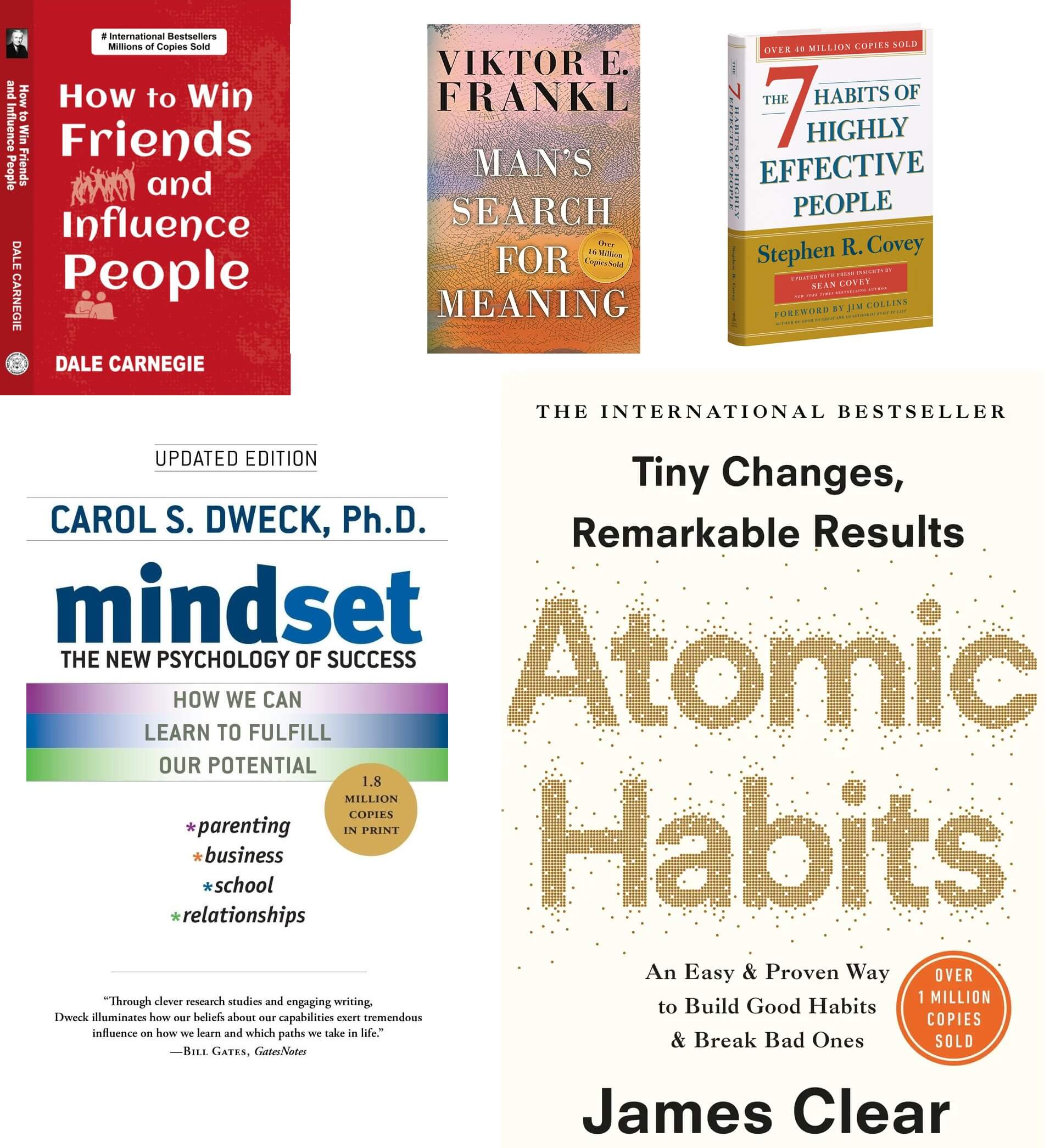
Influential Self-Help Books to Read
Self-help books can give readers useful language for habits, communication, purpose, learning, and personal responsibility. They are less useful when readers treat them as universal formulas or substitutes for professional support.
This guide uses “influential” rather than “best” because influence can be discussed more responsibly. A book may be widely read, culturally visible, or helpful for reflection, but that does not prove every claim in it or make it suitable for every reader.
Table of Content
- Influential Self-Help Books to Read
- How These Books Were Selected
- Quick Comparison: Which Book Fits Which Need?
- 1. How to Win Friends and Influence People
- 2. Man’s Search for Meaning
- 3. The 7 Habits of Highly Effective People
- 4. Mindset
- 5. Atomic Habits
- Do Self-Help Books Work?
- How to Read Self-Help Books Critically
- Which Book Should You Read First?
- Final Thoughts
- Reference
Summary
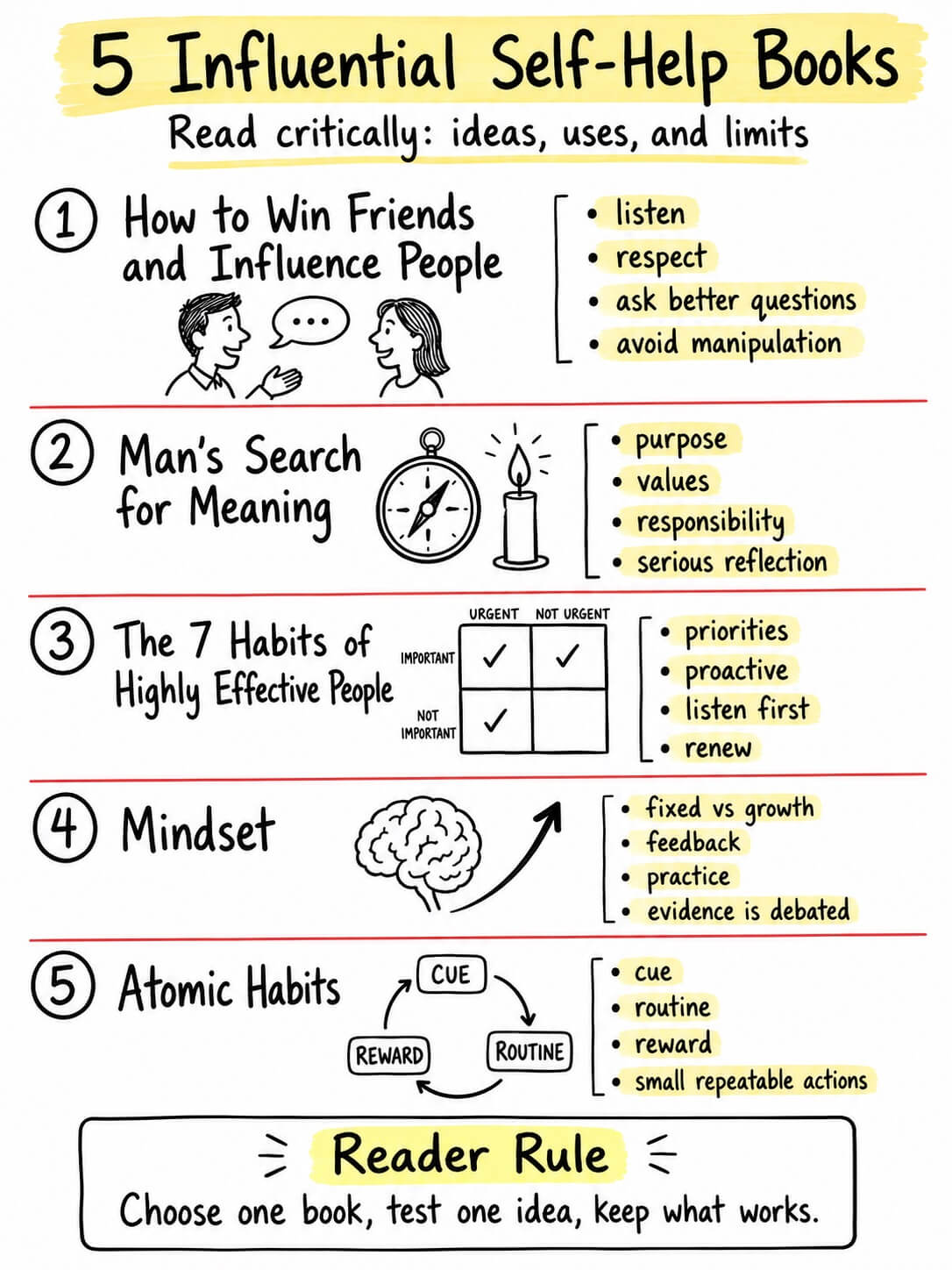
Influential self-help books worth reading critically are How to Win Friends and Influence People, Man’s Search for Meaning, The 7 Habits of Highly Effective People, Mindset, and Atomic Habits. Each book gives readers a framework for communication, meaning, priorities, learning beliefs, or habit design. None should be treated as a complete answer to life, study, work, or mental-health concerns.
Key Takeaways
-
Influence is not the same as evidence.
-
A self-help book works best when matched to a specific need.
-
Older classics can help, but some examples may feel dated.
-
Habit and mindset advice should be applied carefully.
-
Guided self-help differs from unsupported reading.
-
Readers should test advice in low-risk, realistic ways.
How These Books Were Selected
These books were selected because each represents a major self-help theme and remains visible in public discussion, publishing, education, or personal development. The list is editorial, not a scientific ranking.
| Standard | What it means |
|---|---|
| Clear central idea | The book has a message readers can understand and evaluate. |
| Ongoing visibility | The book remains discussed, cited, assigned, or recommended in reader and educational contexts. |
| Practical use | Readers can apply part of the advice without special tools. |
| Explainable limits | The book’s weak points can be identified honestly. |
The goal is not to tell every reader to read all five. The goal is to help readers choose the book that fits their current question.
Quick Comparison: Which Book Fits Which Need?
| Reader need | Book to consider | Main value | Main caution |
|---|---|---|---|
| Better communication | How to Win Friends and Influence People | Listening, tact, and social awareness | Can feel dated; must be read ethically |
| Purpose during hardship | Man’s Search for Meaning | Meaning, responsibility, and reflection | Emotionally serious; not a productivity manual |
| Personal priorities | The 7 Habits of Highly Effective People | Planning, values, and relationship habits | Broad framework; needs follow-through |
| Learning after setbacks | Mindset | Beliefs about learning and ability | Research effects are debated |
| Building routines | Atomic Habits | Small behavior changes and habit cues | Habit change depends on context |
1. How to Win Friends and Influence People
How to Win Friends and Influence People is useful for readers who want to communicate with more care and awareness. Simon & Schuster identifies Dale Carnegie’s book as a long-running self-help title and notes that a newer edition restored material from the original 1936 text.
Core Idea
The book argues that relationships improve when people show sincere interest, listen carefully, and avoid turning every disagreement into a contest. For students, this can apply to group work, interviews, class discussions, and leadership roles. For working readers, it can apply to meetings, feedback, and conflict management.
How to Use It
Choose one communication habit at a time. A reader may focus on asking better questions for one week, then giving feedback more carefully the next week.
The aim should be respect, not manipulation. The title includes the word “influence,” but influence without honesty can damage trust.
Limits
Some examples and social assumptions may feel dated. Readers should keep the useful principles and question advice that feels overly strategic or insincere.
This book is strongest as a communication guide. It is weaker as a guide to emotional health, ethics, or major life decisions.
2. Man’s Search for Meaning
Man’s Search for Meaning is useful for readers thinking about purpose, hardship, and responsibility. Beacon Press describes the book as a work about finding purpose and strength in despair and lists Viktor E. Frankl as the author.
Core Idea
The central idea is that meaning matters deeply in human life. Frankl’s work asks readers to consider what values, responsibilities, or commitments can guide them when life is difficult.
For students and young readers, the book may help shift attention from comparison to purpose. For adults facing uncertainty, it can support reflection on what remains within one’s control.
How to Use It
This book is best read slowly. A useful method is to keep a short reading journal with three questions:
-
What value does this chapter point to?
-
What choice is still within my control?
-
What responsibility am I avoiding or ready to accept?
These questions keep the reading grounded rather than abstract.
Limits
The book deals with serious human suffering. It should not be used to dismiss pain, pressure, grief, or mental-health needs. Readers facing serious distress should seek support from trusted adults, counselors, or qualified professionals.
This is a meaning-centered book, not a time-management system.
3. The 7 Habits of Highly Effective People
The 7 Habits of Highly Effective People is useful for readers who want a broad framework for priorities, responsibility, relationships, and renewal. Simon & Schuster describes Stephen R. Covey’s book as a principle-centered approach to personal and professional problems.
Core Idea
The book organizes personal effectiveness around seven habits, including being proactive, beginning with the end in mind, putting first things first, listening before seeking to be understood, and renewing one’s capacity.
For students, the book can support planning, study priorities, and leadership. For working readers, it can help clarify roles, goals, and communication habits.
How to Use It
A useful exercise is a weekly priority review. Write down:
-
What matters most this week?
-
What is urgent but not important?
-
What can I control?
-
What needs cooperation with others?
This turns the book’s broad principles into practical reflection.
Limits
The book is wide-ranging, which can make it feel abstract. Readers may benefit from choosing one habit and testing it for several weeks rather than trying to apply the whole framework at once.
Some language may feel more suited to workplace or leadership settings than to school life. Students can still adapt the ideas, but they may need concrete examples from their own routines.
4. Mindset
Mindset is useful for readers who want to understand how beliefs about ability can affect learning behavior. Penguin Random House lists Carol S. Dweck’s Mindset as a book about how beliefs regarding ability and talent shape learning and achievement.
Core Idea
The book contrasts fixed mindset and growth mindset. A fixed mindset treats ability as stable. A growth mindset treats ability as something that can develop through effort, strategy, feedback, and practice.
For students, this can be helpful after a poor grade. Instead of saying, “I am bad at this subject,” a student can ask, “Which skill is weak, and what kind of practice or feedback do I need?”
How to Use It
Use the book as a reflection tool, not as a slogan. Replace labels with learning questions:
-
What did I misunderstand?
-
What strategy did I use?
-
What feedback can I get?
-
What should I try next?
This is especially useful in subjects that require practice over time, such as mathematics, writing, languages, or technical skills.
Limits
The research around growth mindset needs careful handling. Sisk and colleagues found weak overall effects in meta-analyses, while Macnamara and Burgoyne later argued that reported intervention effects may be affected by study design, reporting flaws, and bias.
The practical lesson is narrow: beliefs about learning matter, but they are not the only factor. Teaching quality, time, health, sleep, support, curriculum, and feedback also affect outcomes.
5. Atomic Habits
Atomic Habits is useful for readers who want practical ways to build routines. Penguin Random House identifies James Clear as the author and frames the book around forming good habits, breaking unwanted habits, and small behavior changes.
Core Idea
The book argues that small behaviors, repeated in supportive environments, can shape larger patterns. It focuses on cues, routines, identity, and making desired behaviors easier to start.
For students, this can mean reviewing notes after class, keeping study materials visible, or starting homework with a small first action. For working readers, it can mean setting a consistent planning cue or reducing friction around a useful routine.
How to Use It
Start with one small habit connected to an existing routine. Examples:
-
After breakfast, review five vocabulary words.
-
After class, organize notes for ten minutes.
-
After opening a laptop, write the first task on paper.
-
After dinner, prepare materials for the next morning.
The habit should be small enough to repeat on ordinary days.
Limits
Habit formation is not instant. Lally and colleagues studied daily habit formation and found that automaticity develops through repetition, with variation across people and behaviors. Gardner, Lally, and Wardle describe habit formation as repetition in a consistent context until behavior becomes more automatic.
Readers should avoid blaming themselves when habits are hard to build. Schedules, stress, family duties, health, environment, and access to resources can all affect consistency.
Do Self-Help Books Work?
Self-help books can help when they give readers useful concepts, reflection prompts, or small actions to test. They are less reliable when they make broad claims without evidence or when readers expect one book to solve complex problems.
WHO defines self-care as the ability of individuals, families, and communities to promote health, prevent disease, maintain health, and cope with illness with or without support from a health or care worker. This broad definition helps explain why personal habits matter, but it does not mean every self-help book is a health intervention.
For mental health, the distinction matters. NICE’s depression guideline covers treatment and management for adults and includes treatment options for less severe depression, while NHS describes guided self-help as going through a workbook or online course with help from a therapist. That is different from reading a general self-help book alone.
How to Read Self-Help Books Critically
A self-help book should improve your judgment, not replace it. The safest approach is to test ideas carefully and avoid treating any author as a complete authority.
Ask What Kind of Claim Is Being Made
Some claims are personal observations. Some are moral arguments. Some are based on research. Some are marketing language. These should not be treated equally.
A claim about study habits needs less evidence than a claim about mental health or academic achievement. The more serious the outcome, the stronger the evidence should be.
Test Advice in Low-Risk Ways
Try advice in small, reversible ways. A student can test a study routine for two weeks. A reader can practice listening more carefully in group work. A worker can try a weekly planning review.
Avoid making major health, legal, financial, or education decisions based on one book.
Watch for Overpromising
Be cautious when a book or article suggests that success depends only on attitude, discipline, or mindset. Real outcomes are shaped by personal effort and external conditions.
Good self-help writing should leave room for complexity.
Which Book Should You Read First?
The right starting point depends on your current need.
If you struggle with routines, start with Atomic Habits. If you struggle with communication, start with How to Win Friends and Influence People. If you feel uncertain about direction or purpose, consider Man’s Search for Meaning. If you need a broader planning framework, choose The 7 Habits of Highly Effective People. If academic setbacks discourage you, Mindset may help when paired with better strategies and feedback.
A simple rule is to choose the book that matches one current problem. Read it with notes. Apply one idea. Review whether it helped.
Final Thoughts
Self-help books are most useful when readers approach them with curiosity and caution. The five books in this guide are influential because they give readers memorable frameworks for communication, meaning, priorities, learning, and habits.
They are not equal in tone, evidence, or purpose. Read them as tools, not instructions for life. Keep what improves your thinking, question what sounds too broad, and seek qualified support when a problem is beyond what a book can address.
Reference
- World Health Organization. “Self-care for health and well-being.” 2024.
- National Institute for Health and Care Excellence. “Depression in adults: treatment and management.” NG222, published 2022; last reviewed 2026.
- NHS. “Talking therapies.” Guided self-help description.
- Simon & Schuster. “How to Win Friends and Influence People.”
- Beacon Press. “Man’s Search for Meaning” teacher guide.
- Simon & Schuster. “The 7 Habits of Highly Effective People.”
- Penguin Random House. “Mindset by Carol S. Dweck.”
- Penguin Random House. “Atomic Habits” / James Clear official listing context.
- Sisk, V. F., Burgoyne, A. P., Sun, J., Butler, J. L., and Macnamara, B. N. “To What Extent and Under Which Circumstances Are Growth Mind-Sets Important to Academic Achievement?” 2018.
- Macnamara, B. N., and Burgoyne, A. P. “Do Growth Mindset Interventions Impact Students’ Academic Achievement?” 2023.
- Lally, P., van Jaarsveld, C. H. M., Potts, H. W. W., and Wardle, J. “How are habits formed: Modelling habit formation in the real world.” 2010.
- Gardner, B., Lally, P., and Wardle, J. “Making health habitual: the psychology of habit-formation and general practice.” 2012.




Comments 0
No comments yet. Be the first to start the conversation.