



The Industrial Revolution and the Digital Revolution are often compared because both changed how people create value, organize work, communicate, and compete. The comparison matters for students, teachers, workers, and general readers because it shows how major technology shifts affect not only machines, but also skills, institutions, inequality, and daily life.
The Industrial Revolution mechanized physical production. It moved many economies from farming, hand production, and small workshops toward machines, factories, steam power, coal, iron, railways, and industrial cities.
The Digital Revolution digitized information. It moved societies from analog and paper-based systems toward digital electronics, computers, software, data, networks, mobile devices, cloud services, and automation.
Answer Summary:
The Industrial Revolution changed the production of physical goods through machines, factories, and new energy systems. The Digital Revolution changed the production, storage, movement, and use of information through computers, networks, software, and data. Both reshaped work, communication, infrastructure, and opportunity, but neither affected all people or regions equally.
Table of Content
- Quick Answer: What Is the Main Difference?
- Industrial Revolution vs Digital Revolution: Fast Comparison Table
- What Was the Industrial Revolution?
- What Is the Digital Revolution?
- Similarities Between the Two Revolutions
- Key Differences Between the Industrial and Digital Revolutions
- Timeline: From Steam Power to Digital Networks
- Is the Digital Revolution the Same as the Fourth Industrial Revolution?
- Impact on Jobs and Skills
- Which Revolution Had a Bigger Impact?
- Common Misconceptions
- Practical Implications for Readers
- Conclusion
Key Takeaways:
-
The Industrial Revolution mechanized physical production.
-
The Digital Revolution digitized information, communication, and automation.
-
Both changed work, skills, infrastructure, inequality, and daily life.
-
Neither revolution happened everywhere at the same time.
-
Digital access is still unequal despite wider global connectivity.
-
The Digital Revolution and Fourth Industrial Revolution are related, but not the same.
-
A fair comparison needs criteria, not a simple “better” or “bigger” verdict.
Quick Answer: What Is the Main Difference?
The main difference between the Industrial Revolution and the Digital Revolution is the type of production each changed.
The Industrial Revolution changed physical production. It used machines, factories, steam power, coal, iron, and transport systems to produce goods at larger scale. The Digital Revolution changed information processing. It used electronics, computers, software, networks, and data to store, copy, transmit, calculate, and automate information.
A simple comparison is this: the Industrial Revolution made production mechanical and factory-based; the Digital Revolution made information digital, networked, and programmable.
Both revolutions created new opportunities and new risks. Both raised productivity in some areas, disrupted older ways of working, and rewarded people and regions with access to infrastructure, capital, education, and skills. Both also created problems that technology alone could not solve.
Industrial Revolution vs Digital Revolution: Fast Comparison Table
| Aspect | Industrial Revolution | Digital Revolution |
|---|---|---|
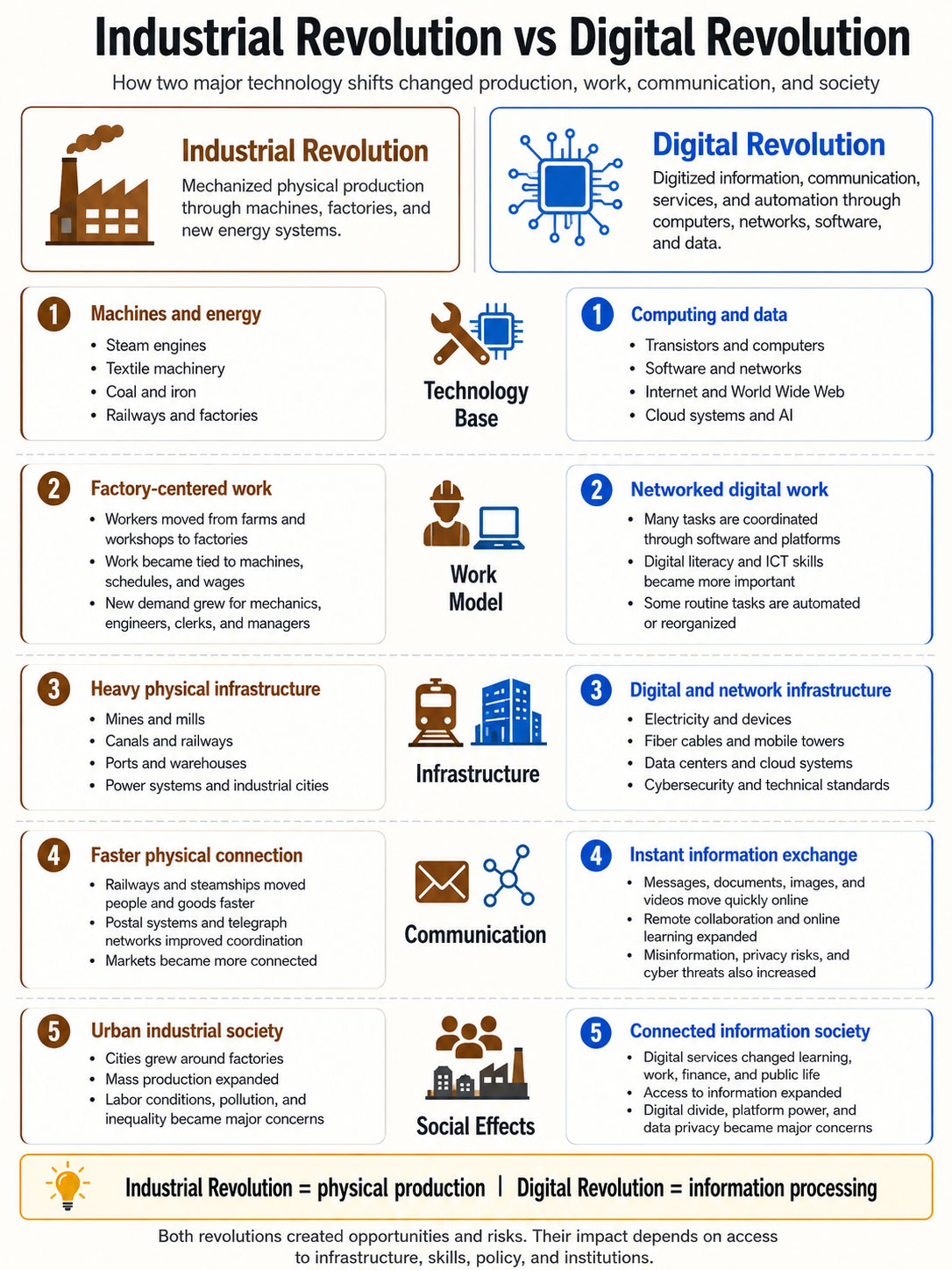
| Core change | Mechanization of physical production | Digitization of information, communication, and automation |
| Main technologies | Steam engines, textile machinery, coal, iron, factories, railways | Transistors, computers, software, internet, World Wide Web, mobile devices, data systems |
| Main workplace shift | From farms, homes, and workshops to factories and industrial cities | From paper, analog systems, and local offices to digital platforms and networked work |
| Main infrastructure | Mines, mills, canals, railways, ports, warehouses, power systems | Electricity, chips, devices, broadband, data centers, cloud systems, cybersecurity |
| Speed of spread | Slow and uneven, over decades and centuries | Faster global diffusion, but still unequal |
| Main opportunities | Mass production, transport growth, new industries, urban employment | Faster communication, online services, digital learning, automation, data-based coordination |
| Main risks | Difficult labor conditions, pollution, urban crowding, unequal gains | Digital divide, cyber risks, privacy concerns, misinformation, uneven skill access |
What Was the Industrial Revolution?
The Industrial Revolution was a long shift from mainly agrarian and hand-production economies toward mechanized manufacturing, factory systems, industrial energy use, and urban labor.
It began first in Britain and later spread to Europe, North America, and other regions at different speeds. The British Industrial Revolution is commonly dated around 1760–1840, though exact dates vary by historian and region. World History Encyclopedia describes the British Industrial Revolution as a period of mechanization and deep social change involving steam-powered machines, factories, and growing urban centers.
This was not a single invention or a single event. Textile machinery, coal mining, improved iron production, steam power, canals, railways, finance, and factory organization worked together. Machines made it possible to produce more goods. Factories brought labor, equipment, capital, supervision, and schedules into one production system.
The Industrial Revolution changed more than industry. It changed where people lived, how families earned income, how cities grew, and how governments later responded to labor, housing, health, and infrastructure problems. Its effects included new industries, wider availability of manufactured goods, better transport networks, difficult working conditions, child labor in some industries, urban crowding, and unequal gains.
For readers comparing the two revolutions, the key point is that industrialization reorganized the material economy. It changed how societies produced, moved, and consumed physical goods.
What Is the Digital Revolution?
The Digital Revolution is the shift from analog, mechanical, and paper-based systems to digital electronics, computing, software, networks, and data-based systems.
It is closely linked with the Information Age and is often described as the Third Industrial Revolution. Its foundations include digital electronics, the transistor, computers, computer networks, software, the internet, the World Wide Web, mobile devices, cloud systems, and data-based automation.
One major milestone was the transistor. The Nobel Prize in Physics 1956 was awarded to William B. Shockley, John Bardeen, and Walter H. Brattain for research on semiconductors and the discovery of the transistor effect. Transistors made smaller, more reliable electronic circuits possible, which helped support modern computing and communication systems.
Another major milestone was the World Wide Web. CERN states that Tim Berners-Lee invented the Web in 1989 while working at CERN. The Web made internet-based information easier for ordinary users to access through linked pages and browsers.
The Digital Revolution did not remove the physical economy. Food, housing, energy, factories, transport, and logistics still matter. What changed is that more physical and service activities now depend on digital coordination. Shops use digital payments. Factories use sensors and software. Students use online learning platforms. Banks process transactions digitally. Governments deliver some services through digital portals.
Similarities Between the Two Revolutions
The Industrial Revolution and the Digital Revolution are similar because both changed the basic tools societies use to produce value.
In the Industrial Revolution, machines and external power changed physical work. In the Digital Revolution, computing and networks changed information work. In both cases, the technology mattered because a wider system formed around it.
A steam engine was useful because mines, factories, fuel supply, transport routes, investors, and workers could use it. A computer network is useful because devices, electricity, software, standards, data centers, cybersecurity, and users make it function.
Both revolutions also changed skills. Industrialization increased demand for factory workers, engineers, mechanics, transport workers, clerks, managers, and urban services. Digitalization increases demand for digital literacy, ICT specialists, software-related skills, cybersecurity awareness, data handling, and the ability to work with digital tools. The OECD Digital Economy Outlook 2024 discusses how digital change affects skill demand and highlights the importance of foundational, ICT, and complementary skills.
Both revolutions also created uneven benefits. Industrialization rewarded people and regions with access to capital, energy, transport, markets, and technical knowledge. Digitalization rewards people and regions with electricity, connectivity, devices, digital skills, secure institutions, and language access.
Technology does not distribute benefits equally by itself. Infrastructure, education, policy, bargaining power, and access shape who benefits and who is left behind.
Key Differences Between the Industrial and Digital Revolutions
1. Physical Production vs Information Processing
The Industrial Revolution centered on physical production. It changed textiles, iron, mining, transport, machinery, and manufacturing. Its main question was how to produce more physical goods using machines, energy, and organized labor.
The Digital Revolution centers on information processing. It changes how information is stored, copied, searched, transmitted, analyzed, and automated. It affects factories, but it also affects banking, education, media, healthcare administration, entertainment, logistics, public services, and everyday communication.
This distinction matters because digital change is often less visible. A railway or factory is easy to see. A database, algorithm, cloud service, or payment system may shape daily life without appearing as a physical object to the user.
2. Factory-Centered Work vs Networked Work
Industrialization concentrated many workers in factories and industrial cities. Work became tied to machines, schedules, supervisors, wages, and urban housing. The factory became a central symbol of industrial society.
Digitalization allows more tasks to be coordinated through networks. Some jobs still require physical presence, but many activities now depend on software, databases, messaging systems, online platforms, and remote coordination tools.
This does not mean everyone can work remotely. It means coordination itself has become more digital. A teacher may use a learning platform. A nurse may use digital records. A delivery worker may depend on route software. A manufacturer may track inventory through connected systems.
3. Heavy Infrastructure vs Digital Infrastructure
Industrialization required visible infrastructure: mines, canals, railways, ports, mills, warehouses, and power systems.
Digitalization also depends on physical infrastructure, but much of it is less visible to ordinary users. It needs electricity, semiconductor supply chains, devices, fiber-optic cables, mobile towers, satellites, data centers, cloud systems, technical standards, and cybersecurity.
The Digital Revolution is not weightless. Phones, computers, batteries, servers, and network equipment must be produced. Data centers need power and cooling. Broadband depends on regulation, investment, maintenance, affordability, and technical capacity.
4. Different Speeds of Global Spread
The Industrial Revolution spread over decades and centuries. Its early effects were concentrated in Britain and later in other industrializing regions. Many parts of the world industrialized later, unevenly, or under global trade and colonial systems shaped by unequal power.
The Digital Revolution has spread faster because software, standards, mobile devices, and online services can cross borders more quickly than railways or factories. Still, digital access is not universal. The International Telecommunication Union reported that in 2025, about 74 percent of the world’s population was online, equal to about 6 billion people, while more than a quarter of the global population remained offline.
This is one of the clearest parallels between the two revolutions. Access to infrastructure shapes who benefits first.
5. Different Communication Effects
The Industrial Revolution improved communication and transport through railways, steamships, postal systems, telegraph networks, and faster movement of goods and people. It made markets and states more connected.
The Digital Revolution changed the speed, cost, and volume of communication. Messages, documents, images, videos, software updates, money transfers, and public information can move across borders quickly. This supports online learning, remote collaboration, digital journalism, public-service delivery, and global coordination.
It also creates risks. Misinformation can spread quickly. Private data can be exposed. Cyberattacks can disrupt organizations. Digital platforms can concentrate attention, data, and market power. These risks show why digital governance, privacy, media literacy, and security matter.
Timeline: From Steam Power to Digital Networks
The two revolutions are easier to understand when placed in a broader technology timeline.
| Period | Common label | Main change |
|---|---|---|
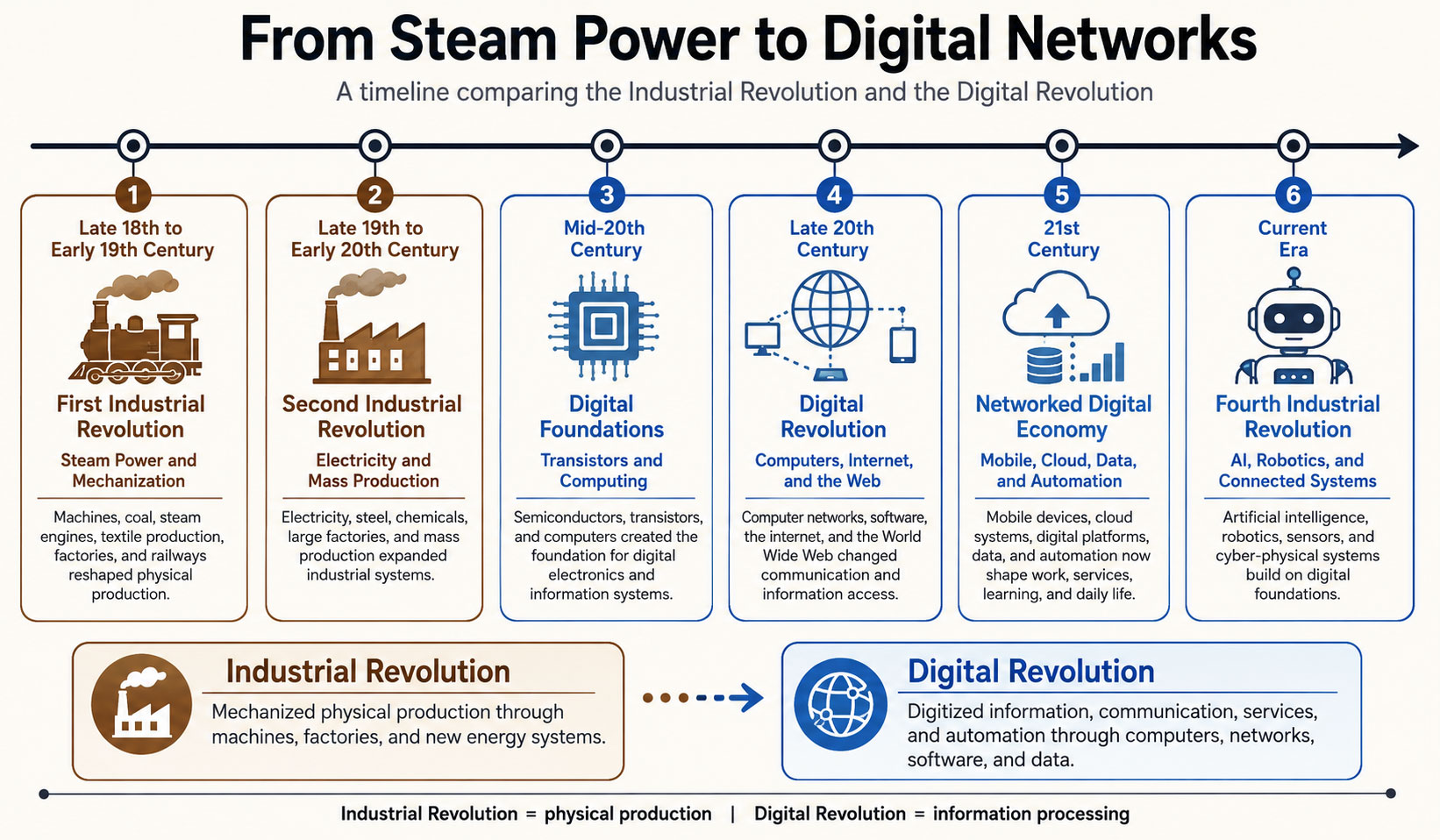
| Late 18th to early 19th century | First Industrial Revolution | Mechanization, steam power, factories, coal, textiles, iron |
| Late 19th to early 20th century | Second Industrial Revolution | Electricity, steel, chemicals, mass production, large-scale industry |
| Mid-20th century onward | Digital or Third Industrial Revolution | Electronics, computers, software, internet, digital communication |
| Late 20th and 21st century | Fourth Industrial Revolution | AI, robotics, connected sensors, cyber-physical systems, advanced automation |
These labels are useful, but they should not be treated as exact global timelines. Different countries experienced these changes at different times and in different ways.
The Digital Revolution is better understood through milestones than through a single starting year. The transistor, digital computers, computer networking, personal computers, the internet, the World Wide Web, mobile devices, and cloud services all contributed to the broader shift.
Is the Digital Revolution the Same as the Fourth Industrial Revolution?
The Digital Revolution and the Fourth Industrial Revolution are related, but they are not the same.
The Digital Revolution is usually associated with digital electronics, computers, software, networks, and information systems. It created the foundations for digital communication, online services, databases, and programmable tools.
The Fourth Industrial Revolution refers to a newer phase that builds on digital systems. It is often used for technologies such as artificial intelligence, robotics, connected sensors, biotechnology, autonomous systems, and cyber-physical integration.
A simple distinction helps: a personal computer, spreadsheet, website, or database fits mainly within the Digital Revolution. A factory using connected sensors, robotics, automated monitoring, and AI-supported maintenance fits more closely with Fourth Industrial Revolution language.
The terms overlap because newer systems depend on older digital foundations. Still, treating them as identical can confuse readers. The Digital Revolution made information digital; the Fourth Industrial Revolution applies digital systems more deeply to physical, biological, and automated processes.
Readers who want a related Collegenp resource on modern human-machine work may find industrial automation and ergonomics useful.
Impact on Jobs and Skills
The Industrial Revolution changed work by expanding factory labor, wage employment, transport jobs, engineering roles, clerical work, and industrial management. It also reduced some older forms of craft and home-based production.
Workers had to adjust to machines, factory schedules, urban life, and employer-controlled workplaces. Over time, industrial societies also had to develop labor rules, public health systems, education systems, and urban infrastructure to respond to industrial problems.
The Digital Revolution changes work differently. It often changes tasks before it changes whole occupations. Some routine clerical, administrative, and production-support tasks can be automated or reorganized. At the same time, demand grows for people who can use digital tools, manage data, secure systems, communicate across platforms, and combine technical skills with judgment.
This does not support a simple claim that automation removes all jobs. A careful view is that technologies can remove some tasks, create others, change wages, shift bargaining power, and require new training.
For students and career readers, the practical lesson is that digital skills matter, but they are not enough alone. Reading, writing, numeracy, problem-solving, teamwork, ethical judgment, and subject knowledge remain important because tools change quickly.
Readers interested in the historical engineering connection can also read Collegenp’s article on mechanical engineering and the Industrial Revolution.
Which Revolution Had a Bigger Impact?
There is no single honest answer unless the comparison criteria are clear.
The Industrial Revolution may appear larger if the focus is physical production, factories, urbanization, mass transport, energy use, and the rise of industrial capitalism. The Digital Revolution may appear larger if the focus is communication, information access, services, data, automation, and global coordination.
A better question is: bigger impact on what?
For production, the Industrial Revolution changed how physical goods were made. For communication, the Digital Revolution changed how information moves. For labor, both changed skills and job structures. For inequality, both rewarded people and regions with earlier access to infrastructure and education. For governance, both forced societies to create new rules and protections.
The strongest comparison is not a contest. It is a framework for understanding how technology reorganizes society.
Common Misconceptions
The Industrial Revolution Happened Overnight
It did not. It was a long, uneven process shaped by inventions, labor, capital, energy, trade, transport, law, and social change. British dates are often used as a reference point, but they do not describe every region’s experience.
The Digital Revolution Is Only the Internet
The internet is important, but the Digital Revolution is broader. It includes digital electronics, semiconductors, computers, software, networks, databases, mobile devices, cloud systems, automation, and data.
Digital Technology Benefits Everyone Equally
It does not. Access depends on electricity, connectivity, affordability, devices, language, skills, disability access, gender inclusion, safety, and public institutions. ITU’s 2025 data shows that global internet use has expanded, but a significant share of the world remains offline.
Automation Simply Removes Jobs
Automation changes tasks, skill needs, and demand. Some jobs shrink, some grow, and many are reorganized. Claims about future job loss should be treated carefully and supported by current labor evidence.
The Digital Revolution and Fourth Industrial Revolution Are Identical
They are related but distinct. The Digital Revolution created the digital foundations. The Fourth Industrial Revolution applies digital systems more deeply through AI, robotics, sensors, and cyber-physical integration.
Practical Implications for Readers
For students, this comparison is useful because it helps avoid a shallow “old machines vs new computers” answer. A stronger essay or classroom explanation compares technology, production, labor, communication, infrastructure, inequality, and governance.
For teachers, the topic works as a cross-disciplinary lesson. It connects history, economics, geography, technology, labor studies, and digital citizenship.
For workers, the lesson is that technology changes tasks and skill expectations. Adaptation is not only about learning one tool. It includes building flexible technical, communication, and reasoning skills.
For policymakers, the comparison highlights infrastructure and fairness. Industrialization required roads, railways, public health, education, urban planning, and labor rules. Digitalization requires connectivity, affordability, digital skills, cybersecurity, privacy protection, inclusive design, and reliable public services.
For general readers, the main value is perspective. Major technology changes are not only about inventions. They are about systems: who has access, who controls infrastructure, who gains, who loses, and what rules society builds around new tools.
Conclusion
The Industrial Revolution and the Digital Revolution are similar because both changed how societies produce value, organize work, communicate, and distribute opportunity. They are different because they changed different foundations of life.
The Industrial Revolution mechanized physical production through machines, factories, steam power, coal, iron, and industrial infrastructure. The Digital Revolution digitized information, communication, and automation through electronics, computers, software, networks, and data.
Neither revolution should be described as purely beneficial or purely harmful. Both created new opportunities and serious risks. Both rewarded people and regions with access to infrastructure and skills. Both required new institutions, rules, and protections.
The most useful way to compare them is not to ask which one was “better.” It is to ask how each changed technology, labor, infrastructure, communication, inequality, and daily life.







Comments 0
No comments yet. Be the first to start the conversation.