



Nepal’s Post-2065 BS National Honors: A Comprehensive Analysis
In Nepal’s political history, the 2006 People’s Movement (2062/63 BS) brought a transformative change. Building on that movement, the first meeting of the Constituent Assembly on May 28, 2008 (Jestha 15, 2065 BS) ended the 240-year-old monarchy and declared Nepal a “Federal Democratic Republic.”
With the establishment of the republic, fundamental changes were needed across the state’s structures, symbols, and traditions. During the monarchy, honors and medals such as “Tri-Shakti Patta,” “Gorkha Dakshin Bahu,” and “Nepal Pratap Bhaskar” were seen as symbols of royal rule. Therefore, republican Nepal felt the need for a new honors system to recognize citizens and foreign friends who made exceptional contributions to the nation.
To address this need, the Government of Nepal issued the Vibhushan Act, 2007 (2064 BS) and the Vibhushan Regulation, 2008 (2065 BS), establishing new national honors after 2065 BS.
In practice, Nepal’s honors are mainly categorized into three types: Orders (Manpadavi), Decorations (Alankar), and Medals (Padak). These honors recognize contributions across national life, including political, economic, social, cultural, administrative, and security sectors.
Legal Framework and the Decoration Committee
The legal basis for distributing honors in Nepal is the Vibhushan Act, 2007 (2064 BS). Under Section 2 of the Act, “Vibhushan” refers to Orders (Manpadavi), Decorations (Alankar), and Medals (Padak). The Act provides for the formation of a high-level “Decoration Committee” to recommend recipients.
Under the law, the senior Deputy Prime Minister or the senior-most minister in the Council of Ministers serves as Chairperson, and the Minister for Home Affairs serves as a member. In addition, the Council of Ministers appoints six expert members—at least one of whom must be a woman—selected from among individuals who have made notable contributions to national life, based on inclusive principles. The Home Secretary serves as Member-Secretary.
Article 277(1) of the Constitution of Nepal authorizes the President to confer national honors, decorations, and medals on the recommendation of the Government of Nepal. Generally, the list of recipients is made public each year on Constitution Day (Asoj 3, BS), and the honors are formally conferred at a special ceremony at the President’s residence, Shital Niwas, on Nepali New Year (Baisakh 1, BS) or on Republic Day.
Types of Major Honors After 2065 BS
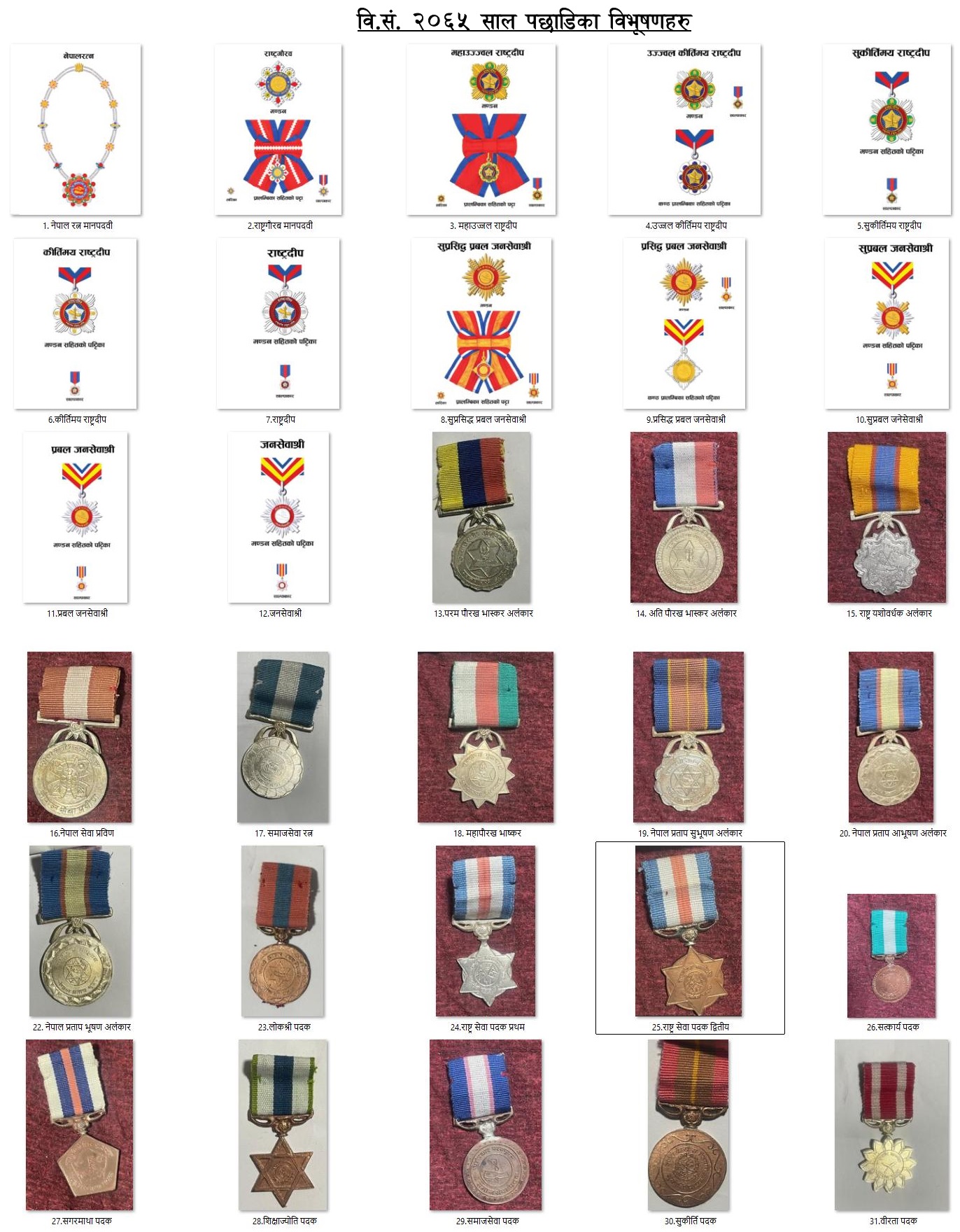
Based on available documents and images, Nepal has introduced 36 types of Orders, Decorations, and Medals. The categories and order of precedence are clearly set out in the Vibhushan Regulation, 2008 (2065 BS). They can be classified as follows.
A. Orders (Manpadavi)
Orders are Nepal’s highest civilian honors. They include four main types.
Nepal Ratna Manpadavi (Nepal Ratna Manpadavi)
Nepal Ratna is the highest civilian honor of Nepal. It is conferred once a year on only one exceptional individual (living or posthumously) for historic and exemplary contributions that enhance the nation’s prestige. It is octagonal in shape and set with diamonds.
Nepal Ratna has, so far, been conferred posthumously on Ganesh Man Singh (2010), Girija Prasad Koirala (2015), Madan Bhandari (2016), B. P. Koirala (2018), and Pushpalal Shrestha (2019). Due to the use of gold and diamonds, its production cost is approximately NPR 1.5–2.0 million (about NPR 15–20 lakh).
Rastra Gaurav Manpadavi (Rastra Gaurav Manpadavi)
This is the second-highest Order. It is awarded to foreign heads of state who elevate Nepal’s international standing, or to citizens who render highly distinguished contributions within Nepal. Under the rules, it can be conferred on a maximum of two individuals per year. Recipients include former Prime Minister Jhalanath Khanal and Nepali Congress leader Suvarna Shamsher (posthumously), among others.
Rastradip Series (Rastradip Series)
The Rastradip Order has five classes:
-
Mahaujjal Rastradip (First Class): The highest class, awarded to extremely distinguished individuals such as the Chief Justice, former Prime Ministers, or equivalent dignitaries.
-
Ujjal Kirtimaya Rastradip (Second Class): Awarded to ministers, Supreme Court justices, or equivalent senior officials.
-
Sukirtimaya Rastradip (Third Class): Awarded to senior officials and citizens who make important national-level contributions.
-
Kirtimaya Rastradip (Fourth Class): Awarded for excellent work in significant government or non-government services.
-
Rastradip (Fifth Class): The fifth class in the series, awarded to citizens and public servants devoted to national service.
Janasewashree Series (Janasewashree Series)
This is awarded for commendable service in the civil service, security agencies, or social service. It has five classes:
-
Suprasiddha Prabal Janasewashree (First Class): For the Chief Secretary, Chief of Army Staff, or equivalent officeholders and other major contributors.
-
Prasiddha Prabal Janasewashree (Second Class): For secretaries, lieutenant generals, or equivalent officials.
-
Suprabal Janasewashree (Third Class): For joint secretaries, deputy lieutenant generals/DIGs, or equivalent public servants.
-
Prabal Janasewashree (Fourth Class): For under-secretaries, brigadier generals/SPs, or equivalent officers.
-
Janasewashree (Fifth Class): For section officers, majors/inspectors, equivalent officers, and other staff with outstanding service.
B. Decorations (Alankar)
Decorations are mainly awarded for distinguished and courageous contributions in the security sector (Nepali Army, Nepal Police, Armed Police Force), the civil service, and social service. As listed in the referenced image, decorations include:
Military and security decorations
-
Param Paurakh Bhaskar Alankar (for the Nepali Army)
-
Ati Paurakh Bhaskar Alankar (for the Nepali Army)
-
Mahapaurakh Bhaskar Alankar (for the Nepali Army)
-
Nepal Pratap Bhushan, Nepal Pratap Abhushan, and Nepal Pratap Subhushan (for officers of Nepal Police, Armed Police Force, and the Investigation Department)
Civilian and social decorations
-
Rastra Yashovardhak Alankar: For citizens who enhance the nation’s honor and prestige.
-
Nepal Sewa Prabin: For long-term, outstanding national service.
-
Samajsewa Ratna: For incomparable contributions to social service.
C. Medals (Padak)
Medals are distributed by evaluating excellent work performed by employees at various levels, security personnel, and members of the public in their respective fields. Among the 36 honors referenced in the image, the medals list includes:
-
Lokashree Padak: For outstanding contributions to folk literature, art, culture, and public-interest issues.
-
Rastra Sewa Padak I: For public servants (first level) who perform assigned responsibilities exceptionally well in government and security services.
-
Rastra Sewa Padak II: For public servants (second level) who perform commendable work in government service.
-
Satkarya Padak: For exemplary and good deeds in any field that benefit society and the nation.
-
Sagarmatha Padak: For courageous individuals who make Nepal known globally through mountaineering, tourism promotion, and adventure sports or acts.
-
Shiksha Jyoti Padak: For teachers, professors, or educationists who make distinguished contributions to educational development, research, and academic advancement in Nepal.
-
Samaj Sewa Padak: For individuals or institutional representatives who do notable work in social service at the local or national level.
-
Sukriti Padak: For those who establish honest good practices and perform commendable work in their professional field.
-
Veerta Padak: For security personnel who show indomitable courage against enemies or criminals, or courageous citizens who protect others without regard for their own lives.
-
Shourya Padak: For those who display valor in security operations, rescue work, or difficult circumstances.
-
Prakritik Prakop Piditoddhar Padak: For individuals or security personnel who risk their lives in rescue and relief operations during disasters such as earthquakes and floods/landslides.
-
Vikas Ratna Padak: For significant contributions to infrastructure construction, economic development, and plan implementation.
-
Shanti Padak: For those who maintain peace and security within the country or contribute to world peace by participating in UN peace missions.
-
Vigyan Pravidhi Padak: Science, technology,
Controversies and Criticisms in Honors Distribution
Although honoring genuine national service and talent is a state responsibility, Nepal’s honors distribution system became highly controversial in the last decade. The main reasons include:
Unlimited numbers and “mass-award mentality”
The prestige of an honor depends on its rarity. However, Nepal saw a growing practice of distributing honors to thousands each year. In 2010/11 (2067 BS), honors were given to 269 individuals; in 2018/19 (2075 BS), to 518; in 2021/22 (2078 BS), to 903; and in 2022/23 (2079 BS), to 993 individuals. Former administrators and legal experts have pointed out that such large numbers diluted the value of honors.
Former Supreme Court Justice Balaram K.C. even remarked sarcastically that Nepal could become “the country that distributes the most medals per 10 million population.”
Nepotism, patronage, and political quota-sharing
A trend emerged of recommending honors for leaders’ relatives, influential contractors, cooks, drivers, and party cadres. For example, during then Prime Minister K. P. Sharma Oli’s tenure, there was criticism that medals were given to those who wrote poems praising him. Similarly, it was strongly criticized that, on the recommendation of then Chief Secretary Lok Darshan Regmi, a medal was awarded even to Regmi’s father.
Likewise, in 2021/22 (2078 BS), controversy arose after the government led by then Prime Minister Sher Bahadur Deuba awarded “Suprasiddha Prabal Janasewashree” to Maoist chairperson Pushpa Kamal Dahal’s wife, Sita Dahal, and also awarded a medal to contractor Humnath Koirala, who was reportedly blacklisted.
Judiciary-related dispute
When the government awarded honors to sitting Chief Justices and justices of the Supreme Court (such as Chief Justice Cholendra Shumsher J.B.R. and other judges), the Nepal Bar Association strongly opposed it. Legal experts argued that when the government is itself a litigating party and judges receive medals from the same government, it undermines the principle of an “independent judiciary.”
Financial burden
The state spends millions of rupees on producing honors. Ministry of Home Affairs data indicates that producing medals made of gold, silver, and diamonds costs around NPR 6.0–8.0 million annually (and more in some years). Nepal Ratna alone costs NPR 1.5–2.0 million. During economic hardship, citizens protested what they viewed as unproductive expenditure draining the public treasury.
Rejection of medals
As honors were perceived to be distributed arbitrarily without clear standards, even eligible and respected individuals began refusing them. Journalists Haribahadur Thapa, Krishnajwala Devkota, Narayan Amrit, cartoonist Rabin Sayami, senior advocate Shambhu Thapa, former Kathmandu mayor P. L. Singh, and others boycotted the medals offered by the government. According to one figure, more than 274 individuals have refused to receive honors that were officially announced.
Reform Efforts, Suspension, and the Current Status (2080–2082 BS)
After extreme distortions and widespread public criticism, the government took some stricter steps to correct the system.
Suspension of distribution in 2023/24 (2080 BS)
On the occasion of Constitution Day (Asoj 3, 2080 BS), at the initiative of then Deputy Prime Minister and Home Minister Narayan Kaji Shrestha, the government fully suspended the honors distribution process. The Council of Ministers decided to form a task force to study international practice and existing law and to develop new criteria. As a result, no medals were awarded in 2080 BS.
New criteria in 2024/25 (2081 BS)
Based on the task force report and the recommendation of the Ministry of Home Affairs, the government issued the “Procedure for Recommendation of Honors and Standards for Conferment, 2081 BS.” Under these new standards, strict limits were introduced, allowing a maximum of only 200 recipients per year. A clear quota was set: Orders for 100 individuals, Decorations for 50 individuals, and Medals for 50 individuals.
Amendment to include former Presidents (2081–2082 BS)
Around Poush 2081 BS and Baisakh 2082 BS, the government amended the standards again, opening a legal route to confer “Mahaujjal Rastradip (First Class)” on former high dignitaries (such as former Presidents). Previously, the rule applied only up to former Vice Presidents.
Political quota-sharing deadlock and renewed obstruction (current status in 2082 BS)
Even after the standards were issued and a “Decoration Recommendation Committee” was formed under the leadership of Deputy Prime Minister Prakash Man Singh to invite applications and recommendations, the process became obstructed again because political parties could not agree on “quota-sharing” over who should receive medals. When the committee attempted to finalize names, competition among ruling parties to include their preferred individuals prevented a final list from being concluded. Consequently, honors distribution—stalled since 2022/23 (2079 BS)—has still not achieved full continuity or resolution up to 2025/26 (2082 BS).
Conclusion
In any country, state-conferred honors and medals represent the highest respect for those who devote their lives to national development, security, literature, art, and social service. After 2065 BS, the key purpose of honors established by republican Nepal—such as Nepal Ratna, Rastradip, and Janasewashree—was to identify those who make selfless contributions to nation-building.
However, by exploiting legal loopholes and distributing medals to hundreds based on political access, a mass-award approach has undermined the dignity of these national distinctions. Since 2023/24 (2080 BS), the government’s efforts to reduce numbers through standards and to suspend distribution are positive. Yet, unless the culture of political quota-sharing ends and honors are conferred only on a fully transparent, independent, merit-based basis, “Vibhushan” cannot regain its lost credibility. Today’s urgent need is for the Decoration Committee to remain free from political pressure and to select only genuine national servants, unsung researchers, courageous security personnel, and selfless social workers.
Resource: Ministry of Home Affairs, Nepal





Comments 0
No comments yet. Be the first to start the conversation.