



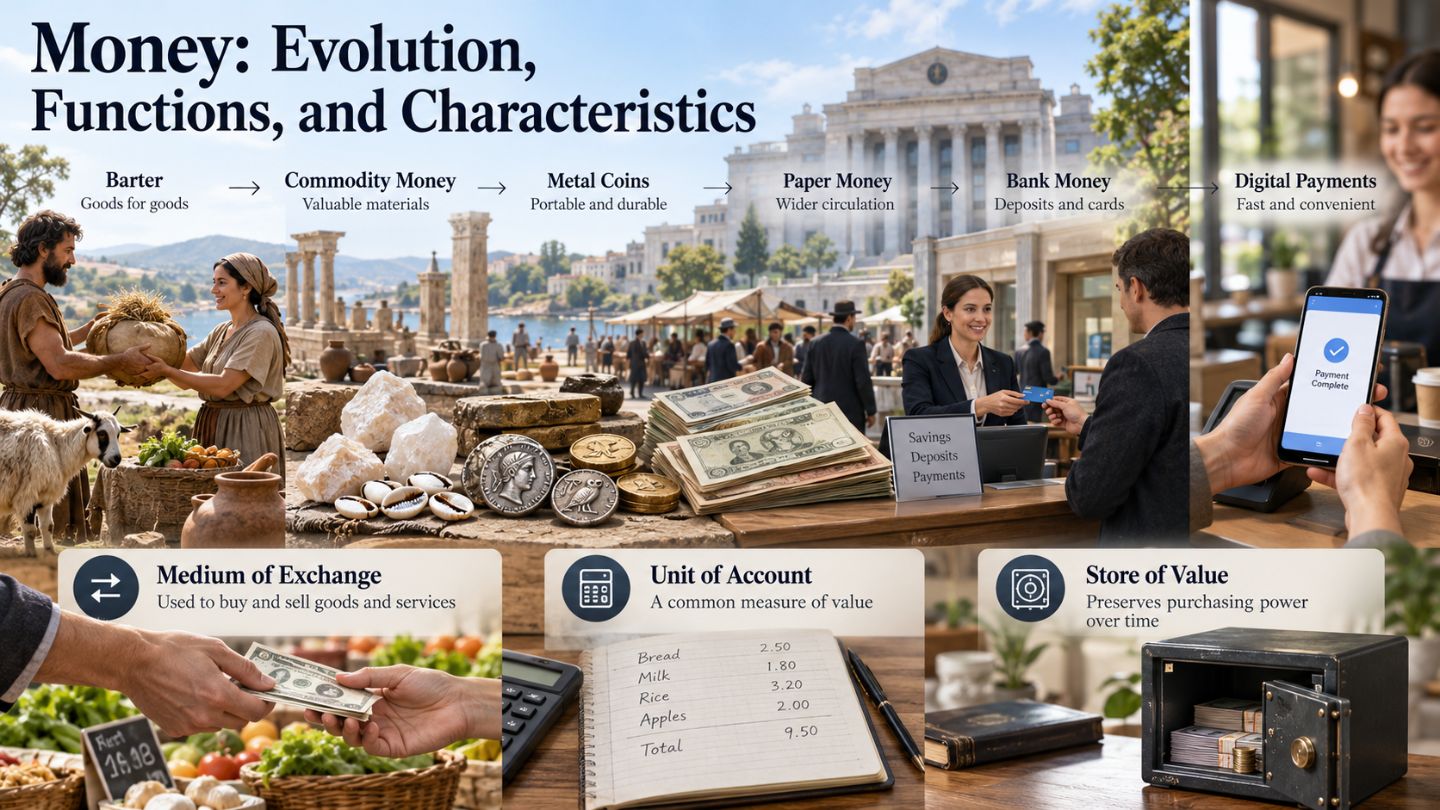
Money is one of the basic institutions that makes large-scale economic exchange possible. It allows people to sell one good or service and use the proceeds to buy something different, without having to find a trading partner who wants exactly what they offer. It also gives households, businesses, and governments a common way to quote prices, keep accounts, settle debts, and carry purchasing power from one period to another.
Economists commonly describe money through three core functions: medium of exchange, unit of account, and store of value. Some treatments add a fourth function, standard of deferred payment, because money is also used to state and settle obligations due in the future. The International Monetary Fund (IMF) uses these functions when explaining what makes an asset or instrument monetary.
Money should not be confused with wealth. A person may own land, shares, machinery, or other valuable assets without holding much money. Money is distinguished by its liquidity and broad acceptability for payment. Its forms have changed across history, but its economic purpose remains tied to exchange, valuation, settlement, and purchasing power.
What Is Money?
Money is an asset or instrument that people broadly accept in payment and use to express prices. A banknote is money because people expect others to accept it. A bank deposit can also function as money because it can be transferred to make payments. By contrast, an asset may be valuable without functioning well as money if it is difficult to spend, hard to value consistently, or not widely accepted.
The three-function definition is useful because it focuses on what money does rather than what it is made from. Gold, paper notes, bank deposits, and other instruments can all perform monetary functions under different arrangements.
Why Did Societies Develop Money?
Money reduces several problems that arise in direct exchange. In a barter transaction, each side must want what the other side offers at the same time. Economists call this the “double coincidence of wants.” Barter can also make it difficult to compare unlike goods, divide valuable items, and settle obligations that occur at different times.
Economic history is more varied than a simple story in which every society moved in a fixed sequence from barter to metal, then paper, then digital money. Barter, credit relationships, accounting units, commodities, coins, and other payment arrangements have overlapped in different places and periods. Historical evidence from ancient banking and payment practices shows that credit and deposit arrangements existed alongside, and in some cases before, widespread coin-based monetary systems.
The main economic advantage of money is that it separates selling from buying. A person can receive money in one transaction and spend it later in another, rather than searching for someone willing to make a direct swap.
How Money Evolved
Commodity Money
Commodity money consists of objects that have value apart from their monetary use. Historical examples have included precious metals and other widely accepted goods. A useful commodity money needs qualities that make exchange practical, such as recognizability, durability, divisibility, and sufficient scarcity.
Precious metals became important in many monetary systems because they could be stored, transported, divided, weighed, and standardized more easily than many other commodities. Commodity money also has limits: metal can be heavy, costly to verify, and inconvenient for frequent transactions.
Coins, Paper Claims, and Fiat Currency
Coins improved the use of metal as money by standardizing weight, quality, and denomination. A trusted issuer could stamp metal to indicate that a coin met an accepted standard, reducing some of the need to weigh and test metal during every transaction.
Paper instruments later reduced the need to move heavy metal. In some monetary systems, notes represented claims on gold, silver, or another asset and could be redeemed under stated conditions. Over time, many systems separated currency from direct convertibility into a commodity. This produced modern fiat currency arrangements, although the path differed across countries.
Fiat money is not redeemable for a fixed quantity of gold or another commodity. Its monetary value depends on broad public acceptance, confidence that others will accept it, government and legal arrangements, and the credibility of the monetary system.
Calling fiat money “worthless paper” is misleading. The physical material may have little value, but the monetary claim has value because it is accepted within an economic and legal framework. Legal-tender rules can support that framework, but legal status alone does not fully explain why a currency is trusted or widely used.
Bank Deposits and Electronic Money
A large share of everyday money in modern banking systems exists as bank deposits rather than notes and coins. A balance in a transaction account can be transferred through cards, bank transfers, cheques, or other payment systems. The payment method changes how money moves; it does not necessarily create a new type of money.
The Bank of England distinguishes among currency, commercial bank deposits, and central bank reserves, and notes that bank deposits make up a major part of the money used in a modern economy.
This distinction matters when discussing “digital money.” Bank deposits have long been recorded electronically. Mobile wallets and payment apps may give users a different way to transfer bank deposits or electronic money, but the app itself is not automatically a separate currency.
Cryptoassets and Digital Currency
Cryptocurrencies and other cryptoassets should not be treated as interchangeable with digital money. Some can be transferred electronically and used for certain payments, but an asset does not become money simply because it is digital.
The Bank for International Settlements has assessed cryptoassets against the standard functions of money and has identified limits such as uneven acceptance, unstable purchasing power, and weak use as a unit of account. Whether a particular cryptoasset functions as money depends on how widely and reliably it performs those roles. It is more accurate to treat cryptocurrencies as a separate category of digital assets rather than assume that every cryptocurrency is money.
The Main Functions of Money
| Function | Meaning | Practical role |
|---|---|---|
| Medium of exchange | Money is accepted in payment for goods, services, and assets. | It removes the need for direct barter in ordinary transactions. |
| Unit of account | Money provides a common unit for quoting and comparing values. | Prices, wages, costs, assets, and debts can be expressed in the same unit. |
| Store of value | Money carries purchasing power from the present into the future. | People can hold money for later spending, although inflation can reduce its real purchasing power. |
| Standard of deferred payment | Money is used to state and settle obligations due later. | Loans, wages, rents, and contracts can be denominated in a common monetary unit. |
The first three functions are the standard definition used across much of economics, while some monetary frameworks also include deferred payment as a fourth function.
These functions are connected. A currency that is widely accepted for payments becomes more useful as a unit of account. A unit of account is easier to rely on when its purchasing power is reasonably stable. If confidence in a currency falls sharply, one or more of these functions can weaken.
What Characteristics Make Money Effective?
Educational treatments commonly identify six practical characteristics of useful money: durability, portability, divisibility, uniformity, limited supply, and acceptability.
Durability and Portability
Money should remain usable over repeated transactions and be transferable without unreasonable difficulty. Physical currency must withstand handling, while digital balances depend on reliable recordkeeping and payment infrastructure.
Divisibility and Uniformity
Money needs units small enough for low-value purchases and large enough for bigger transactions. Equal units of the same currency should also have equal monetary value. These qualities make pricing, change, and settlement easier.
Acceptability
Money works through shared expectations. A person accepts money because they expect other people and institutions to accept it later. Broad acceptance is one of the strongest differences between money and many other valuable assets.
Controlled or Limited Supply
A monetary system needs a credible process governing issuance. This does not mean the quantity of money must remain fixed. It means users need confidence that monetary units will not be created in a way that seriously damages trust in their purchasing power.
Recognizability, resistance to counterfeiting, secure transfer, and relative stability in value also make money more useful. These are practical attributes rather than rigid laws, and different forms of money satisfy them in different ways.
The Main Types of Money
Money can be classified according to what gives it value and who issues the claim.
Commodity money derives value from the commodity itself. Representative money is a claim that can be redeemed for an underlying asset under the rules of the system. Fiat currency is not convertible into a commodity at a fixed rate and depends on institutional credibility and acceptance.
Modern economies also distinguish between central bank money and commercial bank money. Central bank money generally includes physical currency issued by the central bank and reserve balances held by eligible financial institutions. Commercial bank money consists mainly of deposits held by households and businesses at banks.
Electronic money is a broader category used for monetary value stored or transferred electronically under particular legal and payment arrangements. Definitions differ across jurisdictions, so it is more useful to identify the issuer and the nature of the claim than to assume every digital balance is the same type of money.
How Is Money Created in a Modern Banking System?
Money creation is often misunderstood because cash is the most visible form of money. In many modern economies, much of the money used by the public is held as commercial bank deposits.
The Bank of England explains that when a commercial bank makes a loan, it normally credits the borrower’s deposit account, creating a new deposit and expanding bank money. When the loan principal is repaid, the corresponding deposit money is reduced.
Banks cannot create unlimited money. Lending is constrained by capital and liquidity rules, settlement needs, the creditworthiness of borrowers, demand for loans, the bank’s risk limits, and monetary conditions. Central bank policy affects the price and availability of credit, but a central bank does not mechanically choose the exact quantity of commercial bank deposits in the economy.
Economists and statistical agencies use monetary aggregates to measure different layers of money. Narrow measures focus on highly liquid forms used directly for payments, while broad measures include additional liquid deposits and related instruments. Exact definitions vary by country and statistical system.
What Do Central Banks Do?
Central banks support the monetary system, but their legal mandates and responsibilities differ across countries. Common functions include issuing or managing central bank money, carrying out monetary policy, providing settlement services to banks, supporting payment-system stability, and responding to financial-system liquidity stress.
Monetary policy is commonly implemented through tools that influence short-term interest rates and financial conditions. These can include policy rates, open-market operations, standing lending or deposit facilities, asset transactions, and reserve-related rules or remuneration. The exact toolkit differs by monetary system. The U.S. Federal Reserve, for example, describes open-market operations as a key tool for implementing monetary policy.
Some central banks also supervise banks directly; in other systems, supervision is shared with or assigned to separate regulators. It is more accurate to say that central banks often contribute to financial stability and supervision than to assume that every central bank regulates every financial institution.
For additional background, see Collegenp’s explanation of the role of central banks in national economies.
Money, Inflation, and Purchasing Power
Money can store value only to the extent that it preserves purchasing power. When the general price level rises, a fixed amount of money buys fewer goods and services. This is why inflation directly affects the store-of-value function of money.
High or unstable inflation can also weaken the unit-of-account function. If prices change rapidly, households and businesses have more difficulty comparing prices across time, preparing budgets, writing long-term contracts, and separating changes in individual prices from changes in the overall price level. Money may still be used for payment, but its other functions become less reliable.
Price stability does not mean every price stays fixed. Relative prices change as supply and demand change. The monetary concern is broader: whether the currency provides a reasonably dependable basis for pricing and settlement.
Collegenp also has a separate explanation of how inflation affects the functions of money.
Why Money Matters for Economic Activity
Money supports specialization because producers do not need to exchange their output directly for every good they want to consume. A worker can be paid in money, a business can compare revenue with costs, and a household can postpone some spending by holding liquid balances.
A common unit of account also makes economic calculation easier. Businesses can keep accounts, compare projects, set wages, record debts, and measure profit or loss using the same unit. Governments can collect taxes and make payments in a defined currency. Financial contracts can state future obligations in monetary terms.
Money connects the present with the future, but it is not a risk-free way to preserve wealth. Inflation can reduce purchasing power, bank deposits carry risks managed through banking and regulatory systems, and exchange rates affect the external value of currencies. The role of money as a store of value is better understood as the ability to transfer purchasing power over time, not a promise that purchasing power will remain unchanged.
Money and Payment Systems Are Different
A payment system is the infrastructure or set of rules used to transfer money. Money is the asset or claim being transferred. This distinction explains why a new payment technology does not automatically create a new currency.
Paying by cash transfers physical currency. Paying by bank card usually instructs financial institutions to transfer deposit money. A mobile payment service may transfer bank deposits or another regulated monetary claim. The user experience changes, while the underlying money may remain the same.
This distinction is useful when evaluating financial technology. Questions about speed, convenience, security, privacy, and access concern the payment system; questions about who issues the monetary claim, what supports it, and whether it is widely accepted concern the money itself.
Closing Perspective
Money is best understood by its functions rather than by a single physical form. Across history, societies have used commodities, coins, paper claims, fiat currency, bank deposits, and electronic records to support exchange and accounting. These forms did not appear everywhere in the same sequence, and several have often existed side by side.
The standard definition focuses on money as a medium of exchange, unit of account, and store of value, with deferred payment often added as a fourth function. Effective money also tends to be durable, portable, divisible, uniform, broadly accepted, and governed by a credible system of issuance.
Modern monetary systems depend on both public institutions and private banking. Central banks provide an anchor for settlement and monetary policy, while commercial banks create much of the deposit money used in everyday transactions. Understanding that structure makes it easier to distinguish money from wealth, payment technology, credit, and speculative assets.







Comments 0
No comments yet. Be the first to start the conversation.