



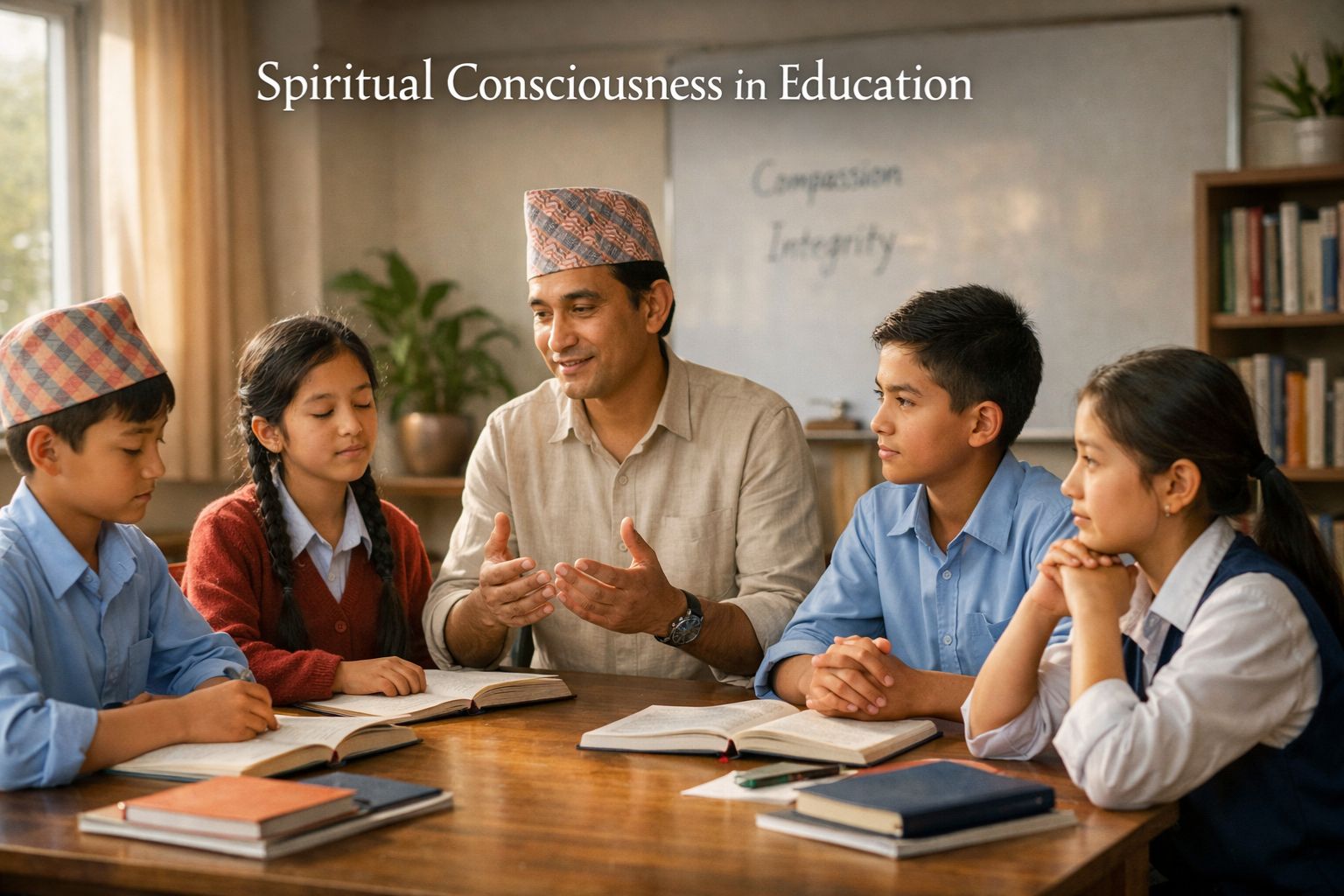
Spiritual Consciousness and Param Jeevan Tantra in Education
Education is often judged by grades, credentials, and measurable academic results. That view is too narrow. Education should also help students develop moral judgement, self-discipline, inner awareness, and a sense of responsibility toward other people.
This matters because schools deal with more than subject knowledge. They also face stress, distraction, weak self-control, moral confusion, and fragile social ties. A system that values academic performance alone may produce capable students without giving enough attention to character, reflection, or purpose. This is where spiritual consciousness and Param Jeevan Tantra become meaningful in education.
Spiritual consciousness refers to awareness of self, purpose, values, and responsibility. Param Jeevan Tantra can be understood as a consciousness-based framework for life, discipline, reflection, and self-realisation. Together, these ideas support a broader educational vision in which learning moves beyond information transfer and contributes to the growth of the whole person.
This approach does not reduce education to ritual or sectarian belief. Instead, it places emphasis on reflection, ethical awareness, self-knowledge, mental steadiness, and social responsibility. When applied carefully, it can enrich curriculum, classroom practice, and the overall purpose of education.
Table of Content
- Spiritual Consciousness and Param Jeevan Tantra in Education
- What Is Spiritual Consciousness in Education?
- What Does Param Jeevan Tantra Mean?
- Why Is This Idea Relevant in Education Now?
- How Can This Framework Shape the Curriculum?
- What Changes in Teaching and Learning?
- What Outcomes Can Schools Reasonably Expect?
- What Are the Limits and Risks?
- How Can Institutions Assess Fit?
- Conclusion
- FAQs
What Is Spiritual Consciousness in Education?
Spiritual consciousness in education means awareness of self, purpose, values, and responsibility within the learning process. It is linked to reflection, compassion, ethics, service, and self-control rather than ritual alone.
A Working Definition for Schools
In a school setting, spiritual consciousness can be understood as reflective awareness that shapes how students see themselves, other people, and the meaning of their actions. It encourages questions such as: What kind of person am I becoming? What responsibilities come with knowledge? How should I act under pressure, conflict, or uncertainty?
Students do not grow through intellect alone. They also grow through emotional maturity, social understanding, and inner discipline. Many educational problems do not come from lack of information. They come from weak judgement, poor self-control, shallow purpose, or failure to reflect on consequences.
Seen in this way, spiritual consciousness is not only a separate topic. It is an educational orientation that can appear through classroom discussion, reflective writing, ethical dilemmas, community service, quiet attention practice, and teacher modelling of fairness and care.
How It Differs From Religious Instruction
Spiritual consciousness is not the same as teaching one faith tradition. It focuses on awareness, ethical depth, self-knowledge, and humane conduct.
Religious instruction usually teaches the stories, doctrines, or practices of a specific tradition. A spirituality-informed educational approach can instead focus on capacities shared across different backgrounds, such as reflection, empathy, patience, truthfulness, responsibility, and care for others. A school may discuss silence, attention, gratitude, honesty, or service without requiring students to accept one theological position.
That distinction is essential. Once a school moves from reflective education to belief enforcement, the educational purpose weakens and the risk of exclusion rises.
What Does Param Jeevan Tantra Mean?
Param Jeevan Tantra can be understood as a higher framework for living that places consciousness at the centre of life. In educational terms, it points to learning that joins self-knowledge, discipline, attentiveness, and purposeful action.
A Consciousness-Based Framework for Life
This framework does not treat life as material existence alone. It connects life with consciousness, discipline, meditation, action, and fulfilment of human potential.
In educational language, the message is direct. Students need more than content mastery. They also need direction, restraint, concentration, meaningful action, and a sense of inner coherence. A learner who knows facts but lacks discipline may struggle to use knowledge well. A learner with ambition but no moral measure may pursue success without responsibility. A learner with skill but no inner steadiness may find it hard to sustain attention or care for others.
Education, then, becomes more than training the mind. It becomes formation of the person.
Links to Self-Knowledge
Knowledge without self-knowledge is incomplete. A student may solve problems and still remain unclear about motives, values, and responsibility. Education becomes deeper when it narrows that gap.
Learning is not only accumulation. It is also reflection, recognition, and moral awakening. This makes education a process of becoming, not just a process of knowing.
Why Is This Idea Relevant in Education Now?
This idea matters because education today faces moral strain, social fragmentation, mental stress, and weak value orientation. Academic work needs to be reconnected with ethics, self-discipline, and reflective life.
Moral Strain and Value Confusion
Education often remains limited to intellectual development while neglecting moral direction and social duty. Yet values always enter education, whether schools discuss them directly or not. They enter through competition, peer influence, media, and institutional habits.
The real question is not whether values shape education. They already do. The more important question is whether they enter through reflection and guidance or through pressure that goes unexamined.
Mental Stress and Fractured Attention
Students often learn under pressure, comparison, distraction, and uncertainty. That makes mental balance an educational issue, not just a personal one.
Spiritual consciousness is closely connected with calm attention, emotional steadiness, and better self-control. Mindfulness and reflective practices can support these qualities. In a school setting, this does not have to become religious exercise. It may take the form of short silence, breathing routines, reflective journaling, or classroom practices that strengthen focus and composure.
The Case for Balanced Development
Education should address intellectual, emotional, social, and reflective development together. This is a broader and stronger account of learning than exam preparation alone.
The point is not to reduce the value of academic standards. Reading, science, mathematics, and professional preparation remain central. But these become more meaningful when joined with ethics, self-awareness, and social responsibility. Without that connection, schooling may become efficient but thin.
How Can This Framework Shape the Curriculum?
This framework shapes curriculum by adding clear attention to values, reflection, dialogue, and disciplined awareness alongside subject learning. It does not require the removal of academic content.
Value-Centred Learning
A value-centred curriculum asks students to study more than material needed for tests. It also asks them to examine fairness, truthfulness, self-restraint, compassion, responsibility, and civic conduct.
This can happen across subjects. Literature can open discussion on moral conflict and empathy. History can examine justice, power, and public duty. Science can raise questions about the ethical use of knowledge. Social studies can connect personal conduct to life in community. A value-centred curriculum does not depend on slogans. It depends on careful questions, reflective tasks, and serious discussion.
Reflection, Dialogue, and Life Skills
Dialogue deserves a central place in education. Knowledge is not a fixed object handed down once and for all. It develops through inquiry, questioning, and exchange.
Students need room to ask, test, and revise ideas. Value questions are not learned well through memorisation alone. Students need to speak, listen, disagree with respect, and explain why one line of action is stronger than another. Reflection matters for the same reason. Some forms of learning require pause. Students need time to connect experience with meaning.
Life skills are part of this process as well. Time management, emotional restraint, attention, listening, cooperation, and service are not side issues. They are part of education’s purpose.
Mindfulness and Attentive Practice
Mindfulness can serve as a useful educational practice when its purpose remains clear. In classroom terms, attentive practice may include silence, breathing routines, mindful observation, reflective note-taking, or structured moments of focus at the start and end of lessons.
The goal is not ritual performance. The goal is steadier attention, calmer response, and stronger self-awareness. Inclusive language helps ensure that such practices remain open to students from different backgrounds.
What Changes in Teaching and Learning?
Teaching and learning change when the classroom moves from one-way delivery toward guided reflection, dialogue, and lived example. The teacher becomes more than an instructor of content. The teacher also becomes a guide whose conduct shapes the learning climate.
The Teacher as Guide
Teacher behaviour carries educational weight. A patient, fair, attentive, and self-controlled teacher teaches those qualities through daily practice.
This model asks for more than subject competence. It asks for reflective professionalism. Teachers need to know how to guide discussion on values without imposing belief, how to model respect under pressure, and how to build trust without lowering academic standards.
Dialogue Over One-Way Delivery
Value-based learning depends on thought, not repetition. Students need space to raise questions, examine dilemmas, and explain their reasoning.
One-way delivery still has a place for some content. But a school that wants students to grow in judgement, empathy, and responsibility needs conversation, reflection, and shared inquiry. A dialogic classroom also reveals where students are confused, disengaged, or ethically uncertain.
Student Growth Across Connected Dimensions
Student development includes intellectual, emotional, social, and reflective dimensions. These are not separate silos. Attention affects learning. Emotion affects judgement. Social awareness affects behaviour. Reflection affects purpose.
A more complete education asks broader questions about success. It asks not only what a student scored, but also how the student responds to responsibility, reflects on action, works with others, and remains steady under difficulty.
What Outcomes Can Schools Reasonably Expect?
A more reflective and value-aware educational approach may support stronger ethical judgement, better self-discipline, greater social responsibility, and improved emotional balance.
Ethical Judgement and Responsibility
Students should learn to think about the moral consequences of action, not only personal gain. Education has public consequences. Students later become workers, citizens, neighbours, and decision-makers. Their choices affect other people.
When ethical questions are discussed openly and with care, students become more able to recognise conflict between convenience and integrity. They also become more able to explain why some actions build trust while others weaken it.
Self-Discipline and Steady Attention
Self-control, concentration, patience, and inner order are practical educational strengths. A student with steadier attention can persist with reading, problem-solving, and revision. A student with stronger self-control can manage distraction and reduce impulsive behaviour.
Discipline becomes stronger when students begin to carry it within their own habits and choices instead of relying only on external control.
Social Concern and Service
Education should not be treated only as a private ladder. It should also support service, cooperation, justice, and social awareness. This broadens the meaning of success.
A school using this approach may give more space to peer support, community service, collaborative learning, and reflection on public responsibility. Personal ambition remains important, but it is placed within a wider social horizon.
Emotional Balance and Resilience
Attention practice and reflection can help support calmness, concentration, and stronger mental balance. Emotional balance matters because students work under pressure, comparison, uncertainty, and failure.
A reflective classroom can give students routines that help them recover focus and respond more steadily. That supports persistence and a stronger sense of direction in learning.
What Are the Limits and Risks?
These ideas have educational value, but they also carry risks. Schools need safeguards around pluralism, coercion, weak evidence, and teacher readiness.
The Need for Pluralism and Inclusion
Any spirituality-linked educational approach has to respect diversity. Students come from different religions, philosophies, languages, and family traditions. A school should not present one worldview as the measure of moral worth.
This is why inclusive language matters. Reflection, attention, ethical judgement, and care for others often travel across difference more easily than sectarian vocabulary. A shared educational space needs concepts that students from different backgrounds can enter without pressure.
The Line Between Education and Indoctrination
Education invites inquiry. Indoctrination closes inquiry. Education examines and discusses. Indoctrination demands assent.
If students cannot question a framework, compare perspectives, or express respectful disagreement, the educational value weakens. Schools should also avoid shallow symbolism. A few rituals without discussion, purpose, or teacher preparation may turn a serious educational idea into empty performance.
Why Evidence and Teacher Preparation Matter
Philosophical ideas and practical classroom outcomes are not the same thing. Schools need to separate educational vision from effects that require stronger empirical support.
Teacher preparation matters for the same reason. Without training, moral discussion may turn into sermon, and attention practice may become rigid routine. A careful school approach needs both clarity and restraint.
How Can Institutions Assess Fit?
Institutions can assess fit by reviewing mission, student diversity, teacher readiness, and the educational purpose of each activity.
Questions Schools Should Ask
A school considering this framework should ask:
- What problem are we trying to address: stress, discipline, school culture, values, or several of these together?
- Are we using language that all students can enter?
- Can teachers guide reflective discussion without coercion?
- How will reflection connect to subject learning?
- How will the school review impact on classroom climate, attention, or conduct?
- Are parents and stakeholders clear about the educational purpose?
These questions keep the work grounded and proportionate.
A Phased Adoption Model
A phased model is stronger than abrupt adoption. A school may begin with teacher preparation, reflective classroom routines, and ethics-rich discussion inside existing subjects. A later phase may add advisory periods, service reflection, or short attention practices. After that, the school may review student response, classroom climate, and stakeholder trust before any wider use.
This gradual path gives institutions room to revise language, method, and expectation.
Conclusion
Spiritual consciousness and Param Jeevan Tantra offer a way to restore balance in education. Schooling should develop not only intellect but also judgement, discipline, emotional steadiness, and social responsibility.
Read in educational terms, this is a call for reflective, value-aware, and humane learning. The strongest use of this framework is careful adaptation, not blind adoption. Schools can draw from its emphasis on self-awareness, dialogue, ethical reflection, and attentive practice while protecting pluralism, academic integrity, and student inclusion.
FAQs
What is spiritual consciousness in education?
Spiritual consciousness in education is awareness of self, purpose, values, and responsibility within the learning process. It is linked to reflection, compassion, ethics, service, and self-discipline rather than ritual alone.
What is Param Jeevan Tantra in simple terms?
Param Jeevan Tantra is a higher life framework grounded in consciousness, discipline, attention, and self-realisation. In educational language, it means learning should support character and self-knowledge as well as academic skill.
Is spiritual consciousness the same as religious teaching?
No. Spiritual consciousness is not the same as teaching one faith tradition. It focuses on reflection, moral judgement, inner balance, and responsibility in educational terms.
How can schools apply these ideas without excluding students?
Schools can apply these ideas by using inclusive language, keeping discussion open, avoiding belief enforcement, and linking reflection to shared concerns such as honesty, care, responsibility, and attention.
What is the main educational benefit of this approach?
The main educational benefit is balanced student development. Education supports intellectual growth together with ethics, self-discipline, mental steadiness, and social responsibility.





Comments 0
No comments yet. Be the first to start the conversation.