



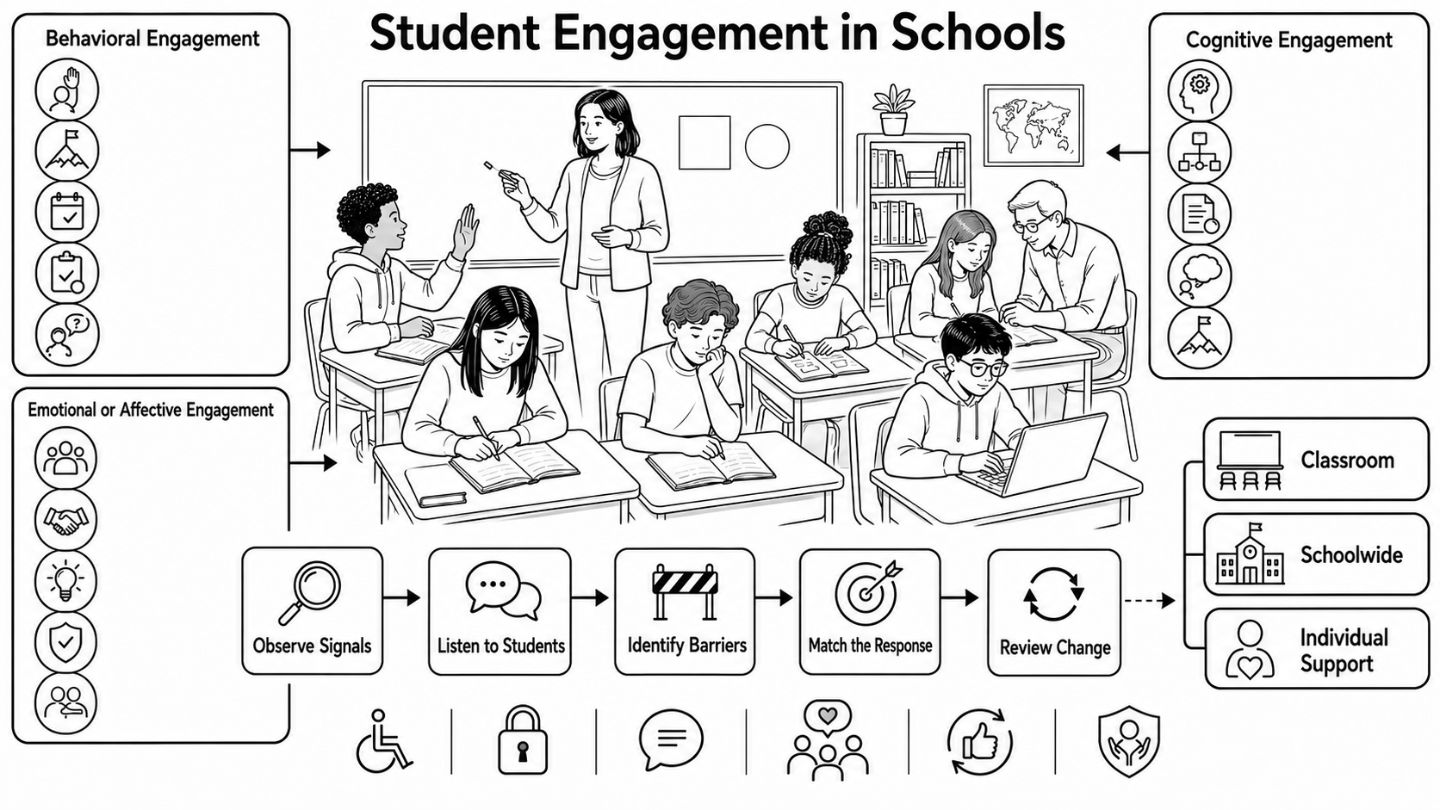
Student engagement in schools involves more than attendance, task completion, eye contact, enthusiasm, or compliance with classroom rules. It includes how students participate, how they experience learning and school, and how much mental effort they invest in understanding.
This distinction matters because similar behaviors can have different explanations. A student who rarely speaks may be reflecting carefully, facing a language or access barrier, avoiding an unsafe interaction, or struggling to understand the task. A student who completes every activity may still be following instructions without making sense of the content.
Schools therefore need to diagnose the barrier before choosing a response. A participation barrier may require clearer routines or more accessible response options. A belonging concern may call for stronger relationships and peer norms. A cognitive barrier may require clearer explanations, better-matched challenge, usable feedback, or more thinking time.
This guide is intended for primary and secondary school teachers, school leaders, instructional coaches, and education-focused readers. It explains how to identify engagement barriers, select classroom or schoolwide responses, and review change while adapting decisions to age, culture, language, disability, subject, privacy, safeguarding, and local policy.
Answer summary: Student engagement is the behavioral, emotional or affective, and cognitive involvement students bring to learning and school life. Schools can support it through clear expectations, caring relationships, meaningful challenge, accessible participation, student voice, and usable feedback. Progress should be reviewed through several sources of evidence rather than attendance, grades, visible behavior, survey scores, or technology activity alone.
Table of Content
- What Does Student Engagement Mean?
- Why Do Schools Focus on Engagement?
- What Can Student Disengagement Look Like?
- How Should Schools Diagnose Engagement Barriers?
- Which Classroom Practices Can Support Engagement?
- How Should Engagement Strategies Be Adapted?
- What Schoolwide Conditions Support Engagement?
- When Is Individual Support Needed?
- How Can Schools Measure Engagement Fairly?
- A Practical 30-Day Engagement Review Cycle
- Common Mistakes When Addressing Engagement
- Quick School Engagement Checklists
- Building Engagement Through Informed, Manageable Change
Key takeaways:
-
Engagement has behavioral, emotional or affective, and cognitive dimensions.
-
Visible participation is one signal, not a complete judgment.
-
Schools should investigate the likely barrier before selecting a response.
-
Belonging, clarity, challenge, voice, access, and feedback interact.
-
Classroom practices cannot resolve every schoolwide or individual concern.
-
Measurement is stronger when several sources are reviewed over time.
-
Privacy, accessibility, equity, and safeguarding belong within the process.
What Does Student Engagement Mean?
Student engagement is commonly described through behavioral, emotional or affective, and cognitive dimensions. These dimensions overlap, but they represent different aspects of a student’s involvement in learning and school.
Fredricks, Blumenfeld, and Paris presented this three-part student engagement framework in a foundational research review. Some later models add social or agentic dimensions. The three-part model remains a useful organizing structure when voice, agency, belonging, and connectedness are treated as related conditions rather than interchangeable terms.
| Dimension | Meaning and possible signals | Measurement caution |
|---|---|---|
| Behavioral | Participation, effort, persistence, attendance patterns, task completion, help-seeking, and conduct | Observable behavior does not establish how a student feels or thinks |
| Emotional or affective | Interest, value, comfort, anxiety, trust, belonging, and feelings about learning, teachers, peers, and school | Adults should not infer internal experience from expression, silence, or eye contact alone |
| Cognitive | Sense-making, strategy use, reflection, self-regulation, revision, and persistence through challenge | Correct answers and fast completion do not necessarily show depth of understanding |
A student may show strength in one dimension and difficulty in another. A student may attend regularly and complete work while feeling disconnected from school. Another may value a subject but struggle to participate because the task format is inaccessible.
Behavioral Engagement
Behavioral engagement refers to the observable ways students take part in learning and school life. It may appear through attendance, persistence, contributions, task completion, help-seeking, and participation in agreed routines.
These signals require context. Missing work may reflect unclear instructions, limited access, excessive difficulty, insufficient challenge, language demands, or circumstances beyond the classroom. Frequent participation may also remain shallow when students are rewarded mainly for speed, volume, or recall.
Teachers should examine when the behavior occurs, whether it appears across subjects, what changed before it began, and what the student says about the task.
Emotional or Affective Engagement
Emotional or affective engagement concerns how students experience learning, relationships, and school. It includes interest, value, comfort, anxiety, frustration, safety, trust, and belonging.
School connectedness is related but not identical to engagement. The U.S. Centers for Disease Control and Prevention describes school connectedness as students feeling that adults and peers care about them as individuals and about their learning. It also includes feeling valued, supported, and that one belongs at school. (CDC)
Emotional engagement cannot be judged reliably from appearance alone. A student may look calm while feeling excluded, or appear restless while remaining mentally invested. Private student input and repeated observation provide more context than a single impression.
Cognitive Engagement
Cognitive engagement is the mental investment students make in understanding. It appears when students connect ideas, explain reasoning, select strategies, monitor comprehension, revise work, and persist through productive difficulty.
A classroom can be busy without requiring much thought. Activities invite cognitive engagement when students retrieve, compare, explain, solve, apply, question, create, or reflect rather than mainly copy or complete.
Challenge also needs support. Students are less able to invest in complex thinking when instructions are unclear, required prior knowledge is absent, materials are inaccessible, or feedback arrives too late to use.
Engagement, Participation, Motivation, and Connectedness
These concepts overlap, but they answer different questions.
| Concept | Main question | Relationship to engagement |
|---|---|---|
| Participation | What is the student visibly doing? | One possible behavioral indicator |
| Motivation | Why does the student begin or continue? | A related influence that may change by task and context |
| Connectedness and belonging | Does the student feel cared for, supported, and included? | Relational conditions associated with emotional engagement |
| Engagement | How is the student participating, experiencing, and thinking? | The broader multidimensional construct |
Compliance is also different from engagement. A compliant student may follow instructions without seeing value in the work or investing much thought. Safe and orderly routines matter, but order alone does not demonstrate meaningful learning.
Why Do Schools Focus on Engagement?
Schools focus on engagement because it describes processes that occur during learning: participation, persistence, thinking, relationships, feedback, and reflection.
Research often reports associations between these processes and academic, motivational, attendance, or wellbeing outcomes. Such findings do not establish that one activity or program will produce the same result in every school.
The Programme for International Student Assessment, or PISA, provides cross-country evidence about students’ experiences of teacher support and school life. PISA 2022 Results, Volume II covers life at school, support from home, students’ pathways, education investment, governance, and learning during and after pandemic-related disruption. Its findings apply to the participating countries, economies, populations, and measures used in PISA.
The OECD’s 2025 paper on teacher support for student learning reports associations between students’ perceptions of support in mathematics lessons and measures such as mathematics performance, belonging, anxiety, motivation, self-regulation, and proactive learning behavior. The paper states that PISA data provide correlational rather than causal evidence for the practices discussed.
These findings make engagement and teacher support useful areas for school inquiry. They do not establish one universal intervention or justify guarantees about achievement, attendance, or wellbeing.
What Can Student Disengagement Look Like?
Student disengagement may appear through withdrawal, avoidance, inconsistent effort, disruption, shallow completion, low trust, weak persistence, or reduced interest. It may also appear as quiet compliance, where a student completes tasks but invests little thought or personal meaning.
No single sign identifies the cause.
| Observed signal | Explanations to investigate | Useful first evidence |
|---|---|---|
| Work is missing or unfinished | Unclear instructions, mismatched difficulty, limited access, low perceived value, or personal circumstances | Student conversation, work samples, task instructions, and patterns across subjects |
| Student rarely speaks | Reflection preference, language demand, fear of error, exclusion, sensory load, or insufficient preparation time | Private student input, alternative response options, and observation across settings |
| Participation is frequent but answers remain shallow | Speed is rewarded, questions require recall only, or feedback does not press for reasoning | Response quality, question design, thinking time, and revision evidence |
| Attendance or punctuality changes | Transport, health, safety, family responsibilities, transition, school climate, or other barriers | Contextual attendance information and confidential follow-up |
| Student appears compliant but disconnected | Low relevance, limited challenge, weak belonging, or a completion-only focus | Reflection prompts, work quality, student views, and evidence of reasoning |
Before describing a student as lazy, unmotivated, or resistant, staff should ask whether the available evidence supports that conclusion. In many cases, the evidence identifies a behavior without explaining its cause.
Useful questions include:
-
Does the pattern occur in one task, subject, relationship, or setting?
-
Can the student explain the learning goal and how to begin?
-
Does the student contribute through writing, problem-solving, drawing, or reflection?
-
Has the student received an accessible and private way to explain the barrier?
-
What changed before the pattern appeared?
-
What evidence would indicate that a response is helping?
How Should Schools Diagnose Engagement Barriers?
A suitable response begins by identifying the signal, gathering more than one source of information, considering plausible barriers, and selecting a change connected to those barriers.
The starting question is not simply which activity to use. It is what may be limiting participation, belonging, or sustained thinking in this setting.
| Likely barrier | Questions to ask | Matched response and evidence |
|---|---|---|
| Relevance or purpose | Do students understand why the learning matters and where it applies? | Clarify purpose and application; review student explanations, effort, and work quality |
| Challenge, clarity, or feedback | Is the work repetitive, inaccessible, confusing, or unsupported? | Adjust support and demand; review task entry, errors, revision, and persistence |
| Belonging or relationships | Do students feel respected, included, and safe to contribute? | Strengthen teacher care and peer norms; review student voice and participation patterns |
| Autonomy or voice | Can students influence examples, processes, roles, or products within clear boundaries? | Offer bounded choices; review ownership, strategy use, and work quality |
| Access or personal circumstances | Are language, disability, wellbeing, bullying, transition, or family circumstances affecting access? | Adapt access and follow local support procedures; use confidential student and family input |
A bank of student engagement activities in the classroom may provide practical ideas after the likely barrier has been identified. Activities should not replace diagnosis.
Relevance or Purpose Barriers
Students need to understand what they are learning, why it matters, and how it may be used. Relevance does not require turning every lesson into entertainment.
Teachers may connect a task to a larger question, show how knowledge will be used later, or ask students to apply an idea in a credible context.
Challenge, Clarity, or Feedback Barriers
Students may withdraw when work is too easy, too demanding, poorly explained, or disconnected from feedback they can use.
Teachers can check whether students understand the goal, know how to begin, can access examples or success criteria, and receive feedback while revision remains possible.
The answer is not to remove every difficult task. The aim is to match intellectual demand with clear explanations, relevant prior knowledge, accessible materials, and opportunities to address misunderstanding.
Belonging or Relationship Barriers
Students may be less willing to take academic risks when they expect ridicule, exclusion, unfair treatment, or indifference. Supportive relationships and clear expectations should operate together.
A CDC-authored review of classroom management and school connectedness identified six broad categories: teacher care and support, peer connection, student autonomy, classroom social dynamics, teacher expectations, and behavior management. The reviewed evidence was mainly U.S.-focused, and the findings should not be treated as proof that every practice produces the same effect in every school.
Autonomy or Voice Barriers
Student voice means giving students meaningful opportunities to express perspectives and influence parts of learning or school life. It does not mean unlimited choice or the removal of academic expectations.
Bounded choice may involve selecting an example, question, practice order, group role, response format, or final product while the learning objective remains fixed. Options should be manageable and accessible.
Schools should also close the feedback loop. When students provide views, adults should explain what changed, what did not change, and why.
Access or Individual Barriers
Participation may be affected by disability, neurodivergence, language demand, sensory load, bullying, wellbeing, transition, safety, or circumstances outside school. Staff should not infer these conditions from behavior alone.
Teachers can adapt task access, offer several participation routes, and seek confidential input. When concerns are sensitive or extend beyond classroom design, staff should follow applicable accessibility, pastoral, counseling, family-contact, referral, and safeguarding procedures.
Which Classroom Practices Can Support Engagement?
Classroom practices are most useful when they serve a clear learning purpose and address an identified barrier. Brief novelty may attract attention, but sustained engagement depends more on clarity, relationships, access, challenge, thinking, and feedback.
Make Purpose and Expectations Clear
Students should know what they are learning, why the task matters, what a satisfactory response involves, and how to begin.
A practical sequence is to state the purpose, model part of the process, identify a small number of criteria, and ask students to explain the task before independent work begins. This also helps teachers distinguish disengagement from misunderstanding.
Related classroom management tips for teachers may support clear routines and expectations, but behavior management should remain connected to learning, fairness, and respectful relationships.
Use Active Learning to Require Thinking
Active learning asks students to carry out intellectual work through retrieval, explanation, comparison, discussion, problem-solving, practice, creation, or reflection.
The planning question is not whether the room appears active. It is what students must think about and what evidence will show understanding.
The supporting article on active learning and student retention can provide additional classroom ideas. Any outcome claim should still be considered in relation to subject, age, task design, duration, and how the practice is used.
Offer Bounded Choice and Student Voice
Choice may support ownership when options are meaningful, limited, accessible, and connected to the same objective.
Students may select:
-
an example or topic within a defined range;
-
the order of practice tasks;
-
a role in a structured group;
-
one of several response formats;
-
a question for further inquiry.
Choice should not transfer responsibility for curriculum, safety, or valid assessment to students. Too many options may also increase confusion or place additional demands on students who prefer a clear route.
Build Feedback and Metacognition
Feedback is more useful when students can act on it. It should connect current work to the learning goal and identify a manageable next step.
Reflection prompts may ask:
-
What strategy did I use?
-
Where did I become uncertain?
-
What evidence shows that I understand?
-
Which feedback will I apply first?
-
What will I change on the next task?
These prompts help students examine their learning process rather than focus only on whether an answer was correct. Related learning strategies for school students may support further work on retrieval, revision, planning, and self-monitoring.
Support Peer Connection and Belonging
Group work does not automatically create connection. It needs clear roles, respectful norms, accessible participation routes, and individual thinking time.
Teachers can allow preparation before discussion, accept written or visual contributions, rotate roles fairly, and establish help-seeking routines that do not expose or embarrass students.
Match Relevance With Meaningful Challenge
Students need work with a clear purpose and sufficient intellectual demand. An entertaining task that requires little thought may create temporary activity without deeper learning.
Planning should identify:
-
the main idea students need to understand;
-
the prior knowledge required;
-
the point of productive difficulty;
-
the support available;
-
the evidence of explanation, application, or revision.
Use Technology Only When It Serves Learning
Technology may support access, practice, feedback, collaboration, or representation. Device activity by itself does not establish engagement.
Before selecting a tool, schools should examine:
-
the learning purpose;
-
accessibility and non-digital alternatives;
-
information collected by the service;
-
age suitability;
-
privacy and retention terms;
-
staff workload;
-
evidence relevant to the intended use.
The discussion of how EdTech can affect student engagement may provide additional context. Logins, clicks, game points, screen time, and submission counts should not be treated as complete measures of behavioral, emotional, or cognitive engagement.
How Should Engagement Strategies Be Adapted?
Engagement strategies should be adapted to developmental stage, cultural context, disability and access needs, language demands, subject, and task. One visible style of participation should not become the standard for judging every student.
| Context | Adaptation question | Possible adjustment |
|---|---|---|
| Age and development | Is the level of choice, reflection, independence, and task length suitable? | Use shorter routines and more modelling with younger learners; increase planning responsibility gradually |
| Culture and participation norms | Does the strategy assume frequent public speaking or direct eye contact? | Allow preparation time, written responses, small-group contribution, and culturally appropriate participation |
| Disability or neurodivergence | Does the task create sensory, communication, movement, or processing barriers? | Provide accessible materials, predictable routines, alternative formats, and agreed accommodations |
| Language | Is the language demand greater than the content demand being assessed? | Pre-teach terms, use visuals, allow rehearsal, and distinguish language support from content judgment |
| Subject and task | Does the participation structure fit the learning objective? | Select approaches suited to the reasoning required in mathematics, languages, science, arts, or practical work |
These are planning prompts, not universal prescriptions. Adaptation should draw on student input, family participation where appropriate, relevant staff knowledge, curriculum expectations, and applicable accessibility requirements.
A student should not be classified as disengaged because one preferred participation style is inaccessible. Schools should examine learning through several forms of evidence.
What Schoolwide Conditions Support Engagement?
Schoolwide action is appropriate when engagement patterns cross classrooms, subjects, grades, student groups, transitions, common spaces, attendance information, or climate feedback.
| Response level | Main focus | When it is appropriate |
|---|---|---|
| Classroom | Task design, routines, relationships, feedback, participation routes, and access | The pattern is concentrated in one class, subject, task, or routine |
| Schoolwide | Shared language, climate, expectations, staff learning, student voice, transitions, and review | The pattern appears across classrooms, groups, grades, or common systems |
| Individual support | Confidential inquiry, accessibility planning, pastoral support, counseling, family collaboration, or referral | General approaches are insufficient or the concern is sensitive or safety-related |
Build a Relational Climate With Consistent Expectations
Students receive mixed messages when care, expectations, and responses differ greatly between settings. School leaders can examine whether expectations are understandable, applied fairly, and paired with support rather than humiliation or public labeling.
Consistency does not require identical teaching. It means that students encounter understandable expectations, respectful communication, reliable support routes, and fair responses across the school.
Use Student Voice in School Decisions
Student voice is strongest when students understand what they can influence and how their input will be used.
Schools can:
-
provide more than one accessible feedback route;
-
offer private options for sensitive concerns;
-
examine patterns without exposing individuals;
-
include students who are less likely to volunteer publicly;
-
report what changed and explain decisions.
A survey without a response process may weaken trust. Student input becomes meaningful when it is connected to action, explanation, or continued discussion.
Review Transitions, Attendance Barriers, and Family Partnerships
Changes in attendance, punctuality, participation, or belonging may appear around school entry, year-level changes, school moves, re-entry, staffing changes, or other transitions.
Attendance information can identify a pattern requiring inquiry, but it does not explain the cause. Follow-up should be confidential, contextual, and consistent with local attendance and safeguarding procedures.
Family communication should be clear, respectful, accessible, and translated where required. Schools should not assume every family has the same time, language, technology access, transport, or experience with education systems.
Support Staff Learning and Consistency
Schoolwide work needs shared language and manageable routines rather than disconnected initiatives.
Leaders can select a narrow focus, provide time to examine student input and work, agree on one or two practices, and review how those practices function across settings. The aim is coherent learning conditions, not identical lessons in every classroom.
When Is Individual Support Needed?
Individual support is appropriate when classroom and schoolwide responses do not address the concern, or when information points to accessibility, wellbeing, bullying, safety, family circumstances, transition, or another sensitive issue.
The initial response should be confidential inquiry rather than public correction or unsupported diagnosis. Depending on the school system, support may involve the student, family, accessibility staff, pastoral staff, counselor, school psychologist, safeguarding lead, or another designated professional.
Schools should limit information sharing to a defined support purpose, provide accessible communication routes, record review points, and follow applicable consent, privacy, disability, and safeguarding requirements. General engagement guidance cannot replace local professional procedures.
How Can Schools Measure Engagement Fairly?
Schools can assess engagement more fairly by combining student voice, observation, work evidence, learning conversations, and contextual information over time. No single score represents the full behavioral, emotional, and cognitive construct.
| Evidence source | What it may show | Limits and cautions |
|---|---|---|
| Surveys or pulse checks | Reported interest, belonging, challenge, support, and experience | Requires suitable language, age fit, evidence of validity, privacy controls, and a response plan |
| Observation and participation records | Visible effort, persistence, interaction, routines, and access | Does not reveal private feelings, reasoning, or the cause of behavior |
| Work samples and learning conversations | Strategy use, explanation, revision, persistence, and understanding | Does not represent the student’s full relational or school experience |
| Attendance and task completion | Patterns requiring follow-up | Does not establish motivation, belonging, safety, or cognitive investment |
| Focus groups or interviews | Detailed explanations behind patterns | May not represent the wider group and may raise confidentiality concerns |
| Digital platform information | Logins, submissions, timing, and interaction records | Does not establish attention, understanding, belonging, or meaningful learning |
Combine Sources and Review Change Over Time
Triangulation means selecting sources that answer different parts of the question.
A school examining limited discussion participation may combine:
-
private student input;
-
observation of who speaks and under which conditions;
-
written or visual work;
-
evidence of reasoning and revision;
-
a later review after changing the participation structure.
Disagreement between sources can be informative. A student may report strong interest while speaking rarely because the discussion format is inaccessible. Observation and self-report do not need to match perfectly to support further inquiry.
Disaggregate Information Cautiously
Group-level review may reveal differences in access or experience, but analysis of small groups may expose or stigmatize students.
Schools should separate data by student group only when the purpose is clear, privacy can be protected, and the likely educational benefit justifies the risk. The inquiry should examine whether school structures create barriers rather than treating a student group as deficient.
Protect Privacy and Explain Data Use
Before collecting engagement information, schools should define:
-
the question being examined;
-
the minimum information required;
-
who will have access;
-
how confidentiality will be protected;
-
how students and families will be informed;
-
what happens when a concern is disclosed;
-
how long records will be retained;
-
when records will be deleted.
Camera, gaze, facial-expression, biometric, or automated attention systems should not serve as stand-alone measures of engagement. These tools risk confusing visible behavior with learning and raise accessibility, equity, consent, and privacy concerns.
Any named survey or monitoring system requires local review for licensing, validity, age and language suitability, consent, information protection, retention, safeguarding, and appropriate interpretation.
A Practical 30-Day Engagement Review Cycle
A 30-day cycle gives a teacher or school team a defined period for testing one or two manageable changes and reviewing the evidence. The timeframe is a planning device, not a promise that an engagement concern will be resolved within one month.
-
Define one narrow question. Focus on a specific concern, such as limited discussion participation, difficulty beginning tasks, or reduced persistence.
-
Establish a small baseline. Gather two or three forms of evidence instead of creating a large new data system.
-
Listen and identify plausible barriers. Include student input and consider purpose, clarity, challenge, belonging, voice, access, and personal circumstances.
-
Choose one or two matched changes. Options may include more thinking time, clearer success criteria, structured peer roles, bounded choice, or an accessible help-seeking routine.
-
Use the changes consistently. Keep the learning goal, review period, and evidence criteria clear.
-
Review and adjust. Compare the new evidence with the baseline, ask students what changed, retain useful elements, revise weak ones, and route sensitive concerns through local procedures.
The cycle should remain manageable for staff. A focused set of relevant evidence is often more useful than a large amount of information collected without a clear question.
Common Mistakes When Addressing Engagement
Engagement work becomes weaker when it targets visibility, novelty, or compliance rather than the underlying barrier.
| Mistake | Why it is insufficient | Better direction |
|---|---|---|
| Treating entertainment as engagement | Enjoyment may be brief and require little sustained thought | Connect interest to purpose, explanation, application, and challenge |
| Counting attendance or hand-raising as the full measure | These show presence or visible participation, not the whole construct | Combine them with student voice, work evidence, and context |
| Starting with technology | Device activity may occur without understanding or belonging | Begin with the learning need, then examine access, value, and privacy |
| Using incentives without diagnosis | Rewards may change behavior while leaving the barrier in place | Investigate the barrier and select a connected response |
| Requiring one participation style | Speaking speed, eye contact, or public performance may disadvantage some learners | Offer accessible response routes and assess learning in several forms |
| Changing too many practices at once | Staff cannot determine which change mattered, and workload increases | Test one or two changes and set a review point |
| Collecting information without a response plan | Students may disclose concerns without knowing what will happen | Define purpose, access, confidentiality, action, retention, and deletion first |
Quick School Engagement Checklists
For Teachers
-
Is the learning purpose clear?
-
Do students know how to begin?
-
Does the task require meaningful thinking?
-
Are accessible participation options available?
-
Can students act on the feedback?
-
Have I asked about the barrier rather than inferred it?
-
What evidence will show whether the change was useful?
For School Leaders
-
Do staff share a multidimensional definition of engagement?
-
Are belonging, fairness, clarity, challenge, and access reviewed across settings?
-
Can students provide feedback through safe and accessible routes?
-
Do staff have time to test and review a small number of practices?
-
Are individual concerns handled confidentially?
-
Are privacy, retention, consent, accessibility, and safeguarding expectations clear?
Building Engagement Through Informed, Manageable Change
Schools support engagement by treating it as a learning, relationship, and access issue rather than a demand for constant activity.
The process is to define the concern, listen to students, examine several signals, identify plausible barriers, select a connected classroom or schoolwide response, and review what changes. Sensitive or persistent concerns should be handled through suitable individual support and local procedures.
A practice that changes discussion participation may not address belonging. A schoolwide routine may not replace an accessibility adjustment. A survey result may identify a pattern without explaining it.
Evidence can inform decisions, but it does not replace student voice, local knowledge, professional judgment, or careful adaptation.







Comments 0
No comments yet. Be the first to start the conversation.