



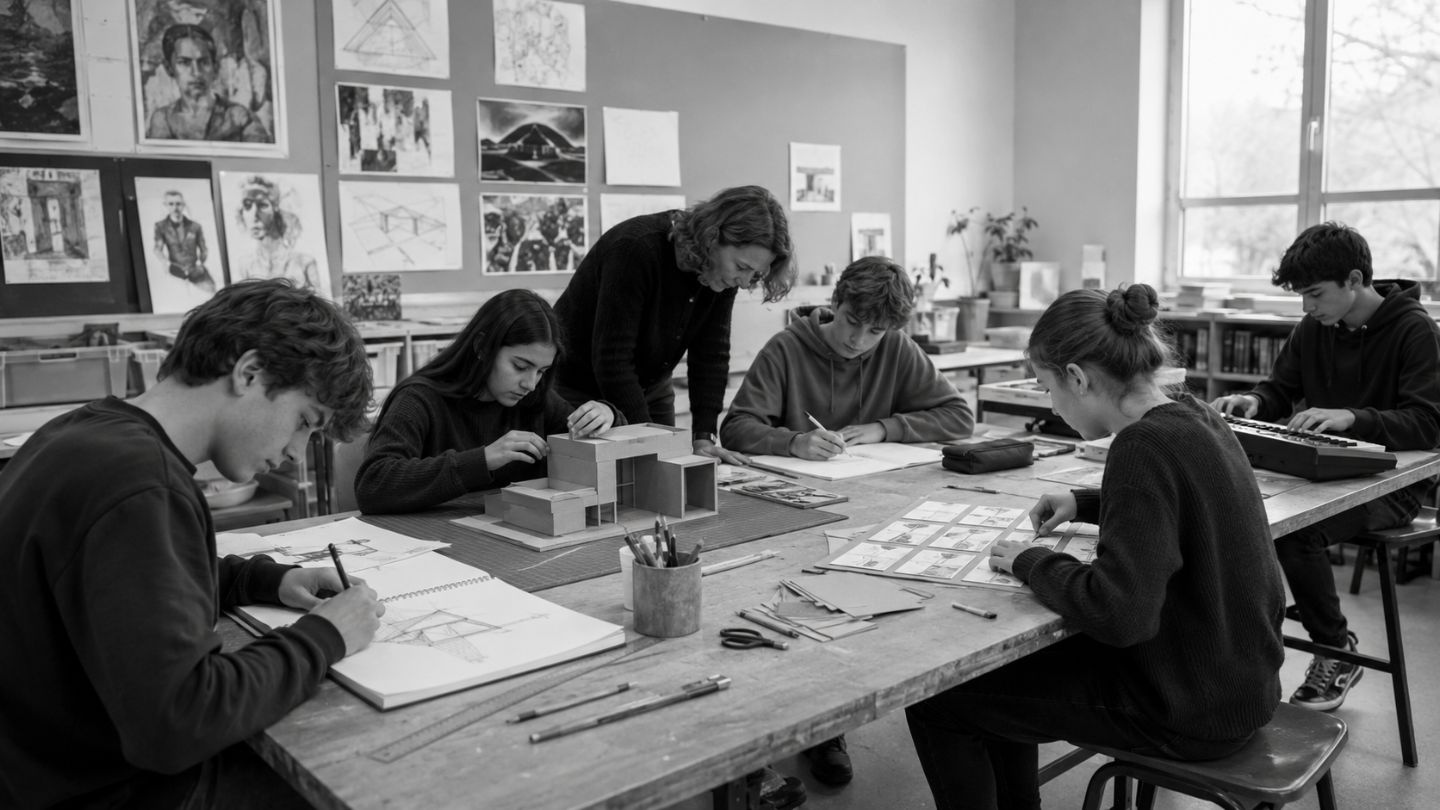
Schools should offer more creative courses because students need regular opportunities to generate, test, revise, interpret, and communicate ideas. These courses may include visual art, music, drama, dance, creative writing, design, film, media production, crafts, coding, making, and interdisciplinary science, technology, engineering, arts, and mathematics projects.
The educational case extends beyond examination scores. Creative courses teach distinct disciplines, give students structured practice in improving ideas, and widen access to cultural and practical learning. Research connects selected forms of arts participation and supportive classroom conditions with creative thinking, engagement, writing, empathy, and some academic outcomes. However, the strength and type of evidence vary.
Creative courses should therefore complement foundational subjects rather than replace them. Their value depends on clear learning goals, suitable teaching, regular participation, accessible provision, and assessment that recognizes both the creative process and completed work.
Answer summary: Schools have several defensible reasons to provide more creative courses. These subjects give students guided practice in developing and revising ideas, may support engagement and selected learning outcomes, and widen access to cultural and creative education. Responsible expansion requires clear course aims, supported teachers, adequate curriculum time, accessible participation, suitable assessment, and evaluation within the school’s own context.
Table of Content
- What Counts as a Creative Course?
- How Do Creative Courses Develop Ideas?
- What Does the Evidence Say About Student Outcomes?
- Why Does Their Value Extend Beyond Test Scores?
- How Can Wider Provision Improve Access and Choice?
- How Can Creative and Core Subjects Work Together?
- What Are the Main Objections?
- How Can Schools Expand Creative Courses Responsibly?
- A Balanced Case for More Creative Courses
Key takeaways:
-
Creative courses include more than visual art.
-
Generating, testing, critiquing, and revising ideas are processes students can practise.
-
Evidence is positive in selected areas but does not support universal promises.
-
Creative and foundational subjects can serve complementary purposes.
-
Access depends on scheduling, cost, disability inclusion, and course availability.
-
Course quality matters more than adding subject names to a timetable.
-
Schools can begin with a defined pilot and review it before expanding.
What Counts as a Creative Course?
A creative course is a timetabled subject in which students produce, interpret, test, revise, perform, design, or communicate original work. The term is used here as a practical category rather than a standardized research definition.
Dedicated arts subjects
Visual art, music, drama, and dance are clear examples. Each has its own knowledge, techniques, vocabulary, traditions, and standards of judgment.
Students do not participate only for personal expression. They may also study form, context, composition, interpretation, technique, and audience. Progress often involves practice, feedback, revision, and increasingly informed decisions.
Readers seeking a wider overview can also examine arts education and its benefits for study and career.
Writing, design, media, and making
Creative courses can also include creative writing, photography, film, graphic design, architecture basics, crafts, media production, coding, makerspace work, and selected interdisciplinary STEAM projects.
In digital and creative education, students should make purposeful decisions about tools, audience, form, testing, revision, and presentation. Simply using a device or completing a pre-designed digital task does not necessarily make a course creative.
Evidence about one discipline should not automatically be applied to every course in this wider category. A music program, a design project, and a creative-writing course may use different teaching methods and produce different outcomes.
Dedicated courses and creative teaching are different
Creative teaching refers to methods used within subjects such as mathematics, science, languages, or social studies. Dedicated creative courses teach an artistic, design, writing, media, or making discipline in its own right.
Both approaches can belong in the same curriculum. Cross-subject projects allow students to apply ideas, while protected courses provide time for sustained disciplinary learning. Creative teaching across the curriculum should not become a reason to remove dedicated arts or design subjects.
How Do Creative Courses Develop Ideas?
Creative thinking is not limited to sudden inspiration. It can involve producing possibilities, comparing them, working within constraints, testing an approach, receiving criticism, revising the work, and explaining the final choices.
The OECD’s PISA 2022 creative-thinking assessment examined 15-year-old students in 64 countries and economies. It defined the assessed competence as generating, evaluating, and improving original and diverse ideas. The assessment focused on performance in defined tasks rather than labeling students as inherently creative or non-creative.
OECD analysis found that students who reported classroom practices that encouraged creativity performed slightly better after accounting for socioeconomic background and mathematics and reading performance. This was an association, not evidence that adding a particular course would cause a measurable score increase.
The OECD also reported that participation in activities such as art, drama, creative writing, or programming about once a week was associated with better creative-thinking performance than participation that was infrequent or daily. The report presents this as an observed pattern rather than a universal timetable prescription.
Schools considering related classroom methods can review approaches for teaching critical, creative, and independent thinking.
What Does the Evidence Say About Student Outcomes?
Research supports a measured case for creative and arts participation, but the evidence varies by outcome and study design. Associations, evidence syntheses, randomized interventions, and policy frameworks should not be treated as equivalent forms of proof.
| Outcome area | Evidence indicates | Main limitation |
|---|---|---|
| Creative thinking | OECD data associate supportive teaching and approximately weekly participation in selected activities with slightly stronger performance. | The findings are associations and do not prove that a new course caused the difference. |
| Academic learning | The Education Endowment Foundation reports a positive average effect of about three additional months of progress in other curriculum areas. | The evidence is rated moderate, and the average does not predict results in every school. |
| Writing, empathy, discipline, and engagement | A randomized Houston study found improved writing achievement and emotional empathy and fewer disciplinary infractions. Elementary pupils also showed gains in selected outcomes. | The study examined a particular intervention in 42 schools in one U.S. city. |
| Social-emotional and academic outcomes | A National Endowment for the Arts report found positive relationships using three U.S. longitudinal datasets. | The evidence is observational and does not establish that participation caused the outcomes. |
| Cultural and educational value | UNESCO places culture and the arts within education policies, curricula, and teacher preparation. | This is a policy position rather than a universal measured effect. |
Evidence from a randomized school program
A randomized controlled trial can support stronger causal conclusions than an observational comparison when assignment and implementation are appropriately managed.
Daniel H. Bowen and Brian Kisida’s randomized Houston arts-education study was published in the Journal of Policy Analysis and Management in 2023. It involved 42 elementary and middle schools in Houston, Texas.
The researchers reported fewer disciplinary infractions, improved writing achievement, and increased emotional empathy among students assigned additional arts opportunities. Among elementary students, who were the program’s primary focus, they also found increases in school engagement, college aspirations, and cognitive empathy.
These findings apply to the intervention that was studied, not to every creative course. The program involved a specific population, partnership structure, amount of exposure, and urban U.S. setting.
Academic transfer is possible but variable
The Education Endowment Foundation’s Arts Participation toolkit reports that the average effect on learning in other curriculum areas is positive but moderate, equivalent to about three additional months of progress.
The toolkit identifies outcomes in English, mathematics, and science. It rates the evidence as moderate and states that 80 studies were identified. It also notes that many studies were not independently evaluated and that evaluations conducted by organizations connected with the approach tended to report larger effects. The evidence review was last updated in July 2021. (EEF)
The reported average is not a promise to parents, students, or school boards. Results may differ by age, art form, teaching quality, program duration, and measured outcome.
Grades should also not be the sole reason for providing music, drama, art, writing, or design. A subject can have educational value even when transfer to mathematics, science, or language attainment remains uncertain.
Longitudinal evidence shows relationships, not proof
The National Endowment for the Arts’ report on childhood and adolescent arts education analyzes three longitudinal datasets from the U.S. Department of Education’s National Center for Education Statistics.
The report describes positive relationships between arts participation and selected social-emotional and academic outcomes. Because the evidence is observational, differences among participants may help explain the findings. It supports further investigation rather than universal causal claims.
The available evidence does not support claims that creative courses automatically raise grades, work identically for every learner, treat mental-health conditions, or secure employment.
Why Does Their Value Extend Beyond Test Scores?
Creative subjects contain knowledge and practices worth learning even when their effects on examination performance are uncertain.
Students encounter artistic traditions, cultural forms, design choices, performance conventions, methods of interpretation, and standards of craft. They learn how different media shape meaning, how creators work within constraints, and how audiences may interpret the same work differently.
UNESCO Member States adopted the Framework for Culture and Arts Education on 15 February 2024. The framework calls for culture and the arts to receive greater attention in educational policies, curricula, programs, and teacher preparation. It also emphasizes local and Indigenous cultures, heritage, cultural diversity, digital technologies, and partnerships between educational and cultural institutions.
The UNESCO framework is a policy document rather than an outcome study. It explains why culture and the arts deserve a place in education, but it does not prove that one timetable model will produce the same results in every school.
Creative subjects therefore do not need to justify their existence only through gains in other subjects. Mathematics is not expected to prove that it improves drawing, and music should not be valued only when it raises mathematics scores.
How Can Wider Provision Improve Access and Choice?
School provision can give students access to creative learning without requiring every family to arrange private lessons, specialist equipment, extracurricular travel, or instruction outside school.
This is an equity rationale rather than proof of a measured effect. Adding a course does not automatically remove every barrier.
The Education Endowment Foundation notes that extracurricular activities and cultural visits may create financial barriers for pupils from disadvantaged backgrounds. OECD findings also indicate that access to creative opportunities differs among schools and student groups. These findings are context-dependent and do not quantify how much a new course would reduce inequality in one school.
A subject may appear in a course catalog while remaining difficult to join because of:
-
timetable clashes;
-
material or equipment charges;
-
inaccessible rooms or software;
-
transport requirements;
-
selective entry rules;
-
limited course places;
-
insufficient support for students with disabilities.
Schools should therefore examine who enrolls, who continues, whose work is represented, and which students remain absent.
Choice also requires more than one short elective. A single annual art option is not the same as sustained opportunities across music, drama, writing, design, media, and making. Schools do not need to provide every discipline at once, but they can avoid treating one course as a substitute for the entire creative field.
Parents and curriculum decision-makers may also find value in a broader guide to understanding school curriculum and programs.
How Can Creative and Core Subjects Work Together?
Creative and foundational academic subjects can serve complementary purposes. Curriculum planning involves trade-offs, but creativity and knowledge are not opposing educational goals.
Creativity depends on knowledge
Students need subject knowledge to make informed creative decisions.
A writer needs vocabulary, genre awareness, and an understanding of audience. A designer needs knowledge of materials, function, proportion, and constraints. A musician needs knowledge of rhythm, structure, technique, and interpretation.
Creativity is not an alternative to learning facts or disciplinary methods. It is one way students use, combine, question, and communicate what they know.
Dedicated courses can connect with other subjects
Connections across subjects are useful when they follow genuine learning goals.
Design may involve measurement and physics. Documentary work may combine research, writing, visual communication, and ethical judgment. Creative writing may deepen attention to language, evidence, and perspective.
Related approaches are discussed in Collegenp’s article on education that fosters creativity and innovation.
Creative subjects need their own integrity
Arts and design should not be used only as decoration for another lesson. A poster made during a science class is not equivalent to sustained learning in visual communication. Acting out a historical event is not the same as studying drama.
Cross-curricular work is strongest when each contributing discipline has clear aims, suitable teaching, and enough time for students to develop their work rather than complete a brief display task.
What Are the Main Objections?
The main concerns about creative-course expansion involve time, cost, assessment, academic priorities, prior experience, and uneven quality. These concerns require practical planning rather than dismissal.
“There is no room in the timetable”
A school can begin with a protected weekly block, a term-based pilot, or a rotation among disciplines. The chosen format should provide enough continuity for instruction, feedback, practice, and revision.
An occasional activity day may introduce a subject, but it is not equivalent to a sequenced course. Schools can review a pilot before deciding whether to expand, revise, or discontinue it.
“Creative courses cost too much”
Costs differ by discipline and local conditions. Writing, drama, reused materials, and selected digital work require different resources from instrumental music, ceramics, or film production.
Existing equipment, staff knowledge, shared resources, and community partnerships may reduce some barriers. Schools should still prepare a realistic budget covering materials, maintenance, training, accessibility, transport, and replacement costs.
The Education Endowment Foundation reports that costs can range from very low to high depending on the provision. Specialist tuition, small groups, and activities outside the school day may cost more than regular classroom provision.
“Creative work is too subjective to assess”
Assessment does not require one correct answer. Teachers can use transparent criteria for:
-
understanding of the task;
-
technical or disciplinary control;
-
quality of decision-making;
-
testing and revision;
-
reflection and explanation;
-
collaboration where relevant;
-
presentation of completed work.
A rubric can clarify expectations without forcing every student toward the same response. Assessment can consider both the process and the result rather than rewarding appearance alone.
“Only talented students benefit”
A school course should teach development rather than select only students who already perform well. Beginners need suitable starting points, instruction, practice, feedback, and opportunities to revise.
Prior experience may affect a student’s starting level, but it should not determine who belongs in a course. Assessment can recognize developing knowledge and control while maintaining meaningful standards.
“Academic results matter more”
Academic outcomes matter, but they are not the only educational outcomes. Selected arts interventions have reported academic, engagement, writing, or social-emotional outcomes, while cultural and disciplinary learning provides a separate reason for inclusion.
Schools can protect literacy, mathematics, science, and other foundational subjects while judging creative courses through clear aims, student work, participation, teaching quality, and suitable evidence.
“A new course may be poorly designed”
Adding a course name does not ensure worthwhile learning. A weak course may lack clear aims, sufficient time, trained staff, suitable materials, progression, meaningful feedback, or fair access.
Before expansion, schools should check whether the proposed course has:
-
defined disciplinary learning goals;
-
enough time for practice and revision;
-
teacher knowledge or specialist support;
-
accessible facilities and materials;
-
clear assessment criteria;
-
entry points for beginners;
-
a plan for reviewing participation and student work.
Quality, frequency, teacher support, access, and local context influence what a course is likely to achieve.
How Can Schools Expand Creative Courses Responsibly?
A phased process allows a school to learn from a defined starting point before committing to wider expansion.
Phase 1: Audit access and define a pilot
Begin by recording which creative subjects are already available, which grades receive them, how much time they receive, and whether fees, selection rules, materials, or timetable clashes restrict participation.
Consult students and teachers about interests, barriers, facilities, staff strengths, and suitable formats. Consultation should inform curriculum judgment rather than replace it.
Choose a defined pilot with:
-
a named subject or discipline;
-
a specific student group;
-
a stated duration;
-
clear learning goals;
-
identified teachers or partners;
-
an agreed review date.
The pilot should run long enough for teaching, practice, critique, and revision.
Phase 2: Support teaching and widen access
Teachers need planning time, suitable materials, relevant professional learning, and access to subject specialists where required.
Community arts organizations, practitioners, libraries, universities, or cultural institutions may contribute expertise or equipment. Before relying on a partnership, schools should examine continuity, safeguarding, scheduling, accessibility, and responsibility.
Access checks should cover:
-
material or equipment charges;
-
disability access;
-
transport;
-
scheduling;
-
beginner participation;
-
cultural representation;
-
access to devices or software;
-
workload for students and teachers.
School-wide expansion should follow evidence from the pilot rather than assume that one model will suit every grade or discipline.
Phase 3: Review evidence and decide what to expand
Evaluation should match the course’s stated aims. Schools may review:
-
enrollment and continued participation;
-
attendance;
-
student work and portfolios;
-
progress in disciplinary knowledge;
-
use of feedback and revision;
-
student engagement;
-
teacher observations;
-
student and family feedback;
-
participation gaps among groups.
No single measure is likely to capture every form of creative learning. Satisfaction alone is insufficient, while one standardized test may overlook the process and disciplinary knowledge the course was designed to teach.
After a term or year, the school can decide what to retain, revise, expand, combine, or discontinue. The review should consider learning quality, access, staffing, cost, workload, and effects on the wider timetable.
A Balanced Case for More Creative Courses
Schools have several defensible reasons to offer more creative courses. These subjects give students sustained practice in producing and improving ideas, teach cultural and disciplinary knowledge, may support selected academic and social outcomes, and can widen access to learning that is not equally available outside school.
The evidence remains conditional. A result from one program or country does not establish the same outcome elsewhere, and adding course titles does not create quality. Schools need supported teachers, adequate time, suitable assessment, accessible participation, and review against stated goals.
A practical starting point is to examine what students can regularly write, design, make, perform, interpret, test, and revise within the current timetable. Where those opportunities are narrow or uneven, a carefully planned expansion of creative courses is a reasonable part of balanced education.





Comments 0
No comments yet. Be the first to start the conversation.