



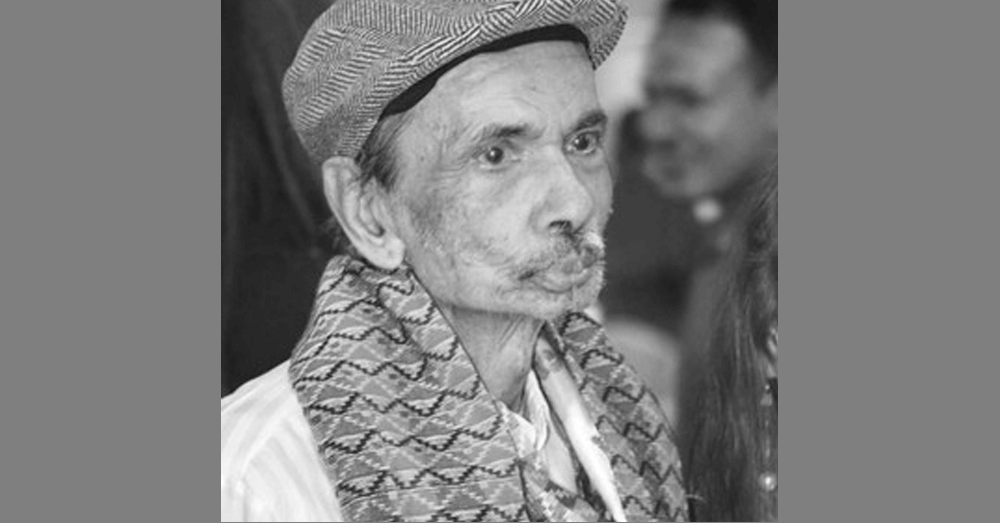
Bhakta Raj Acharya (1942–2024 AD; 1999–2080 BS) was a Nepali singer and composer known for his contributions to Nepali light music (Sugam Sangeet). His work in modern songs, ghazals, devotional music, and patriotic songs established his place in the history of Nepali music. He was particularly recognized for his devotional singing and was widely known as Bhajan Shiromani.
Born in Dhankuta, Nepal, Acharya spent his childhood in the Dooars region of West Bengal, India. He developed his musical skills there before moving to Kathmandu, where he began his professional singing career through Radio Nepal. Winning first place in the vocal category of the nationwide National Song Competition in 2030 BS was an important achievement in his musical career.
Some of his best-known songs include "Hajar Sapanaharuko Maya Lagera Aauchha," "Jati Chot Dinchhau," "Mutu Jalirahechha," "Jahan Chhan Buddhaka Aankha," and "Maya Meri Sanjh Bani." In addition to singing compositions written by different lyricists, he composed the music for many of his recordings.
Health problems shortened his active singing career. Nevertheless, his recorded songs, musical compositions, and devotional performances established his distinctive identity in Nepali light music.
Bhakta Raj Acharya: Quick Facts
|
Particulars |
Details |
|---|---|
|
Full Name |
Bhakta Raj Acharya |
|
Birth |
1999 BS (1942 AD) |
|
Birthplace |
Dhankuta, Nepal |
|
Father |
Balbhadra Acharya |
|
Mother |
Renuka Acharya |
|
Death |
Falgun 14, 2080 BS (February 26, 2024) |
|
Profession |
Singer and composer |
|
Major Musical Genres |
Modern songs, ghazals, bhajans, patriotic songs, and children's songs |
|
Popular Title |
Bhajan Shiromani |
|
Main Professional Association |
Radio Nepal and Nepali light music |
|
Spouse |
Sushila Acharya |
|
Sons |
Satya Raj Acharya and Swaroop Raj Acharya |
Published sources provide different figures for the number of songs Acharya recorded. Radio Nepal and Kantipur, among others, report approximately 400 songs, while the Nepali Pratibha Pratisthan, UK, mentions approximately 450. Without a complete and verified discography, neither figure can be treated as definitive.
Birth, Family, and Childhood
Bhakta Raj Acharya was born in Dhankuta to Balbhadra Acharya and Renuka Acharya. His father died when he was very young.
Following his father's death, his family moved to the Dooars region of India, where Acharya spent his early years.
In an interview with Bhupendra Khadka in 2077 BS, Acharya recalled that his family moved from Dhankuta to Dooars in 2000 BS after his father's death. According to him, financial difficulties prevented him from continuing regular schooling beyond the primary level.
Although he could not pursue further formal education, he studied English privately. He also continued developing his interest in music alongside his work.
While working in the tea gardens of Dooars, Acharya found opportunities to sing and practice musical instruments. This environment became an important part of his early musical development.
Early Musical Education and Practice
Bhakta Raj Acharya developed his musical knowledge primarily through continuous practice, contact with people interested in music, and experience with available instruments.
He gained practical musical experience while working in the Dooars region of India. His practice became more systematic after he began working at the Samsing Tea Garden.
Musical Training with D. B. Ghising
According to Acharya, D. B. Ghising, the head clerk at Samsing Tea Garden, was interested in music. Ghising had access to instruments such as the harmonium, tabla, and guitar.
Acharya practiced music with him and learned about certain ragas and chords.
This experience helped him understand musical instruments and composition alongside vocal performance.
Learning Staff Notation from Dibya Khaling
Acharya also stated that he learned staff notation from composer Dibya Khaling.
Staff notation is a system of representing musical notes, rhythm, and other musical information in written form.
Understanding this system helps musicians study musical structures and practice compositions systematically.
The training and regular practice Acharya received in Dooars formed the foundation of his singing and composing abilities. He later applied this knowledge in his work as both a singer and composer.
Early Attempts in Kathmandu and Entry into Radio Nepal
Bhakta Raj Acharya had visited Nepal in search of singing opportunities before establishing himself professionally in 2030 BS.
According to his interview, he first arrived in Kathmandu in 2020 BS. At that time, he passed Radio Nepal's vocal audition but did not receive an opportunity to record a song.
Unable to afford to remain in Kathmandu, he returned to Dooars.
He continued working in the tea gardens while practicing music. Over the following years, he devoted time to classical music and prepared to return to Nepal.
Arrival in Kathmandu in 2030 BS
In his interview, Acharya stated that he arrived in Kathmandu on Chaitra 5, 2030 BS.
After arriving, he met singer Kumar Basnet. With Basnet's assistance, he came into contact with composer Natikaji and received an opportunity to record a song at Radio Nepal.
According to Acharya, he recorded his first song the following day.
First Recorded Song
Bhakta Raj Acharya's first recorded song was "Malai Jeevan Chahinchha."
The lyrics were written by Nakulkaji, while Acharya himself composed the music.
After recording his first song, he began seeking further musical opportunities. During this period, he participated in the nationwide National Song Competition.
In later interviews, Acharya described the day he recorded his first song as one of the most memorable moments of his musical career.
The National Song Competition of 2030 BS
Winning first place in the nationwide National Song Competition held in 2030 BS marked an important turning point in Bhakta Raj Acharya's professional career.
To participate in the competition, he approached composer Amber Gurung for a song.
Gurung gave him "Hoshiyar Yasbakhat Samayako Mukhailai China," a song for which Gurung had written the lyrics and composed the music.
Acharya performed the song and secured first place in the vocal category.
Following this achievement, his musical activities at Radio Nepal expanded.
Earlier Acquaintance with Amber Gurung
Acharya and Amber Gurung had met before the competition.
According to Acharya, Gurung visited Dooars in 2024 BS to attend a cultural program in West Bengal.
Acharya performed Hindi and Bengali songs at the event. Their acquaintance from that occasion later encouraged him to approach Gurung for a competition song in Kathmandu.
His success in the National Song Competition helped establish public recognition of his singing abilities.
Professional Musical Career at Radio Nepal
Radio Nepal was the principal institution associated with Bhakta Raj Acharya's professional musical career.
Following his success in the competition, he received opportunities to record songs, compose music, and collaborate with different lyricists and musicians.
In an interview, he stated that he began working at Radio Nepal on a daily-wage basis in 2031 BS. He later entered the institution's regular service.
During his time at Radio Nepal, he recorded modern songs, ghazals, bhajans, patriotic songs, and children's songs.
He also performed compositions for which he had created the music himself.
His Work as Both Singer and Composer
Bhakta Raj Acharya's musical contribution was not limited to vocal performance.
He composed the music for many of the songs he sang. Publications by the Nepali Pratibha Pratisthan, UK, and recollections by contemporary singers also acknowledge that he performed numerous songs featuring his own compositions.
As a composer, he sought to create melodies suited to the words and emotions of each song.
As a singer, he performed those compositions with clear pronunciation, rhythmic precision, and vocal control.
These combined abilities established him as both a singer and composer in Nepali light music.
Popular Songs of Bhakta Raj Acharya
Modern songs, ghazals, and patriotic compositions occupied an important place in Bhakta Raj Acharya's musical career.
His well-known songs include:
-
Hajar Sapanaharuko Maya Lagera Aauchha
-
Jati Chot Dinchhau
-
Mutu Jalirahechha
-
Jahan Chhan Buddhaka Aankha
-
Hajar Aankha Herne Meri Mayalulai
-
Maya Meri Sanjh Bani
-
Jeevan Bhanun Ta
-
Kohi Nagaros Prem
-
Malai Jeevan Chahinchha
These songs address themes such as love, relationships, human emotions, perspectives on life, and national identity.
Acharya's recordings demonstrate that his work extended across different themes and musical genres.
Hajar Sapanaharuko Maya Lagera Aauchha
"Hajar Sapanaharuko Maya Lagera Aauchha" is one of Bhakta Raj Acharya's well-known modern songs.
The lyrics were written by poet Ishwar Ballabh, while Acharya composed the music and provided the vocals.
Poet and literary critic Abhi Subedi discussed the song's poetic qualities and Acharya's musical interpretation in an article published in The Kathmandu Post.
The song is an example of Acharya's ability to present literary writing through music.
It also demonstrates the relationship between lyrics, melody, and vocal expression in his work.
Jati Chot Dinchhau
"Jati Chot Dinchhau" is among Acharya's emotionally expressive songs.
The composition addresses pain and sensitivity experienced in romantic relationships. Acharya's vocal delivery reflects the meaning of the lyrics.
His performance is restrained, with clear pronunciation and the use of rhythm and vocal expression appropriate to the song's emotional content.
Mutu Jalirahechha
"Mutu Jalirahechha" is another familiar song recorded in Acharya's voice.
The song expresses personal experiences and emotional states.
It is one of the compositions that can be considered when examining his singing style.
Jahan Chhan Buddhaka Aankha
"Jahan Chhan Buddhaka Aankha" is a song associated with patriotic sentiment.
The composition expresses Nepal's cultural identity through its association with Buddha and conveys feelings toward the country.
Musicians also performed the song during the final tribute ceremony held after Acharya's death.
Maya Meri Sanjh Bani
"Maya Meri Sanjh Bani" is another well-known modern song performed by Acharya.
The composition expresses themes of love and emotional closeness.
The song is also mentioned in recollections of listeners who heard Acharya's music through Radio Nepal during the 2030s BS.
It provides insight into the early years of his professional singing career.
Bhakta Raj Acharya's Singing Style
Bhakta Raj Acharya's singing was characterized by control over musical pitch, clear pronunciation, and vocal expression suited to the emotional content of a song.
Contemporary musicians and music critics have particularly highlighted these qualities.
Control Over Pitch and Rhythm
Acharya practiced classical music, and its influence can be observed in his vocal technique.
In a recollection of Acharya's singing, singer Deep Shrestha identified his attentiveness to musical pitch as an important characteristic.
Maintaining vocal control, using melodic movement appropriately, and sustaining rhythm were notable aspects of his performances.
Clear Pronunciation
Acharya placed considerable importance on the pronunciation of words while singing.
His interview from 2077 BS also addressed how incorrect pronunciation could change the meaning of a word.
Clear pronunciation helps listeners understand the meaning of lyrics. It becomes particularly important when literary compositions are presented through music.
Deep Shrestha also highlighted the clarity of Acharya's pronunciation in his assessment of the singer's work.
Expression Appropriate to the Lyrics
Acharya adopted a singing style that conveyed the emotions expressed in the lyrics.
Changes in vocal intensity, rhythm, and expression can be heard in his performances according to the subject of each song.
This approach supported his work in emotionally expressive modern songs and ghazals.
An assessment of his singing style therefore requires consideration not only of the quality of his voice but also of the relationship between lyrics, melody, and vocal performance.
Contributions to Modern Songs and Ghazals
Modern songs and ghazals were important genres during Bhakta Raj Acharya's active musical career.
Through modern songs, he expressed themes of love, relationships, reflections on life, and personal experiences.
In ghazal singing, the relationship between words, rhythm, and emotion is particularly important. Acharya's clear pronunciation and vocal control were also relevant to his performances in this genre.
The use of literary compositions was a notable aspect of his musical work.
In an interview, he stated that he had composed and performed songs written by poets and lyricists including Ishwar Ballabh, Kshetra Pratap Adhikari, and Dinesh Adhikari.
These collaborations connected his singing and composing with contemporary Nepali literature.
Understanding Acharya's musical contributions therefore requires examining the literary foundations of his songs alongside their melodies.
Contributions to Devotional Music
Bhakta Raj Acharya's devotional singing was a major reason he became widely known as Bhajan Shiromani.
Bhajans are a form of music associated with religious faith, spiritual reflection, and devotion.
Alongside modern songs, Acharya made devotional music an important part of his musical work.
Clarity of pronunciation and control over musical notes were regarded as important qualities of his bhajan performances.
Contemporary singer Deep Shrestha also praised Acharya's voice and delivery while discussing his devotional singing.
The Devotional Album Samarpan
The album Samarpan is an important recording associated with Bhakta Raj Acharya's devotional music.
According to Acharya's own account, Music Nepal released the devotional album in 2043 BS.
The album presented a collection of his bhajans to listeners.
Samarpan remains an important recorded work for studying Acharya's musical history beyond modern songs, particularly his contributions to devotional singing.
Patriotic Songs and Other Musical Genres
Bhakta Raj Acharya also performed patriotic songs and children's songs.
One of his earliest major public achievements was associated with a national song competition.
His performance in the 2030 BS competition demonstrated his ability to sing compositions expressing patriotic sentiment.
He subsequently recorded songs on a variety of subjects.
An interview published by Kantipur mentions modern songs, ghazals, bhajans, patriotic songs, and children's songs among his recordings.
This variety demonstrates that his musical work was not confined to a single genre.
Collaborations with Contemporary Lyricists and Musicians
Bhakta Raj Acharya developed his career during a period when numerous artists were active in Nepali modern music.
He collaborated with Amber Gurung and maintained musical connections with Narayan Gopal, Fatte Man Rajbhandari, and other musicians.
Relationship with Narayan Gopal
Bhakta Raj Acharya and Narayan Gopal were contemporary singers in Nepali modern music.
In an interview, Acharya described his relationship with Narayan Gopal as friendly.
According to Acharya, they discussed musical performance, pronunciation, and related subjects.
These discussions indicate that the two singers exchanged ideas about musical practice and vocal presentation.
Collaboration with Fatte Man Rajbhandari
Acharya also performed duets with singer Fatte Man Rajbhandari.
According to Acharya, they sang together in compositions for which he had written the music, as well as in compositions by Rajbhandari.
Such collaborations expanded Acharya's creative activities through his work with other singers and composers.
However, much of his musical identity remains associated with recordings featuring both his own compositions and vocals.
Health Problems That Interrupted His Singing Career
Bhakta Raj Acharya's active singing career was affected by serious health problems.
On Mangsir 19, 2046 BS, he was seriously injured in an attack in Kathmandu.
He received medical treatment following the incident. After some improvement in his condition, he returned to singing at public events.
Public Performance in 2049 BS
In an interview conducted in 2077 BS, Acharya recalled performing three songs at an event at Ratna Rajya Laxmi Campus in 2049 BS.
The songs he performed were:
-
Mutu Jalirahechha
-
Sagar Chha Gahabhitra
-
Jati Chot Dinchhau
He subsequently developed a health problem affecting his tongue.
Cancer and Medical Treatment
After problems appeared in his tongue, medical examinations identified cancer.
His treatment required surgery on his tongue, which severely affected his ability to speak and sing.
Available accounts mention both the attack in 2046 BS and his subsequent cancer diagnosis. However, sufficient medical evidence is not available to establish that the attack directly caused the cancer.
Following surgery, Acharya could no longer sing regularly as he had previously.
Although his professional singing career came to an end, the songs he had recorded remained part of Nepal's musical archive.
His Relationship with Music After He Stopped Singing
Bhakta Raj Acharya remained connected to music even after he could no longer sing regularly.
He continued listening to music and discussing songs with members of his family.
In his interview from 2077 BS, he stated that he offered feedback when his sons, Satya Raj and Swaroop Raj, played songs for him.
This suggests that his interest in music continued even after he withdrew from active singing.
In the same interview, he also mentioned composing music for two songs in the film Acharya, which was based on his life.
His involvement in musical composition therefore continued to a limited extent after his regular singing career ended.
Acharya: The Film Based on Bhakta Raj Acharya's Life
The Nepali film Acharya was released in 2011.
The film was directed by Prashant Rasaily.
Acharya's son, Satya Raj Acharya, portrayed his father in the film.
The story draws on Acharya's early life, musical training, professional experiences, and health-related events.
Available film credits also list Bhakta Raj Acharya as a music director.
Although biographical films can help audiences understand the lives of historical figures, their individual scenes should not automatically be treated as independently verified historical evidence.
Acharya presented his life story through cinema.
Awards and Honors Received by Bhakta Raj Acharya
Bhakta Raj Acharya received recognition at different stages of his career for his contributions to music.
First Place in the National Song Competition
Acharya secured first place in the vocal category of the nationwide National Song Competition held in 2030 BS.
He achieved this distinction by performing a song written and composed by Amber Gurung.
Pratibha Samman from Nepali Pratibha Pratisthan
The Nepali Pratibha Pratisthan, UK, presented Bhakta Raj Acharya with the Pratibha Samman in 2011.
According to the organization's published account, the award recognized his contributions to Nepali light music.
Padmashree Sadhana Samman
Bhakta Raj Acharya received the Padmashree Sadhana Samman for the year 2077 BS.
The Khemlal-Harikala Lamichhane Samaj Kalyan Pratisthan presented the honor in 2078 BS.
The award recognizes individuals who have devoted extended periods to creative pursuits, including music.
For Acharya, the honor represented institutional recognition of his dedication to music.
Family and Musical Continuity
Bhakta Raj Acharya's wife was Sushila Acharya.
His two sons, Satya Raj Acharya and Swaroop Raj Acharya, are active in Nepali music.
The brothers are also known collectively as Satya-Swaroop.
They have performed their father's songs at various musical programs.
Satya Raj Acharya also portrayed his father in the biographical film Acharya.
The brothers' connection with their father's music extends beyond family relationships into their professional musical careers.
Their performances have helped keep his compositions and singing style accessible to newer generations of listeners.
Death and Final Tributes
Bhakta Raj Acharya died on Falgun 14, 2080 BS (February 26, 2024).
Following health complications, he was taken to Nepal Mediciti Hospital in Lalitpur. Doctors confirmed his death upon his arrival at the hospital.
Radio Nepal, Kantipur, and other news organizations reported his death.
The following day, his body was placed at the premises of the Nepal Academy of Music and Drama for public tribute.
Musicians, public figures, and well-wishers gathered to pay their final respects.
Songs including "Jahan Chhan Buddhaka Aankha" and "Hajar Sapanaharuko Maya Lagera Aauchha" were performed during the tribute ceremony.
His cremation subsequently took place at Pashupati Aryaghat.
Bhakta Raj Acharya's Contributions to Nepali Music
Bhakta Raj Acharya's musical contributions can primarily be assessed through his singing, compositions, devotional performances, and collaborations with contemporary lyricists and musicians.
Vocal Expression in Modern Songs
Acharya brought clear pronunciation and emotionally appropriate vocal expression to modern Nepali songs.
Contemporary singers particularly highlighted his attention to pitch, rhythm, and the meaning of lyrics.
His recordings provide useful material for studying vocal performance in Nepali modern music.
Connection Between Literature and Music
Acharya composed and performed songs written by different poets and lyricists.
His work with literary compositions by poets such as Ishwar Ballabh illustrates his direct connection with Nepali literature.
These recordings demonstrate how he interpreted written lyrics through melody and vocal expression.
Contributions to Devotional Music
His devotional recordings and the album Samarpan document his involvement in bhajan singing.
His public recognition as Bhajan Shiromani is also an important part of his musical history.
Role as a Composer
Acharya composed the music for many of the songs he performed.
This distinguished him not only as a singer who interpreted the compositions of others but also as a composer in his own right.
Creating melodies suited to the emotional content of lyrics and then performing those melodies himself was an important part of his creative practice.
Importance of Preserving Musical Records
A complete and verified catalog of Acharya's songs, original recording dates, lyricists, composers, and other production credits would be valuable for musical research.
Published sources differ in their accounts of the number of songs he recorded. Researchers examining his contributions must therefore consider the reliability and origin of available records.
A comprehensive study of his work should also include lesser-known songs, devotional recordings, collaborations, and compositions alongside his most popular performances.
Conclusion
Bhakta Raj Acharya contributed to Nepali light music as both a singer and composer.
Born in Dhankuta, he practiced music in the Dooars region of India before moving to Kathmandu and beginning his professional singing career through Radio Nepal.
His success in the National Song Competition of 2030 BS marked a significant turning point in his career.
He subsequently worked in modern songs, ghazals, devotional music, patriotic songs, and other musical genres. Composing the music for many of his own recordings was a notable aspect of his creative work.
Although health problems brought his active singing career to an end, the compositions and recordings he produced remain important in the history of Nepali music.
His singing style, pronunciation, compositions, devotional performances, and collaborations with contemporary artists are important subjects for studying the musical heritage of Nepal.
References
1. Khadka, Bhupendra. (Mangsir 19, 2077 BS). Interview with Bhakta Raj Acharya: 'Here, the Asuras Rule!'. Kantipur.
2. Khadka, Bhupendra. (Mangsir 16, 2074 BS). Mangsir 19: The Day the Melody Was Lost. Kantipur.
3. Shrestha, Deep. (Falgun 19, 2080 BS). Bhaktaraj Gharana. Kantipur, Koseli.
4. Subedi, Abhi. (March 2, 2024). Bhakta Raj Acharya's Musical Times. The Kathmandu Post.
5. Moktan, Rina. (February 26, 2024). Veteran Singer, Composer Bhakta Raj Acharya Passes Away. The Kathmandu Post.
6. Radio Nepal. (February 26, 2024). Noted Singer, Musician Acharya Passes Away. Public Service Broadcasting, Radio Nepal.
7. Onta, Bishad Raj. (February 28, 2024). Bhakta Raj Acharya, 81. Nepali Times.
8. Nepali Pratibha Pratisthan, UK. (2015). Bhajan Shiromani Bhakta Raj Acharya.
9. Shilapatra. (Kartik 3, 2078 BS). Bhakta Raj Acharya Receives Padmashree Sadhana Samman and Keshav Dahal Receives Padmashree Puraskar.
10. Pariyar, Dhruvasatya. (Falgun 16, 2080 BS). When an Unknown Singer's Song Was Played on Radio Nepal: Maya Meri Sanjh Bani. Ratopati.
11. Onlinekhabar. (Falgun 15, 2080 BS). Jahan Chhan Buddhaka Aankha and Hajar Sapana Performed at Bhakta Raj Acharya's Farewell.
12. The Film Nepal. Acharya (2011): Cast and Crew. Film archive.


Comments 0
No comments yet. Be the first to start the conversation.