



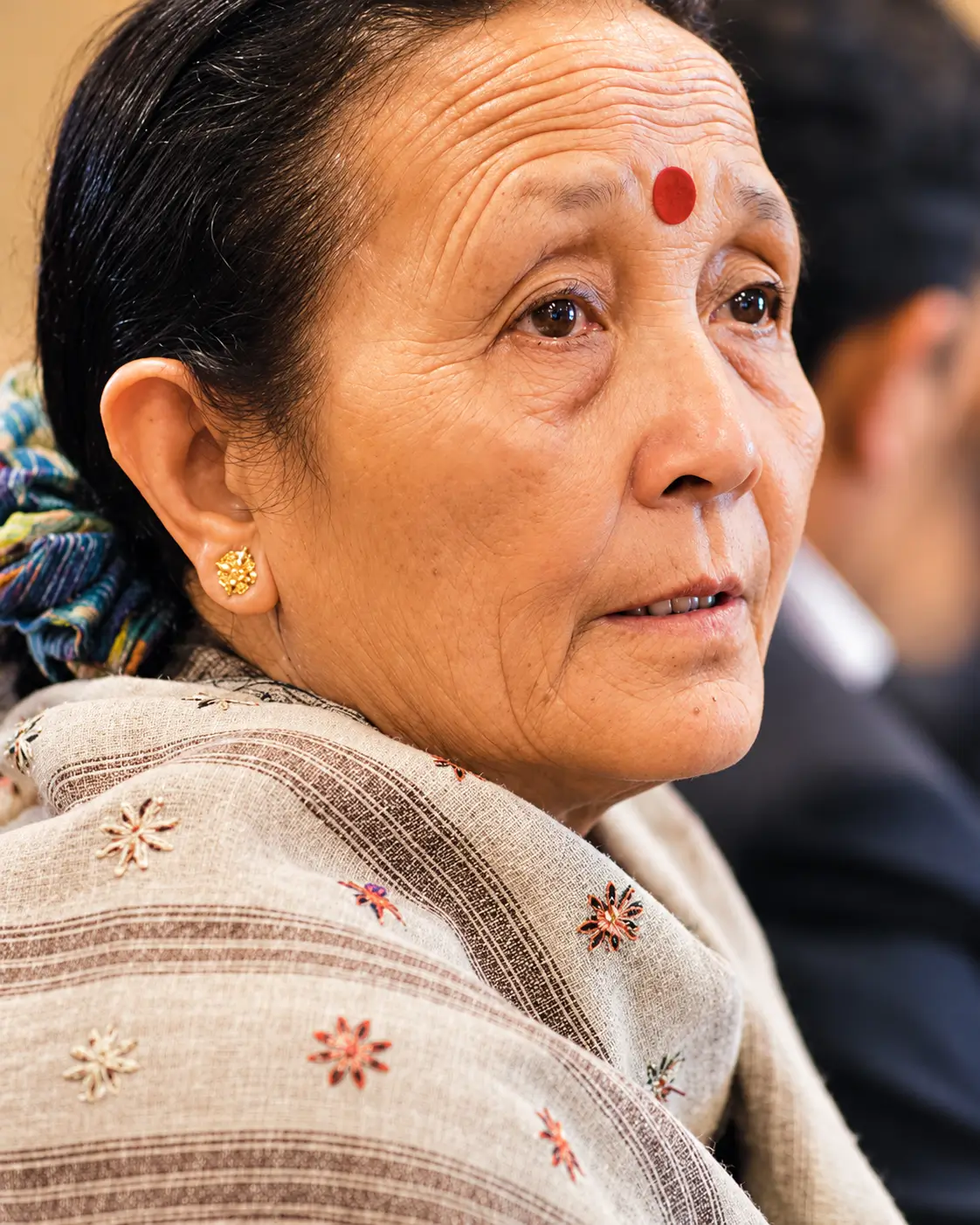
Anuradha Koirala is a Nepali social activist, the founder of Maiti Nepal, an organization working against human trafficking, and the first Province Chief of the former Province No. 3 (now Bagmati Province). She was born on April 14, 1949, in Okhaldhunga District, Nepal.
After spending approximately 25 years in the teaching profession, she established Maiti Nepal in 1993. Through the organization, she has worked to provide protection, rescue, rehabilitation, education, and healthcare services to women and children affected by human trafficking and violence.
In recognition of her contributions to social service, the American news network CNN named her CNN Hero of the Year in 2010. In 2017, the Government of India awarded her the Padma Shri.
Beyond her social activism, Koirala has held public and constitutional responsibilities. She served in a ministerial-level capacity in the then Ministry of Women, Children and Social Welfare during 2002–2003. In January 2018, she was appointed the first Province Chief of the then Province No. 3. Her tenure ended in November 2019.
Anuradha Koirala: Quick Facts
|
Details |
Information |
|---|---|
|
Full Name |
Anuradha Koirala |
|
Date of Birth |
April 14, 1949 |
|
Birthplace |
Okhaldhunga, Nepal |
|
Nationality |
Nepali |
|
Father's Name |
Colonel Pratap Singh Gurung |
|
School Education |
St. Joseph Convent School, Kalimpong, India |
|
Higher Education |
St. Xavier's College, Kolkata, India |
|
Academic Qualification |
Bachelor's degree in History |
|
Early Profession |
English language teacher |
|
Teaching Experience |
Approximately 25 years |
|
Main Areas of Work |
Human trafficking prevention, women's and children's rights, rescue, and rehabilitation |
|
Organization Founded |
Maiti Nepal (1993) |
|
Associated Educational Institution |
Teresa Academy |
|
Former Government Responsibility |
Ministerial-level responsibility in the Ministry of Women, Children and Social Welfare (2002–2003) |
|
Constitutional Position |
First Province Chief of the former Province No. 3 (2018–2019) |
|
Major International Honors |
CNN Hero of the Year (2010), Padma Shri (2017) |
Birth, Family Background, and Childhood
Anuradha Koirala was born on April 14, 1949, in Okhaldhunga District, Nepal. According to her official biography published by the Office of the Province Chief of the former Province No. 3, her father was Colonel Pratap Singh Gurung.
She spent most of her childhood in Kalimpong, West Bengal, India, where she received her early education.
In her autobiographical account published by The Annapurna Express on November 7, 2022, Koirala stated that she had been interested in social service since childhood.
Her family background, education, and personal experiences appear to have influenced her later decision to work for the protection of women and children.
Education and Teaching Career
Anuradha Koirala attended St. Joseph Convent School in Kalimpong, India, for her school education.
After completing school, she moved to Kolkata for higher education. In her autobiographical account, she stated that she graduated with a degree in History from St. Xavier's College.
Her official biography published by the Office of the Province Chief also lists her educational qualification as a Bachelor of Arts.
After completing her higher education, she returned to Nepal and began her teaching career. She taught English at various schools in Kathmandu.
In her autobiographical account, Koirala stated that she had spent 25 years teaching before establishing Maiti Nepal.
Her teaching career gave her opportunities to understand children's educational needs, family circumstances, and social problems. She later made education an important part of her social initiatives.
Personal Experiences and the Journey into Social Service
Anuradha Koirala has publicly spoken about experiencing domestic violence in her personal life.
In interviews and public statements, including a conversation with CNN in 2010, she discussed difficulties she had faced during her previous married life.
According to Koirala, these experiences helped her understand the circumstances of women facing violence and insecurity and recognize their need for safe shelter.
In the early 1990s, she came into contact with women living in difficult circumstances around the Pashupati area of Kathmandu.
Some of these women had experienced domestic violence and other social problems. Their situations were made more difficult by limited access to financial assistance, protection, and opportunities for self-reliance.
Koirala began helping these women. Her initial efforts eventually developed into an organized social initiative.
Establishment and Early Development of Maiti Nepal
Anuradha Koirala established Maiti Nepal in 1993.
The organization's initial objective was to provide safe shelter and necessary assistance to women and children affected by violence, trafficking, and exploitation.
Over the following years, Maiti Nepal expanded its activities to include human trafficking prevention, rescue, rehabilitation, healthcare, education, and legal assistance.
How Did Maiti Nepal Begin?
In her autobiographical account published in 2022, Koirala described the financial and administrative difficulties she encountered while establishing the organization.
According to her account, she had approximately NPR 30,000 when she started Maiti Nepal. This amount included personal savings and money obtained from selling jewelry.
She began the organization's initial activities in rented accommodation consisting of three rooms and a kitchen.
The premises provided shelter to women affected by human trafficking and violence. As the number of people requiring accommodation increased, providing food, housing, and other basic necessities became increasingly challenging.
Koirala stated that regular financial assistance was unavailable during the early years. She used her personal resources and even borrowed money from acquaintances to meet the needs of women and children living in the shelter.
Maiti Nepal gradually expanded its services as financial assistance became available from individuals and organizations.
Meaning of the Name 'Maiti Nepal'
In Nepali society, the word Maiti generally refers to a woman's parental home or the home where she was born and raised.
The name Maiti Nepal reflects the organization's objective of providing safe shelter and a sense of belonging to women affected by violence, trafficking, and other difficult circumstances.
The organization's approach extends beyond providing accommodation. It also prioritizes the safety, dignity, rights, and rehabilitation of affected individuals.
Anuradha Koirala's Campaign Against Human Trafficking
Anuradha Koirala's primary social contribution is associated with preventing human trafficking and protecting affected individuals.
Maiti Nepal, the organization she founded, has implemented programs involving public awareness, border monitoring, rescue, rehabilitation, healthcare, education, and legal assistance.
1. Human Trafficking Prevention and Public Awareness
Maiti Nepal conducts community-level awareness programs to inform people about the risks associated with human trafficking.
These programs aim to provide information about the safety of women and children, risks of exploitation, safe movement, and services available to people requiring assistance.
Human trafficking may involve deceptive promises of employment, marriage, education, or other opportunities. Traffickers may also use deception, coercion, or exploit a person's vulnerable circumstances.
Raising awareness about these risks and connecting people with appropriate assistance and protection services are important aspects of prevention programs.
2. Nepal–India Border Monitoring
To address the risk of human trafficking across the Nepal–India border, Maiti Nepal has operated transit homes and assistance programs at various locations.
The organization's official website provides information about transit homes in Kanchanpur, Kailali, Nepalgunj, Bardiya, and other locations.
Through these programs, the organization provides information and counseling to people at risk, assists with necessary protection measures, and coordinates with relevant authorities.
According to Koirala's biography published by the Office of the Province Chief, Maiti Nepal has also involved people affected by human trafficking as peer counselors and border monitors.
This approach seeks to use the experiences of affected individuals in awareness and protection programs.
Border monitoring and rescue activities must respect individuals' freedom of movement, privacy, and legal rights.
3. Cross-Border Rescue and Repatriation
Maiti Nepal has participated in efforts to rescue and repatriate Nepali women and children subjected to trafficking and exploitation in India and other locations.
Cross-border rescue operations require coordination among government authorities, police, social organizations, and other stakeholders in the countries concerned.
Following rescue, providing affected individuals with safe accommodation, healthcare, psychosocial counseling, and rehabilitation support is equally important.
4. The 1996 Mumbai Rescue Operation
A major rescue operation conducted in Mumbai, India, in 1996 was a significant event in the history of repatriation and rehabilitation of Nepali women and girls affected by human trafficking.
That year, Indian police conducted operations at various locations in Mumbai and rescued women and girls who had experienced trafficking and sexual exploitation.
According to a report submitted by the Government of Nepal to the United Nations, 128 Nepali women and girls were repatriated to Nepal following the operation.
The report identifies seven organizations that contributed to their repatriation and rehabilitation: Maiti Nepal, ABC Nepal, CWIN, Nava Jyoti, WOREC, Shanti Rehabilitation Centre, and Stri Shakti.
In her autobiographical account published in 2022, Koirala also stated that the number of people requiring shelter at Maiti Nepal increased following the Mumbai rescue operation.
The incident highlighted the importance of providing safe accommodation, healthcare, and long-term rehabilitation alongside rescue efforts for people affected by human trafficking.
5. Rehabilitation and Legal Assistance
People rescued from human trafficking may require different forms of assistance for their immediate safety and long-term rehabilitation.
Maiti Nepal's programs include services designed to address these needs.
The organization's principal areas of assistance include:
-
Safe accommodation and protection
-
Medical examinations, treatment, and access to necessary healthcare services
-
Psychosocial counseling
-
Formal and non-formal education
-
Vocational skills training
-
Legal assistance and support for access to justice
-
Family and community reunification and reintegration
Maiti Nepal has also participated in activities aimed at protecting the rights of affected individuals and raising public awareness against human trafficking.
6. Healthcare Services and Special Protection
Maiti Nepal also operates healthcare assistance programs for women and children.
Sonja Jeevan Kendra, a healthcare center under Maiti Nepal, was established in 2001.
According to the organization's official information, the center provides general health examinations, laboratory services, medicines, necessary counseling, and referrals for further treatment.
The center also reports providing services and counseling related to antiretroviral therapy (ART) for people living with HIV.
These services aim to address the healthcare and long-term protection needs of individuals affected by violence and trafficking.
Teresa Academy and Contributions to Children's Education
Teresa Academy, a school operated under Maiti Nepal, was established on April 2, 1998.
According to Maiti Nepal's official website, the school initially offered nursery, kindergarten, and Grade 1 classes. It enrolled 45 students during its initial period.
The school aims to provide access to education for children facing difficult economic and social circumstances, those without parental protection, and those at risk of trafficking.
Teresa Academy has particularly prioritized the education of children requiring protection and educational support.
This educational initiative demonstrates the connection between Anuradha Koirala's teaching experience and her campaign for the protection of women and children.
Advocacy for Laws and Policies Against Human Trafficking
Anuradha Koirala and Maiti Nepal have engaged in public awareness and policy advocacy concerning human trafficking prevention, protection of affected individuals, and access to justice.
One of Nepal's principal legal provisions addressing human trafficking is the Human Trafficking and Transportation (Control) Act, 2064 BS (2007).
The Act, published by the Nepal Law Commission, defines human trafficking and transportation as criminal offenses. It also includes provisions concerning investigation, punishment, victim protection, rehabilitation, and compensation.
Maiti Nepal's work is connected to efforts to improve legal awareness, protect affected individuals, and support access to justice.
However, legislation is developed through the state's legislative process. It would therefore be inappropriate to attribute the enactment of an entire law solely to one individual or organization.
Historical Background of Nepal's National Anti-Human Trafficking Day
Nepal observes National Anti-Human Trafficking Day every year on Bhadra 20 of the Nepali calendar.
The historical basis of this observance is not the 1996 Mumbai rescue operation. Rather, it is associated with the ratification of the SAARC Convention against trafficking in women and children.
The convention, adopted at the 11th SAARC Summit held in Kathmandu in 2002, was ratified by Nepal's then House of Representatives on Bhadra 20, 2063 BS.
In remembrance of that date, Nepal began observing National Anti-Human Trafficking Day annually on Bhadra 20, starting in 2064 BS.
Although Maiti Nepal and Anuradha Koirala's campaign forms part of Nepal's broader efforts against human trafficking, directly linking the establishment of the national observance to the 1996 Mumbai rescue operation would be factually incorrect.
Anuradha Koirala's Public and Political Career
Alongside her social activism, Anuradha Koirala has held responsibilities within Nepal's public administration and constitutional system.
Notable aspects of her public career include her ministerial-level responsibility during 2002–2003 and her tenure as Province Chief from 2018 to 2019.
Ministerial-Level Responsibility During 2002–2003
In 2002, Anuradha Koirala joined the government led by Lokendra Bahadur Chand, which had been appointed by the then King Gyanendra Shah.
A report published by Inter Press Service on October 12, 2002, stated that she had been appointed to a position responsible for women and social welfare.
The official list of former officeholders published by the relevant ministry places Koirala under the category of State Ministers. It records her tenure from Mangsir 2, 2059 BS, to Jestha 21, 2060 BS.
However, some contemporary news reports and other published biographies describe her designation as Assistant Minister. The ministry's official records classify her as a State Minister.
She held this responsibility during a period of political tension between Nepal's monarchy and parliamentary political parties.
Joining the Nepali Congress in 2017
Anuradha Koirala joined the Nepali Congress on November 12, 2017.
At a program organized in Baluwatar, Kathmandu, the then Prime Minister and Nepali Congress President Sher Bahadur Deuba welcomed her into the party.
The event publicly marked Koirala's formal political involvement after many years of leadership in social organizations.
Appointment as the First Province Chief of Province No. 3 in 2018
On January 17, 2018, the then government decided to appoint Anuradha Koirala as the Province Chief of Province No. 3.
On January 19, 2018, President Bidya Devi Bhandari administered the oath of office and secrecy to the newly appointed chiefs of all seven provinces.
Koirala became Nepal's first female Province Chief.
Her official workplace was Hetauda, which had been designated as the temporary capital of Province No. 3 at the time.
The Province Chief is a constitutional position appointed under Nepal's Constitution. Responsibilities associated with this office include constitutional functions relating to the formation of provincial governments, specified procedures involving the Provincial Assembly, and authentication of provincial laws.
Koirala performed these constitutional responsibilities during the initial years of Province No. 3.
During her tenure, the province was officially known as Province No. 3. The Provincial Assembly subsequently approved the name Bagmati on January 12, 2020.
Removal from the Position of Province Chief
On November 3, 2019, President Bidya Devi Bhandari removed the chiefs of all seven provinces following a recommendation from the then government led by KP Sharma Oli.
The decision ended Anuradha Koirala's tenure as Province Chief of Province No. 3.
She held the constitutional position for approximately 22 months, from January 2018 to November 2019.
Major Awards and Honors Received by Anuradha Koirala
Anuradha Koirala has received various national and international honors for her campaign against human trafficking and her contributions to protecting women and children.
Her major awards and honors include:
|
Year |
Award or Honor |
Awarding Organization or Country |
|---|---|---|
|
2006 |
Courage of Conscience Award |
The Peace Abbey, United States |
|
2010 |
CNN Hero of the Year |
CNN, United States |
|
2014 |
Mother Teresa Memorial International Award for Social Justice |
Harmony Foundation, India |
|
2017 |
Padma Shri |
Government of India |
CNN Hero of the Year 2010
In 2010, the American news network CNN named Anuradha Koirala its CNN Hero of the Year.
The CNN Heroes program recognizes individuals making notable contributions to social service.
Koirala was among the 10 CNN Heroes selected that year. She was named Hero of the Year through public voting.
She received the honor in recognition of her work through Maiti Nepal in preventing human trafficking and supporting rescue and rehabilitation.
Following the award, her social campaign received additional coverage in international media.
Padma Shri Award from the Government of India in 2017
The Government of India awarded Anuradha Koirala the Padma Shri in 2017.
The Padma Shri is India's fourth-highest civilian honor.
An official notification issued by India's President's Secretariat on April 13, 2017, listed Koirala as a recipient from Nepal in the field of social work.
The award formally recognized her contributions to social service at the level of the Government of India.
Anuradha Koirala's Social Contributions and Impact
Anuradha Koirala's principal social contribution has been advancing the protection and rehabilitation of people affected by human trafficking through organized institutional initiatives.
Maiti Nepal, which she founded, has operated various protection and assistance programs for more than three decades.
Protection of People Affected by Human Trafficking
People affected by human trafficking should not be viewed solely as individuals requiring rescue. They are also entitled to education, healthcare, safety, and a life of dignity.
Maiti Nepal's approach combines safe shelter with healthcare, counseling, education, and skills development.
This approach emphasizes the importance of addressing both immediate safety and long-term rehabilitation.
Participation of Affected Individuals
Maiti Nepal has adopted practices that involve people affected by human trafficking in counseling and prevention programs.
Such participation can help incorporate their experiences into public awareness and protection initiatives.
However, these programs must respect the voluntary participation, safety, privacy, and mental health needs of the individuals concerned.
Focus on Education and Self-Reliance
Maiti Nepal has connected education and vocational training programs with rehabilitation efforts.
Through educational initiatives such as Teresa Academy, the organization has worked to improve access to education for children requiring protection.
Similarly, vocational training aims to help affected individuals identify opportunities for financial independence and self-reliance.
These initiatives relate to the broader importance of education and skills development for Nepali women and girls.
Social and Institutional Cooperation
Human trafficking cannot be addressed through the efforts of a single individual or organization.
Prevention, investigation, rescue, healthcare, access to justice, and rehabilitation require coordination among government authorities, police, local communities, social organizations, and international partners.
Anuradha Koirala's social campaign forms part of these broader efforts to protect vulnerable individuals and promote women's rights and gender equality in Nepal.
Conclusion
Anuradha Koirala is an important figure in Nepal's social campaign against human trafficking.
Since establishing Maiti Nepal in 1993, she has worked in areas including the protection, rescue, rehabilitation, healthcare, education, and legal assistance of women and children.
The CNN Hero of the Year award in 2010 and the Padma Shri in 2017 are among her major international honors. She has also held ministerial-level responsibilities within the Government of Nepal and served as the country's first female Province Chief.
Her life and work help demonstrate the importance of preventing human trafficking while protecting the dignity, safety, rights, and long-term rehabilitation of affected individuals.
References
1. Office of the Province Chief, Bagmati Province. Anuradha Koirala – Official Bio-Data. Official record covering her date of birth, educational qualifications, family background, public responsibilities, and honors.
2. Anuradha Koirala. Anuradha Koirala: One Woman's Mission to Free Nepal from Human Trafficking. The Annapurna Express, November 7, 2022. First-person autobiographical account covering her birth, education, teaching experience, and the early history of Maiti Nepal.
3. Maiti Nepal. About the Founder/Chairperson. Official information about the founder and her social campaign.
4. Maiti Nepal. About Maiti Nepal. Official information about the organization's objectives and areas of work.
5. Maiti Nepal. Transit Homes. Official information about transit homes and the expansion of services.
6. Maiti Nepal. Teresa Academy – School. Official information about the school's establishment, objectives, and educational programs.
7. Maiti Nepal. Sonja Jeevan Kendra. Official information about the healthcare center's establishment and services.
8. Government of Nepal, Relevant Ministry. Former Ministers. Official records of former ministers, state ministers, and assistant ministers responsible for women and children's affairs.
9. Suman Pradhan. Nepal: King's Govt Sets Stage for Showdown with Politicians. Inter Press Service, October 12, 2002. Contemporary news report concerning Anuradha Koirala's appointment to the government.
10. Nepali Times. Anuradha Koirala Wins. November 22, 2010. News report concerning the CNN Hero of the Year award.
11. Government of India, President's Secretariat. The Gazette of India – Padma Awards Notification. April 13, 2017. Official record of the Padma Shri award.
12. The Kathmandu Post. Maiti Nepal's Koirala Joins Nepali Congress. November 12, 2017. News report concerning her entry into the Nepali Congress.
13. The Kathmandu Post. Govt Appoints Provincial Chiefs, Fixes Temporary Capitals. January 17, 2018. News report concerning the appointment of provincial chiefs.
14. The Kathmandu Post. President, Acting on Cabinet Decision, Removes Governors of All Seven Provinces. November 3, 2019. News report concerning the removal of provincial chiefs.
15. The Kathmandu Post. Province 3 Assembly Endorses Bagmati as the Name of the Province by Majority Votes. January 12, 2020. News report concerning the naming of Bagmati Province.
16. Nepal Law Commission. Human Trafficking and Transportation (Control) Act, 2064 BS. Official legal source concerning human trafficking and transportation control.
17. Gorkhapatra. Today's Latest Objective Questions and Answers Related to Public Service Examinations. Information concerning the historical basis of Nepal's National Anti-Human Trafficking Day.
18. Government of Nepal. Initial Report under the Optional Protocol to the Convention on the Rights of the Child, CRC/C/OPSC/NPL/1. Paragraph 170 of the report submitted to the United Nations describes the 1996 Mumbai rescue operation, the repatriation of 128 Nepali women and girls, and the involvement of seven organizations.
19. Yatsuko Fujikura. Repatriation of Nepali Girls in 1996: Social Workers' Experience. HIMALAYA, Volume 21, Issue 1, 2001. Academic study examining the repatriation and rehabilitation of Nepali girls following the Mumbai rescue operation.




Comments 0
No comments yet. Be the first to start the conversation.