




Bagmati Province Technical and Vocational Education and Training Council
Bagmati Province has brought the Provincial Technical and Vocational Education and Training Council into implementation only five years after enacting the Provincial Technical and Vocational Education and Training Council Act, 2018 (2075 BS), which envisioned a separate training council for the province.
Although the federal CTEVT, which operates under the federal government, was expected to be transferred to the provinces after Nepal moved to federalism, that transfer did not take place. As a result, the Bagmati Province Government established a separate training council.
Bagmati Province is the only province to establish its own CTEVT-type council.
What is the goal of the Provincial Technical and Vocational Education and Training Council?
Main objective
The main objective of establishing the provincial technical training council is to produce skilled human resources by providing technical and vocational education.
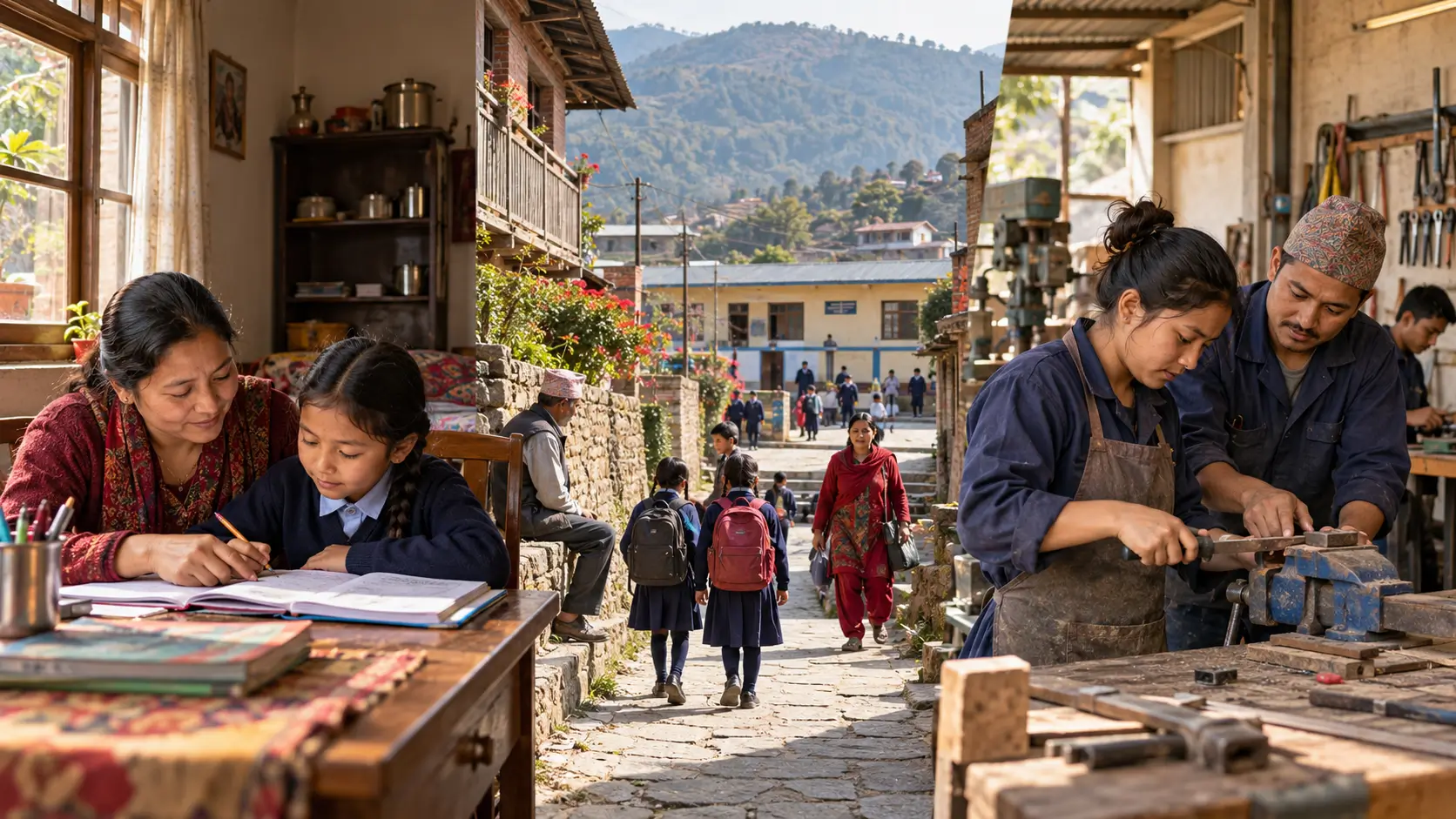
The council aims to equip citizens with skills so that they remain relevant and capable both within Nepal and abroad. It is built on the belief that this is the era of technical education and that technology must be linked with business.
With that perspective, the Bagmati Province Government gave priority to technical education after enacting the law in 2018 (2075 BS). Once the regulations were formulated in FY 2023/24 (2080/81 BS), the way was opened for the formation of the council.
After the council was completed in FY 2024/25 (2081/82 BS), it has been working to make young people in Bagmati Province skilled through technical and vocational education. Its main purposes and goals are to connect them to income-generating activities, make them self-reliant, and produce skilled manpower capable of entering the labor market and securing employment.
For broader context on technical and skill-based education, the council’s focus aligns with the growing demand for practical and employment-oriented learning.
On what basis and how is work being carried out?
Mandate and powers
The provincial council has been assigned a jurisdiction similar to that of the federal CTEVT. The provincial council has the authority to establish its own schools, grant affiliation, develop curricula, conduct skill testing, and regulate, control, and set standards for technical institutions operating within the province.
The council is formed under the chairpersonship of the Province’s Minister for Social Development. Its membership includes the secretaries of seven provincial ministries, the ex officio member responsible for human resources at the Provincial Policy and Planning Commission, one member recommended by the Trade Union Coordination Committee, and one member each from among industrialists and technical experts, all nominated by the minister.
Current administrative arrangement
The Act provides for the council to have its own profile, logo, fund, and staff. However, until it has its own employees, the work has been carried out by personnel from the provincial civil service.
The Member Secretary has been designated as the chief executive of the council.
What demands and priority areas has the council received?
Short-term training demand
The council has been providing training based on the Training Operation Procedure, 2023 (2080 BS), which was designed to run short-term training programs.
In the previous fiscal year, youth-targeted programs were conducted and skill-based training was provided to 3,660 people in different sectors and subjects.
Under the service sector, training has been provided in hospitality, barista, cook, bakery, caregiving, beauty parlor-related work, and, on the construction side, in electrical installation, plumbing, and related fields, following the federal CTEVT curriculum.
At present, barista and cook training in the service sector are in highest demand. Montessori training is also in very high demand, and the current capacity is not sufficient to meet that demand.
Long-term 24-month training programs have also been conducted in coordination with donor agencies.
Long-term programs and outcomes
In the current fiscal year, quotas have been sent for 300 Montessori trainees, described as child development facilitators, in 14 constituent institutions of the council under curricula in seven subjects.
The fact that even B.Ed. graduates who already hold teaching licenses come to take short-term Montessori training shows the importance and effectiveness of this training.
Similarly, people who received beautician training have connected themselves to income generation through online business, opened their own parlors, obtained jobs in parlors, and no longer need to visit parlors for their own and their family’s needs.
This has increased sources of income while also saving time and expenses, and has supported movement toward self-reliance. It has also been found that the skills, knowledge, and certificates gained from council training have helped trainees secure employment abroad.
Young people need to be informed about which sectors have higher demand for manpower, where direct income can be earned, which fields support self-reliance, and in which areas they can connect to employment as quickly as possible.
Those who received Montessori training have been employed in private and public schools. In the previous fiscal year, 77.78 percent of those trained by the council passed the skill test conducted by the National Skill Testing Committee.
What level of manpower is the training designed to produce?
Short-term training structure
Short-term training consists of 390 hours and 65 working days. This produces manpower equivalent to CTEVT Level One.
Worker education model
There is also a 24-month training course, referred to as worker education. After three and a half months of theoretical classes at the training institution, the remaining period is spent in practical training at industries, workshops, and hotels according to the subject area. Agreements are made with institutions for this purpose.
Trainees are provided a daily transportation allowance of Rs. 100. Accident insurance is arranged, and materials and uniforms are provided.
Trainees must be paid 25 percent of the minimum wage set by the Government of Nepal. Depending on the trainee’s work, institutions may also provide incentive payments, and some trainees have even secured employment.
Based on prior learning recognition, if a person has skills and competence but does not hold a formal qualification certificate, the learning can be verified through skill testing and certified on the basis of an experience letter issued by the institution or firm where that person worked.
How is coordination managed between overlapping provincial and federal structures?
Federal-province overlap
Although the country moved into a federal system, this has not been implemented in the case of CTEVT. As a result, separate structures exist in the province.
Bagmati Province is the only one among the seven provinces that has its own CTEVT-type body. The council has now entered its second year of operation, but it has not yet been fully systematized from a policy perspective, and it has not been able to exercise all the powers granted by the Act.
The council still has to rely on the federal level for skill testing. There are 18 constituent institutions in the province, but they too remain under the federal council.
Short-term training and trainer training have been conducted in coordination with CTEVT. Skill testing is still carried out by the national committee.
The federal CTEVT has its own staff. The provincial council was also envisioned as having its own staff, but it does not yet have them. There is clearly duplication, and under the current governance structure, these institutions should come under the province, which is also a matter of rights.
This is something the federal government must address. Although task forces have been formed and expert suggestions have been taken to bring the federal CTEVT under provincial control, implementation has not taken place.
All provinces are in agreement that the federal CTEVT should come under provincial jurisdiction. This issue also connects with Nepal’s wider education governance framework, especially regarding the division of authority between federal and provincial institutions.
What are the council’s challenges?
Institutional and policy challenges
Due to the lack of physical infrastructure, the council has been forced to operate from four rooms in the building of the former Skill Development Center.
There are 13 personnel, but they are not the council’s own staff; they belong to the provincial civil service.
After changes in government, it takes time for new leadership to understand the council, and this has created problems in moving policy matters forward. The dual structure has also created some confusion among service seekers.
Planned improvements
Even so, during the period since the council was formed, it has developed its own profile and logo. After public complaints that various bodies were providing training in the name of training, the council developed software and a system to maintain records of trainees in order to bring training under a single-window system.
It is in the process of acquiring land to construct an administrative building, and once the land is available, the plan is to begin construction in the current fiscal year.
The process for developing curricula for short-term training has moved forward, and suggestions have been collected for the curriculum of the 24-month training program.
Suggestions have also been collected, with the participation of private-sector employers, for curricula aimed at producing workers according to labor market demand. A district-wise study has also been conducted to identify how many employer institutions exist within the province and what level of manpower is required.
Likewise, the council is preparing a procedure to provide scholarships to students of technical institutions. For Telecom’s 10-month workplace-based training program, the process has been moved forward for 40 seats.






Comments 0
No comments yet. Be the first to start the conversation.