Araniko College (अरनीकाे कलेज सिन्धुपाल्चाेक) is a community higher education institution in Bahrabise Municipality Ward No. 4, Bahrabise, Sindhupalchok, Bagmati Province, Nepal. Established on 21st Shrawan 2062 BS (August 5, 2005), the college was founded so that students completing secondary education in the local area could continue to bachelor-level study without leaving their community. It runs as a service-oriented institution affiliated with Tribhuvan University and has also received support from the University Grants Commission (UGC).
Araniko College offers bachelor-level study in management and education through BBS and B.Ed. programs. The campus combines local access, community backing, and essential academic facilities such as classrooms, a library, an ICT lab, smart-board-supported teaching spaces, Wi-Fi, and a playground, giving it a steady role in higher education access in Sindhupalchok.
Established: 21st Shrawan 2062 BS (August 5, 2005)
Type: Community educational institution
Affiliation: Tribhuvan University
Grant Support: UGC Nepal support and local-level support
Location: Bahrabise Municipality Ward No. 4, Bahrabise, Sindhupalchok, Bagmati Province, Nepal
Distance: 87 km northeast of Kathmandu; 27 km south of Liping, the China border point
Programs: Bachelor of Business Studies (BBS), Bachelor of Education (B.Ed.)
Academic System: Four-year full-time bachelor’s programs under TU annual system
Total Students: 277
Student Distribution: 156 in Management; 121 in Education
Faculty and Staff: 20 total; 17 teaching and 3 administrative
Campus Land: 21 ropani, 7 aana, 1 paisa, and 1 daam
Campus Structures: Two permanent buildings, 12 rooms in each, plus six temporary sheds
Contact: aranikocollege@gmail.com | +977-11-489159 | +977-9860972223 | +977-1-1489168 | aranikocollege.edu.np
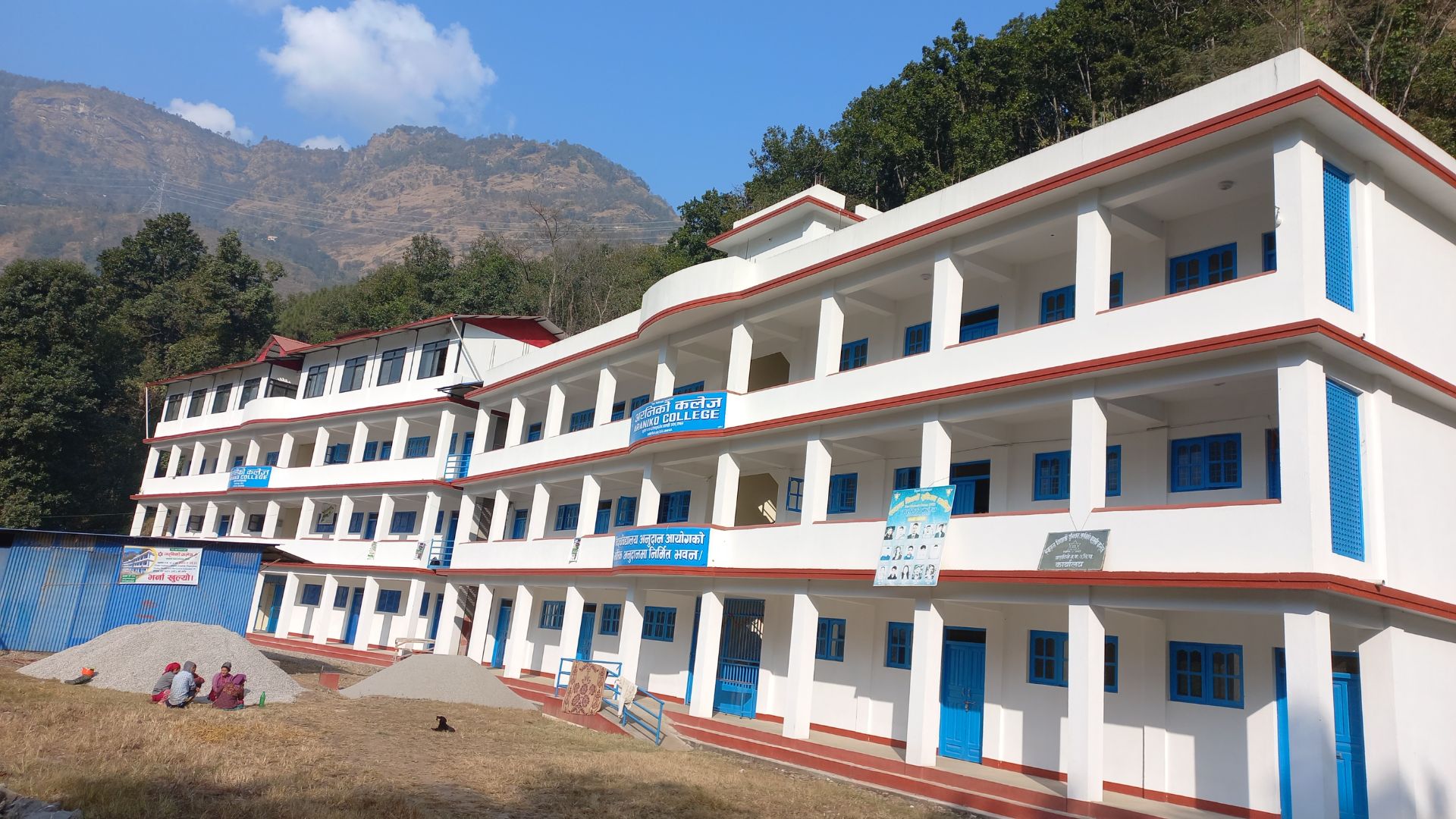
Araniko College was established through the initiative of local parents and education-minded community members who wanted affordable higher education to be available within Bahrabise and nearby settlements. The decision to establish the college grew from the local need created by the presence of 13 secondary schools in the surrounding area that provide education up to Grade 12. For many students, the next step after school would otherwise have required travel or relocation.
The college was named after Arniko, Nepal’s national luminary artist, following a parents’ gathering organized by the Shri Sharda Former Students Society. Since its establishment, the institution has worked within a community-campus model supported by local donors, grants, and student fees. It was built with the stated aim of producing capable human resources and strengthening the educational foundation of future generations. The college also carries a regional development objective: to contribute to making Bahrabise an educational center for the wider area.
Bahrabise itself holds practical importance for the campus. It is a long-established settlement and commercial center linked by transportation routes to surrounding communities. The college’s location has helped it serve students from Sindhupalchok and nearby localities, especially those seeking bachelor-level education in management and education close to home.
Araniko College offers two bachelor-level academic programs under Tribhuvan University:
Faculty of Management: Bachelor of Business Studies (BBS)
Faculty of Education: Bachelor of Education (B.Ed.)
The BBS program has been in operation since 2062 BS, and the B.Ed. program since 2063 BS. In the academic year 2081/082, the college enrolled 156 students in BBS and 121 students in B.Ed.
The BBS program follows the four-year annual system of TU’s Faculty of Management. Its academic structure moves from foundation and core management courses in the early years to concentration courses, business research methods, and a final project in the fourth year. The curriculum also includes attendance and annual examination requirements under TU rules.
The B.Ed. program also follows TU’s four-year annual structure. Under the Faculty of Education framework, the program is organized around communication skills, professional core courses, specialization major and minor subjects, and teaching practice/practicum. The annual-system B.Ed. is designed to prepare teachers who can teach two subjects at the secondary level.
Admission to bachelor-level programs at Araniko College follows the relevant TU faculty and campus procedures. In general, students apply after the admission notice is published, submit the required academic documents, and complete enrollment after selection and fee payment. Depending on faculty rules or campus requirements, admission may include merit-based selection, entrance requirements, or both. Academic registration, examinations, and results follow TU rules and the applicable academic calendar.
For Araniko College’s two academic programs, the academic baseline is as follows:
BBS: Applicants must have successfully completed 10+2 in business or commerce, or an equivalent course recognized by TU, or must have studied Mathematics or Economics as a full paper at the 10+2 level.
B.Ed.: Applicants must have completed Grade 12, Higher Secondary, PCL, or an equivalent qualification. For TU’s B.Ed. annual system, additional subject-related requirements apply according to the chosen specialization area.
Students seeking campus-level details on forms, dates, seat availability, and fee procedures can contact the administrative office directly.
Applicants for TU bachelor-level admission generally submit the following documents:
Academic Transcript (Grade Sheet): Class 12 / +2 or equivalent
Character Certificate: From the previous institution
Migration Certificate: If the previous board or university is different
Transfer Certificate (TC): From the previous school or college
Citizenship Certificate or Birth Certificate (copy)
Passport-size Photographs
Entrance Examination Scorecard: If required by the program or campus
Completed Admission/Application Form
Admission Fee Payment Receipt
Equivalence Certificate: If the qualification is from a foreign board or university
These are the standard TU bachelor-level admission documents used where applicable.
Araniko College has 20 teachers and staff members in total. The academic side includes 17 faculty members, with 3 full-time and 13 part-time teachers listed in the data provided. Administrative support is handled by 3 staff members, including an accountant, IT staff, and office assistant. This staffing structure shows a campus model that relies on a mix of regular academic personnel and part-time faculty support.
The teaching environment combines classroom-based instruction with digital teaching tools. The college has arranged smart-board-supported teaching, and its digitalization efforts have also been linked with confidence in conducting both physical and online teaching activities for students. This points to an academic setting that remains centered on direct teaching while also using digital support where needed.
The learning approach is also shaped by the structure of the two TU programs. For BBS, TU prescribes a mix of lectures, group discussions, problem-solving exercises, guest lectures, practical work, project work, and case-based teaching where possible. The fourth year includes research and final project work.
For B.Ed., the annual-system structure includes professional core courses, specialization studies, and teaching practice. In the final year, students undertake teaching practice along with an elective related to instructional technology or ICT in education.
Araniko College has developed a campus with basic academic and student-support facilities. The campus infrastructure includes:
Land Area: 21 ropani, 7 aana, 1 paisa, and 1 daam
Buildings: Two permanent buildings with 12 rooms each
Additional Structures: Six temporary sheds
Library
ICT Lab / Computer Lab
Classrooms with smart boards
Wi-Fi across rooms and campus premises
CCTV across buildings and campus areas
Playground
Canteen
Furniture and classroom seating
Conference hall
Multimedia support
Counseling support
Journal-related academic activity
Tour and ECA support
The physical asset base also includes computers, printers, laptops, bookshelves, desks, benches, chairs, and office furnishings. These facilities support both routine academic work and the general needs of campus life.
Student life at Araniko College is shaped by its role as a local-access community campus. With 277 students enrolled, the campus remains at a size where academic and institutional life is closely tied to the surrounding community. The majority of students, 262 in the data provided, are from Sindhupalchok District, which shows the college’s direct regional reach.
The student body also reflects local social diversity. Janajati students form the largest group in the available demographic data, with 147 students. Gender distribution in the same dataset shows 171 female students and 106 male students. These figures indicate that the college serves a wide local student base rather than a narrow catchment.
The campus experience is also shaped by Bahrabise’s geography and local economy. The town functions as a transport and market center, and the college sits within an area where population concentration and educational demand have been increasing. For many students, the value of the campus lies in being able to pursue higher education within their own region while using a college that has its own land, buildings, and academic support spaces.
Araniko College’s student-support and campus activities include:
Sports
Educational tours
Extracurricular activities (ECA)
Counseling
Journal-related activities
Conference hall use for academic and campus events
Multimedia-supported academic activity
Playground-based student engagement
These activities sit alongside classroom learning and contribute to the broader student experience.
Financial support at Araniko College comes from a mix of institutional and community sources. The college’s financial and support framework includes:
UGC regular and physical grants
Physical grants from local levels
Donations from donors
Student fees
Interest from fixed deposits
Scholarship support as part of the campus’s student-support features
A grant for establishing a higher education management information system under the digitalization work performance grant program of fiscal year 2080/81
The college also has a donor-based community support base, with 196 donors mentioned in the available institutional summary.
Key milestones in the development of Araniko College include:
2062 BS: Formal establishment of the college
2062 BS: Start of the BBS program
2063 BS: Start of the B.Ed. program
Academic year 2081/082: Completion of 19 years and entry into the 20th year
Development of its own campus land and buildings
Expansion of digital teaching support through smart boards, Wi-Fi, and ICT facilities
Receipt of digitalization support for higher education management information system development
Community fundraising that built a donor-supported institutional base
Positioning of Bahrabise as a local center for higher education access
Students looking at Araniko College often find these points relevant:
Local access to TU-affiliated bachelor’s education in Sindhupalchok
Community-campus foundation with long-term local support
Two established bachelor’s programs in management and education
Own land, buildings, classrooms, and student facilities
Library, ICT lab, Wi-Fi, smart boards, and playground
Regional accessibility through Bahrabise’s transport links
Growing educational demand in the surrounding area
A campus setting closely connected to local community needs
Araniko College holds a distinct place in Sindhupalchok as a community-based institution created to widen access to higher education. Its foundation reflects local educational demand, and its academic focus remains clear through the BBS and B.Ed. programs run under Tribhuvan University. The college has moved from its original community initiative to an institution with its own land, buildings, digital teaching support, and a stable student base.
For students in Bahrabise and nearby areas, the college represents a practical route to bachelor-level study in management and education without leaving the district. Its role is closely tied to local participation, institutional continuity, and the long-term goal of sustaining higher education opportunities within the region.
Contact Araniko College's administrative office for detailed information on the course, admissions, location, fees, scholarships, facilities, counseling, or eligibility.
Araniko College
Email Address: aranikocollege@gmail.com
Phone Number: +977-11-489159, +977-9860972223, +977-1-1489168
Website: https://aranikocollege.edu.np
Location: Bahrabise Municipality Ward No. 4, Bahrabise, Sindhupalchok, Bagmati Province, Nepal
Araniko College is affiliated with Tribhuvan University.
The college is located in Bahrabise Municipality Ward No. 4, Bahrabise, Sindhupalchok, Bagmati Province, Nepal.
The college offers Bachelor of Business Studies (BBS) and Bachelor of Education (B.Ed.) at the bachelor level.
BBS has been in operation since 2062 BS, and B.Ed. since 2063 BS.
The available data records 277 students in total, with 156 in Management and 121 in Education.
The campus has permanent buildings, classrooms, a library, ICT lab, smart boards, Wi-Fi, CCTV, a canteen, playground, counseling support, and ECA-related facilities.
For BBS, applicants must have completed 10+2 in business or commerce, or an equivalent qualification recognized by TU, or must have studied Mathematics or Economics as a full paper at the 10+2 level.
For the TU four-year B.Ed. annual system, applicants must have completed Grade 12, Higher Secondary, PCL, or an equivalent qualification, with additional subject-related requirements depending on specialization.